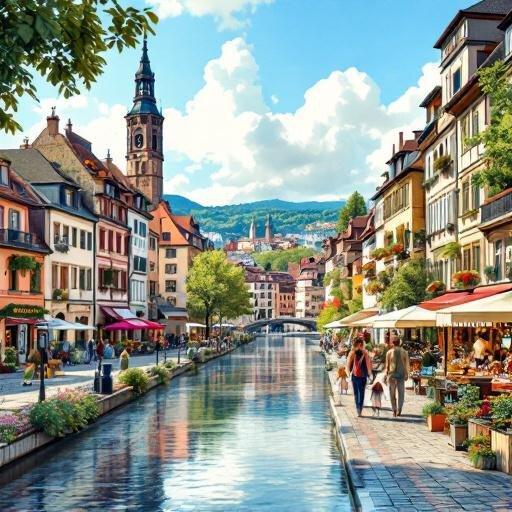
Strasbourg and Colmar: two very different urban models
The first difference is almost physical. Strasbourg is not on the same scale as Colmar. According to INSEE, the municipality of Strasbourg has just under 300,000 inhabitants, and the Eurometropolis exceeds 500,000 inhabitants. Colmar operates on another level, with about 70,000 inhabitants in the city. This changes everything: traffic intensity, depth of the real estate market, commercial diversity, cultural life, and even the daily sense of space.

Strasbourg functions as a complete regional metropolis. It hosts European institutions, a leading university, a structured tram network, very contrasting neighborhoods, and a real cross-border economic life. Colmar, on the other hand, plays a more focused role: well-maintained historic center, renowned wine-growing environment, simpler short-distance travel, less hurried atmosphere. This difference in pace matters more than one might think. A person used to services accessible without a car will often prefer Strasbourg. Conversely, someone who avoids large urban areas will find a more natural breathing space in Colmar.
It is also necessary to look at the territory around each city. Strasbourg benefits from a significant suburban effect with Schiltigheim, Illkirch-Graffenstaden, Bischheim, Lingolsheim, and Ostwald. In practice, “living in Strasbourg” often means living in the metropolitan area, with good connections to the center. Around Colmar, suburban housing and wine-growing villages play a major role in residential choices. One sometimes gains in space and tranquility there, but at the cost of greater dependence on the car.
Housing: rents, purchase, and market tension
On paper, Colmar seems more accessible. In reality, this is often true, but with important nuances. Strasbourg offers a larger housing stock, from student studios to family apartments in well-served neighborhoods, but demand is strong there. The presence of many students, young professionals, and households attracted by metropolitan employment tightens the market, especially at the start of the school year and for small units. Colmar generally remains more affordable, with average rents often lower, but the supply is also less abundant; it is therefore not uncommon to see well-located and properly renovated properties disappear quickly.

To give a realistic scale for 2025-2026, a studio or one-bedroom apartment generally rents for more in Strasbourg than in Colmar, particularly in the city center, Krutenau, Orangerie, or areas close to universities and the tram. In Colmar, the pressure is less intense, but the selection can be tighter on recent properties or those with parking. When buying, the gap also exists: Strasbourg is driven upwards by its metropolitan role, student attractiveness, and proximity to Germany, while Colmar remains more moderate, except for highly sought-after heritage locations.
What you really need to compare before signing
The gross rent is not enough. In Strasbourg, a slightly smaller apartment but located two minutes from the tram can save the cost of a car, a parking subscription, or forty minutes of daily commuting. In Colmar, a slightly outlying home can offer more space for the same budget, which matters a lot for a family or a teleworker. In both cases, charges, insulation, the cellar, bike storage, and parking possibilities concretely change the quality of life.
| Criterion | Strasbourg | Colmar |
|---|---|---|
| Renting | More choice, but often tighter market | Often cheaper, but more limited supply |
| Buying | Generally higher prices | Easier access outside premium areas |
| Small units | Highly demanded by students and young professionals | Less turnover, less abundance |
| House with outdoor space | Often more accessible on the outskirts | More frequent in the nearby peri-urban area |
If we think in terms of “residential quality,” Colmar often scores points for those seeking more space and less noise. Strasbourg, meanwhile, retains the advantage for those who want to live without a car or have a real diversity of neighborhoods, from the most central to the most family-oriented. The right choice therefore depends on lifestyle, not just the price shown in the listing.
Employment: Strasbourg leads in diversity, Colmar in clarity
The Strasbourg employment basin is clearly larger. This is its strongest argument. There are jobs in institutions, services, digital sector, healthcare, higher education, commerce, logistics, engineering, finance, industry, and cross-border activities. The presence of the University of Strasbourg, major hospitals, and a denser network of companies creates an objectively more varied labor market. For a couple whose two careers must coexist, Strasbourg often offers more solutions.

Colmar is not, however, a city without opportunities. Its economy is based on a more compact fabric, with an important place for services, agri-food, commerce, tourism, health, administration, and certain industrial activities of Haut-Rhin. The market is simply narrower there. For someone arriving without a network and without a secure job, the search can prove more demanding. On the other hand, when one already has an activity compatible with the region — crafts, health, tourism, telecommuting, commerce, local industry — Colmar quickly becomes credible.
The cross-border factor and professional mobility
Strasbourg benefits from a specific advantage: its position on the Rhine axis. The link with Germany influences employment, exchanges, and mobility. Bilingual profiles or those accustomed to international environments find a more favorable ground there. Colmar, meanwhile, is well situated between Strasbourg and Mulhouse, which can be very convenient for mobile profiles. Living in Colmar while working elsewhere in Haut-Rhin or occasionally in Strasbourg remains quite realistic, especially by train. But if employment is the primary criterion and nothing is yet secured, Strasbourg remains the safest city.
In a moving project, it is better to distinguish “pleasant city” and “city that maximizes my professional options.” The two do not always overlap.
Transport and travel: Strasbourg’s clear daily advantage
On this point, Strasbourg takes a very concrete lead. Its tram and bus network allows living in many neighborhoods without depending on a car, which lightens the budget and reduces logistical fatigue. Strasbourg station, served by the TGV, places Paris at about 1 h 45 to 1 h 50 on the best connections, which changes the game for regular professional trips. By bike, the city is often cited among French references for cycling infrastructure; this is not a detail, but a real comfort of use.

Colmar, by comparison, is easier to get around on foot over certain distances, but the system does not have the same metropolitan strength. For many residents, the car still holds an important place, especially as soon as one moves away from the center or lives in the surrounding municipalities. This is not prohibitive: if one works nearby and appreciates a city easier to cross, Colmar can even seem more relaxing. But for a household with teenagers, students, staggered schedules, or two different workplaces, Strasbourg offers significantly greater flexibility.
Finally, one must take into account the reality of parking. In Strasbourg, living downtown with a car can quickly become expensive or restrictive. In Colmar, the issue is more manageable, even if the central areas logically remain more sensitive. Practically, highly motorized households often feel more comfortable in Colmar or its outskirts; those who want to reduce car use tend more naturally towards Strasbourg.
Quality of life: atmosphere, family, culture, and daily rhythm
Quality of life is not a slogan; it is the sum of small things repeated every week. Travel time, noise, ease of shopping, access to nature, cultural offerings, feeling of safety, activities for children, possibilities for outings without heavy planning. Strasbourg offers more options: museums, theaters, events, bookstores, restaurants, student life, urban parks, cultural institutions. For some people, this density is stimulating. For others, it is tiring.

Colmar is often appreciated for its calmer atmosphere. Distances seem more manageable, spontaneous outings are easier, and nature is close by without effort. The vineyard, Alsatian villages, and the first Vosges hills create a very attractive environment for weekends. For families, this proximity is a real advantage. However, one must accept a less extensive cultural and university offer, as well as a city more exposed to the tourist season in its historic center.
For families, students, and remote workers
For a family with children, both cities can be suitable, but for different reasons. Strasbourg reassures with its facilities, transport network, and density of services. Colmar convinces with a daily life that is often smoother, more spacious housing for a comparable budget, and quick access to outdoor activities. For students, Strasbourg’s advantage is clear thanks to the University of Strasbourg, one of the largest in France. For remote workers, Colmar is gaining ground: less urban pressure, pleasant environment, useful train station, and often lower residential costs than Strasbourg.
- Choose Strasbourg if you prioritize studies, car-free mobility, culture, and professional diversity.
- Choose Colmar if you seek a calmer pace, a more readable city, and a better space/budget compromise.
- Decide on a case-by-case basis if you work remotely or if your job is located in another municipality of Bas-Rhin or Haut-Rhin.
Real budget: what life costs beyond rent
A common mistake is to compare only the real estate listing. Yet the monthly budget also depends on transport, childcare, parking, leisure, energy, and lost time. Strasbourg may cost more in rent but save on a car, several fuel fill-ups per month, and part of the logistical stress. Colmar may allow renting larger spaces but require more motorized travel depending on the neighborhood or municipality chosen.
The level of services also influences expenses. In a large city, there are more temptations and offers, but also more competition between shops. In a medium-sized city, consumption is sometimes different: fewer outings, more domestic life, more planned purchases. The differences are therefore not automatic. For a single urbanite without a car, Strasbourg can remain very financially coherent. For a family seeking three bedrooms and outdoor space, Colmar or its outskirts often become more rational.
So, is it better to live in Strasbourg or Colmar?
If one seeks the most honest answer, Strasbourg is generally the best choice to maximize opportunities: employment, studies, transport, services, cultural life, daily mobility. It is the most complete city. Colmar, on the other hand, often becomes the best choice to better live one’s daily life: a calmer pace, simpler environment, quick access to nature, often more affordable residential costs outside highly sought-after areas. It is not a question of a “better” city in absolute terms, but of coherence with one’s real life.
For a young professional without local ties, Strasbourg is the safest bet. For a family wanting space and a gentler environment, Colmar often deserves a very serious visit. For a remote worker or a couple whose job is already stable, the balance can even clearly tip towards Colmar. The best method is to test both cities over a long weekend, visit a central neighborhood then a residential area, simulate a home-to-work commute, and look at available listings over two weeks. The best comparison always starts on the ground.
FAQ: living in Strasbourg or Colmar
Is Strasbourg much more expensive than Colmar?
On average, yes, especially for small units and well-served central neighborhoods. However, the gap depends on the type of property. For family housing or in the suburbs, the difference can narrow. Transport costs must also be factored in: higher rent in Strasbourg can be offset by less dependence on a car.
Is it easier to find work in Strasbourg?
Yes. The job market is larger and more diverse. Strasbourg offers more opportunities in services, higher education, health, institutions, digital sectors, and support functions. Colmar remains interesting if you target a specific sector or already have a secure position.
Is Colmar a good city for a family?
Often yes. Its size is reassuring, travel is easier, and access to nature is quick. For families sensitive to calm, space, and a less hectic pace, Colmar ticks many boxes. However, Strasbourg retains the advantage for the variety of facilities and public transport.
Is it possible to live without a car in both cities?
In Strasbourg, yes, in many cases. The tram, bus, bike, and density of services make this lifestyle realistic. In Colmar, it depends more on the neighborhood, work, and lifestyle habits. In the city center, it is doable; in the suburbs, the car often regains an important place.
Which city to choose for a teleworker?
Colmar can be very attractive for a teleworker looking for more space, a pleasant environment, and a less dense city. Strasbourg remains preferable if you need quick access to a large professional network, various coworking spaces, or frequent train travel.