
In brief
🕶️ The right optical coverage is the one that covers your actual use: simple glasses, progressive lenses, contact lenses, or family needs. A “premium” contract is only useful if its limits and conditions match your expenses.
💶 Always check the frame reimbursement ceiling, the level of lens coverage, the contact lens allowance, and the existence of mutual insurance waiting periods. The right indicator is not the commercial promise, but the out-of-pocket optical expense after reimbursement.
📄 The 100% Health can eliminate the remaining payment on certain equipment, but it does not always replace enhanced coverage for more technical lenses, advanced options, or a higher renewal frequency.
What does an optical mutual insurance really reimburse?
Optical mutual insurance supplements the low coverage of Social Security on visual equipment. It can cover the frame, lenses, certain comfort options, and, in many contracts, contact lenses. The important question is therefore not “is it reimbursed?”, but “how much remains to be paid, for which equipment, and under what conditions?”.

In practice, Social Security reimburses little on optics outside the 100% Health basket. The mutual insurance then intervenes according to its own logic: either a percentage of the reimbursement base (BRSS), or an optical allowance in euros, sometimes with a separate ceiling for the frame and lenses. It is this calculation method that changes everything on the final bill.
| Element | What it means | Impact on your budget |
|---|---|---|
| Frame | Often capped by the contract | The excess remains your responsibility if the frame is premium |
| Simple lenses | Reimbursement easier to balance | Moderate out-of-pocket expense if coverage is adequate |
| Complex / progressive lenses | Often high cost, many options | The quality of the optical allowance becomes decisive |
| Contact lenses | Reimbursed only in certain cases or via allowance | The mutual insurance can make a real difference if you wear them regularly |
- Optical allowance: maximum amount reimbursed over a given period, often clearer for the insured.
- BRSS percentage: reimbursement calculated on a very low official base in optics, thus often not very advantageous alone.
- Optician third-party payment: you advance less money at the time of purchase, which improves budget visibility.
How to choose between an optical package and reimbursement by percentage?
If you want a quick answer: for optics, the package is often clearer and more useful than a simple percentage of the BRSS, especially for expensive or progressive lenses. The percentage may suffice for a simple prescription, but it quickly becomes limited as the quote increases.
Reimbursement by percentage works well when expenses remain close to the Social Security bases. However, modern equipment often includes treatments and lens indices that significantly increase the price. In this case, a clear package with an annual cap allows you to anticipate the real cost and avoid unpleasant surprises.
| Criterion | Optical package | Reimbursement by percentage |
|---|---|---|
| Clarity | High: amount known in advance | More difficult to estimate without knowing the BRSS |
| Interest for progressive lenses | Often more suitable | Often insufficient for expensive equipment |
| High-end frame | May be limited by a specific cap | Unfavorable if the reimbursement base is low |
| Predictability of out-of-pocket costs | Good if the cap is clearly indicated | Variable depending on the optician’s price |
For a serious analysis, ask yourself how much you spend on average every two years, since the legal renewal of the equipment depends on age, medical situation, and contract conditions. A higher contribution can be worthwhile if you often replace your glasses or if your prescription requires technical lenses.
Essential criteria for choosing your optical coverage
The best contract is not the most generous on paper, but the one that combines a coherent reimbursement level, appropriate caps, and easy-to-use conditions. Before signing, you need to look beyond the marketing table and read the limitations: frames, lenses, contact lenses, exclusions, waiting periods, and renewal.
Coverage of glasses
Glasses often represent the most visible item, but also the most misunderstood. The frame may be capped, while lenses are reimbursed according to their type: simple, thinned, anti-reflective treated, or progressive lenses. The more complex the prescription, the more useful a generous package becomes.
- Frame: check the separate cap, often lower than the cost of a designer frame.
- Simple lenses: an average guarantee may suffice if you have a mild prescription.
- Complex lenses: favor a high cap and explicit conditions on options.
- Options: anti-reflective, thinning, blue light filter, specific treatments can increase the bill.
Coverage of contact lenses
The contact lens mutual deserves careful reading, as contact lenses are often less well covered than glasses. Some plans reimburse only lenses deemed medically necessary, others offer a global annual package. If you wear contact lenses daily, the contract must specify the frequency, cap, and nature of accepted products.
Daily, monthly, or yearly lenses do not have the same costs nor the same usage logic. A package that is too low may seem adequate on the brochure but become uninteresting over the year. For regular wear, it is better to compare the annual total of purchases with the cap actually paid by the mutual.
100% Health in optics
The 100% Health glasses scheme allows obtaining certain equipment without out-of-pocket costs, provided you choose a compatible offer. It is an effective solution to control your budget, but it does not cover all desires or all prescriptions. As soon as you look for more technical lenses, a particular design, or specific needs, the enhanced guarantee becomes relevant again.
| Situation | 100% Health coverage may be sufficient | A reinforced mutual insurance remains preferable |
|---|---|---|
| Simple glasses | Yes, if the offered plan suits you | Only if you want a frame or lenses outside the basket |
| Progressive lenses | Sometimes, depending on the offer and your needs | Yes, if you want options or superior comfort |
| Contact lenses | No, the scheme does not cover all uses | Yes, especially for regular wear |
| Tight budget | Very useful to eliminate out-of-pocket expenses | Less of a priority if your needs are standard |
Associated services not to be overlooked
The quality of an optical mutual insurance is not measured solely by the amount reimbursed. Third-party payment, partner optician networks, processing speed, and the existence of mutual insurance waiting periods directly influence your experience. A contract that looks good on paper can be frustrating if it locks your budget for several weeks or imposes heavy procedures.
- Third-party payment: useful to limit upfront costs at the optician.
- Partner network: can improve negotiated rates, but check if the savings compensate for the limitation of choice.
- Waiting period: period during which the coverage does not yet apply.
- Renewal: check the allowed frequency for changing glasses or lenses.
How to choose your optical coverage according to your profile?
The right level of coverage mainly depends on your usage. A person who rarely changes glasses does not have the same needs as a progressive lens wearer or a family with several children. The classic mistake is to overpay for a too broad plan or, conversely, to subscribe to coverage that is too low for your actual equipment.
| Profile | Priority to consider | Relevant coverage level |
|---|---|---|
| Simple glasses | Contribution / reimbursement ratio | Intermediate coverage with clear flat rate |
| Progressive lenses | Cap on lenses and options | Reinforced coverage, especially if the prescription changes |
| Monthly contact lenses | Dedicated annual flat rate | Plan with explicit contact lens reimbursement |
| Family with children | Renewal and cumulative amounts | Family contract or modular plan |
| Looking for minimal budget | Actual out-of-pocket expense over 12 months | Simple plan + 100% Health if compatible |
If you wear simple glasses
For a light prescription, there is no need to pay for a disproportionate coverage level. The goal is mainly to neutralize the cost of a reasonable frame and standard lenses, without making the monthly contribution explode. If your glasses last a long time and you don’t often change your prescription, intermediate coverage may suffice.
If you have a strong prescription or progressive lenses
In this case, the contract choice should be based on the amount actually available for lenses, not just the frame. Progressive lens reimbursements vary greatly depending on the plans. Also check comfort options, as they can represent a significant part of the final quote.
If you wear contact lenses
The decisive point is to know if the contract provides a dedicated flat rate or coverage conditioned on a prescription. Regular use often justifies specific coverage, as the annual cost of lenses can far exceed what a standard plan reimburses. Always compare the announced flat rate to the actual volume of your purchases.
How to read a mutual insurance coverage table without making mistakes?
A coverage table is not always easy to read, but a few lines are enough to avoid unpleasant surprises. For optical coverage, you need to identify the reimbursement base, the percentage or flat rate, the overall ceiling, the renewal frequency, and any possible exclusions on certain options. This is where the true level of protection is determined.
The reading must be methodical: a generous reimbursement line can be neutralized by a low ceiling, a waiting period, or an exclusion on technical lenses. That is why coverage tables must be analyzed taking into account the optician’s quote, and not in isolation.
- Reimbursement base: serves as a reference for calculation but often remains very low in optics.
- Ceiling: maximum limit paid by the mutual insurance, often decisive for complex lenses.
- Waiting period: during this period, you pay contributions without immediately benefiting from the coverage.
- Exclusions: certain options, premium frames or lenses may be partially excluded.
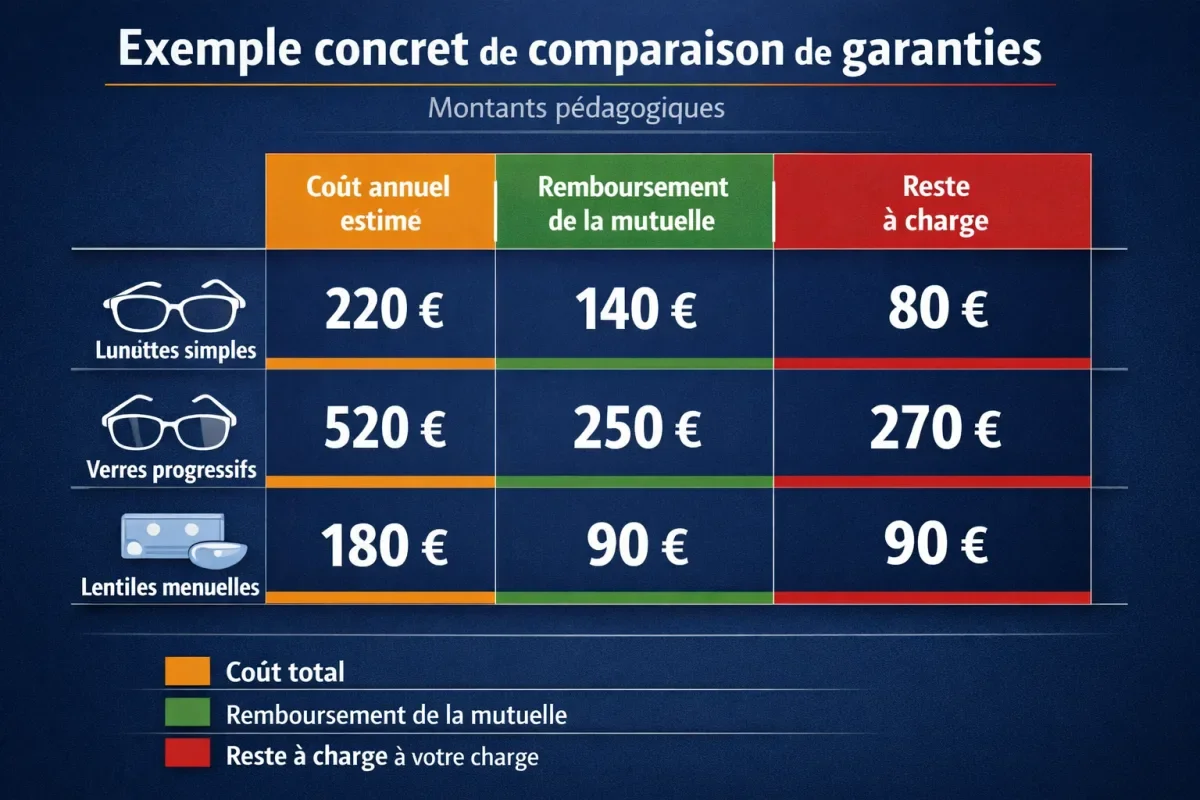
Concrete example of coverage comparison
Here is a simple case to visualize the out-of-pocket optical cost. The amounts below are educational assumptions: the idea is to show the logic of comparison, not to replace a real quote. Imagine glasses costing €350, with €90 for the frame and €260 for the lenses.
| Profile | Estimated annual cost | Mutual insurance reimbursement | Out-of-pocket cost |
|---|---|---|---|
| Simple glasses | €220 | €140 | €80 |
| Progressive lenses | €520 | €250 | €270 |
| Monthly lenses | €180 | €90 | €90 |
This type of comparison shows that a slightly more expensive plan can be more cost-effective if it significantly reduces the out-of-pocket cost on the items you actually use. Conversely, paying for a premium coverage for very simple needs often means financing unnecessary ceilings.
Checklist before subscribing
Before choosing your optical mutual insurance, check your current visual needs, the renewal frequency of your equipment, and the type of correction concerned. A good decision is made with a quote in hand, not solely based on a sales pitch. Always compare the total cost over 12 months, not just the monthly premium.
- Evaluate whether you need simple glasses, progressive lenses, or contact lenses.
- Check the reimbursement ceiling for the frame and lenses.
- Read the conditions of the lens allowance and any possible restrictions.
- Verify waiting periods, exclusions, and legal renewal terms.
- Ask if third-party payment is offered at your usual optician.
FAQ about optical mutual insurance
Which mutual insurance reimburses glasses best?
The best mutual insurance for glasses is the one that matches your actual quote. For simple glasses, an intermediate coverage may suffice. For progressive lenses or more expensive equipment, prioritize a high optical allowance, a clear ceiling, and few restrictions on options.
Are contact lenses reimbursed?
Yes, but not always in the same way depending on the contracts. Some mutual insurances reimburse lenses under medical conditions, others offer an annual allowance. If you wear lenses regularly, check the exact amount, the coverage frequency, and any contractual limitations.
Is 100% Health coverage enough for everyone?
No. The 100% Health coverage meets standard needs very well and sometimes allows you to avoid any out-of-pocket expenses, but it does not cover all desires or all technical needs. As soon as you want more elaborate lenses, a specific frame, or coverage for contact lenses, additional insurance may be preferable.
Should you choose a high fixed allowance or a percentage reimbursement?
In most cases, the fixed allowance is clearer and more effective in optics, especially for complex lenses. The percentage may suffice if your needs are simple, but it depends on a low reimbursement base. To decide, always compare the final cost of your equipment, not just the calculation method.
How to reduce out-of-pocket expenses in optics?
Request a detailed quote, compare several guarantees, check for third-party payment, and see if your optician offers deals compatible with 100% Health coverage. The real lever is to match your contract to your actual prescription and renewal frequency, rather than reflexively choosing the highest ceiling.