Sommaire
Why is everyone talking about lithium and Alzheimer’s (2025 news)
In early August 2025, a team affiliated with Harvard published in Nature a study that shifted the debate: by analyzing human brain tissues along the continuum aging → mild cognitive impairment → Alzheimer’s disease, the authors observed a marked decrease in endogenous lithium from the early stages. They also showed that certain forms of lithium can be trapped by amyloid plaques, which reduces cerebral bioavailability. In mice, low doses of lithium orotate – a form that better escapes amyloid trapping – restore brain markers and memory, including in aged animals.
These results fit into an older literature suggesting that naturally higher lithium levels in drinking water are associated with a lower incidence of dementia in certain cohorts (non-linear relationship). Articles from Harvard Medical School and the Harvard Gazette have summarized these data for the general public, while emphasizing the need for clinical trials in humans before any therapeutic recommendations.
Key takeaway: talking about “lithium deficiency” is a media shortcut. The study shows a decrease in brain lithium and effects in animals, but does not prove that deficiency causes Alzheimer’s in humans. The hypothesis is stimulating but not yet clinically validated.
What would lithium do in the brain? Proposed mechanisms
The authors and commentators describe several plausible pathways explaining why available lithium could protect the brain:
- Synapses & neuroplasticity: maintenance of connections and signaling; when deficient, networks weaken and memory declines.
- Myelination: support of oligodendrocytes and myelin sheath; deficiency promotes faulty nerve conduction and cognitive fragility.
- Microglia & amyloid clearance: microglia clear brain debris; insufficient lithium impairs this clearance.
- Molecular pathways (e.g. GSK-3β): lithium modulates kinases and cascades related to tau/amyloid, and reprograms gene expression profiles toward neuroprotection.
- Trapping by plaques: certain forms (e.g. carbonate) bind more to amyloid; “avoiding” forms (e.g. orotate, in the study) remain available and effective in mice.
These elements remain partly pre-normative: they illuminate a mechanistic framework but do not authorize nutritional or medical prescriptions without clinical trials.
What the data show (human, animals, population)
1) Human tissues
In post-mortem prefrontal cortex, lithium levels are higher in subjects without cognitive decline and lower from MCI onward, then even lower in Alzheimer’s. The authors also observe trapping by amyloid deposits, which may explain the local drop in bioavailability.
2) Animal models
In mice, a lithium-deficient diet reproduces Alzheimer’s characteristics: increased amyloid-β and abnormal tau, inflammation, synaptic loss, demyelination, memory disorders. Conversely, low-dose lithium orotate improves memory and histopathological markers, including at advanced stages.
3) “Population” studies (drinking water)
Danish analyses (several million people, longitudinal data) report a non-linear association: at certain levels, municipalities with more lithium-rich water appeared to have a lower incidence of dementia, subject to potential confounding factors. These studies are not sufficient to establish clinical recommendations, but they converge with the experimental signal.
In which foods (and waters) can lithium be found?
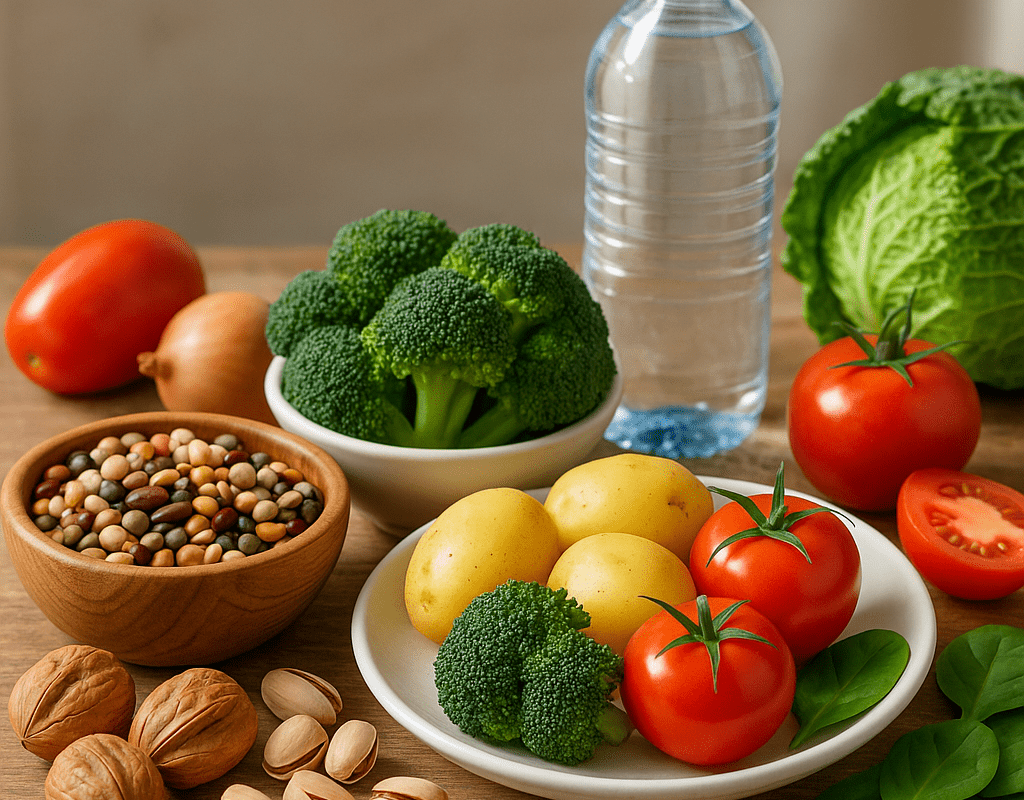
Lithium is a trace element ubiquitous in trace amounts. There is no official RDA and food content varies greatly depending on soils, varieties, and supply chains. Literature reviews indicate that cereals and vegetables (notably potatoes, tomatoes, cabbages) provide the bulk of the traces, supplemented by legumes (peas, beans, lentils, chickpeas), green leaves, nuts/seeds, and, depending on context, certain seafood products. Mineral waters from thermal springs can offer higher and stable contents (on the order of 0.1 to > 1 mg/L depending on brands and countries).
Practical benchmarks (indicative magnitudes)
- Legumes: peas, beans, lentils, chickpeas — often around mg/kg (variable by country).
- Vegetables: tomatoes, potatoes, cabbages — from traces to a few mg/kg depending on soils.
- Whole grains: wheat, barley, brown rice — rather low (hundredths to tenths of mg/kg) but frequently consumed.
- Nuts & seeds / green leaves: modest but regular contributions.
- Seafood products: heterogeneous contributions depending on species and zones.
- Mineral waters: some European references around 1 mg/L; others very low (< 0.01 mg/L).
For a detailed list and examples of brands/magnitudes, see our dedicated article: Foods rich in lithium: what we know.
Important: even “rich” foods provide only traces. Mineral water (depending on the brand) can represent a more regular source than food alone. This does not constitute a medical recommendation; it is a matter of cautious dietary hygiene.
Clinical caution, limitations, and next steps
- No self-supplementation: lithium salts (e.g., carbonate, orotate) have a narrow therapeutic margin and require medical monitoring (kidneys, thyroid, interactions). The 2025 results are mainly preclinical.
- Nutritional status: lithium has no officially recognized “essential” status for humans, and no authority sets an RDA.
- Geographical variability: food and water contents depend on soils; avoid extrapolating from one country to another.
- Upcoming research: randomized trials, early biomarkers, pharmacokinetics of “avoiding” forms of amyloid trapping, intervention window (prevention vs treatment).
FAQ
Can drinking more lithium-rich mineral water prevent Alzheimer’s?
Observational studies (e.g. Denmark, 2017) suggest an association between lithium in water and a lower incidence of dementia, but this is not proof of causality. No standardized individual recommendation exists.
Can I take lithium orotate?
Not without medical advice. Even at low doses, lithium can be toxic and interact with other treatments. Results in mice do not guarantee efficacy or safety in humans.
Is there a recommended daily dose of lithium?
No. There is no official RDA to date. Some publications discuss exploratory benchmarks, to be interpreted with caution.
What simple foods can increase (natural) intake?
Prioritize variety: legumes, whole grains, potatoes, tomatoes, cabbages, some nuts/seeds, and possibly a more lithium-rich mineral water depending on your habits and health status.
Sources
- Nature (2025): “Lithium deficiency and the onset of Alzheimer’s disease.” Research article (low brain lithium, amyloid trapping, efficacy of lithium orotate in mice). Source: nature.com.
- Nature News & Views (2025): “New hope for Alzheimer’s: lithium supplement reverses…” Perspective on results (orotate vs carbonate, amyloid evasion). Source: nature.com.
- Harvard Medical School (2025): “Could Lithium Explain — and Treat — Alzheimer’s Disease?” Popular summary. Source: hms.harvard.edu.
- Harvard Gazette (2025): “Could lithium explain — and treat — Alzheimer’s?” Popular article. Source: news.harvard.edu.
- JAMA Psychiatry (2017): “Association of Lithium in Drinking Water With the Incidence of Dementia” (Denmark, non-linear relationship). Source: jamanetwork.com / PMC.
- Review (2018): “Is Lithium a Micronutrient? From Biological Activity and Dietary Intake…” (food sources: cereals, potatoes, tomatoes, cabbages, mineral waters). Source: PMC.
- Study (2024): “Lithium Content and Its Nutritional Beneficence…” (ICP-MS measurements of foodstuffs in Eastern Europe). Source: PMC / ResearchGate.
- Scientific press (2025): The Week, Washington Post (coverage of the study and calls for clinical trials).
Note: this article does not provide medical advice. If you have therapeutic questions, consult your doctor.