Climate Zones in France: General Overview
Classification Principles
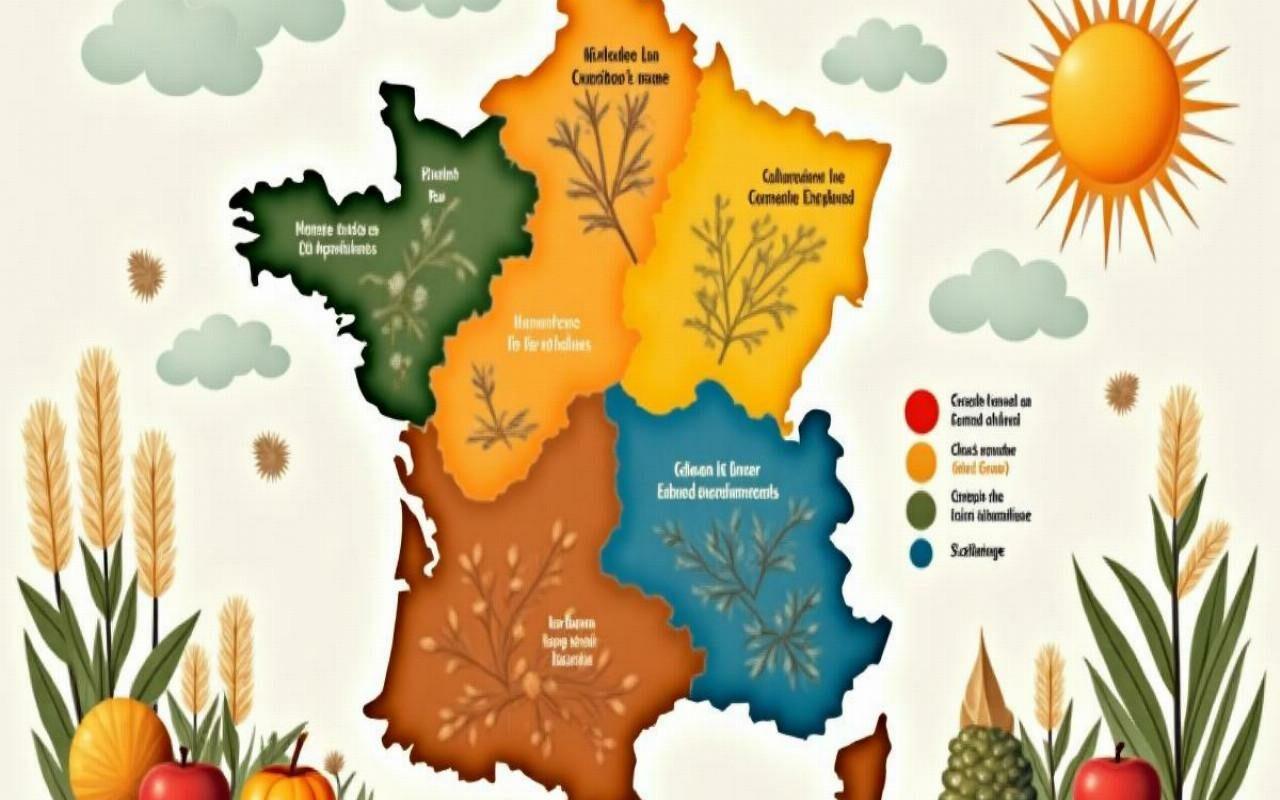
To distinguish a Mediterranean climate from a continental or oceanic one, climatologists rely on quantified parameters: annual thermal amplitude, number of frost days, precipitation distribution. The reference tool remains the Köppen-Geiger classification, which segments the planet into major categories, but at the French level, these broad traits are refined to account for the diversity of reliefs and maritime proximity. Thus, traditionally, five major climate groups are counted: oceanic, Mediterranean, continental, mountainous, and semi-continental.
Oceanic: Mildness and Humidity
The oceanic climate bathes the western quarter and the north of France. Here, the **influence of the Atlantic** tempers extremes: winters remain mild (5 °C on average) and summers cool (around 18 °C). Precipitation is spread throughout the year, with an average of 800 mm annually. ↅ In Brittany, Normandy, or Hauts-de-France, this humid atmosphere favors the cultivation of **grass** for livestock (milk and beef) and market gardening, notably potatoes.
Mediterranean: sun and summer drought
In the South, the Mediterranean climate is characterized by a hot and dry summer (up to 30 °C on some days), and a mild winter where the thermometer rarely drops below 5 °C. Rainfall, concentrated in autumn and winter, is around 600 mm annually. In the Rhône Valley or Languedoc, this alternation of sun and rain has shaped the vine, olive tree, and fruit trees. The heat peak requires **reasonable irrigation** strategies, often using drip systems.
Continental: contrast and severity
The eastern regions, in Champagne-Ardenne or Alsace, experience a continental climate marked by harsh winters (–5 °C to –10 °C) and hot summers (up to 25 °C). Precipitation is lower than in oceanic zones (between 600 and 700 mm), and frost can last several days. This extreme atmosphere benefits cereal crops (wheat, barley) and sugar beets: the winter cold contributes to the **accumulation of sugar** in the roots.
Mountain: altitude and variations
The Alpine, Pyrenean, or Massif Central mountain ranges form a mountain climate where each valley shapes its microclimate. Above 800 m altitude, negative temperatures are noted several months per year and precipitation often falls as snow. Agriculture focuses on **extensive livestock farming** (sheep, cattle) and the production of AOP cheeses, taking advantage of the floristic richness of the alpine pastures.
Semi-continental: between two worlds
Rarer but identifiable in the East (Vosges, Ardennes), this hybrid climate combines the severity of the continental with more abundant rainfall. Winters are cold, summers moderately warm, and precipitation well distributed. Farmers cultivate cereals and rapeseed here, while experimenting with orchards of **fruit trees** adapted to frost variations.
Summary table of climatic zones
| Zone | Average temperature | Rainfall | Emblematic crops |
|---|---|---|---|
| Oceanic | 5 °C (winter) / 18 °C (summer) | 800 mm | Market gardening, dairy farming |
| Mediterranean | 5 °C (winter) / 30 °C (summer) | 600 mm | Vine, olive trees, arboriculture |
| Continental | –5 °C / 25 °C | 650 mm | Cereals, beets |
| Mountain | –10 °C / 15 °C | 1000 mm (including snow) | Livestock, AOP cheeses |
| Semi-continental | –5 °C / 22 °C | 800 mm | Cereals, orchards |
Impact of climates on agricultural sectors
Viticulture: from terroir to bottle
One might think that the **vine** thrives uniformly under the southern sun, but each grape variety is demanding: Chardonnay finds its quintessence in Burgundy, where the semi-continental climate brings freshness and acidity, while Syrah flourishes in the Rhône Valley thanks to generous sunshine and well-drained soils. Differences in frost, wind (such as the Mistral), or temperature amplitude are all factors that refine the aromatic palette of the wines.
Cereals and field crops
**Soft wheat** prefers moderate temperatures and a spring without water stress: hence the success of the Paris Basin, an oceanic zone par excellence. To the East, harsh cold accelerates grain maturation, improving gluten content, ideal for rustic breads. Rapeseed follows winter moisture almost everywhere, but it fears prolonged dry summers, which force sowing to be delayed or require irrigation.
Fruit growing and market gardening
In the West, under an oceanic climate, the **apple** and the “Breton strawberry” exploit cool soils and regular rainfall, without excessive heat. Conversely, Mediterranean orchards rely on peach, apricot, and almond, cultivated on terraces to capture maximum sunlight and drain water. Market gardeners in Bordeaux or the Basque Country use plastic tunnels to limit spring frost and extend the harvest.
“Without a perfect match between climate and crop, there is no optimal quality.” – Revisited agricultural proverb
Adaptation and challenges in the face of climate change
Shift of cultivation areas
With warming, the Mediterranean zone is moving northward. Some Bordeaux winemakers are adjusting their grape varieties, introducing southern varieties more resistant to drought. In the North, trials of Merlot or Syrah are multiplying, where once only Chardonnay held sway.
Innovative farming practices
Beyond varieties, **agroecology** is emerging as a response: soil cover to limit evaporation, **localized irrigation** systems, diversified rotations. In dry regions, artificial photoperiods are being experimented with to simulate an early spring and maintain yields despite reduced rainfall.
Role of research and cooperatives
Agronomic institutes develop modeling tools to anticipate climate evolution. Cooperatives, for their part, pool resources to finance irrigation equipment or acquire improved seeds. A collective movement is emerging, combining tradition and innovation.
FAQ
What are the major differences between oceanic and continental climates?
The oceanic climate is characterized by mild winters and cool summers with regular rainfall, while the continental climate experiences cold winters, hot summers, and more pronounced precipitation in summer.
How does the Mediterranean climate influence viticulture?
This climate offers strong sunshine and dry summers, ideal for grape ripening, but requires irrigation techniques to compensate for summer water deficits.
Is the mountainous zone compatible with intensive agriculture?
No, mountain agriculture remains extensive: it relies on livestock and cheese production, adapted to poor soils and steep slopes.
What are the impacts of climate change on French crops?
There is a gradual shift in crop growing areas, an increase in water stress, and the need to adopt varieties more tolerant to heat and drought.
{
“@context”: “https://schema.org”,
“@type”: “WebPage”,
“about”: {
“@type”: “Thing”,
“name”: “Climatic zones and agriculture in France”
},
“keywords”: [“climatic zones”,”agriculture”,”France”,”viticulture”,”market gardening”]
}
{
“@context”: “https://schema.org”,
“@type”: “FAQPage”,
“mainEntity”: [
{
“@type”: “Question”,
“name”: “What are the major differences between oceanic climate and continental climate?”,
“acceptedAnswer”: {
“@type”: “Answer”,
“text”: “The oceanic climate is characterized by mild winters and cool summers with regular rainfall, while the continental climate experiences cold winters, hot summers, and more pronounced precipitation in summer.”
}
},
{
“@type”: “Question”,
“name”: “How does the Mediterranean climate influence viticulture?”,
“acceptedAnswer”: {
“@type”: “Answer”,
“text”: “This climate offers strong sunshine and dry summers, ideal for grape ripening, but it requires irrigation techniques to compensate for summer water deficits.”
}
},
{
“@type”: “Question”,
“name”: “Is the mountain zone compatible with intensive agriculture?”,
“acceptedAnswer”: {
“@type”: “Answer”,
“text”: “No, mountain agriculture remains extensive: it relies on livestock farming and cheese production, adapted to poor soils and steep slopes.”
}
},
{
“@type”: “Question”,
“name”: “What are the impacts of climate change on French crops?”,
“acceptedAnswer”: {
“@type”: “Answer”,
“text”: “There is a gradual shift in crop growing areas, an increase in water stress, and the need to adopt varieties more tolerant to heat and drought.”
}
}
]
}