
The 10 Highest Mountains in the World: Complete Ranking, Altitudes, and Countries
When we talk about the highest mountains in the world, we almost immediately think of the Himalayas. And for good reason: the tallest peaks on the planet are mostly concentrated in Asia, between the Himalayas and the Karakoram. This ranking is established by absolute altitude, from the highest summit to the tenth, with figures that may vary slightly depending on sources and topographic surveys.
No unnecessary chatter here: you will find a comparative table, then clear profiles on each mountain, with their altitude, their country, their mountain range, and what makes them famous. We also talk about difficulty, accessibility, and first ascent, because in high mountains, meters don’t tell the whole story. Updated: April 2026.
Sommaire
In Brief
- 🏔️ The 10 highest peaks in the world are all located in Asia, mainly in the Himalayas and the Karakoram.
- 📏 The highest summit in the world is Everest, reaching 8,848.86 m between Nepal and China.
- ⚠️ The highest summit is not necessarily the most difficult: Annapurna I and K2 are often considered more challenging than Everest.
- 🌍 The highest summit outside Asia is Aconcagua, in Argentina, at 6,961 m.
Table of the Highest Mountains in the World
Here is the descending ranking of the highest mountains in the world. The table allows you to compare at a glance the altitude, the main or bordering country, the range, and the year of the first ascent. Practical, readable, no mental gymnastics.
| Rank | Mountain | Altitude | Country | Mountain Range | First Ascent |
|---|---|---|---|---|---|
| 1 | Everest | 8,848.86 m | Nepal / China | Himalayas | 1953 |
| 2 | K2 | 8,611 m | Pakistan / China | Karakoram | 1954 |
| 3 | Kangchenjunga | 8,586 m | Nepal / India | Himalayas | 1955 |
| 4 | Lhotse | 8,516 m | Nepal / China | Himalayas | 1956 |
| 5 | Makalu | 8,485 m | Nepal / China | Himalayas | 1955 |
| 6 | Cho Oyu | 8,188 m | Nepal / China | Himalayas | 1954 |
| 7 | Dhaulagiri I | 8,167 m | Nepal | Himalayas | 1960 |
| 8 | Manaslu | 8,163 m | Nepal | Himalayas | 1956 |
| 9 | Nanga Parbat | 8,126 m | Pakistan | Himalayas | 1953 |
| 10 | Annapurna I | 8,091 m | Nepal | Himalayas | 1950 |
Good to know: the 8,000 m threshold has become a major reference in mountaineering. We often talk about mountains over 8000 m, but it is not an administrative category: it is a cultural and physiological landmark, linked to thin air, extreme cold, and lack of oxygen.
1. Everest, the highest peak in the world
Everest tops this ranking with an altitude of 8,848.86 m. Located on the border between Nepal and China, in the Himalayas, it remains the absolute symbol of high altitude. Its Tibetan name, Chomolungma, and its Nepalese designation, Sagarmatha, also recall its strong cultural roots.
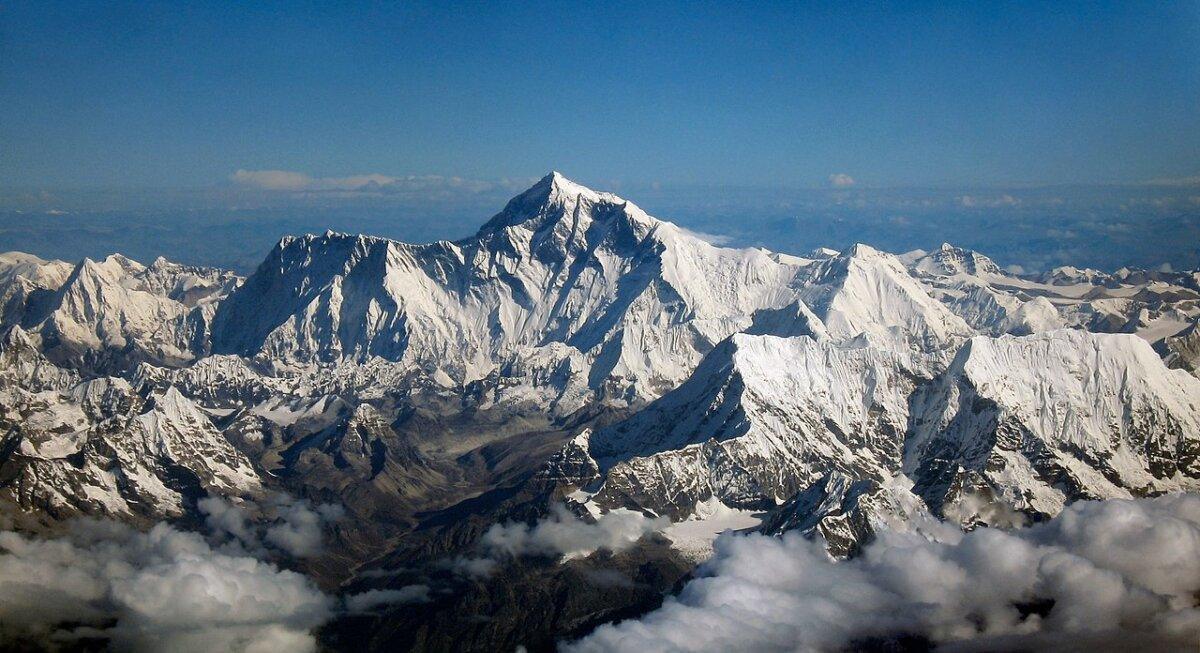
This summit fascinates because it combines everything that high mountains have most spectacular: extreme altitude, unstable weather, crowds on some popular routes, and the “death” zone above 8,000 m. Yes, the summit is legendary, but the real challenge often begins well before the final ridge. It is also one of the few places where the expedition experience remains more striking than the number itself.
- Altitude: 8,848.86 m
- Country: Nepal / China
- Range: Himalayas
- First ascent: 1953
2. K2, the most feared mountain
K2 stands at 8,611 m and is located in the Karakoram, on the border between Pakistan and China. In the ranking of the highest mountains in the world, it holds second place, but in the imagination of mountaineers, it often plays the role of the most austere summit. Its reputation comes less from its height than from its technical difficulty, steep slopes, and capricious weather.
“In high mountains, the weather does not negotiate: it imposes its tempo.”
Basic principle often recalled by expedition guides
K2 is famous for its “committed” nature: exposed passages, sometimes tiny weather windows, and climbing routes that require true mastery of mountaineering. The first ascent, achieved in 1954 by an Italian expedition, reinforced its aura. In other words, it is not just a great summit: it is a great test.
- Altitude: 8,611 m
- Country: Pakistan / China
- Range: Karakoram
- First ascent: 1954
3. Kangchenjunga, between power and sacred dimension
With 8,586 m, Kangchenjunga closes the podium. This mountain is located between Nepal and India, still in the Himalayas. It is highly respected locally, to the point that some traditions prefer not to consider its summit as a mere sporting objective. This detail changes everything: here, the mountain is not just a record, it is also a cultural place.
On the ground, Kangchenjunga appeals to mountaineers who like long, isolated expeditions with very little “urbanized” approach. Access is tougher than on more frequented peaks, and logistics weigh heavily. Its first ascent dates back to 1955, but its image remains less commercial than Everest’s. This raw aspect is part of its charm.
- Altitude: 8,586 m
- Country: Nepal / India
- Range: Himalayas
- First ascent: 1955
4. Lhotse, Everest’s direct neighbor
Lhotse reaches 8,516 m and shares the border between Nepal and China. Its main distinctive feature? It is attached to Everest by the massif and many people know it without necessarily being able to name it. Yet, this summit has its own identity: a formidable south face, exposed ridges, and serious commitment.
Historically, its first ascent in 1956 showed that at high altitude, neighbors do not necessarily resemble each other. The Lhotse sometimes seems “in the shadow” of Everest, but it imposes its own logic. In practice, it is a summit over 8,000 m that requires acclimatization, patience, and strict management of weather windows. Not really a Sunday stroll.
- Altitude: 8,516 m
- Country: Nepal / China
- Range: Himalaya
- First ascent: 1956
5. Makalu, the solitary pyramid
Makalu rises to 8,485 m. Again, it is located between Nepal and China, in the Himalaya. Its almost perfect pyramid shape makes it immediately recognizable. It is one of the most visually elegant peaks in the ranking, but this beauty hides a serious mountain, especially in terms of wind and ridges.
Makalu is also appreciated for its somewhat more isolated character. It is often chosen for the purity of its route and for the feeling of remoteness it provides. Its first ascent, in 1955, took place during the great era of conquering Himalayan giants. The atmosphere is less “crowded” than on Everest, but the demands remain high.
- Altitude: 8,485 m
- Country: Nepal / China
- Range: Himalaya
- First ascent: 1955
6. Cho Oyu, the giant reputed to be more accessible
At 8,188 m, Cho Oyu is one of the over 8,000 m peaks most often described as “approachable.” Of course, this word must be put into context: we are talking about an extreme mountain, located between Nepal and China, in the Himalaya. Accessible does not mean easy. At this altitude, every effort is costly.
Its reputation comes from a generally less technical profile than that of K2, Nanga Parbat, or Annapurna I. As a result, it attracts climbers who want to get introduced to very high altitude without immediately entering maximum commitment. First ascent in 1954, and since then, it remains a reference for understanding what a “less hard” summit above 8,000 m really means.
- Altitude: 8,188 m
- Country: Nepal / China
- Range: Himalaya
- First ascent: 1954
7. Dhaulagiri I, the giant of western Nepal
Dhaulagiri I stands at 8,167 m and is located in Nepal, in the Himalaya. Its geographical isolation makes it very impressive: it rises like a monumental block above the surrounding valleys. It is not just a high mountain, it is an imposing mass, visible from afar and feared for its often snow-laden slopes.
The first ascent, achieved in 1960, confirmed that this summit was not a “little brother” of the other Himalayan giants. Its conditions remain demanding due to possible avalanches and rapidly changing weather. Dhaulagiri does not always attract media attention, but it holds true prestige among climbers who like serious lines.
- Altitude: 8,167 m
- Country: Nepal
- Range: Himalaya
- First ascent: 1960
8. Manaslu, the expedition objective that has become very popular
Manaslu rises to 8,163 m in Nepal, in the Himalaya. Its name is often translated as the “mountain of the spirit,” which gives it a special aura. On the ground, it has become one of the Himalayan peaks most sought after by commercial expeditions, precisely because it offers a great summit without the ultra-famous reputation of K2 or Annapurna.
But beware: very frequented does not mean trivial. Snowy slopes, avalanche risks, and altitude make the ascent demanding. First ascent in 1956. Its recent popularity among climbers clearly shows a classic phenomenon in high mountain: the more a summit becomes “accessible,” the more it attracts people, and the more safety management becomes crucial.
- Altitude: 8,163 m
- Country: Nepal
- Range: Himalaya
- First ascent: 1956
9. Nanga Parbat, the dangerous giant of Pakistan
Nanga Parbat rises to 8,126 m in Pakistan, in the Himalaya. It carries a nickname that says a lot: the “Killer Mountain”. This reputation comes from its exposure, its enormous faces, and its tragic history, marked by many failures and accidents before the first successes.
Its first ascent dates back to 1953, but the summit remains one of the most striking to understand the danger at very high altitude. The Rupal face, in particular, is famous for its verticality and scale. While Everest embodies prestige, Nanga Parbat embodies harshness. It’s not the same story, and that is precisely what makes it essential in this ranking.
“The highest is not always the most difficult.”
Essential guide to reading a mountaineering ranking
- Altitude: 8,126 m
- Country: Pakistan
- Range: Himalaya
- First ascent: 1953
10. Annapurna I, the most famous mountain for its difficulty
Annapurna I closes this top 10 with 8,091 m, in Nepal, in the Himalaya. Its name is associated with a historic achievement, since its first ascent in 1950 was the first victory on a summit over 8,000 m. But this glory comes with a much darker reputation: Annapurna is among the most feared mountains in the world.
Why? Because of a mix of risks: avalanches, unstable weather, complex terrain, and constant commitment. Safety statistics have long been among the harshest in the Himalayan world. In short, this summit is less known for the comfort of its route than for its absolute seriousness. Among climbers, it is one of those names that commands respect even before thinking about the summit.
- Altitude: 8,091 m
- Country: Nepal
- Range: Himalaya
- First ascent: 1950
Why are almost all of the world’s highest mountains in Asia?
Because the Himalaya and the Karakoram result from an exceptional tectonic collision between the Indian plate and the Eurasian plate. This collision pushed the earth’s crust upward for millions of years. The result: the highest mountains in the world are concentrated there, and nowhere else. It’s a matter of geology, not chance.
The influence of the Himalaya and Karakoram
These two ranges form the heart of the planet’s roof. The Himalaya aligns the majority of the summits over 8,000 m, while the Karakoram concentrates very technical giants like K2. This geographical proximity explains why the top 10 is almost entirely Asian. In reality, there are 14 summits over 8,000 m on Earth, and they are all located in Asia.
The symbolic threshold of 8,000 m
The threshold of 8,000 m is not just a climber’s whim. Above this altitude, the body enters a very particular territory: available oxygen drops, recovery becomes limited, and exposure to cold intensifies. This is what has made mountains over 8,000 m a category apart, both mythical and physiologically harsh.
“At high altitude, you don’t just fight the slope: you deal with the air, the cold, and the weather.”
Field reading in mountaineering
What is the highest peak outside Asia?
The highest peak outside Asia is the Aconcagua, in Argentina, at 6,961 m. It dominates the Andes and often serves as a reference to understand how much Asia monopolizes the highest altitudes on the planet. In other words: as soon as you leave Asia, you lose more than 1,800 meters in the global ranking.
- Aconcagua: 6,961 m, Argentina, Andes
- Denali: 6,190 m, Alaska, Alaska Range
- Kilimanjaro: 5,895 m, Tanzania, Kilimanjaro massif
This benchmark is useful because it avoids a common confusion: the global ranking by altitude is not a continental prestige ranking. It mainly shows the extraordinary concentration of giant reliefs in Asia. The rest of the world has very high peaks, of course, but none rival the Himalaya-Karakoram block.
How to read this ranking without confusing altitude and difficulty?
The principle is simple: higher does not mean harder. Altitude measures height above sea level, whereas difficulty depends on technique, weather, objective risks, isolation, and type of slope. In practice, a “lower” peak can be much more challenging than a more famous giant.
For example, Everest attracts more attention, but the K2, Annapurna I, or Nanga Parbat are often perceived as more formidable. Why? Because extreme altitude combined with a steep face, unpredictable weather, and avalanche-prone couloirs turns the ascent into a real ordeal. That is why mountaineers talk as much about risk management as about meters climbed.
- Absolute altitude: height measured from sea level.
- Technical difficulty: quality of climbing, ice, and rock.
- Commitment: duration, isolation, exposure, difficulty of rescue.
- Danger: weather, avalanches, rockfalls, altitude, fatigue.
FAQ
What is the highest mountain in the world?
It is Everest, with an altitude of 8,848.86 m. It is located on the border between Nepal and China, in the Himalayas. It remains the absolute benchmark whenever we talk about the highest mountains in the world.
What is the second highest peak?
The K2, at 8,611 m. It is located in the Karakoram, between Pakistan and China. Its reputation as a very technical peak gives it a special place in very high-altitude mountaineering.
Which mountains exceed 8,000 meters?
There are 14 peaks over 8,000 m on Earth. In this top 10, you will find notably Everest, K2, Kangchenjunga, Lhotse, Makalu, Cho Oyu, Dhaulagiri I, Manaslu, Nanga Parbat, and Annapurna I.
Why do altitudes vary according to sources?
Because measurements change depending on the methods used: GPS, satellite measurements, cartographic models, or taking into account snow and ice at the summit. Differences are often small, but they explain why some figures are not strictly identical from one source to another.
What is the highest peak outside Asia?
The Aconcagua, in Argentina. At 6,961 m, it is the highest peak in the Americas and the main reference when comparing major mountains by continent.
Key points to remember
- The global top 10 is dominated by the Himalayas and Karakoram.
- Everest remains the highest peak in the world, but not the hardest.
- K2, Annapurna I, and Nanga Parbat are among the most feared peaks.
- The 8,000 m threshold marks an extreme physiological zone in mountaineering.
- Aconcagua is the highest peak outside Asia.
As a final reference point
This ranking of the highest mountains in the world shows one very clear thing: the planet concentrates its giants in Asia, and each peak tells a different story. Some are famous because they reach very high altitudes, others because they are feared, isolated, or culturally sacred. This is where the ranking becomes truly interesting.
If you want to go further, the most logical next step is to compare the peaks over 8,000 m, the most difficult or highest mountains by continent. Here, we move beyond a simple list to enter the detail that changes everything: that of the terrain, the risk, and the real prestige.