Presentation of the Renault Clio 4
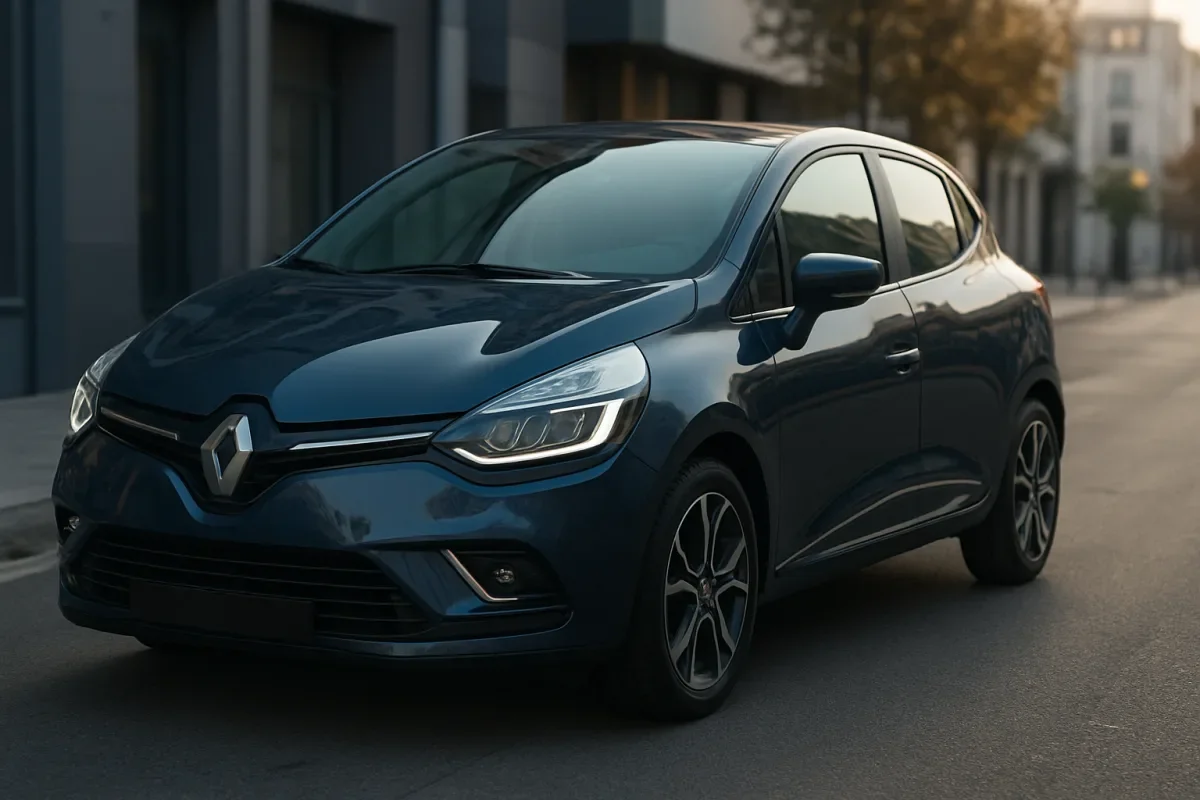
The Clio IV replaced the Clio 3 with a clear ambition: to modernize the range without blowing up costs. Renault hit the mark, as this generation attracted buyers with its more dynamic style, decent interior space and a mechanical offer wide enough to cover almost all uses. On the used market, it still attracts because it remains simple to understand, easy to maintain and available at very varied prices depending on trim and engine.
What made the Clio 4 successful
Its success lies in a very simple recipe: a city car format short enough for the city, but not too cramped for daily trips; known engines; economical diesel versions; and enough trims to target both the rational buyer and the one who wants a slightly more prestigious car. As a result, the Renault Clio 4 has often been chosen as the main car, not just as a second car.
Quick facts about the Clio 4
Dimensions, trunk and interior space
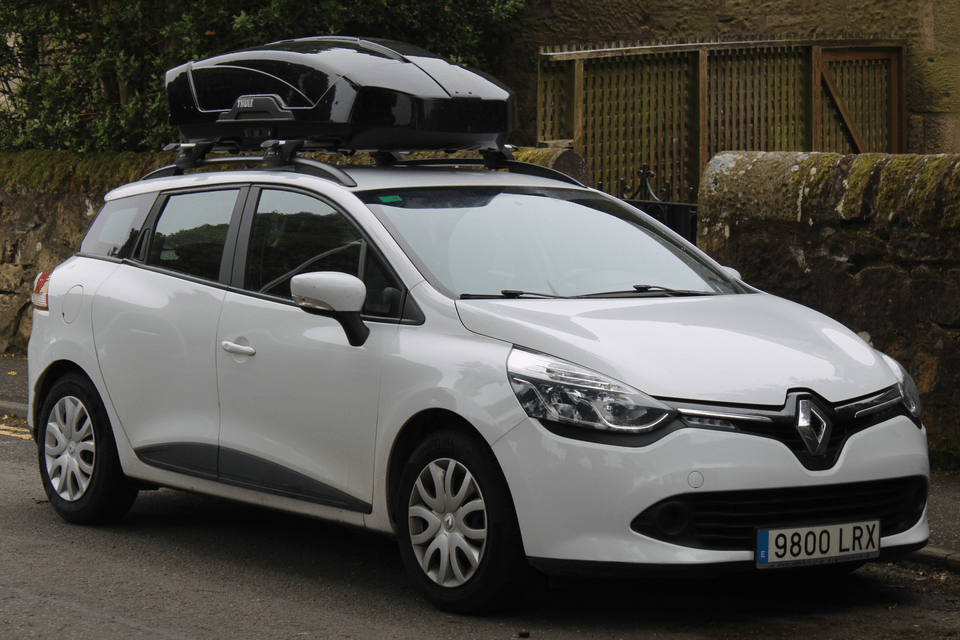
On paper, the Clio 4 remains a compact city car, thus easy to park and maneuver. In real life, it surprises with decent front space and a rear bench sufficient for two adults or two children. The sedan’s trunk is average for the segment, while the Estate becomes clearly more practical if you often carry a stroller, suitcases or sports equipment.
For light family use, it works very well. For a couple with one child, it is often just the right compromise. However, if you regularly make long trips with five adults, you will have to accept the limits of a city car: useful width, knee room and loading volume remain logically limited.
Design and trims
Between phase 1 and phase 2, the change is not only aesthetic. The facelift brings a cleaner front end, revised equipment and, depending on versions, a slightly more refined interior presentation. Regarding trims, you often find Life, Zen, Intens, Limited or more specialized versions like GT, RS or Estate. The real question is not “which is the prettiest,” but “which suits your use without making you pay for unnecessary options.”
Which engines to choose on a Clio 4?
On the Renault Clio 4, the right engine mainly depends on your annual mileage and your journeys. In the city and for short distances, a petrol engine is often more suitable. For heavy drivers, diesel still has a real financial interest, provided you drive enough to avoid clogging. The idea is not to seek power at all costs, but the best torque for usage/cost of maintenance.
Petrol
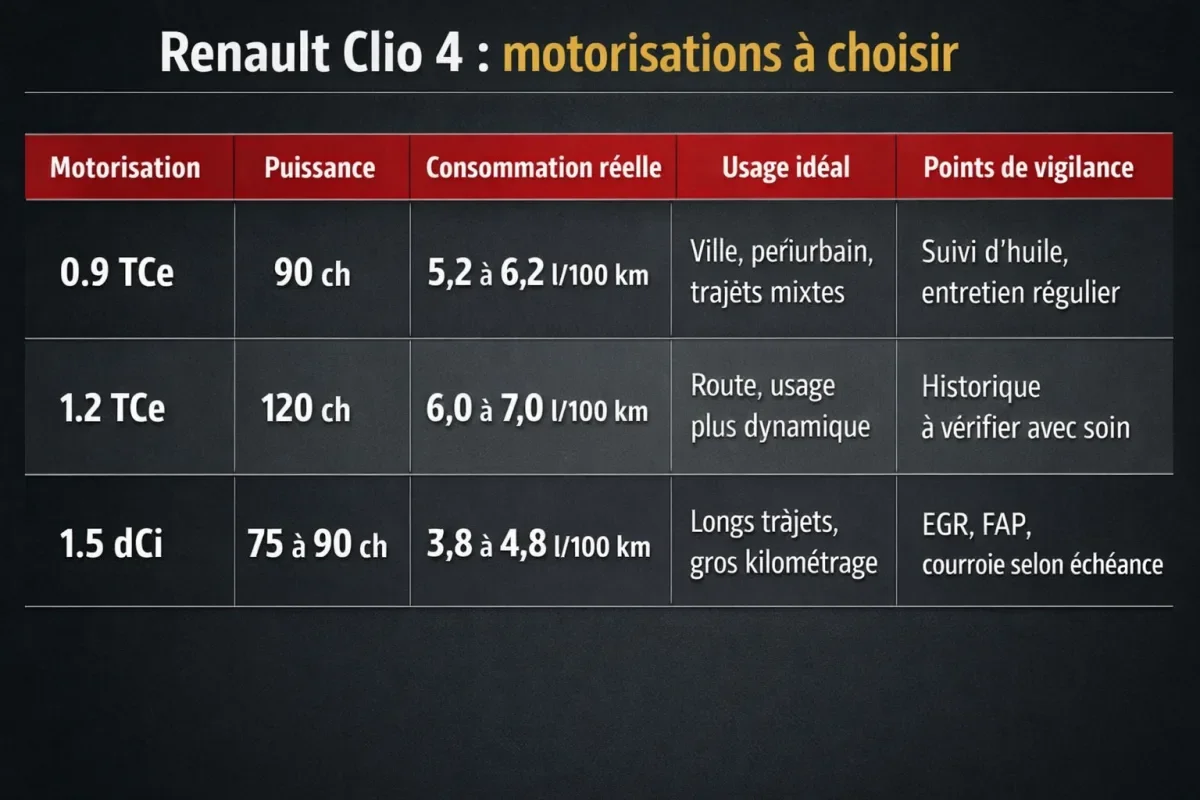
The most common petrol engines on the Clio 4 are small naturally aspirated or turbocharged units depending on the year and trim. For urban use, the 0.9 TCe is often the most interesting: sufficiently flexible, not too thirsty, and more pleasant than a small naturally aspirated engine when the car is loaded. The 1.2 TCe, more lively, may suit those who do more road driving, but you need to pay closer attention to mechanical maintenance. For very short trips, you also have to accept a Clio 4 consumption a little less flattering than advertised on paper, because a small turbo petrol logically drinks more in the city than on the road.
Diesel
The 1.5 dCi remains the classic on the market. It doesn’t inspire dreams, but it gets the job done with a sobriety that many buyers still look for. For heavy drivers, it can drop to very reasonable values, with relaxed driving on the highway. However, it is less comfortable for three-kilometer round trips. On a Clio 4 diesel, EGR clogging, the DPF, and certain peripheral components dislike repeated short trips much more than long distances.
| Engine | Power | Real consumption | Ideal use | Points of attention |
|---|---|---|---|---|
| 0.9 TCe | 90 hp | 5.2 to 6.2 l/100 km | City, suburban, mixed trips | Oil monitoring, regular maintenance |
| 1.2 TCe | 120 hp | 6.0 to 7.0 l/100 km | Road, more dynamic use | History to check carefully |
| 1.5 dCi | 75 to 90 hp | 3.8 to 4.8 l/100 km | Long trips, high mileage | EGR, DPF, belt according to schedule |
Gearboxes
The manual gearbox is the simplest, least expensive, and often the most reassuring solution for used cars. The dual-clutch EDC gearbox provides more comfort, especially in the city and in traffic jams, but it requires serious maintenance and gentle driving. If you do a lot of urban trips, the EDC can be a real pleasure. If you are primarily looking for simplicity and a tight budget, the manual keeps the advantage.
Is the Renault Clio 4 a good used car?
Yes, but not just any. A well-chosen Renault Clio 4 used can be a very good purchase because it remains easy to live with, relatively economical, and easy to resell. However, a poorly maintained version, sold too expensive, or bought on a whim can quickly turn the good deal into a small mechanical hassle.
Reliability strengths
Clio 4 reliability is generally correct if maintenance has been done on time. The most classic versions have a rather good reputation, especially when they have been used consistently with their engine. Simple petrol engines are generally reassuring in the city, and the 1.5 dCi remains a safe bet on models that have been driven regularly and have had their oil changes, filters, and belt replaced on time.
Known problems and breakdowns
- Diesel clogging: to watch if the engine spends its life on short trips. Symptoms are often a loss of flexibility, an engine warning light, or too frequent DPF regenerations.
- Tired EDC gearbox: during the test drive, jerks, hesitations, or slipping should alert you, especially if the car has been used in the city without proper maintenance.
- Oil consumption on some turbo petrol engines: if the level drops too quickly between two services, the matter should be investigated before signing.
- Comfort electronics: air conditioning, radio, sensors, or controls can sometimes act up, not necessarily dramatically, but it should be factored into the budget.
- Typical wear: discs, bushings, shock absorbers, and battery can be expensive if the car has done a lot of city driving.
Maintenance and Recurring Costs
For a Clio 4, the annual budget remains contained if everything is in order. A routine service can range from around 150 to 300 euros depending on the garage, the engine, and consumables. A pair of tires can significantly affect the bill, as can a battery or brakes to be replaced. On the 1.5 dCi, the timing belt must be checked seriously; on a petrol engine, it is especially important to follow oil changes and fluid levels diligently. The icing on the cake: a clear service book often counts more than an impressive odometer.
Used Clio 4: How to Buy Well?
The market for the Renault Clio 4 used is vast, so comparison seems simple but is deceptive in practice. Two cars from the same year can have very different price levels depending on the trim, tire condition, presence of an automatic gearbox, maintenance history, and number of owners. The right approach is to consider the overall condition, not just the listed price.
What Price According to Year, Mileage, and Trim?
In practice, the lowest prices often concern older models, higher mileage, or very basic trims. Facelifted examples, low mileage, and well-equipped ones are negotiated at a higher price. A Clio 4 higher trim, especially with GPS, automatic air conditioning, camera, or EDC gearbox, can justify an extra cost if everything is consistent. Conversely, a high price without a solid maintenance history is not a good deal.
| Budget | What You Can Aim For | What to Watch Out For |
|---|---|---|
| Under €6,000 | Older versions, high mileage, simple equipment | Maintenance, interior wear, tires and brakes |
| €6,000 to €9,000 | More consistent examples, often petrol or dCi | History, clutch condition, belt |
| €9,000 to €13,000 | Phase 2, higher trim, reasonable mileage | Price/equipment ratio |
| Over €13,000 | Recent versions, very clean, better engines | Compare with a Clio 5 or a more recent rival |
Checklist Before Purchase
Before signing, keep it simple and methodical. A good seller is not the one who talks the fastest, but the one who provides the right documents and accepts inspections. If something seems unclear, the history must be clarified before any negotiation.
- Ask for the service book, invoices, and date of last service.
- Check consistency between mileage, wear on the steering wheel, seats, and pedals.
- Test drive the car cold, then warm, to detect noises or misfires.
- Test the gearbox, brakes, air conditioning, screen, windows, and electronic aids.
- Inspect tires, discs, seals, leaks, and any signs of impact.
Which Versions to Favor According to Your Profile?
If you mainly drive in the city, a 0.9 TCe petrol or a small simple engine with manual gearbox is often the best compromise. For a small family, the five-door version with mid-level trim is more than enough, especially if the trunk is used reasonably. For a high-mileage driver, the 1.5 dCi retains the advantage, provided the mileage is consistent and maintenance clear. For a tight budget, it is better to have a less fancy but sound version than a shiny trim with a shaky history.
Comparing the Clio 4 to Its Competitors
Compared to the Clio 5, the Clio 4 plays the card of a more accessible price and well-known mechanics. Compared to a Peugeot 208 or a Volkswagen Polo, it mainly defends itself on purchase and maintenance costs. If you are looking for the newest or most prestigious car inside, the competition may have the edge. If you are looking for the best budget/utility ratio, the Clio 4 remains very credible.
Clio 4 vs Clio 5
The Clio 5 offers a more modern interior, more driving aids, and a more current presentation. The Clio 4 compensates with a softer entry price. If your budget is tight, the older generation still holds a very clear interest. If you want a more recent car in every way, the Clio 5 takes the advantage, but not without extra cost.
Clio 4 vs Peugeot 208 and Volkswagen Polo
The Peugeot 208 can appeal with its style and dynamism, the Polo with its rigor and more upscale finish. The Clio 4 often sits between the two in terms of overall cost: purchase, insurance, maintenance, parts. In real life, this budget difference weighs heavily. For a rational purchase, the Clio 4 therefore still has a real card to play.
Daily maintenance of the Clio 4
Regular maintenance changes everything. On a city car like the Clio 4, most problems come less from a “native” weakness than from neglected use, delayed oil changes, or makeshift maintenance. If you want to keep a healthy car, you need to monitor consumables and not wait for a noise to appear before acting.
Inspections and frequency
A classic inspection often includes oil, oil filter, visual check of brakes, tires, and fluid levels. Depending on the engine, the interval and parts to replace vary. Diesels require closer monitoring of the timing belt and pollution control components. Gasoline engines mainly require regularity and proper maintenance. In other words, fewer surprises and a lot of rigor are better.
Tips to extend the vehicle’s lifespan
- Warm up the engine gently, especially on turbo versions.
- Avoid repeated ultra-short trips on diesel.
- Check fluid levels between inspections, especially oil.
- Replace tires and brakes before reaching the wear limit.
- Keep all invoices: they increase the car’s value at resale.
Clio 4 FAQ
Is the Clio 4 a good used car?
Yes, if you choose a well-maintained example, with an engine suited to your use. The Clio 4 is interesting because it remains affordable, fairly comfortable, and easy to resell. On the other hand, a car without history or sold too expensively is not a good deal, even if it looks great in photos.
Which Clio 4 engine is the most reliable?
There is no “perfect” engine in absolute terms, but the simplest blocks, well maintained and used in the right context, inspire more confidence. For gasoline, the 0.9 TCe often performs well. For diesel, the 1.5 dCi remains relevant for high-mileage drivers, provided it has been maintained without delay.
What real fuel consumption can be expected?
In real use, a gasoline engine can run around 5 to 7 l/100 km depending on the route, while a well-driven diesel can go below 5 l/100 km. City driving raises the numbers, highway stabilizes them. Differences between advertised and real figures mainly come from the type of trip and driving style.
Which trims are the most interesting?
Mid-level trims are often the smartest: they already offer the essentials without exploding the price. A well-equipped version with air conditioning, Bluetooth, cruise control, and rear parking sensors is more than enough for most buyers. High-end trims are only worth it if the price gap remains reasonable.
Should I choose gasoline or diesel?
If you drive little or mostly in the city, gasoline is generally more coherent. If you do a lot of kilometers, especially on roads and highways, diesel keeps a real economic advantage. The right choice is not the one that “consumes the least on paper,” but the one that really matches your use.
Should you buy a Renault Clio 4?
Yes, provided you aim for the right version. The Renault Clio 4 remains a very solid city car for those who want an accessible, versatile car known by garages. The best purchase is not necessarily the cheapest, but the one whose engine, trim, and history fit your daily life. If you drive little, take a simple and healthy gasoline. If you do long trips, a well-maintained diesel can remain an excellent plan. In any case, maintenance and usage coherence outweigh sales talk.