
In brief
🍼 From the 1st day of the 6th month, pregnancy falls under enhanced coverage by Health Insurance, until 12 days after delivery.
💶 The insurance mainly serves to cover what Social Security leaves out: extra fees, private room, comfort acts, and sometimes birth allowance.
⏳ The right reflex is to anticipate: some contracts apply a waiting period, so subscribing after the pregnancy test may be too late.
What does Social Security reimburse during pregnancy?
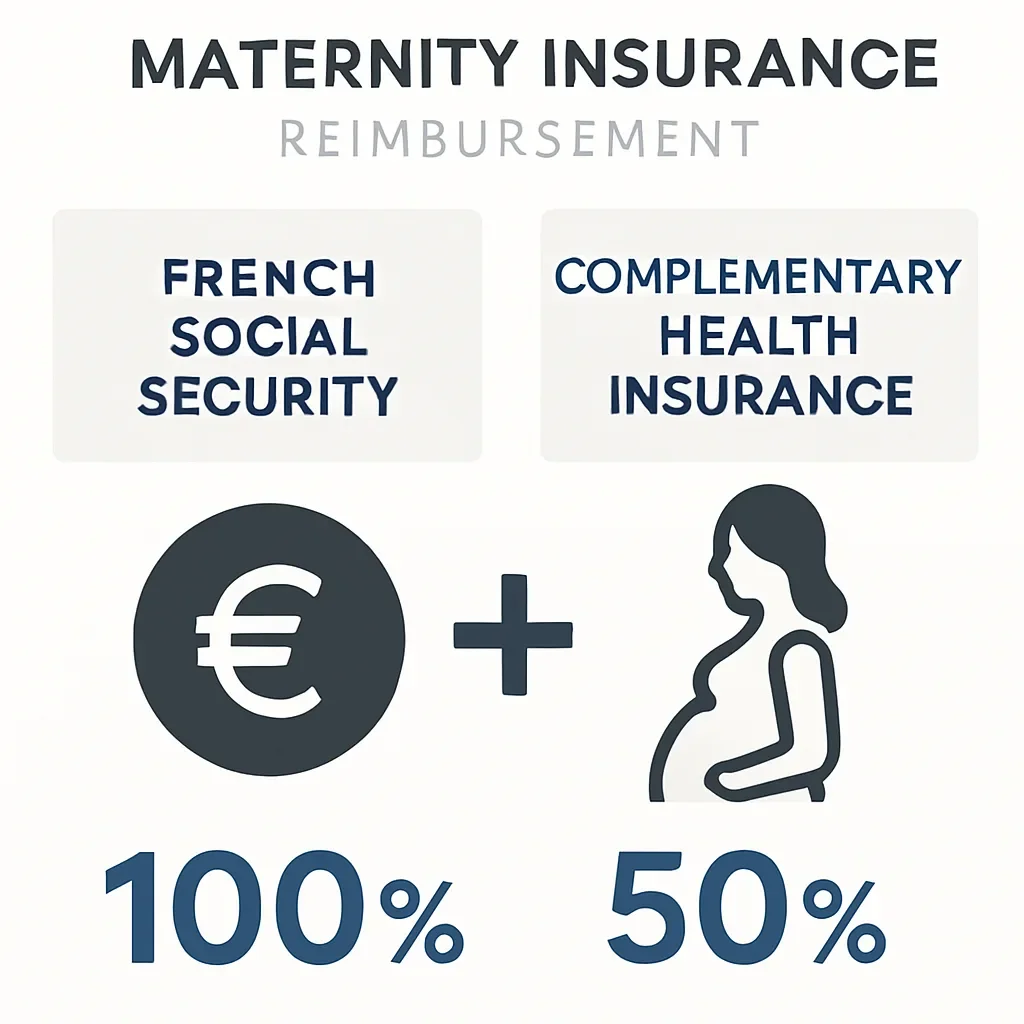
Social Security covers 100% of the reimbursement base for maternity-related care from the 1st day of the 6th month of pregnancy until 12 days after delivery. Before this switch, reimbursement follows the usual rules, which sometimes leaves an out-of-pocket expense.
According to ameli, the logic is simple: the further along the pregnancy, the broader the coverage. This refers to coverage of care within the limits of the agreed rate. In other words, if the professional charges more, the difference may remain your responsibility.
Practically, pregnancy entitles you to a series of well-identified care:
- 7 recommended prenatal exams, medically monitored throughout the pregnancy;
- 3 follow-up ultrasounds, including the famous 3rd trimester ultrasound;
- 8 sessions of childbirth and parenting preparation;
- delivery, hospitalization, and immediate follow-up after birth, under the conditions provided by Health Insurance.
The subtle point is that not all care is equal. A consultation with a gynecologist in sector 1 does not have the same impact on your wallet as a visit to a specialist in sector 2 with extra fees. And this is exactly where insurance starts to become interesting.
What the insurance really complements during pregnancy
The insurance is not intended to do the work of Social Security again: it comes to complement what is missing. In practice, it mainly serves to cover the gaps between the reimbursed base and the actual bill. This is where big differences play out between two contracts that, on paper, seem very close.
On the ground, complementary reimbursements mainly target the following items:
| Item | What Social Security covers | What the mutual insurance can reimburse | Point of caution |
|---|---|---|---|
| Specialist consultations | Reimbursement base | Co-payment and sometimes extra fees | Sector 1 or sector 2? |
| Private room | Often not covered | Daily allowance or annual ceiling | Limited ceiling, depending on the maternity hospital |
| Alternative medicine | Very rarely | Osteopathy, acupuncture, sophrology allowance | Number of sessions capped |
| Birth allowance | No | Fixed premium according to the contract | Seniority required in some cases |
| Delivery in clinic | Reimbursed base | Supplement on remaining out-of-pocket expenses | Extra fees and additional costs |
One point comes up all the time: extra fees. If the gynecologist, anesthetist, or clinic charges above the base rate, the mutual insurance can help absorb the bill. But you have to read the fine print, because a 100% reimbursement does not always mean full reimbursement. Joking aside, this is often where surprises hide.
It is observed in practice that a good portion of quote requests concern two very concrete items: the private room and specialist fees. A family who went through a private clinic reports that the bill mainly increased on these lines, not on the exams themselves. In other words, comfort and the medical sector often weigh more than routine care.
How to read guarantee levels without getting fooled?
The classic trap is to believe that 100% covers everything. In reality, this percentage is calculated on the Social Security reimbursement base, not on the price shown on the quote. That’s why two mutual insurances “at 100%” can give very different results depending on the specialist consulted and the city where you live.
| Level | What it means | When it is useful |
|---|---|---|
| 100% | Reimbursement base + possible supplement on co-payment | Simple follow-up, practitioners without extra fees |
| 150% | Coverage above the base, within an upper limit | Some moderate extra fees |
| 200% | More comfortable ceiling for specialists and hospitalization | Pregnancy followed in sector 2 |
| Flat rate | Fixed sum paid for a specific expense | Birth, private room, alternative medicine |
The truly good maternity contract is not the one that shows the sexiest percentage, it is the one that covers useful items, at the right time, without hidden waiting periods or ridiculous ceilings.
In practice, it is better to look at three lines at once: the reimbursement percentage, the annual ceiling, and exclusions. A mutual insurance with a large private room allowance but no reimbursement for anesthesia extra fees may be less interesting than a more balanced contract. In other words, you have to read the sheet as a whole, not like an advertisement.
Should you choose your mutual insurance before becoming pregnant?
Subscribing before becoming pregnant changes everything, because many contracts apply a waiting period on maternity. If the contract is already in place, the mutual insurance can cover the delivery, extra fees, and certain allowances without unpleasant surprises. If you wait for the positive test, it is sometimes already too late.
Timing is crucial. The pregnancy declaration must be submitted within deadlines to the CPAM and the CAF, and the procedures are detailed on Service-Public.fr. In France, this declaration is usually made before the end of the 3rd month, that is around 14 weeks of amenorrhea.
If you are looking for useful coverage, especially keep these criteria in mind:
- no waiting period or a short waiting period for maternity;
- enhanced reimbursement for extra fees in obstetrics and anesthesia;
- clear birth allowance, without overly opaque conditions;
- private room genuinely covered, not just “mentioned”;
- coverage for ancillary care: osteopathy, acupuncture, sometimes psychologist or sophrology.
If the budget is tight, the Complementary Health Solidarity can be an option to consider, but it does not play exactly the same role as a premium maternity mutual insurance. It all depends on the level of comfort sought, the place of delivery, and the type of follow-up chosen. A straightforward pregnancy in sector 1 does not require the same contract as follow-up in a clinic with regular specialists.
How much can a pregnancy cost with a bad contract?
The bill does not suddenly spiral out of control. It builds up little by little: a somewhat expensive consultation here, an ultrasound with extra fees there, an additional night in a private room, then the total starts to sting. It is often afterwards that one realizes the mutual insurance should have been designed as a financial prevention tool, not just a simple accessory.
| Often forgotten costs | Observed magnitude | Why it matters |
|---|---|---|
| Private room | About 40 to 120 € / night depending on the clinic and city | Can quickly add up over 3 or 4 nights |
| Extra fees | Often 20 to 80 € more per procedure with some specialists | Highly variable depending on the sector and the practitioner’s reputation |
| Osteopathy / acupuncture | About 30 to 70 € per session | Rarely reimbursed by Health Insurance |
| Comfort fees | Variable depending on the facility | They are not always visible in the initial quote |
The clearest differences often appear in private clinics and with sector 2 practitioners. A well-calibrated mutual insurance prevents turning a normal follow-up into a mini financial disaster. And as we often see, the cost does not necessarily come from the delivery itself, but from everything surrounding it.
It is observed in practice that expectant mothers rarely request a complete quote from the start. As a result, they sometimes discover the real price of the room or fees when it is too late to change the contract. A simple written request before entering the maternity ward can avoid quite a few cold sweats.
What steps to take to avoid unnecessary out-of-pocket expenses?
To avoid unpleasant surprises, you need to act on three fronts: administrative, medical, and insurance. First, update your Vitale card and verify that the pregnancy is properly declared. Next, always ask for a quote if the clinic or specialist announces additional fees. Finally, reread your mutual insurance policy, not just the commercial slogan.
Useful habits are quite simple:
- make the pregnancy declaration on time with the CPAM and CAF;
- ask if the practitioner is in sector 1, sector 2, or a member of OPTAM;
- check the coverage level for the private room;
- control the ceilings on the birth allowance and ancillary care;
- keep all receipts, especially for procedures billed outside the standard pathway.
Another point not to overlook: the third-party payment. When it works, it simplifies cash flow during pregnancy, as you advance less money. However, third-party payment does not replace good coverage. It eases immediate payment but does not turn an average contract into a solid one. Important nuance, otherwise you get easily fooled.
FAQ — Health mutual insurance and pregnancy
Does the mutual insurance reimburse the private room at the maternity ward?
Yes, if your contract includes a suitable hospitalization or maternity guarantee. Generally, it is a flat rate per night or an annual ceiling, not an unlimited reimbursement. The amount strongly depends on the facility and the chosen plan.
Are extra fees covered?
Yes, but only if the level of coverage is sufficient. Coverage at 150% or 200% of the base rate is often more comfortable for consultations in sector 2, anesthesia, or certain obstetric procedures. Without this, the out-of-pocket costs can remain quite significant.
What happens if my mutual insurance has a waiting period?
In this case, maternity benefits only apply after a waiting period, often several months. If the pregnancy is already underway, the contract may not necessarily cover the upcoming delivery. That is why it is important to check the waiting period before subscribing.
Is the mutual insurance birth grant the same as the CAF’s?
No, these are two different things. The mutual insurance birth grant depends on the contract, whereas the CAF benefit follows its own rules. Some mutual insurances pay a fixed lump sum, others nothing at all, so it is necessary to read the conditions line by line.
And if I have Complementary Health Solidarity, is that sufficient?
The CSS adequately covers many common treatments, but it remains less flexible than an enhanced maternity contract for comfort expenses or certain extra fees. For an uncomplicated pregnancy in sector 1, it may be sufficient. For a private clinic, the out-of-pocket costs may increase.
Does a multiple pregnancy change reimbursements?
The basic rules remain the same, but medical monitoring is often more intensive, with more exams and consultations. In this case, a more generous contract for specialists and hospitalization quickly becomes more relevant. It is not the number of babies that changes the law, but the volume of care.