Why the Château de Chambord was built: history, ambitions, and secrets of the largest castle in the Loire
Discover why Chambord was built, between royal prestige, political ambition, and Renaissance influence. History, stakes, and secrets of the largest castle in the Loire.
🏰 François I commissioned Chambord to display his power as much as to stay in Sologne.
👑 The castle combines hunting residence, monarchical staging, and artistic ambition.
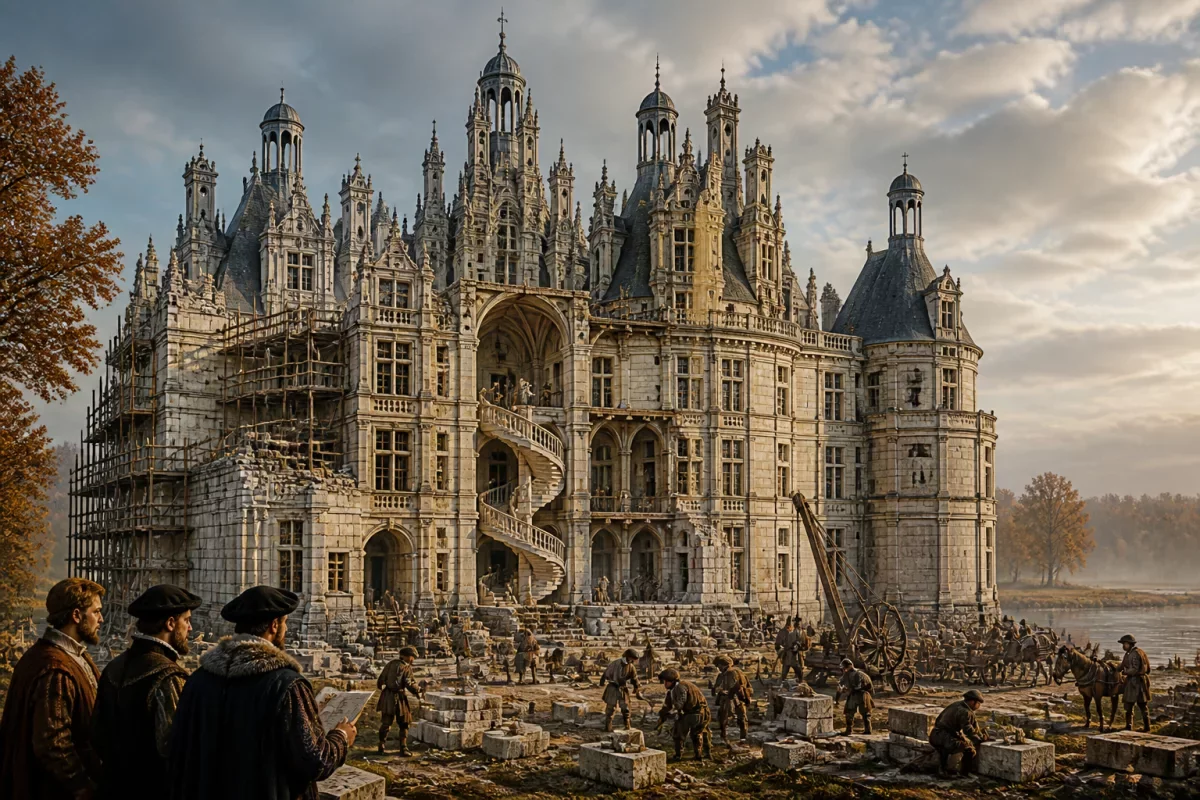
📌 The king spent only 72 nights there, while construction stretched until 1547.
Why Did François I Launch Chambord in 1519?
The short answer is simple: to make Chambord a visible sign of his power. In 1519, François I was not just commissioning a place to stay; he was launching a project capable of manifesting his wealth, modernity, and authority. Hunting mattered, but it does not explain the scale of the project.
The choice of Chambord fits within a courtly logic. A Renaissance king did not just govern: he showed himself. Stone, form, decoration, and grandeur became political instruments. Chambord was therefore conceived as a message before being a refuge.
At Chambord, function never exhausts meaning: the building also serves to declare who commands.
The king also wanted to leave a lasting mark. A monumental castle does not only serve to host occasional stays; it fixes an image of power in the landscape. This is what distinguishes Chambord from a simple hunting lodge: the monument must outlive the moment and still speak when the sovereign is no longer there.
What Was the Castle Really Used For?
Chambord is primarily a place for stays linked to hunting, but the actual use of the castle remains limited. François I spent only 72 nights there, which is enough to break the idea of a residence inhabited like an ordinary palace. The building is monumental; its attendance is not.
Hosting the court in a spectacular setting.
Showing the sovereign’s rank to high-level visitors.
Combining the pleasure of hunting with the representation of power.
This dissociation between intention and actual use is essential. It explains why Chambord still fascinates: it is less a dwelling than a political object set in stone. The castle must impress even when it is not occupied, and that is precisely what makes it unique.
The Three Overlapping Intentions
The historical debate becomes clearer if one stops opposing interpretations. Chambord can be at once a hunting residence, a dynastic symbol, and an architectural manifesto. The question is therefore not to choose a single function, but to understand how these three layers reinforce each other.
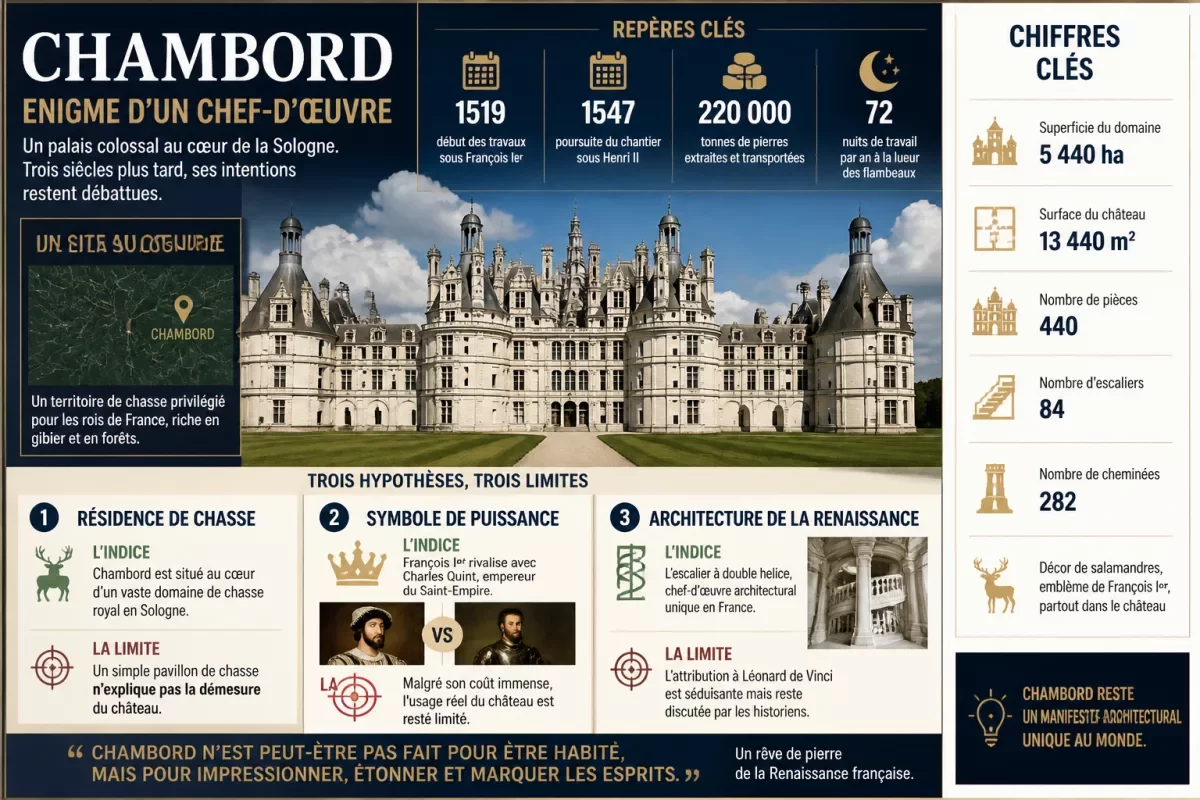
Hunting, royal prestige, and Renaissance architecture: three logics that overlap from the launch of the project in 1519.
This diagram highlights a simple idea: the more modest the concrete use seems, the more the symbolic function gains weight. The project started in 1519 and extended until 1547 clearly shows that this was not a quick utilitarian construction, but a long-term project.
Chambord must offer a hunting setting.
It must also make the king present in the space.
Finally, it must leave a lasting mark on the history of forms.
In other words, the castle is not a building with a single function. It accumulates roles, and it is this superposition that explains its unique status in the history of the Loire castles.
The Italian influence, real but often simplified
The Italian Renaissance clearly influences Chambord, but the building is not a copy. François I wants an architecture capable of rivaling Italian palaces while speaking the language of the French monarchy. The issue is not borrowing, but appropriation.
That is where Chambord becomes interesting: it reflects a court culture that seeks to import novelty without giving up the staging of the king. Renaissance architecture is not only used for decoration; it serves to legitimize.
The castle thus absorbs several influences without dissolving into any one of them. It takes ambitions from Italy but transforms them into an image of French sovereignty. It is this mixture that explains its uniqueness in the French heritage.
Leonardo da Vinci and the double helix staircase
The double helix staircase is the element that concentrates the most legends. Its attribution to Leonardo da Vinci is often recalled, but the essential point is not to turn Chambord into a mere work of Vinci. What matters is the effect produced: a spectacular, memorable, almost theatrical device.
The castle impresses not despite its staircase; it also impresses because of it.
This crossed ascent gives the visitor an unusual experience. Two people can see each other without really crossing paths, which quite well sums up the spirit of the place: an architecture of ingenuity, but above all of surprise. The architectural object becomes a sign of mastery as much as a visual pleasure.
It is therefore necessary to distinguish the history of the invention from that of the legend. Even when the exact attribution is debated, the staircase remains a turning point in the reading of the castle: it elevates Chambord from the status of an ambitious residence to that of a monument designed to amaze.
What Chambord’s architecture says about royal power
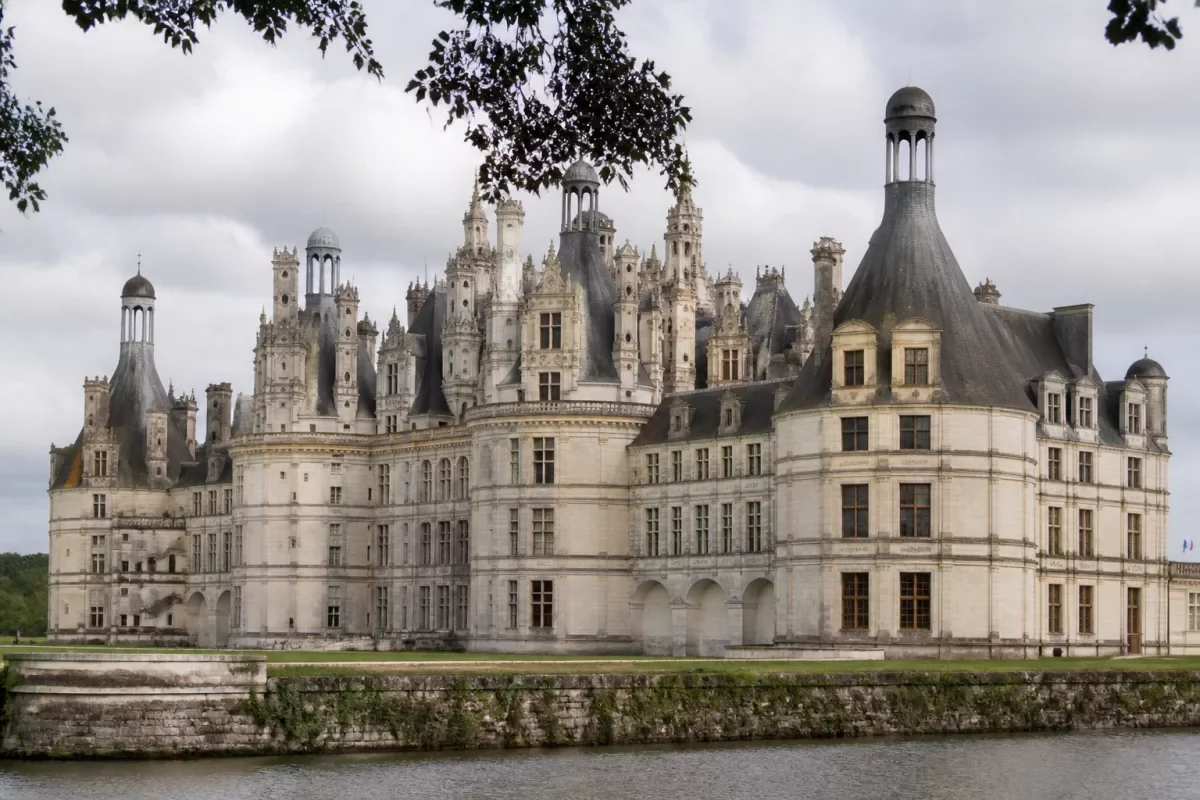
Chambord is designed to be seen from afar, understood up close, and remembered for a long time. Its towers, composite roof, verticality, and profusion of volumes transform the castle into a demonstration of authority. Here, form does not illustrate power: it performs it.
The monumentality of Chambord counts as much as its use: François I only spent 72 nights there, despite a construction site prolonged until 1547.
In this type of monument, monumentality counts as much as habitability. The project aims to produce a lasting effect on contemporaries, including Charles V, former rival of François I, whom the castle was supposed to impress according to a well-established historiographical tradition.
At Chambord, monumentality counts as much as use.
This point changes the reading of the site. One should not only ask “what was it used for?”, but also “what was it supposed to make understood?”. And the answer is clear: Chambord was meant to materialize a strong, cultivated, and self-assured sovereignty.
The numbers that recall the scale of the construction
Numbers help to move beyond vague impressions. Chambord is not a small pleasure castle: it is a massive, long, costly project in stone and not very profitable in royal stay. It is precisely this disproportion that gives it its status as a masterpiece.
Marker
What it shows
What it changes in the reading of the castle
1519
Start of the construction under Francis I
The project is born from a logic of royal prestige
1547
End of the construction started under Francis I
The construction is set over a long period, well beyond a temporary stay
220,000 tons of stones
Material scale of the monument
The mass of the construction serves the image of power
72 nights
Limited actual presence of Francis I
The residential function remains secondary compared to the symbol
1981
UNESCO listing of the Loire Valley
Chambord becomes an international heritage reference
220,000 tons of stones: the monument is materially colossal.
72 nights of the king: the use does not follow the ambition.
1981: the UNESCO listing confirms its heritage significance.
These markers are enough to understand the core of the subject. Chambord is not a “practical” castle in the modern sense. It is a building of representation, designed to last, impress, and summarize a certain idea of the French monarchy.
Why Chambord still fascinates today
Chambord fascinates because it cannot be reduced to a single function. It is both a hunting lodge, a court stage, a manifesto of power, and a laboratory of forms. Its interest lies precisely in this gap between what it promises and what it actually served to do.
The Loire Valley has preserved other great residences well, but Chambord remains one of those that best condense the political ideal of the French Renaissance: a king, a territory, an architecture, and an ambition of duration. The construction begins in 1519, stretches until 1547, and leaves a monument designed to survive the uses that saw it born.
Ultimately, the true answer to the question why the Château de Chambord was built lies in one phrase: to proclaim the greatness of the king as much as to house him. It is this priority of symbol over use that makes Chambord a political masterpiece before being a simple place of stay.
To remember
🏰 Chambord is as much a royal manifesto as a hunting lodge.
👑 Francis I sought to display his power and modernity there.
🌀 The double-helix staircase fuels the legend without summarizing the project.
📏 The construction figures reveal an ambition disproportionate to the actual use.
🏛️ Chambord remains a major symbol of the French Renaissance.
FAQ
Was the Château de Chambord really a hunting lodge?
Yes, partly. But this function alone does not explain the size or sophistication of the project. Hunting serves as a starting point; the representation of power quickly takes over.
Why did Francis I choose Chambord?
The choice responds to a logic of dynastic prestige. Francis I wanted a place that would leave an impression, show his wealth, and bring the spirit of the Renaissance into the kingdom. Chambord was meant to speak of the king even before he stayed there.
Did Leonardo da Vinci really design the staircase?
The attribution to Leonardo da Vinci is traditional, but it should be read with caution. The essential point for the history of the castle is that the double-helix staircase embodies remarkable ingenuity and strongly contributes to the legend of Chambord.
How long did the construction of Chambord last?
The construction started in 1519 and continued until 1547. This duration clearly shows that it was not a quick build intended for simple seasonal use, but a large-scale project carried over several decades.
Why has Chambord become so famous?
Because it condenses several narratives at once: the power of Francis I, the French Renaissance, architectural ingenuity, and the myth of Leonardo da Vinci. It fascinates as much for what it shows as for what it deliberately leaves in the shadows.