Understanding the Commercial Domiciliation Certificate
In practice, this document serves to link a company to a specific and legally usable address. It is not limited to a simple letter: it must convince the administration that the registered office, correspondence address, and sometimes the commercial address are properly justified. That is why the form of the document changes according to the mode of domiciliation.
It is important to distinguish three often confused concepts:
- The domiciliation certificate: it certifies that an address can be used by the company.
- The domiciliation contract: it governs the relationship with a domiciliation company and specifies the duration, services, and obligations.
- The proof of registered office or proof of occupancy: it proves the reality of occupying a premises, a dwelling, or an address made available.
In other words, the certificate is often the most visible document, but it is not always the only useful document. In a file processed via the INPI single window, the appropriate proof depends on the context: commercial premises, domiciliation office, manager’s home, or provision by a third party.
What exactly is it for?
It primarily serves to prove that the declared address is indeed usable as a registered office. In a registration file, it prevents rejection due to inconsistency between the declared address and the documents provided. It is also useful during a transfer of headquarters or a change of domiciliation mode.
Concretely, this document serves several purposes:
- finalize a company creation, especially for an SAS, SARL, or sole proprietorship;
- justify the registered office address to the administration, banks, or certain partners;
- secure the reception of professional mail;
- prove that a transfer of headquarters is based on a regular address;
- avoid an incomplete file during company registration formalities.
In a well-prepared file, the commercial domiciliation certificate acts as a coherence piece. It links the legal status, the chosen address, and the reality of occupation of the place. It is precisely this coherence that matters to the administration.
How to obtain a commercial domiciliation certificate?
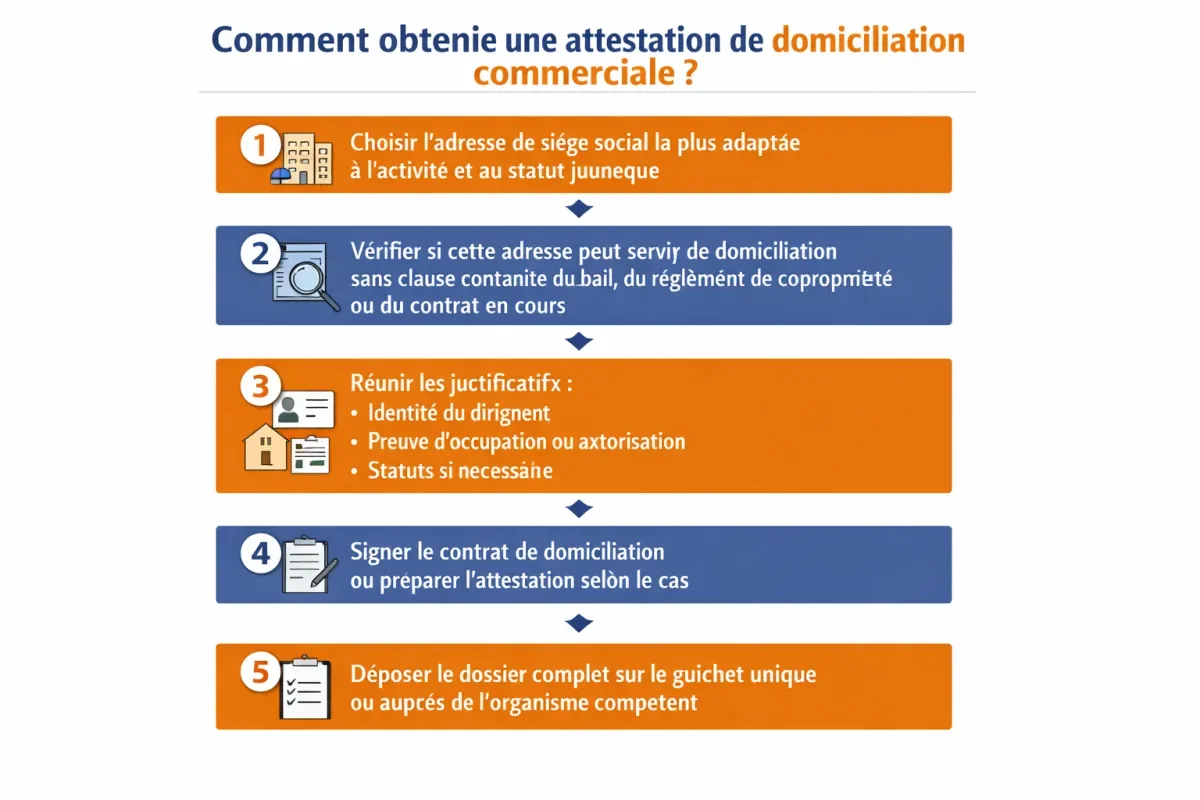
It is practically obtained after choosing the right mode of domiciliation and gathering the appropriate documents. With a provider, the document is often issued after signing the contract. At home or at a third party’s, it depends on written authorization, the lease, or proof of occupancy. The timeframe can range from a few minutes to a few days.
- Choose the registered office address that best suits the activity and legal status.
- Check if this address can be used for domiciliation without any contrary clause in the lease, co-ownership regulations, or the current contract.
- Gather the supporting documents: identity of the manager, proof of occupancy or authorization, articles of association if necessary.
- Sign the domiciliation contract or prepare the certificate as the case may be.
- Submit the complete file to the single desk or to the competent authority.
Going through a domiciliation company
This solution is the most structured to quickly obtain a registered office certificate. The provider offers an address, formalizes the relationship through a domiciliation contract, and issues the certificate once the file is approved. This is often the option chosen when the entrepreneur wants a professional address separate from their home.
Practical case: an SAS created by two partners chooses a domiciliation center to avoid using the president’s home. After signing a 12-month contract and sending the identity document, the provider sends the certificate within the day. The registration file can then be submitted without waiting for a personal proof of address.
Registering your company at home
When the registered office is set at the manager’s home, the certificate often takes the form of a sworn statement or an equivalent document, accompanied by proof of address. This solution is simple and economical, but it remains governed by the lease, co-ownership rules, and sometimes local housing occupation regulations.
The main point of vigilance is the conformity of the address. If the housing does not allow professional use, or if a clause expressly prohibits it, the legal margin of maneuver must be checked before submitting the file. In practice, many founders choose this route at the start, then transfer the registered office later.
Domiciliation in a commercial premises or at a third party’s
When the company has commercial premises, domiciliation is often included in the lease or the provision of the premises. At a third party’s, a clear authorization is required, sometimes supplemented by proof of occupancy of the place. This solution suits activities that receive the public, store equipment, or need a stable presence.
This case is common when the activity justifies a space separate from the home: workshop, shop, office, warehouse, or shared office. However, attention must be paid to the exact nature of the occupation. A coworking space, for example, does not always grant the same rights as a traditional commercial lease.
What documents must be provided?
The file depends on the mode of domiciliation, but some documents almost always recur. The administration wants to verify the identity of the manager, the reality of the address, and the basis of its use. The clearer the file, the more immediately usable the commercial domiciliation certificate is for registration.
- An identity document of the manager or legal representative.
- Proof of occupancy: lease, invoice, title deed, or hosting certificate depending on the case.
- The domiciliation contract if the address is provided by a specialized company.
- A written authorization from the owner, main occupant, or third party lending the address.
- The articles of association or draft articles when required by the creation file.
- Any document requested by the body responsible for formalities, especially during a registered office transfer.
Note: a certificate is not necessarily drafted the same way depending on whether the address is the home, a commercial premises, or a domiciliation center. The best practice is to start from the concrete case, then assemble the documents adapted to the registered office.
How much does a commercial domiciliation certificate cost?
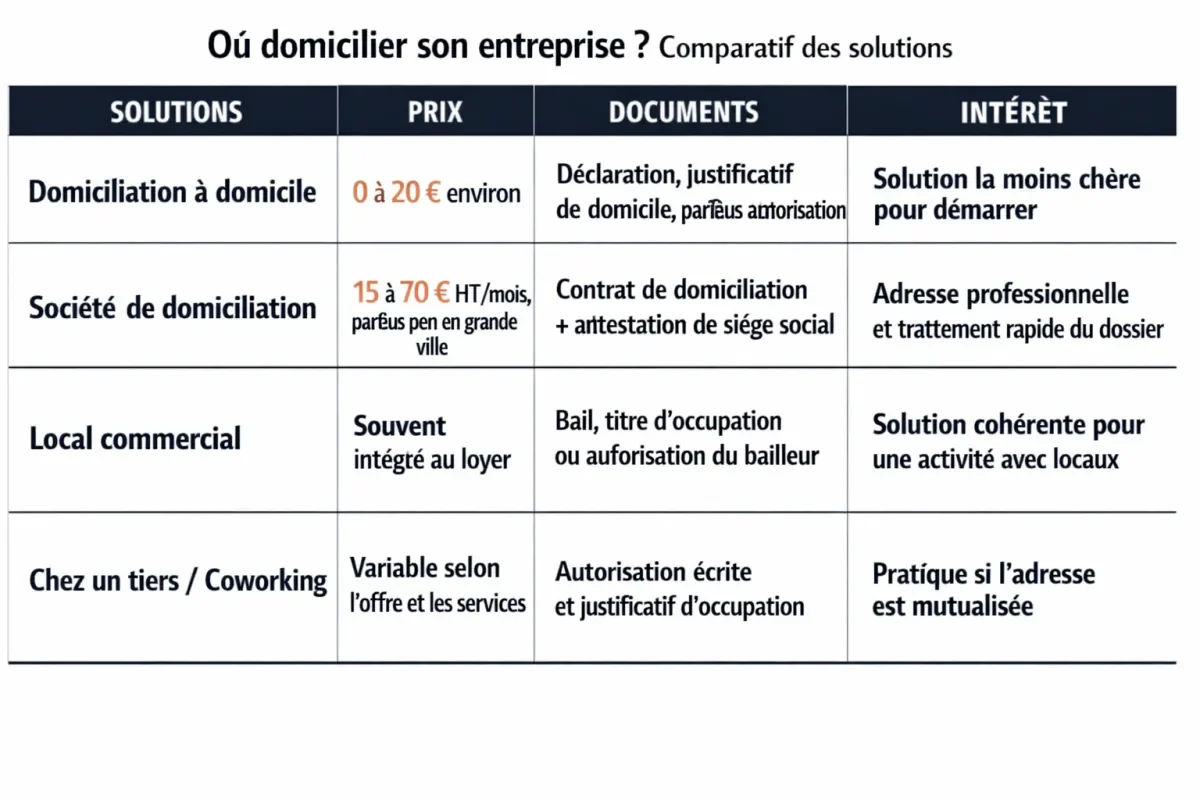
The price mainly depends on the chosen solution. At home, the cost can be zero excluding additional fees. Through a domiciliation company, it is most often expressed as a monthly fee. In a commercial premises, domiciliation is often included in the rent or lease. Additional services affect the final budget.
| Solution | Indicative price | Main document | Benefit |
|---|---|---|---|
| Home domiciliation | Approximately €0 to €20 | Declaration, proof of address, sometimes authorization | Cheapest solution to start |
| Domiciliation company | €15 to €70 excluding tax/month, sometimes more in large cities | Domiciliation contract + certificate of registered office | Professional address and quick processing of the file |
| Commercial premises | Often included in the rent | Lease, occupancy title or landlord’s authorization | Coherent solution for an activity with premises |
| At a third party / coworking | Variable depending on the offer and services | Written authorization and proof of occupancy | Convenient if the address is shared |
The differences come from three parameters: the city, the included services, and the level of formalization of the provider. A prestigious address, a mail forwarding service, access to a meeting room, or call management can quickly increase the price of commercial domiciliation. However, the certificate itself is often included in the basic offer.
Deadlines, validity and obligations to respect
When the file is complete, obtaining it can be very fast. With a provider, the document can be sent within 24 to 48 hours. At home, it all depends on the availability of the supporting documents. The validity period mainly varies according to the domiciliation contract or the duration of authorization given by the third party.
- check that the address remains correct after a move or transfer of headquarters;
- update the statutes if the registered office address changes;
- keep the contract and supporting documents related to the domiciliation;
- comply with any clauses of the lease, co-ownership regulations or service contract;
- quickly notify the relevant organizations in case of modification.
Common mistakes to avoid
File rejections often come from an avoidable detail. A poorly written address, an expired proof, a missing signature or a document not adapted to the mode of domiciliation are enough to block the registration. It is better to reread the entire file before submission, especially if the registered office is set at home or at a third party.
- confusing certificate, domiciliation contract and proof of address;
- providing an address incompatible with the lease or co-ownership;
- forgetting the signature of the manager or address lender;
- submitting a proof that is too old;
- neglecting the specific rules related to the company’s legal status.
FAQ on the commercial domiciliation certificate
Is it mandatory?
Not always in the same form, but proof of the registered office address is almost systematically required for registration or change of headquarters. What changes is the expected document: certificate, contract or proof of occupancy.
Can a company be domiciled at home?
Yes, in many cases, but you must check the lease conditions, co-ownership regulations and the nature of the activity. If a restriction exists, you must ensure that domiciliation remains authorized or choose another solution.
Which document replaces the certificate?
Depending on the case, a domiciliation contract, a commercial lease, a property title or a written authorization can serve this role. The important thing is that the administration can link the address to the right of occupancy or use of the place.
How long does it take to obtain it?
With a domiciliation company, the delay is often very short, sometimes within the day. At home or at a third party, it mainly depends on how quickly the supporting documents are gathered and validated.
Can you change your address after registration?
Yes, through a transfer of the registered office. You will then need to update the formalities and provide a new proof of commercial domicile adapted to the new address.
What you need to remember before submitting your file
The commercial domicile certificate is not just a formality: it is the document that links the company to its registered office and secures the submission of the file. The correct document always depends on the chosen domiciliation method. If you want to proceed quickly and avoid rejection, start with the address, check its compliance, then gather the appropriate supporting documents before registration.