
Does credit card travel insurance really cover the essentials?
Yes, but not always as much as you might think. A credit card can include medical assistance, medical repatriation, coverage of certain expenses abroad, and sometimes a trip or baggage cancellation guarantee. The problem is that these guarantees vary greatly depending on the bank, the card range, and the terms of use.
On paper, it seems comfortable. In practice, credit card guarantees are often designed as a safety net, not as an ultra-complete solution. The good practice is therefore to distinguish what falls under assistance — help, coverage, repatriation — and what falls under insurance — reimbursement of a claim afterward. This nuance changes everything when trouble strikes.
The most common guarantees
Here are the protections most often found in a Visa credit card travel insurance or Mastercard premium travel insurance:
- Medical assistance: guidance, telephone coverage, organization of care.
- Repatriation assistance: return to the country of origin if health requires it.
- Medical expenses abroad: reimbursement up to a limit, sometimes with deductible.
- Baggage: loss, theft, or delayed delivery, depending on the contract.
- Cancellation or interruption: often limited to certain reasons and certain cards.
- Liability abroad: damages caused to a third party outside the country of residence.
In practice, limits can range from a fairly modest level on a standard card to much higher amounts on a premium card. For medical expenses, the difference is sometimes huge: a standard card can remain very limited, whereas dedicated insurance more easily reaches several hundred thousand euros, or even more depending on the destination.
Conditions to be met
The point that most often traps travelers is the activation condition. In many contracts, the coverage only applies if the trip has been paid for fully or partially with the card. Other protections apply automatically as soon as the card is valid, but this depends on the contract. You also need to check the maximum duration of the stay, often limited to a few weeks or a few months.
Another detail that is not trivial: the beneficiaries. Depending on the cards, the spouse, dependent children, or grandchildren may be covered, but not always under the same conditions. And in case of a claim, you must notify the assistance or insurer within the specified deadlines, keep all supporting documents, and then follow the claim procedure. It is rarely the time to discover the fine print.
When does dedicated travel insurance become essential?
It quickly becomes essential as soon as the trip is longer, more expensive, or more exposed to risk. Dedicated travel insurance generally offers higher limits, clearer guarantees, and useful options for family, sports, long stays, or cancellation. In other words, it often provides more clarity and fewer unpleasant surprises.
The major difference is that dedicated insurance is designed for travel. It does not try to cover “a bit of everything” like a bank card; it structures its guarantees around the reality on the ground: illness, cancellation, interruption, baggage, legal assistance, sports activities, sometimes even annual travel or round-the-world trips. It changes the tune, especially when the stay has real financial value.
Main guarantees offered
- Enhanced medical coverage, with often higher limits.
- Broader trip cancellation coverage, according to the causes specified in the contract.
- Trip interruption and early return.
- Baggage: theft, loss, damage, delay.
- Sports extensions: skiing, diving, challenging hiking, depending on options.
- Long-stay plans: round-the-world, temporary expatriation, student mobility.
On the ground, this translates into coverage that is easier to understand. You know what is included, what is not, and up to what amount. It is often more comfortable than dissecting a 40-page bank card leaflet where you have to juggle between the issuer, the network, and the range. Joking aside, when a flight is canceled or a hospitalization occurs, it is better to have a clear contract than an administrative maze.
What are the biggest coverage differences between bank card and dedicated insurance?
The differences mainly lie in four areas: limits, duration, exclusions, and ease of triggering. A bank card can very well cover the essentials of a short trip, but dedicated insurance becomes more robust for high medical expenses, family trips, costly bookings, or destinations where healthcare is expensive.
| Criteria | Bank card travel insurance | Dedicated travel insurance |
|---|---|---|
| Trip reimbursement limit | Often limited, especially on standard cards; higher on premium cards. | Generally higher and better adjusted to the destination. |
| Travel insurance deductible | May exist depending on guarantees and networks. | More transparent, sometimes adjustable depending on the plan. |
| Repatriation assistance | Frequent, but with a precise contractual scope. | Almost always central, with more comprehensive coordination. |
| Trip cancellation coverage | Not systematic, often partial or conditional. | Often included or offered as a broader option. |
| Coverage duration | Sometimes limited to 30, 60, or 90 days depending on the contract. | Adapted to short, long, and multi-destination stays. |
| Family and companions | Variable, with beneficiaries defined by the card contract. | Easier to adjust for a couple, family, or group. |
| Specific activities | Often excluded or limited. | More frequent extensions for risky sports and leisure activities. |
The core of the problem quickly becomes clear: the bank card can be a good base, but it is not always suited for complicated scenarios. It reassures, it helps out, it cushions the blow. Dedicated insurance, on the other hand, handles expensive, long-lasting trips or those with a higher level of risk better.
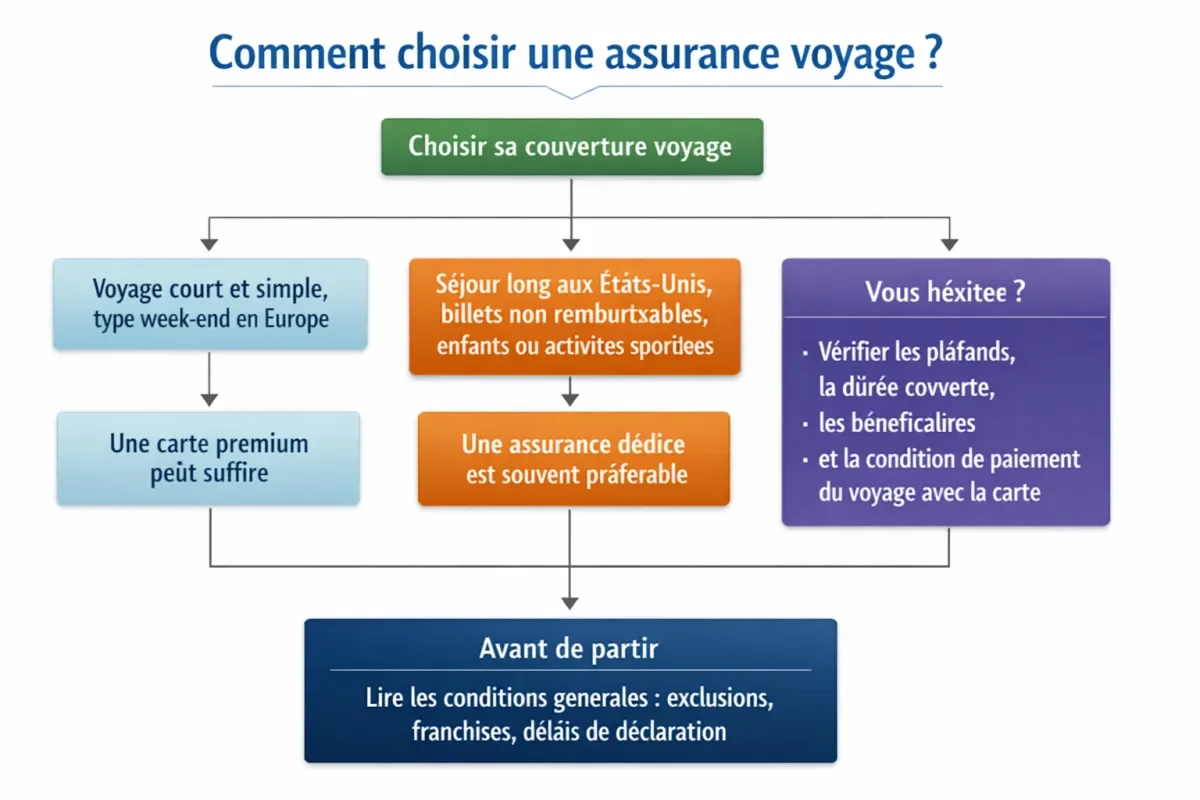
Cases where the bank card is sufficient
- Short, simple, and inexpensive trip.
- Stay in Europe with a limited budget.
- Premium card with clearly documented guarantees.
- Main need: basic assistance and repatriation.
- Tickets and accommodations with low financial commitment.
Cases where dedicated insurance is preferable
- Long trip or round-the-world journey.
- Destination with high medical costs, such as the United States or Canada.
- Family trip with several people to cover.
- Booking flights, hotels, cruises, or tours of high value.
- Practice of sports, risky activities, or a complex road trip.
How to check your coverage before departure?
The best way to avoid unpleasant surprises is to verify in black and white what your card covers and what the dedicated insurance you are comparing does not cover. You should not settle for a marketing summary: it is the general conditions, insurance notices, and guarantee tables that really matter.
The right method in 4 steps
- Identify the exact card: standard, premium, Visa, Mastercard, or other network.
- Check the limits: medical expenses, cancellation, baggage, civil liability.
- Control the exclusions: pre-existing illnesses, sports, excluded countries, maximum duration.
- Confirm the payment condition: trip paid with the card, total or partial according to the contract.
Then, compare with a dedicated international travel insurance for the same trip. Look at the cost, yes, but especially the quality of the protection. A difference of a few dozen euros can avoid thousands of euros in out-of-pocket expenses. It’s not glamorous, but it’s the kind of trade-off that lets you sleep well at night.
Which choice to make according to your traveler profile?
The right choice depends less on your “insurance sensitivity” than on your actual usage. A bank card may suit an occasional traveler who travels for a short time and books little in advance. Conversely, a family, a couple who books early, or a regular traveler will often benefit from choosing a clearer and more flexible dedicated travel insurance.
Occasional traveler
If you travel once or twice a year, for a short stay and without large non-refundable expenses, the bank card may suffice. Provided you know its limits and do not confuse assistance with insurance. If the card is premium, the level of protection can already be adequate for a simple trip.
Regular traveler
For frequent departures, the question quickly becomes one of the regularity of needs. An annual dedicated insurance can be more cost-effective and easier to manage than analyzing each bank card contract individually. Cherry on the cake, it avoids having to redo the same check before each flight.
Family, couple, or group
This is often where the bank card shows its limits. Dependents are not always covered in the same way, and the limit can quickly be insufficient if several people need assistance or if the trip is expensive. Dedicated insurance generally allows a clearer view of who is protected and to what extent.
Long stay, expatriation, or round-the-world trip
For a long stay, the bank card looks more like a crutch than a real solution. The maximum covered duration, exclusions, and medical limits become too tight. A specialized plan is then often preferable, especially if you change countries, practice specific activities, or travel outside Europe.
What mistakes should absolutely be avoided?
The number one trap is to believe that all cards have the same guarantees. False. The number two trap is to think that assistance equals full reimbursement. Also false. And the third, very classic, is to buy insurance blindly without checking the exclusions that can ruin the coverage.
- Forgetting to read the insurance notice before departure.
- Not checking if the trip must be paid with the card.
- Ignoring the maximum covered stay duration.
- Underestimating medical or sports exclusions.
- Waiting for the claim to discover the declaration procedure.
One piece of feedback often heard from travelers: reading the contract is tedious, but it prevents disappointments. Those who have already filed a claim know this well: the supporting documents, deadlines, forms, and exchanges with assistance can quickly become time-consuming. In other words, preparation is almost as important as the coverage itself.
FAQ on credit card travel insurance and dedicated insurance
Does my credit card automatically cover my trips?
Not always. Some guarantees apply automatically if the card is valid, but others require that the trip was paid for with the card, either fully or partially. You therefore need to read the exact contract to know what is actually covered.
Do I have to pay for the trip with the card to be insured?
Often yes for insurance guarantees, but not systematically for assistance. The condition varies depending on the bank, network, and card. The only reliable reflex is to check the general conditions before booking.
Does a premium card replace dedicated travel insurance?
Sometimes for a simple short stay, but not in all cases. A premium card often offers better guarantees than a standard card, without equaling dedicated insurance in terms of limits, options, and contract clarity.
Are children or the spouse covered?
Often, but under specific conditions: family relationship, age, economic dependence, traveling together or not. The beneficiaries vary from one card to another, so it is better to check in black and white who is included.
Does credit card insurance cover cancellation?
Sometimes, but rarely as broadly as dedicated insurance. The trip cancellation guarantee on credit cards mainly exists on certain ranges, with limited reasons and tighter limits. For an expensive trip, dedicated coverage often remains more robust.
In the end, which solution to choose?
If your trip is short, simple, and inexpensive, a good credit card can offer a decent base, especially premium cards. However, as soon as the stay becomes long, expensive, family-oriented, or exposed to significant medical risk, dedicated travel insurance clearly takes the advantage thanks to its clearer limits, options, and flexibility.
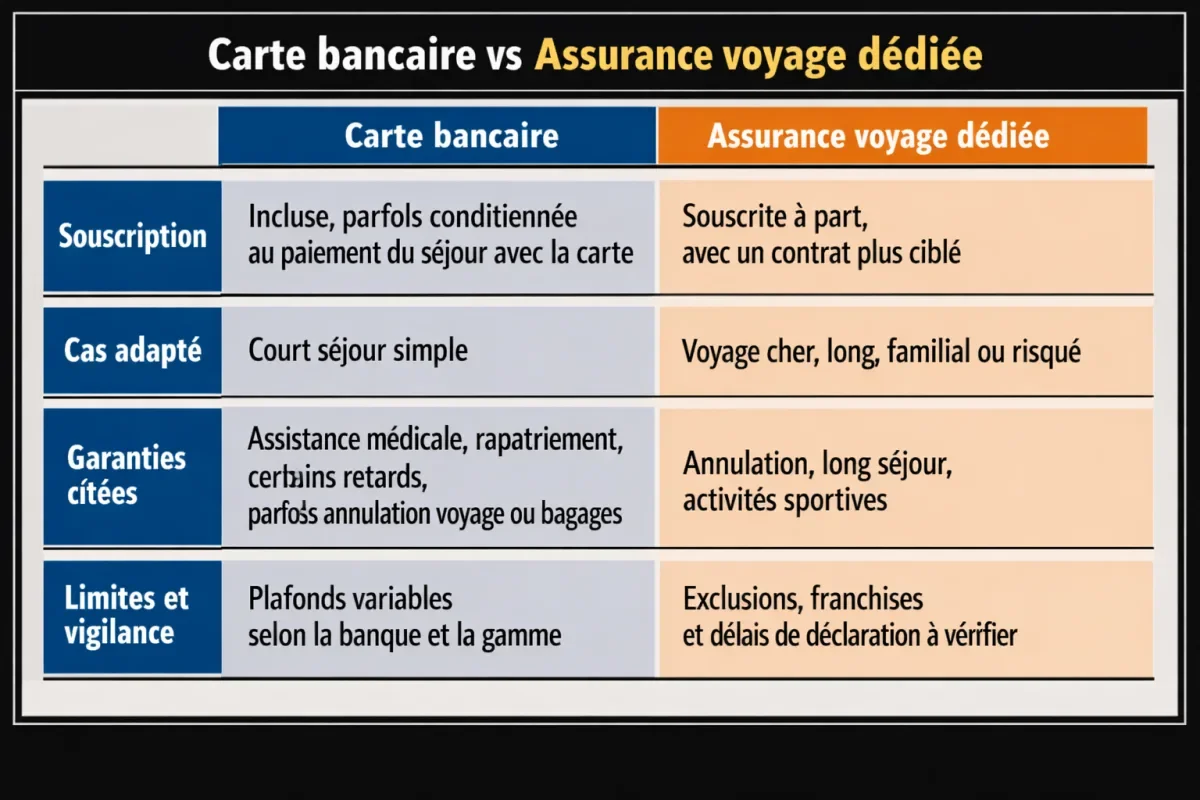
The right choice is therefore not “card or insurance” as a principle, but “what level of protection for which trip.” Checking the limits, exclusions, and triggering conditions before departure remains the most cost-effective reflex. This is where the difference between useful coverage and a nice but overly optimistic promise is very concretely played out.