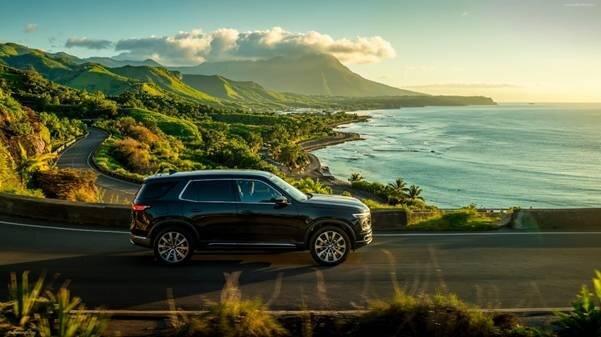
Réunion Island, nicknamed the intense island, reveals its most precious treasures to those who take the time to explore it by car. This pearl of the Indian Ocean offers an extraordinary diversity of landscapes concentrated on barely 2,500 km². From volcanic peaks to turquoise lagoons, from majestic cirques to dizzying waterfalls, every kilometer traveled unveils a new wonder. Renting a car in Réunion proves essential to discover the true soul of this exceptional island.
Sommaire
The Piton de la Fournaise, an accessible fire giant
In the heart of Réunion National Park, the Piton de la Fournaise asserts its majestic presence. This active volcano, one of the most active in the world, fascinates with its lunar landscapes and lava flows frozen in time. Access by car up to the Pas de Bellecombe allows admiring the Dolomieu crater without any particular effort.
The forest road of the volcano, from Bourg-Murat, winds through changing landscapes where tropical vegetation gradually gives way to mineral expanses. This 27-kilometer ascent reveals breathtaking panoramas over the plains and coasts. Once at the summit, the grand spectacle of the Enclos Fouqué unfolds before visitors, a striking testimony to the island’s telluric power.
The Maïdo viewpoint, balcony on infinity
Perched at 2,200 meters altitude, the Maïdo peak is one of the most spectacular viewpoints of Réunion. This car excursion from Saint-Paul, via Le Guillaume, rewards early risers with an exceptional panorama over the Mafate cirque and surrounding peaks.
The winding forest road leading to the viewpoint crosses the tamarind forests of the Hauts, already offering magnificent glimpses of the valleys below. At the summit, the vastness of the Mafate cirque unfolds, revealing its isolated islets and sharp peaks. Sunrises from this natural promontory rank among the island’s most memorable experiences.
The lava road, living volcanic memory
National Road 2, between Sainte-Rose and Saint-Philippe, bears the evocative name of the lava road. This 32-kilometer stretch crosses the Grand Brûlé, a region shaped by successive flows from the Piton de la Fournaise.
The route reveals the island’s recent geological history through striking landscapes where black volcanic rock contrasts with turquoise ocean. The 2007 lava flows cut the road in two, creating a unique landscape where nature is gradually reclaiming its rights. Informative panels line the itinerary, allowing understanding of the volcanic phenomena that sculpted these lands.
The cirques of Cilaos and Salazie, green jewels
The Cilaos cirque, accessible by the famous road with 400 bends, is a must-see for any visitor to Réunion. This national tourist road 5, recognized among the island’s most beautiful, winds through a deep valley bordered by vertical cliffs.
The village of Cilaos, nestled in the heart of the cirque, charms with its authenticity and renowned thermal baths. Panorama lovers can continue to the Roche Merveilleuse viewpoint, accessible by car via the Bras Sec road, to admire a plunging view over the entire cirque.
After the discovery of Cilaos, the Salazie cirque stands out for its lush vegetation and spectacular waterfalls. The road leading from Saint-André gradually reveals the charms of this green valley. Hell-Bourg, ranked among the most beautiful villages in France, is a must-visit stop with its authentic Creole houses and preserved colonial architecture.
The beaches of the west, an accessible tropical paradise
The west coast of La Réunion concentrates the island’s most beautiful beaches, all easily accessible by car. Saint-Gilles-les-Bains and l’Hermitage offer lagoons protected by the coral reef, ideal for swimming and discovering the underwater world.
The beach of l’Hermitage, with its white sand and crystal-clear waters, is a haven of peace for families. The parking lot located 50 meters from the beach facilitates access to this little tropical paradise. Further south, the beach of Saline-les-Bains extends this idyllic setting over several kilometers.
Saint-Denis, cultural and historical capital
Saint-Denis, the administrative capital of La Réunion, deserves an in-depth exploration for its cultural and historical riches. The city center is easily discovered by car, with many parking lots allowing to explore on foot the emblematic neighborhoods.
The Jardin de l’État, the green lung of the capital, regularly hosts the péi market, a showcase of local production and Réunionnais craftsmanship. This authentic market allows discovering the island’s traditional flavors and know-how in an exceptional historical setting. Rue de Paris, the main artery, reveals remarkable colonial architecture with its historic buildings and preserved Creole houses.
The Langevin waterfalls, a grand aquatic spectacle
The Grand Galet waterfall, also called Langevin waterfall, is among the most photogenic on the island. Located in the wild south, it consists of multiple waterfalls spreading over a wide rocky wall, creating a striking aquatic spectacle.
Access by car is from Saint-Joseph via the D33 road, a winding route rewarded by breathtaking views of the Langevin river. A small parking lot allows parking before a short 200-meter walk down to reach the foot of the waterfall. The natural pools invite swimming in fresh and pure water.
Saint-Pierre, beating heart of the south
Saint-Pierre, the island’s second city, captivates with its dynamism and remarkable architectural heritage. The Saturday morning open-air market, set up on the seafront, is one of the main attractions of this southern city.
The covered market, a metal hall dating from 1876, testifies to the city’s rich commercial past. This 19th-century industrial architecture offers an authentic setting to discover local products. The beach of Saint-Pierre, with its black volcanic sand, offers a striking contrast with the white sandy beaches of the west.
Kélonia and the west coast, between land and sea
The Kélonia marine turtle observatory, located in Saint-Leu, is an essential stop to understand La Réunion’s marine richness. This care and awareness center allows observing these exceptional marine reptiles in a remarkable educational setting.
The municipality of Saint-Leu also offers magnificent coastal panoramas and is the ideal starting point to explore the leeward coast. Thrill-seekers will appreciate the paragliding spots that have earned this region international renown.
Cap Méchant, the raw power of the ocean
In the wild south, Cap Méchant reveals the most untamed side of La Réunion. This rocky promontory, located in Saint-Philippe, offers a magnificent spectacle where waves crash against the basalt cliffs.
The site owes its name to the perilous navigation conditions that long frightened sailors. Today, this jagged coast fascinates visitors with its raw beauty and preserved wild character. The rock formations sculpted by marine erosion create a landscape of striking power.
La Réunion thus proves to be an exceptional destination for car enthusiasts. Every road tells a story, every turn reveals a new landscape, every kilometer enriches the traveler’s experience. This intense island fully deserves its nickname as it concentrates natural and cultural wonders in a limited area. To fully enjoy these treasures, nothing beats the freedom provided by exploring by car, allowing stops at will and savoring every moment of this unique tropical adventure.