Introduction
In an era where chronic stress and environmental imbalances are redefining our relationship with health, adaptogenic mushrooms are emerging as valuable allies. These organisms, capable of increasing the body’s nonspecific resistance to aggressions, are rooted in an ancient tradition – from Ayurvedic medicine to Siberian practices – while embracing contemporary challenges. In France, from the humid forests of the Jura to the Provençal moors, an unsuspected mycoflora offers therapeutic treasures. But their discovery requires as much scientific rigor as ecological respect. This article offers a detailed mapping of these extraordinary fungi, exploring their habitats, virtues, and the essential precautions to integrate them into an enlightened wellness approach.
1. The Forest Sentinels: Five Adaptogens Under the Microscope
Reishi (Ganoderma lucidum): The Alchemist of Old Oaks
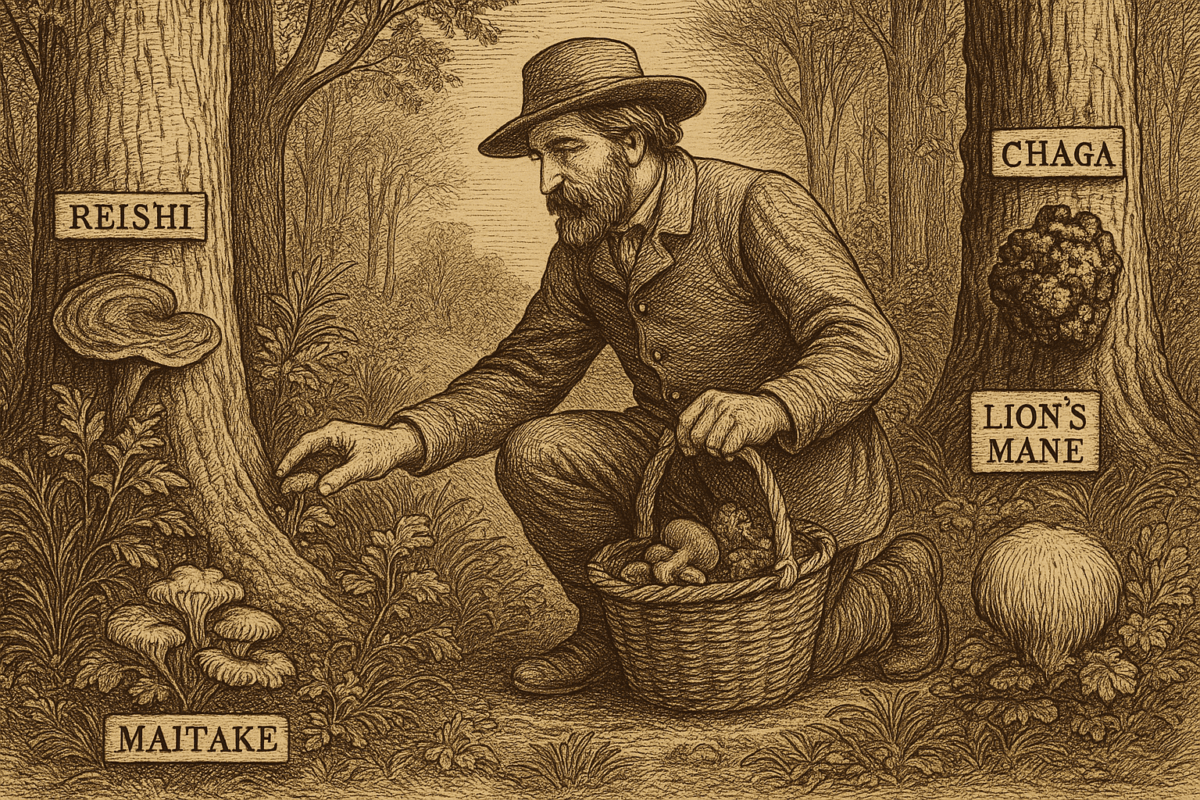
Called “lingzhi” in China where it symbolizes longevity, this polypore with a varnished cap colonizes stumps and dying trunks of deciduous trees. Its polysaccharides (ganoderans) and bitter triterpenes act synergistically to regulate immunity and reduce neurogenic inflammation. A study by INRAE (2021) confirmed its hepatoprotective potential against environmental toxins. In France, its sparse populations are concentrated in the ancient beech-oak forests of Périgord, Morvan, and Cévennes, where it fruits from summer to autumn. Its natural rarity explains the development of wood-flax substrate cultivation, notably in Brittany and Occitania.
Lion’s Mane (Hericium erinaceus): The Sculptor of Synapses
Recognizable by its ice-needle-like outgrowths, this saprophytic mushroom nests in the cavities of century-old beeches. Its hericenones stimulate the synthesis of NGF (Nerve Growth Factor), promoting neurogenesis – a property studied in the management of mild cognitive impairments. The rare French sites, located in the biological reserves of the Vosges and Pyrénées-Atlantiques, see its autumn fruiting between September and November. Its vulnerable status in the Red Book of threatened mushrooms requires sparing harvesting, reserved for experienced mycologists.
Chaga (Inonotus obliquus): The Nordic Paradox
This blackish conk, resembling a carbonized outgrowth, exclusively parasitizes weakened birches in wet areas. Its record concentration of superoxide dismutase (SOD) – up to 50 times higher than that of mate – makes it a shield against oxidative stress induced by urban pollution. Present in Normandy, Savoie, and the Ardennes, it can theoretically be harvested year-round. But its wild collection poses an ethical dilemma: each harvest accelerates the death of the host tree. Hence the growing interest in extracts derived from mycelium cultivated in bioreactors, as offered by the Quebec mycological sector.
Cordyceps militaris: The Energizer of the Alpine Pastures
Unlike the Himalayan Cordyceps sinensis – a caterpillar parasite that has become prohibitively expensive – its European version colonizes the larvae of nocturnal moths in high-altitude meadows. Its cordycepin and adenosine boost mitochondrial ATP production, increasing aerobic endurance. Experienced gatherers track it between July and October in the summer pastures of Alpes-de-Haute-Provence, Pyrénées-Orientales, and Cantal, where its bright orange stromata emerge from rocky soils. Its rarity and the complexity of its biological cycle explain why 98% of marketed supplements come from cultures in sterile environments.
Maitake (Grifola frondosa): the metabolic manager
Nicknamed “dancer” in Japan for its overlapping gills resembling feathers, this grayish polypore forms monumental rosettes at the base of senescent oaks. Its specific beta-glucans (grifolan) activate macrophage TLR receptors, modulating both the immune response and glucose homeostasis. The Limousin and Auvergne forests still harbor wild specimens, harvested in autumn by a few initiates. Facing the decline of its habitats, producers in Lot-et-Garonne have developed a culture on lignin-enriched logs, thus preserving forest strains.
2. Geolocation of adaptogens: a heritage to preserve
| Mushroom | Regions | Season | Biotope |
|---|---|---|---|
| Reishi | Périgord, Morvan, Cévennes | June to November | Decaying oak/beech stumps |
| Lion’s mane | Vosges, Pyrénées-Atlantiques | September to November | Cavities of living beeches >80 years old |
| Chaga | Normandy, Savoie, Ardennes | All year round | Humid birch groves (alt. <1000m) |
| Cordyceps | Alpes-de-Haute-Provence, Cantal | July to October | Alpine grasslands (800-2200m) |
| Maitake | Limousin, Auvergne | September to November | Edges of ancient oak woods |
This table summarizes data from the MycoDB and OFB observatories. Note that these distributions, already fragmented, are affected by climate disruption – chaga has shown a 7% annual decline in the Northeast since 2015.
3. Gathering vs cultivation: towards responsible mycotherapy
The enthusiasm for wild adaptogens paradoxically threatens these fragile ecosystems. In Burgundy, cases of reishi poaching led to prefectural decrees in 2022 limiting harvesting to 100g/day/person. Beyond legal aspects, the toxicological risk remains significant: Ganoderma lucidum can accumulate heavy metals in polluted sites, while false chaga (Phellinus igniarius) causes acute hepatitis. Meanwhile, advances in mushroom cultivation offer sustainable alternatives. Start-ups like Mycélium France produce lion’s mane on urban coffee grounds, achieving yields of 15kg/m² without pesticides. For purists, self-production kits (see Champizen) allow cultivation of certified strains on balconies. This circular approach, combined with short supply chains, embodies the ethical future of mycotherapy.
4. Resources for enlightened exploration
Diving into the world of adaptogens requires reliable sources that combine empirical knowledge and scientific validation. The Food Factor portal deciphers the interactions between fungal strains and the gut microbiota, with detailed protocols for seasonal treatments. The naturopaths of Dietetical offer personalized online consultations, including little-known contraindications (such as the immunostimulant effect discouraged in autoimmune diseases). Finally, the collaborative platform Champizen combines the sale of home cultures and participatory science, inviting citizens to map wild stations to better protect them.
5. FAQ: Key Questions About French Adaptogens
➤ Can these mushrooms be consumed directly after picking?
Most adaptogens require processing to activate their active ingredients. Reishi, tough and bitter, is consumed exclusively as a decoction (30 minutes of boiling) or in the form of freeze-dried powder. Chaga, rich in chitin, requires prolonged hot water extraction (4 to 8 hours at 70°C) to release its polysaccharides. Only maitake can be cooked fresh – provided it is partially dried beforehand to concentrate its ergosterol derivatives. Warning: improper preparation can reduce their bioavailability by up to 90%.
➤ Are there risks of confusion with toxic species?
Yes, especially for cordyceps and lion’s mane. Cordyceps militaris can be confused with Cordyceps ophioglossoides, a truffle parasite that shares its habitat and causes gastrointestinal disorders. Lion’s mane resembles Hericium coralloides, which is edible but lacks adaptogenic properties. As for chaga, its unique appearance limits risks, but impostors like Piptoporus betulinus (also found on birch) can mislead. The golden rule: never consume without validation by a certified mycologist.
➤ Is picking regulated in France?
The law sets a national framework (art. L. 412-5 of the Forestry Code) allowing picking for family use within the limit of 5 kg/person/day. But nature reserves (25% of reishi stations) prohibit it entirely. Some departments like Savoie or Hautes-Pyrénées impose specific quotas for chaga (max 200g/day). Reminder: selling wild mushrooms without a license is punishable by 2 years imprisonment and a €150,000 fine.
➤ Are pharmacy supplements as effective as the raw product?
Standardized extracts (such as β-D-glucans titrated at 30%) offer optimal concentration, especially for reishi and maitake. A comparative study from the University of Strasbourg (2023) shows that alcoholic mother tinctures preserve 78% of triterpenes compared to 45% in homemade decoctions. However, some low-cost products use grain mycelium – less active than the fruiting body. Favor labels “Full Spectrum” or “Fruiting Body Extract.”
➤ How to reconcile therapeutic use and ecological preservation?
Adopt the 3R rule: Reasoned Harvesting (removal ≤10% of a colony), Replanting (inoculation of strains on dead substrates with kits like those from Champizen), Responsibility (participate in citizen science programs on MycoCitoyen.fr). Indoor cultures on coffee grounds or agricultural waste reduce pressure on wild populations by 80%.
Conclusion
Between the lines of this guide lies an essential truth: adaptogenic mushrooms are neither panaceas nor inexhaustible resources. Their complex molecules interact with our physiology just as they engage with forest ecosystems – networked, with subtlety. Using them therefore requires as much humility as curiosity: respecting dosages, supporting sustainable supply chains, protecting threatened habitats. And what if their true power lay in this ability to reconnect us, spore by spore, to the living world that sustains us? 🌍🍄