In brief
🚗 The best price is not necessarily the lowest: you need to look at the deductible, the exclusions, and the included assistance before signing.
🧾 The rate mainly varies with the bonus-malus, the type of vehicle, parking location, and the number of kilometers driven each year.
📉 Some introductory contracts start at very low levels, but a too tight plan can cost a lot at the first mishap. The right reflex is to compare with equal coverage.
🔎 The profiles that benefit most from optimizing their contract are often low-mileage drivers, drivers with bonuses, and owners of older vehicles.
How to find the best price car insurance without cutting coverage?
The right reflex is to compare equivalent offers before looking at the rate. Insurance may seem cheaper because it reduces the displayed deductible, assistance, loaner vehicle, or driver protection. In other words, you need to judge the contract as a whole, not just its monthly price.
The real good deal is not the cheapest contract, but the one that balances premium, deductible, and useful coverage. To aim for the best price, first compare your profile, then the levels of protection, exclusions, and options that quickly increase the bill.
The car insurance market is very sensitive to profile. With the same vehicle, a driver with a bonus, secured parking, and low mileage will often pay much less than a young driver in the city. That’s why a quote only makes sense if the same uses, the same drivers, and the same level of protection are provided.
What criteria really affect the price of car insurance?
The price depends on a handful of very concrete criteria: your driving history, the vehicle, actual usage, and where the car is parked at night. The bonus-malus plays a major role, but power, value, and repair costs also weigh heavily. It is this mix that explains sometimes spectacular price differences.
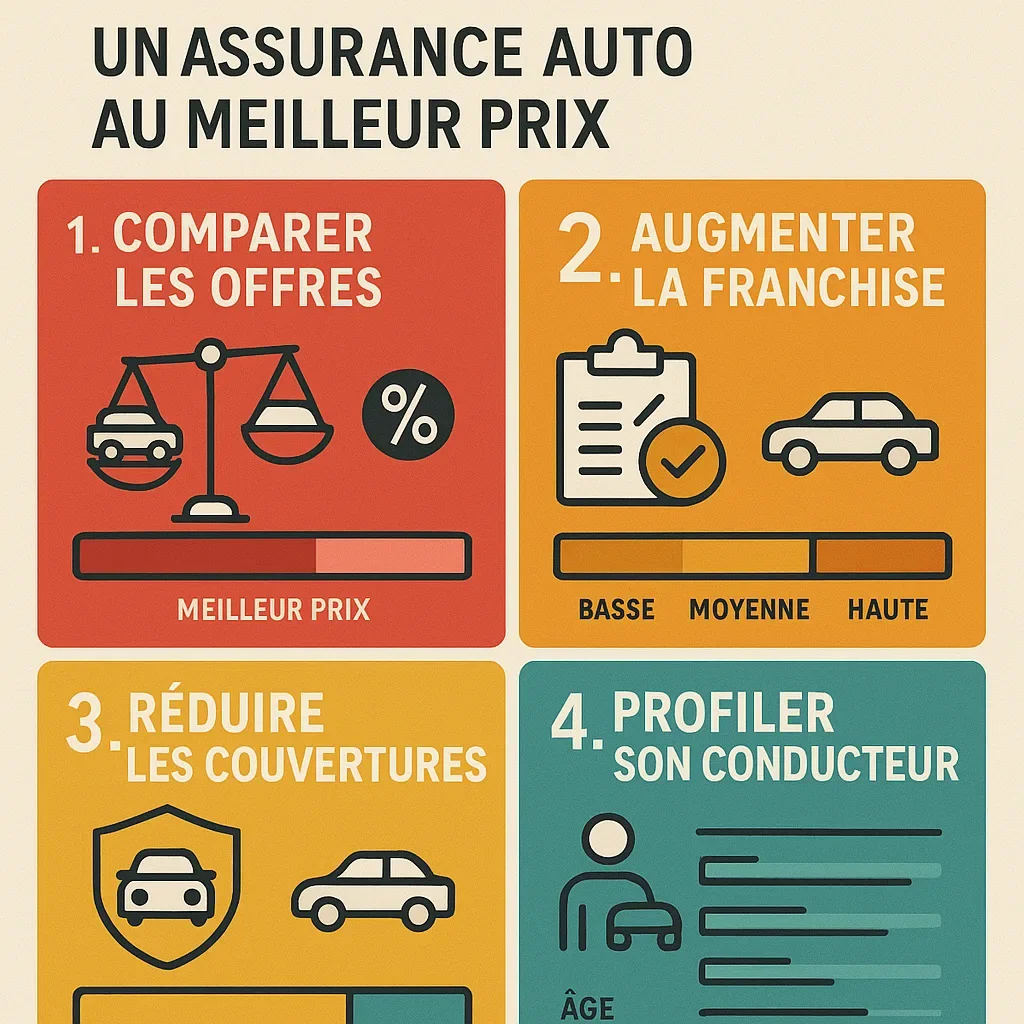
In practice, five levers always come up in quotes:
- The bonus-malus, which rewards or penalizes your history.
- Parking, whether closed or not, in the city center or in a quieter area.
- Annual mileage, especially if you drive little.
- The value of the vehicle and its repair cost.
- Declared drivers, especially young or secondary drivers.
According to INSEE, the car remains a central equipment for a large part of households, which also explains the commercial pressure on prices and the formulas offered. To keep control, it is better to start from actual usage and not a vague estimate, otherwise the quote will be nice… but unreliable.
Which formula to choose according to your driver profile?
The best formula is not the same for everyone. A low-mileage driver with a car over eight years old does not have the same needs as a driver financing a recent vehicle or a young license holder. The right choice is made between third-party, third-party+ and comprehensive, depending on the value of the vehicle and the level of risk accepted.
The most useful remains to cross the profile with actual usage. An old car that is mainly kept for daily trips often supports lighter coverage. Conversely, a new vehicle, still under credit or leasing, generally deserves broader protection, because the cost of a claim can quickly exceed the savings made annually.
| Profile | Often the most coherent formula | Point of attention |
|---|---|---|
| Young driver | Third-party + targeted options | Deductible, assistance, secondary driver |
| Low-mileage driver | Third-party or mileage-based third-party | Annual mileage threshold and excess |
| Old vehicle | Simple third-party | Actual replacement value of the vehicle |
| New or financed vehicle | Comprehensive | Theft, glass breakage, all accident damage |
| Driver with high bonus | Third-party+ or comprehensive depending on the vehicle | Ratio between premium and protected value |
Some guidelines help to decide. Third-party offers often remain the cheapest, while comprehensive formulas are logically more expensive but better protect recent vehicles. Between the two, third-party+ can be an excellent compromise if the contract includes theft, fire, and glass breakage without blowing up the bill.
How to compare offers to pay less without unpleasant surprises?
Always compare three things at the same time: the total price, the deductible, and the exact content of the coverage. A slightly more expensive offer by a few euros can become worthwhile if it avoids a too high deductible or too limited protection. The useful comparison is therefore not that of advertisements, but that of contracts line by line.
At this stage, comparison tools are useful, but only if you keep control over the parameters. If you change the mileage, parking location, or declared drivers, the quote can suddenly collapse or inflate. The goal is to simulate your real situation, not an “optimized” version that doesn’t hold up.
- Check the deductibles for glass breakage, theft, and damages.
- Read the exclusions on trips, parking, and transported items.
- Check the assistance: 0 km, 25 km, or only on highways, it’s not the same.
- Look at the loaner vehicle, often limited in time or absent on small contracts.
- Examine the renewal increase, because an introductory price can rise quickly after one year.
It is also useful to distinguish the starting price from the cost over time. Several online insurers display attractive introductory rates, such as MAAF, AXA, Generali, or Ornikar, but the real question remains: what do you pay in total if an incident occurs?
What concrete levers allow you to lower the bill?
You can often lower the premium without tinkering with the contract. The most effective way is to act on what the insurer considers as risk: mileage, parking, declared driver, deductible, chosen formula, and level of coverage. Marginally, annual payment can also be slightly more advantageous than monthly payment, depending on the companies.
On the ground, an agent from a broker network in the Lyon region observes that differences often come from trivial details: parking in a garage, annual mileage, and secondary driver. Two almost identical files can show a difference of several tens of euros per month.
The most concrete levers are often the following:
- Declare a realistic mileage if you drive little, or even choose a mileage-based formula.
- Avoid unnecessary options if your car is worth little or is parked in a closed place.
- Slightly increase the deductible to reduce the annual premium, provided you can bear this out-of-pocket expense.
- Limit declared drivers to the uses that are actually necessary.
- Choose a formula adapted to the vehicle’s value, not just its age.
- Compare every year before renewal, because the rate can change even if the need does not.
For low-mileage drivers, ADEME’s advice on eco-driving and reducing trips can also help stay below an interesting mileage threshold. It’s not magic, but on an adapted formula, a few thousand fewer kilometers can be enough to move the bill.
Is the cheapest contract really the best choice?
Not necessarily, and this is where many people go wrong. A very cheap contract may hide a high deductible, limited assistance, or annoying exclusions when you actually need them. The best contract is the one that properly protects you without making you pay for coverage that is useless for your usage.
The best price is never just a simple displayed number. It is the price you still find acceptable on the day you really have to file a claim.
To avoid a false good deal, ask yourself three simple questions: what happens in case of glass breakage, theft, or at-fault accident? How much will remain your responsibility? And if you change cars in two years, will the contract follow without trapping you? This is often where the difference between a good deal and superficial savings lies.
The most classic case is the ultra-competitive third-party contract for an old car. Very well. But if the vehicle is still financed, or if you drive a lot in the city, these savings may be too small to offset the real risk. Conversely, a comprehensive insurance on an old model can cost more than it protects.
Frequently asked questions about the best price car insurance
When is the right time to compare car insurance?
The easiest is to compare before the annual renewal, then at every change of situation: moving, new vehicle, reduced mileage, or adding a driver. This is often when differences become visible, especially if your bonus has increased.
Is third-party insurance enough to save money?
Yes, sometimes, but only if the car has limited value or if you accept not being compensated for your own damages. For an old vehicle, this can be consistent. For a recent car, the “low price” can become very expensive in case of a claim.
Does monthly payment cost more than annual payment?
Often, yes. Insurers may apply splitting fees or a slightly higher overall cost when the premium is spread out. It’s not huge each time, but over a year, the difference can be enough to cancel out a small initial saving.
Can you reduce your premium without changing insurer?
Yes, by reviewing the declared mileage, the deductible, or some options that have become unnecessary. A simple contract adjustment can lower the bill without starting over. That said, you need to check that the modification does not deprive you of useful protection.
Do young drivers necessarily have the highest rates?
They generally pay more because the insurer considers the statistical risk higher. But the price varies greatly depending on the car, the parking location, and the chosen coverage. A small well-insured model can remain more affordable than a poorly calibrated contract on an overly powerful car.
Why can two very close quotes hide a real difference?
Because a quote is also read in its fine print: assistance, deductible, exclusions, loaner vehicle, glass breakage, theft, transported contents. Two offers a few euros apart may actually not cover the same things at all. This is where the comparison becomes serious.