Highway Fast Charging Stations in France: The Updated Map to Find the Best Rest Areas and Plan Your Trips
| 📌 | Definition: a fast charging station on the highway generally delivers direct current starting from 50 kW, with ultra-fast stations often reaching 150 kW, 300 kW or more depending on the site and vehicle. |
| 💡 | Key advantage: over a long distance, a 15 to 30 minute break is often enough to regain useful range and maintain a good travel pace. |
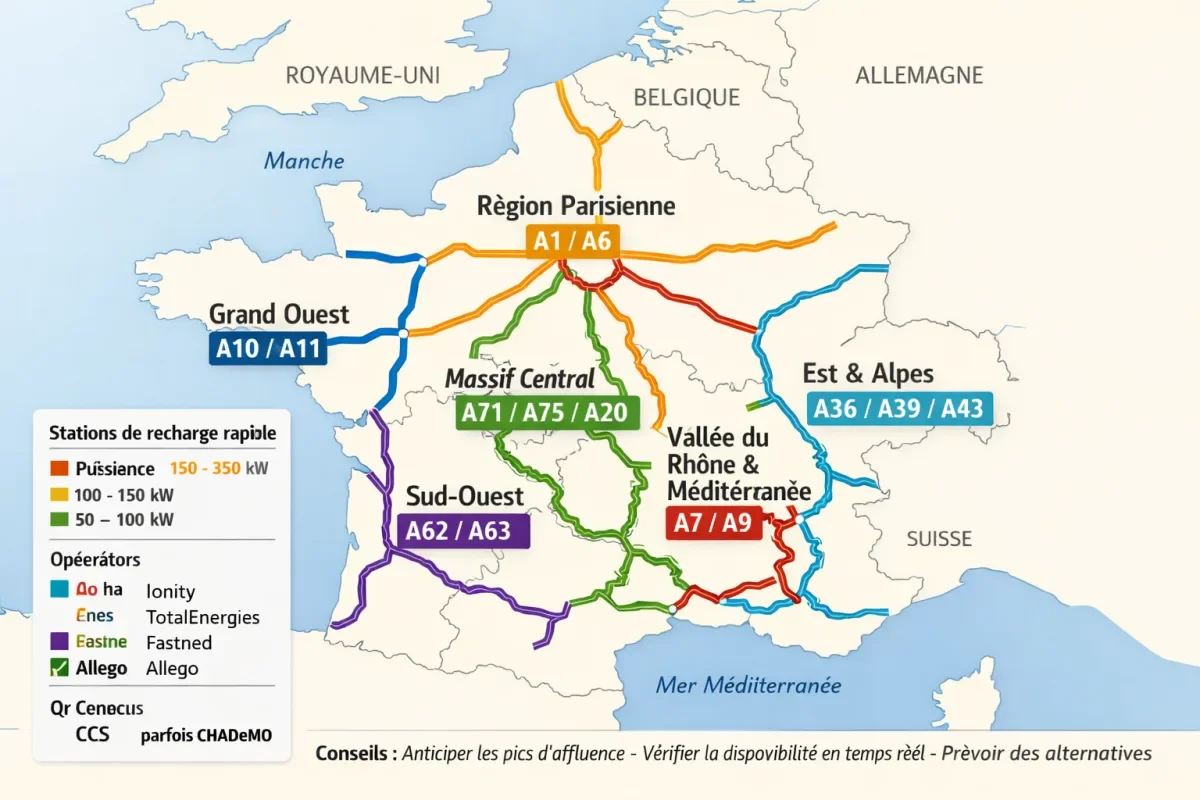
| 🧭 | Routes to watch: A1, A6, A7, A9, A10, A11, A71, A75, A20, A62, A63, A36, A39, and A43 concentrate the majority of long-distance needs. |
| 🔌 | Connectors: the CCS connector largely dominates, while CHAdeMO is becoming rarer and Type 2 mainly concerns slower AC charging. |
| 💳 | Payment: credit card, app, or RFID badge; highway charging prices vary greatly depending on the operator, subscription, and chosen power. |
| 🗓️ | Update: the data below is intended for trip preparation but should always be cross-checked with the actual station status at departure time. |
Over a long distance, the real question is not just finding a charging station, but finding the right station, at the right place, at the right time. A map of highway fast charging stations should therefore be read as a decision-making tool: available power, compatible connector, operator, 24/7 accessibility, and risk of congestion. It is this combination of factors that allows for stress-free electric car travel.
Fast charging on highways follows a simple logic: reduce stop time without multiplying detours. For a Paris-Lyon, Paris-Marseille, or Bordeaux-Paris trip, the goal is not to charge to 100%, but to recover just enough energy to reach the next stop with a comfortable margin. Updated in April 2026, this guide is based on observed practices on major French routes and on references provided by charging networks and public sector sources.
Sommaire
What is a fast charging station on the highway?
A fast charging station on the highway is a direct current station capable of delivering high power, generally starting from 50 kW, with ultra-fast stations often exceeding 150 kW. On highways, it primarily serves to turn a logistical break into a useful break: eat, rest, and regain range during the same stop.
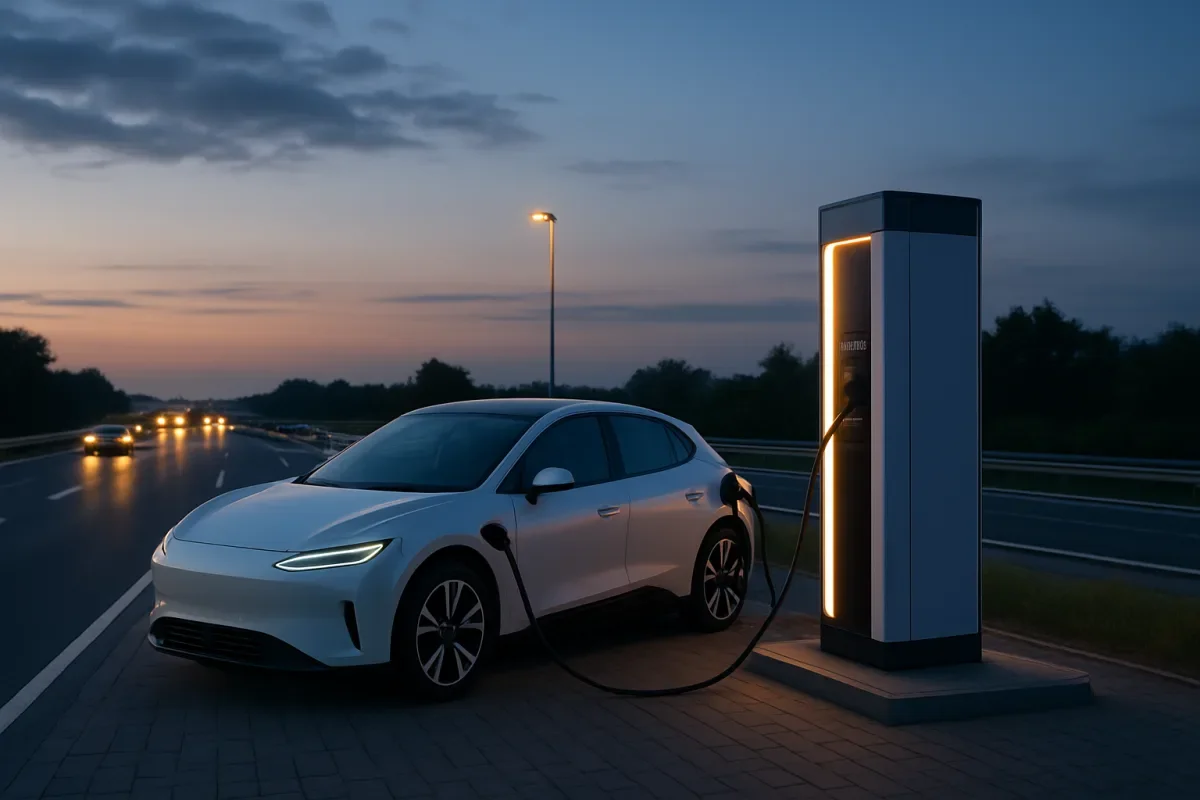
The difference between fast, accelerated, and ultra-fast charging mainly lies in power, but also in the type of current. In alternating current, the car’s onboard charger often limits the actual speed; in direct current, the station feeds the battery directly, allowing much faster charging. This is why highway rest areas now focus on DC, especially for long trips.
Standards and connectors to know
On highways, the most important standard to check is CCS. It equips the vast majority of vehicles compatible with fast charging in Europe. CHAdeMO persists on some older models but is clearly declining. Type 2 remains useful for AC stations, less common on long-distance routes. In practice, compatibility depends as much on the car as on the station: nominal power, protocol, thermal limit, and battery size all play a role.
- CCS: the most common on fast and ultra-fast highway charging stations.
- CHAdeMO: still present on some vehicles, but much less widespread.
- Type 2: mostly reserved for AC points, often less suitable for highway transit.
- Direct current: essential to enjoy a true fast electric car charging.
How to read a map of fast charging stations on the highway?
Proper reading of a map does not consist of spotting only one pictogram. You need to cross-reference four levels: the highway, the rest area, the power, and the operator. A useful map also displays the available connectors, 24/7 access, payment method, and, if possible, real-time status. Without this information, you are not really preparing a trip; you are just guessing.
On major French routes, the most structured zones are generally located around major traffic nodes and interregional connections. Corridors A1 and A6 remain very busy, as do A7 and A9 heading south, A10 and A11 towards the west, as well as A71, A75, and A20 for crossings through the center. The routes A62, A63, A36, A39, and A43 complete the itineraries towards the southwest, east, and the Alps. The most frequent operators are Ionity, TotalEnergies, Fastned, Allego, as well as stations integrated into the networks of concessionaires such as APRR, VINCI Autoroutes, and Sanef.
| Highway / route | Areas or zones to target | Commonly observed power | Frequent operators | Connectors | Practical advice |
|---|---|---|---|---|---|
| A1 / A6 | Major hubs around Paris and the first big stops | 150 to 300 kW | Ionity, TotalEnergies, concessionaire networks | CCS, sometimes CHAdeMO | Very useful for early morning departures and weekend returns |
| A7 / A9 | Rhône Valley and very busy Mediterranean routes | 150 to 350 kW | Ionity, Fastned, TotalEnergies | CCS | Anticipate crowds during holiday periods and peak hours |
| A10 / A11 | Exits from Île-de-France and major stops towards the west | 100 to 300 kW | TotalEnergies, Ionity, Allego | CCS | Good option to schedule a meal break with charging |
| A71 / A75 / A20 | Crossings of the center and the Massif Central | 50 to 150 kW, sometimes more | Mixed networks, national and local operators | CCS, sometimes Type 2 | Plan a backup if a section is less dense |
| A62 / A63 | Southwest and access to major living areas | 150 to 300 kW | Ionity, Allego, TotalEnergies | CCS | Check real-time availability before holiday departures |
| A36 / A39 / A43 | East, Jura, and access to the Alps | 100 to 300 kW | Ionity, Fastned, APRR, other rest area networks | CCS | Monitor the impact of cold on charging speed |
This geographical reading is more reliable than a simple static list, because stations evolve quickly. A rest area can go from 50 kW to 150 kW after modernization, or conversely temporarily show a station unavailable for maintenance. The most useful maps are therefore those that allow filtering by highway, region, minimum power, and connector type, while displaying a clear update date.
How to choose the best charging rest area during a trip?
The best stop is not necessarily the one that shows the highest power. It is the one that makes you lose the least real time: simple exit and return, compatible charger, reliable station, useful services, and reasonable waiting time. On the highway, a good fast charging rest area must combine charging speed and comfort of the break.
To compare two rest areas, you need to look at the actual available power, the number of charging points, the ease of access from the slip road, the presence of restrooms and food services, and the likelihood of congestion. A site with 300 kW but only one occupied charger can be less efficient than a station with 150 kW and several free points. On the highway, the time saved depends as much on the queue as on the displayed badge.
- Useful power: the charger must match the maximum DC capacity of your car.
- Easy access: fewer detours, less time lost, especially if the trip is long.
- Number of points: multiple chargers reduce the risk of waiting.
- On-site services: food, restrooms, coffee, and rest areas improve the break.
- Payment: check if credit card, app, or RFID badge is accepted.
Mini practical case: for a Paris-Marseille trip by electric car, a stop at a well-located rest area on the A7 can last 20 to 30 minutes if the car accepts 150 kW or more. With a battery of about 60 kWh, a well-started session can recover a very useful share of energy, but not necessarily up to 100%. In most cases, charging up to the level needed for the next stage is more rational than waiting for a full charge.
How long does it take to charge on the highway?
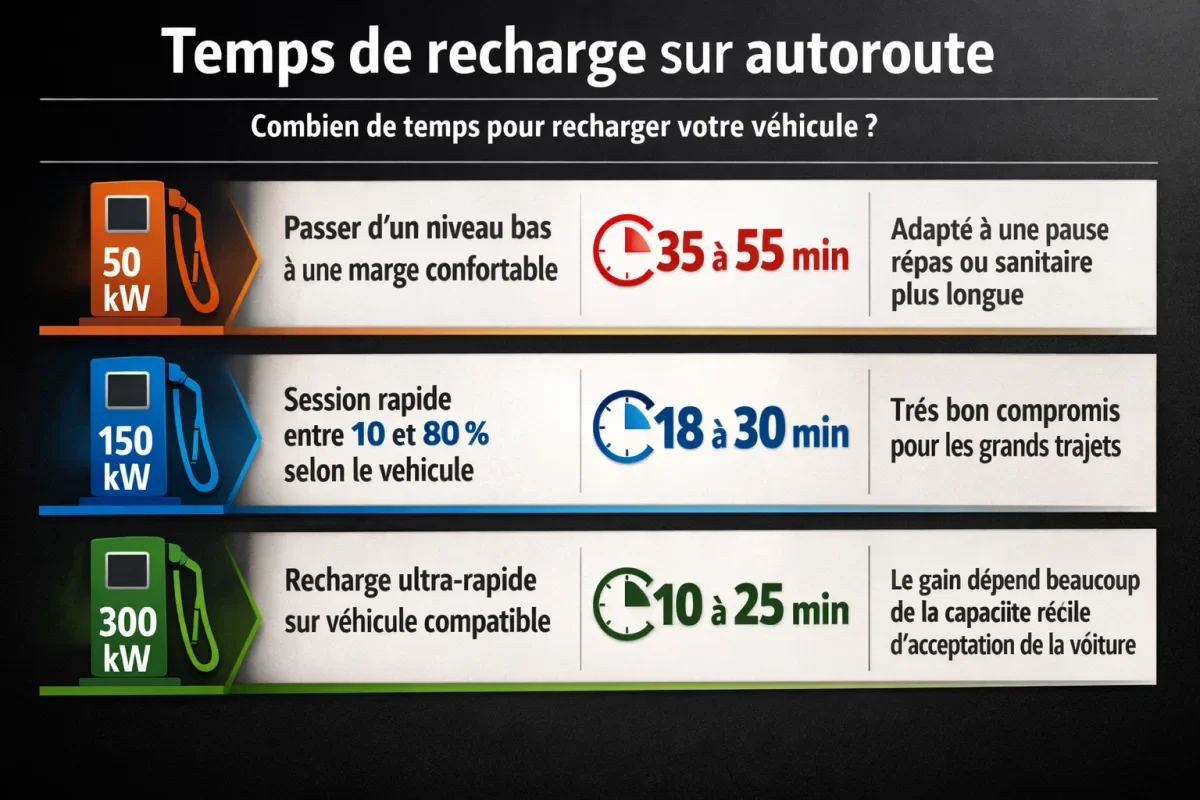
The electric car charging time on the highway depends on the battery, the charger power, the temperature, and especially the vehicle’s charging curve. Two cars plugged into the same charger can therefore show very different durations. The theoretical power is only a ceiling; the actual power delivered can be lower, especially if the battery is cold or already charged beyond 70 to 80%.
| Charger power | Typical targeted recharge | Indicative time | Practical reading |
|---|---|---|---|
| 50 kW | Go from a low level to a comfortable margin | 35 to 55 min | Suitable for a longer meal or restroom break |
| 150 kW | Quick session between 10 and 80% depending on the vehicle | 18 to 30 min | Very good compromise for long trips |
| 300 kW | Ultra-fast charging on compatible vehicle | 10 to 25 min | The gain depends greatly on the car’s actual acceptance capacity |
The difference between displayed power and actual power is especially visible at the end of the session. The charging curve deliberately decreases to protect the battery, so going from 20 to 40% can be very fast, while going from 80 to 100% can become long and not very cost-effective. On the highway, this logic changes everything: you charge to leave, not to optimize every last percentage.
In practice, the best time to stop the session is often when the recovered range comfortably covers the next stage with a small margin. This avoids buying unnecessary minutes at a high rate, and also limits the vehicle’s immobilization on a highly demanded charger.
What are the rates, payment methods, and operators to watch out for?
Highway charging prices vary according to three main parameters: the network, the power, and the billing method. There are still rates per kWh, per minute, or per session, sometimes with occupancy fees if the vehicle remains plugged in too long. On fast highway chargers, the per kWh rate has become dominant, but differences between operators remain marked.
In practice, price differences can be significant between an offer without subscription and a preferential rate linked to a badge or an app. Ultra-fast stations are generally more expensive than 50 kW chargers, but they reduce stop time. The trade-off therefore depends less on the face price than on the overall trip cost, including lost time and possible detours.
- Credit card: simple in theory, but you need to check for a reliable and readable terminal.
- Mobile app: convenient to start the session and monitor consumption, but requires a connection and an account.
- RFID badge: useful if you travel often, especially to centralize networks and simplify authentication.
The most visible networks on highways remain Ionity, TotalEnergies, Fastned, and Allego, while concessionaires like APRR, VINCI Autoroutes, and Sanef play a major role in the network of rest areas. To avoid unpleasant surprises, you need to check if the charging station is accessible 24/7, if contactless payment is accepted, and if an occupancy fee applies after a certain time.
What should you check before setting off on the highway in an electric car?
Before hitting the road, the most important thing is to align the real range, planned stops, and charging compatibility. In other words, you need to know where you can stop, with which connector, at what power, and how long it will cost you. Good preparation greatly reduces stress, especially when the weather, average speed, or traffic conditions are not in your favor.
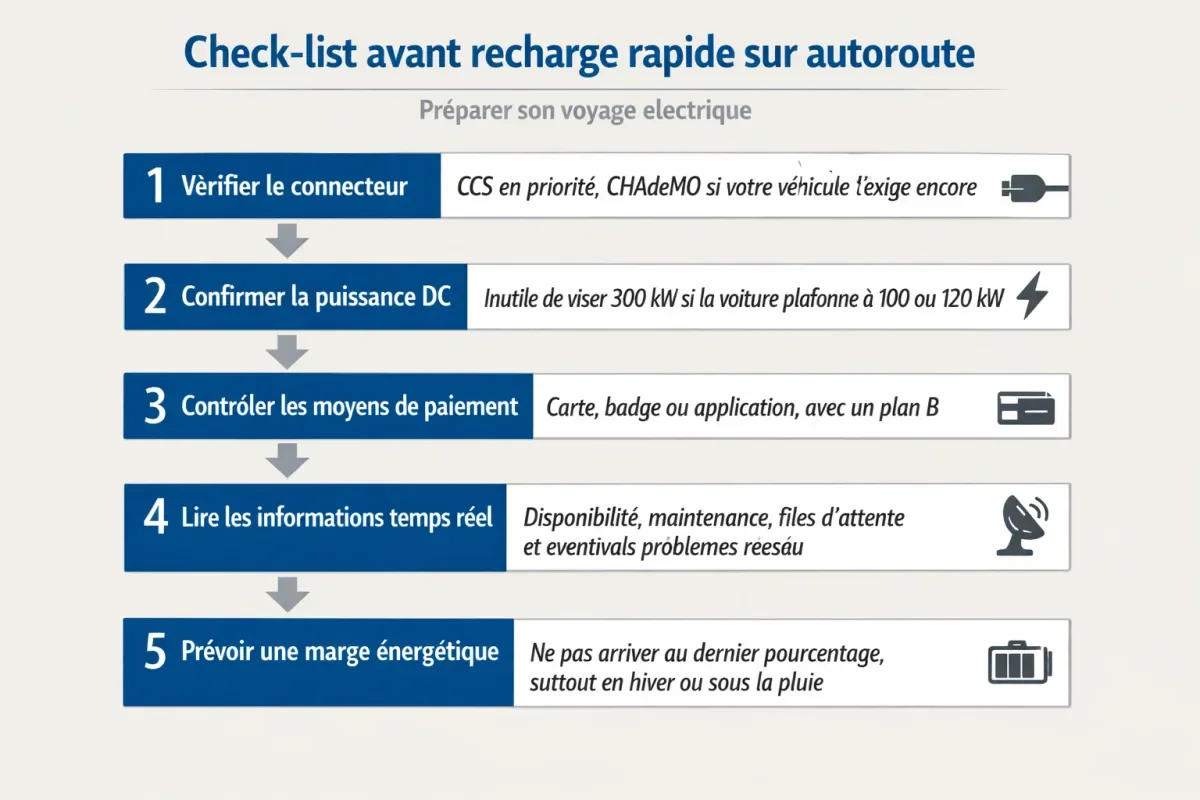
- Check the connector: CCS as a priority, CHAdeMO if your vehicle still requires it.
- Confirm the maximum DC power: no need to aim for 300 kW if the car caps at 100 or 120 kW.
- Check payment methods: card, badge, or app, with a plan B.
- Read real-time information: availability, maintenance, queues, and any network issues.
- Allow an energy margin: don’t arrive at the last percentage, especially in winter or rain.
A frequently underestimated tip is to adjust your speed even before stopping. Driving a bit slower on the last stretch of highway can save several kilowatt-hours, thus reducing the duration or cost of charging. On a long trip, this flexibility often saves more time than obsessively chasing the most powerful charger.
FAQ about fast charging stations on highways
Where can you find the most powerful charging stations?
The most powerful stations are mainly found on busy major routes and on rest areas modernized by fast charging networks. In France, corridors A7, A9, A10, A11, A6, and the main routes towards the southwest or the Alps often concentrate the most interesting stations, but you should always check the actual power displayed at the time of departure.
How long does a highway charge take?
For a car compatible with fast charging, expect often between 15 and 30 minutes at a 150 kW station to recover useful range. At 50 kW, the stop is longer. The exact duration depends on the battery, temperature, starting level, and the vehicle’s charging curve.
Can you pay by credit card everywhere?
Credit card payment is becoming more common, but it is not yet an absolute guarantee at all rest areas. Some stations work better with an app or an RFID badge. To avoid surprises, it is wise to have at least two valid payment methods before setting off.
Are charging stations accessible 24/7?
Many highway rest areas are open continuously, but the actual accessibility of the charging zone can vary depending on location, maintenance, or the organization of the rest area. A station may be accessible while some ancillary services are not, hence the importance of distinguishing station availability from amenity opening hours.
What is the difference between a fast charger and an ultra-fast charger?
A fast charger generally refers to DC charging starting at 50 kW, while ultra-fast often exceeds 150 kW, sometimes 300 kW or more. In practice, the useful speed also depends on the car: a 350 kW charger brings no benefit if the vehicle itself limits its acceptance power.
To prepare a long-distance trip, the most reliable method remains simple: leave with a margin, choose a well-located rest area, check the CCS or your car’s standard, and verify the estimated charging time before leaving home. A good France highway charging station map is less about “finding a charger” than about building a credible itinerary, with short breaks, a reliable operator, and minimal stress.