In brief
🚗 No, driving a motor vehicle without insurance is prohibited in France. The legal minimum is civil liability, in other words third-party insurance.
⚠️ In case of a check, lack of insurance can lead to a fixed penalty fine for a misdemeanor and, depending on the context, additional sanctions. The legal maximum is €3,750.
🛠️ Since April 1, 2024, the green sticker is no longer mandatory on the windshield, according to Road Safety. But the obligation to insure the vehicle has not moved an inch.
Can you drive without car insurance in France?
No. As soon as a motor vehicle is driven, the law requires at least civil liability insurance. In practice, driving without car insurance exposes you to a misdemeanor, even for a short trip, a loaned vehicle, or an “exceptional” outing.
No, driving without car insurance is prohibited in France as soon as a motor vehicle is driven. The law requires at least civil liability coverage. Without it, you expose yourself to a misdemeanor, even for a short trip or a loaned vehicle.
The Ministry of Economy reminds that any motor vehicle put into circulation must be insured, at least for damages caused to others, as detailed on its page about vehicle insurance obligations. In other words, it is not the idea you have of the use that counts, but the existence of active coverage.
What is the minimum mandatory insurance?
The strict minimum is civil liability coverage, often called third-party insurance. It covers material and bodily damage caused to a third party, but not your own damages, nor your vehicle. Everything else — theft, fire, broken glass, all risks — falls under a higher level of protection, not a legal obligation.
Road Safety makes it clear that the absence of a sticker does not mean absence of insurance: it is just a change in proof, not in the rule. The law remains the same, and the vehicle must be covered at all times as soon as it is put into circulation.
Service-Public.fr also summarizes this point on its page about the fixed penalty fine for driving without insurance, reminding that lack of insurance constitutes a misdemeanor, not a simple administrative slip.
What are the risks if you are caught without insurance?
Being caught without insurance can lead to a fine, vehicle impoundment, and, depending on the case, more severe judicial penalties. It all depends on the context: first offense, type of control, possible aggravating factors, and the driver’s behavior. In short, it’s not the kind of lottery you want to win.
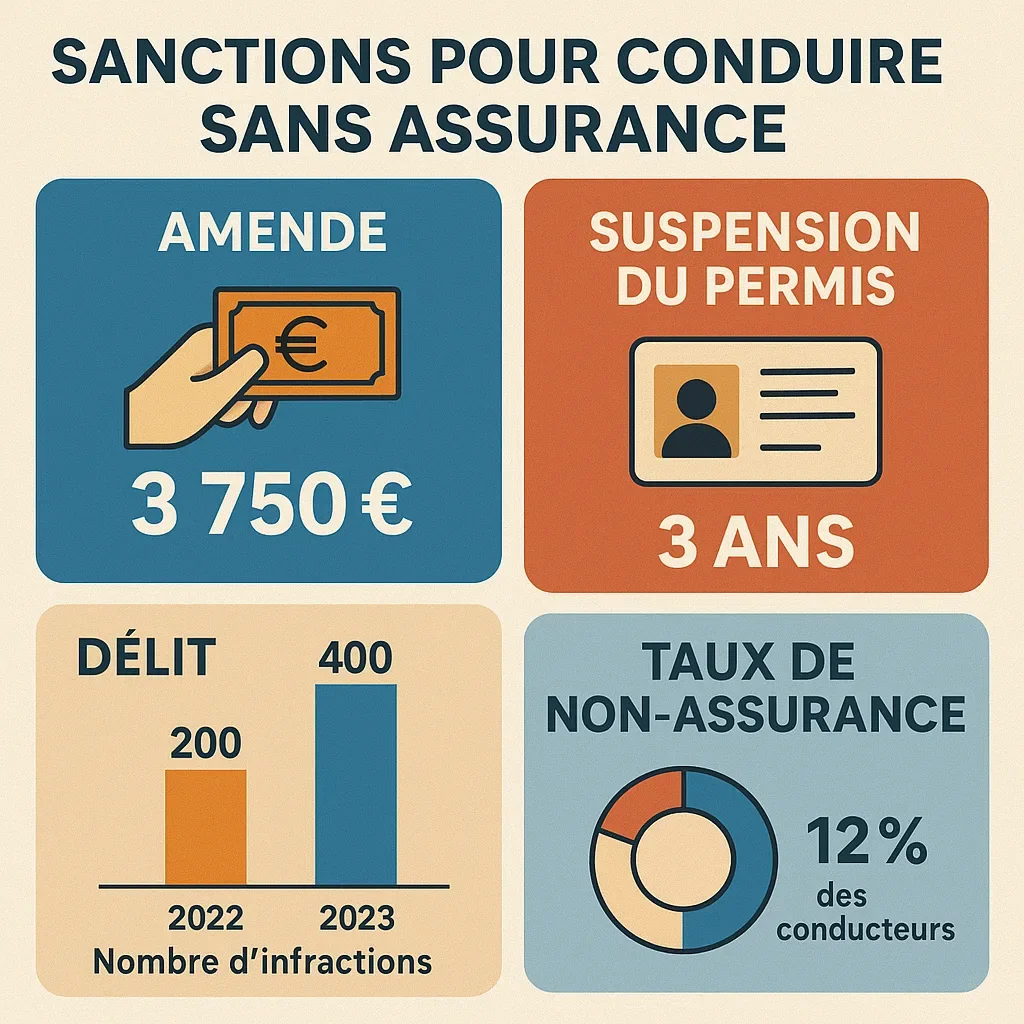
In certain cases provided by the procedure, a fixed criminal fine may apply, often around €500 at the first level of processing, before possible increases depending on deadlines and procedure. Otherwise, the judge may impose a penalty of up to €3,750.
The big advantage, if you can call it that, is that this offense does not lead to loss of points. The bad news is that it can still weigh heavily on your license, vehicle, and wallet. And then, the tune is no longer amusing.
| Situation | Possible consequence | What to remember |
|---|---|---|
| Simple road check | Fixed criminal fine | Processing depends on conditions provided by law |
| Confirmed lack without regularization | Up to €3,750 | The court may impose the legal ceiling |
| Accident with damage | Costs, claims, and additional penalties | The bill can rise very quickly |
| Repeat offense or aggravating context | Increased penalties | The case becomes much more sensitive |
| Vehicle immobilized | Towing and impound fees | The total cost often exceeds the fine |
The Road Safety authority, on its insurance and driving page, also reminds that from April 1, 2024, the police and gendarmerie no longer check the sticker on the windshield, but the vehicle’s status in the appropriate databases. It’s more modern, faster, and frankly less tolerant of bad habits.
What happens after an accident without insurance?
Here, the bill changes scale. Your own damages are generally not covered by an insurer, and if you are responsible, the victims can then turn against you to obtain compensation. The compensation mechanism exists, but it does not erase the debt.
It is observed in practice that many drivers discover the lack of insurance during a simple check, not after a major accident. The real trap is that a rejected payment or unnoticed cancellation can make you believe everything is fine when the contract no longer exists.
When a victim faces an uninsured driver, the Guarantee Fund for Mandatory Damage Insurance can intervene in certain cases to compensate, then seek recourse. In other words: the victim can be protected, but the at-fault driver is not “cleared” for that. The reimbursement can come back like a boomerang.
The real cost of lack of insurance is not visible at first glance. It is often the sum of damages, claims, and ancillary costs that turns a “small saving” into a very bad idea.
Also keep in mind that the more serious the accident, the heavier the consequences become: material damage, injuries, expert assessments, claims, legal fees. From there, we are no longer talking about a simple minor offense, but a real patrimonial issue.
What to do if your car is no longer insured today?
The right reflex is to put the vehicle back under coverage before any trip. Contact an insurer, verify the immediate effect of the contract, and do not use the car until you have a valid certificate. Quick regularization always costs less than an unfortunate check.
The priority is to put the vehicle back under coverage before any trip. Contact an insurer, verify the immediate effect of the contract, and avoid driving until you have a valid certificate. If the car is already immobilized, use a tow truck rather than taking a chance.
If the insurance has expired due to a forgetfulness, a rejected payment, or a cancellation, you must act in this order:
- call the insurer to understand the coverage break;
- request an immediate effect or as soon as possible;
- avoid moving the vehicle before written confirmation;
- keep the exchanges with the insurer in case of control or dispute.
It is always advisable to also check the payment dates, bank details, and notifications received by email. A cancellation or unpaid bill that went unnoticed, and the bad surprise arrives at the worst possible moment.
What tricky cases give the impression of being in compliance?
This is often where troubles begin: vehicle parked on the street, borrowed car, green card removed, or recent purchase without an effective contract. The law looks at the existence of an active coverage, not the impression one has of the vehicle’s use.
Here are the situations that often lead to confusion:
- Borrowed car: the fact that a relative drives does not replace the vehicle’s insurance.
- Vehicle parked on the street: simply parking on a public road does not create a magical exception.
- Used purchase: effective coverage is required before driving away, even to return “home”.
- Expired insurance but vehicle rarely used: low mileage is not enough to erase the obligation.
In practice, a motor land vehicle is not considered “off-topic” just because it is driven little. If you really want to remove it from circulation, you must check the exact framework with the insurer and, depending on the case, the corresponding administrative procedures.
FAQ — Driving without car insurance
Can you drive 24 hours without car insurance after purchase?
No, not without effective coverage. The key point is the contract’s effective date, not the time you signed a paper. Many insurers offer activation the same day, which avoids playing with fire.
Does the disappearance of the green card mean you no longer need insurance?
Absolutely not. Since April 1, 2024, the windshield no longer displays a sticker, but the insurance obligation remains. Control is done differently, notably via files used by law enforcement.
Does a vehicle parked on the street have to be insured?
Yes, if it is still a motor land vehicle kept in the normal usage circuit. The fact that it does not drive every day does not automatically remove the obligation. In case of doubt, it is better to check the exact status of the contract.
Does the FGAO pay everything if I am a victim of an uninsured driver?
No, it does not erase all problems, but it can compensate certain victims under the conditions provided by law. Then, it can seek reimbursement from the uninsured responsible party for the amounts paid.
Can you insure a car the same day?
Yes, very often. Depending on the file and the insurer, coverage can be put in place quickly, sometimes within the day. The most important thing is to have the right documents and not to drive before the contract takes effect.
Does driving without car insurance cause loss of points?
No, this offense does not work like a points infraction. However, it can lead to a fine, measures on the vehicle, and, depending on the case, judicial sanctions that weigh much more than a simple points deduction.