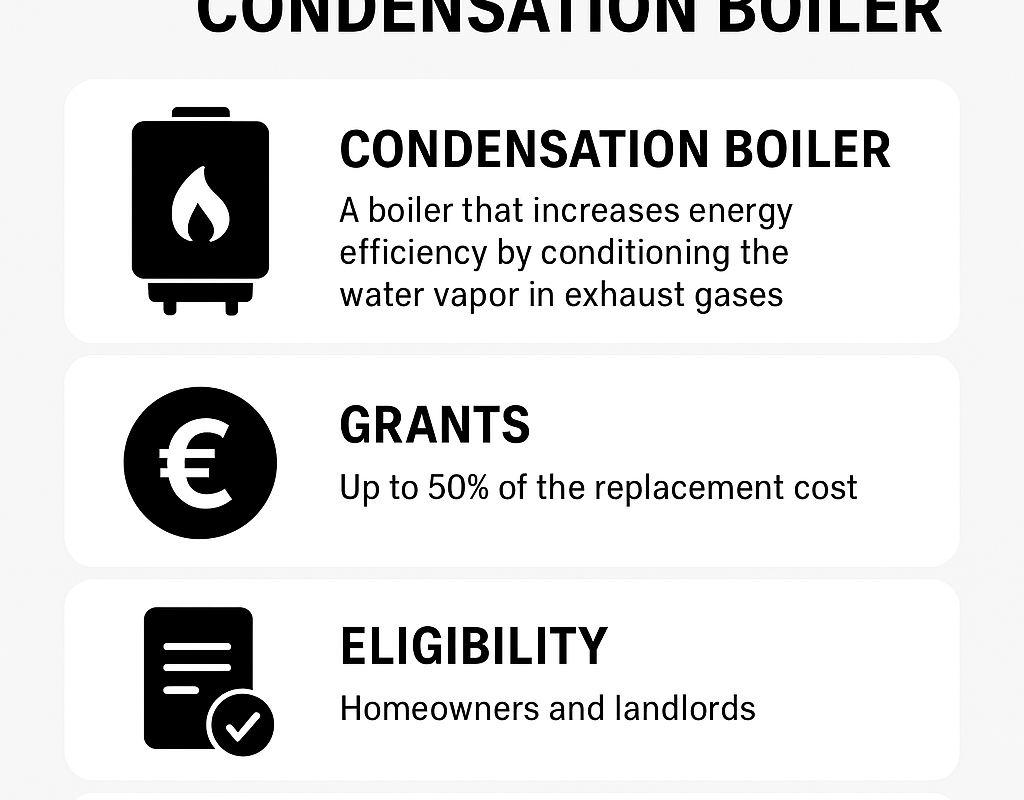
Condensing Boiler: What Financial Aid Is Available for Replacement?
| 📌 | Topic: financial aids still useful when replacing a condensing boiler, with the rules that have really changed. |
| 💡 | Key idea: installing a condensing boiler does not open the same rights as a complete heating system replacement. |
| ⚠️ | Warning: many aids depend on the date of the quote, the signing, and the start of the work. |
| 🏠 | Common case: a gas condensing boiler remains mainly interesting for performance, not for subsidies. |
| 🧾 | Procedures: check eligibility before signing, then prepare the file with complete documents and exact references. |
| 🔎 | To remember: CEE, reduced VAT, eco-PTZ and local aids remain the most common levers. |
The condensing boiler has long been the good student of gas heating: more economical than an old model, it recovers part of the heat from the fumes. But on the aid side, the landscape has shifted, and not just a little. Between MaPrimeRénov’, CEE, reduced VAT and eco-PTZ, it is especially important to know what still finances installation, what targets replacement, and what is no longer available. To understand the basic mechanism, the operation of a condensing boiler remains a good starting point.
Joking aside, the issue is not just to find aid, but to aim for the right aid at the right time. An “identical” project and a renovation that changes energy source do not play in the same league. That is why it is necessary to analyze the work before taking out the pen and signing anything.
Sommaire
Does installing a condensing boiler give entitlement to aid?
Yes, but very rarely for the condensing boiler itself. Since 2023, MaPrimeRénov’ no longer finances gas condensing boilers; the remaining aids are mainly reduced VAT, CEEs, eco-PTZ and, sometimes, a local supplement. If you change the entire system, the level of aid can increase.
The key point is simple: the installation of a high-performance device and the replacement of a complete heating system are not subsidized in the same way. In other words, a project that replaces an old oil boiler with a heat pump does not follow the same logic as a simple identical renewal. For the technical aspect, the guide installing a condensing boiler also details the installation constraints that can raise or lower the budget.
| Project | Often accessible aids | Quick overview |
|---|---|---|
| Installation of a condensing boiler | Reduced VAT, CEE, eco-PTZ, local aids | Often limited if the system remains gas |
| Replacement of an oil boiler | Enhanced CEEs, ANAH aids, sometimes local aids | More favorable if energy source changes |
| Switch to a heat pump or biomass | CEE + national and local aids | Generally the best lever |
Installing a condensing boiler
Installing a condensing boiler in a dwelling already heated with hot water remains technically quite common, but the aid does not automatically follow. The dwelling must often have been completed for more than two years for the reduced VAT, and the company must provide a detailed quote and invoice. In practice, clean files are processed faster than “quickly done, poorly done” files.
Replacing an existing boiler
When replacing an old boiler, everything changes depending on whether you stay with a gas condensing boiler or switch to a more decarbonized solution. Replacing an oil, coal or gas appliance with a heat pump, biomass boiler or hybrid system often opens more doors. To compare options without getting lost, the file condensing boiler or heat pump helps to see where public aid is most generous.
What aid can still be accessed today?
The aid still accessible depends on the type of work, the housing, and especially the timing of your application. In practice, the condensing boiler is less supported than a heat pump, but a well-organized project can still activate CEE, 5.5% VAT, eco-PTZ, and local aid.
The good news is that several cumulative levers remain. The less good news is that none alone can replace a large national subsidy for a gas condensing boiler. To check the current rules, the ANAH MaPrimeRénov’ sheet and the recommendations of the ADEME are good references, as conditions change depending on the nature of the project.
Energy bonuses and CEEs
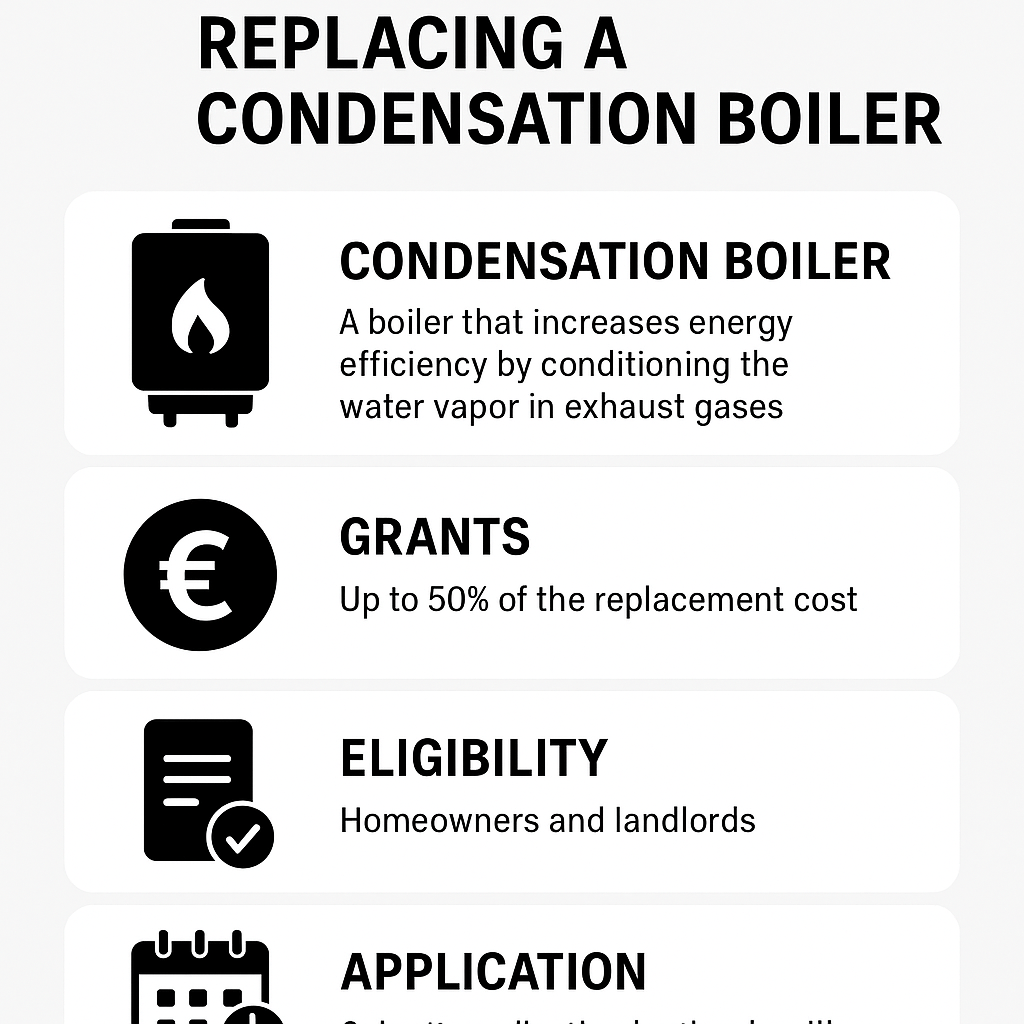
Energy savings certificates, better known as CEEs, remain among the most active aids for this type of project. The principle is simple: the energy supplier or its partner pays a bonus if the work reduces consumption. But beware, the application must generally be submitted before the start of the work, otherwise the file may be rejected.
Reduced VAT
VAT at 5.5% can apply to certain energy renovation works in housing completed more than two years ago. It is not a bonus paid into a bank account, but a direct reduction of the invoice. In practice, the invoice must be properly drafted, and both materials and labor must fall within the framework provided by the scheme.
The eco-PTZ and local aids
The zero-interest eco-loan can help absorb the remaining costs, especially when the project includes several components: heating, regulation, sometimes insulation. Depending on the nature of the work package, it can go up to €50,000 for some cases of comprehensive renovation. Local aids vary from one municipality to another: a metropolis may offer a bonus, while a department may have nothing planned at all.
Removed aids, key dates and mistakes to avoid
The real trap is reading an outdated web page and thinking that aid still exists when it has already changed course. On this subject, one date must be kept in mind: January 1, 2023. Since this turning point, the gas condensing or THPE boiler is no longer, in most cases, eligible for MaPrimeRénov’ as before.
The “historical” aids have sometimes left traces in comparison tools or commercial sheets, which maintains a convenient ambiguity for selling. The reflex to adopt is simple: check the update date, then cross-check with official texts. If your project mainly aims to improve the efficiency of existing heating, the content choosing a condensing boiler helps to decide without relying on promises that are too good to be true.
What is no longer to be counted as main aid
You should no longer build your financing plan on an “old version” national aid hoping it will still pass. The amounts announced for a boiler conversion are not always transferable to a condensing boiler installed alone. In other words, a simple boiler replacement should not be confused with a broader energy renovation.
Difference Between Condensing Boiler and System Change
This is often where everything hinges. Replacing an old boiler with a condensing boiler improves performance but does not completely change the home’s energy source. On the other hand, switching to a heat pump, biomass boiler, or solar thermal system can trigger more aid because the expected climate benefit is greater. The comparison condensing boiler or heat pump is useful to measure this difference in treatment.
What conditions must be met to be eligible?
Eligibility rarely depends on a single criterion. You need to look at the home, the applicant’s status, the age of the property, the nature of the work, and the company’s qualification. A condensing boiler can therefore be technically acceptable but administratively incomplete if the file is not assembled in the correct order.
It is observed in the field that a too vague quote often blocks the file: the exact reference of the boiler, the power, and the type of regulation are missing, and the organization then requests additional information. A family recently switched from oil to condensing gas lost the CEE bonus because the application was submitted after the work was done.
Criteria Related to the Home and Applicant
The primary residence is often prioritized, especially when it comes to national aid. Owner-occupiers and landlords do not always have the same rules, and a condominium sometimes must vote on the work before finalizing the file. The geographic area can also play a role, as some local authorities target older or energy-intensive homes more.
Criteria Related to the Work and the Professional
The work must be carried out by a declared and qualified company, with a quote and then an invoice clearly naming the installed equipment. This is where things get tricky: without power, product reference, or a precise description of services, inspections take longer. Proof of equipment performance counts as much as visible plumbing.
How to Combine Aid and Assemble Your File?
Combining aid works well when anticipated, and poorly when improvised. The right reflex is to check compatible aids before signing anything, then follow the order required by each scheme. Once the work has started, you must keep quotes, certificates, invoices, and supporting documents until final payment, otherwise the file can derail over a detail.
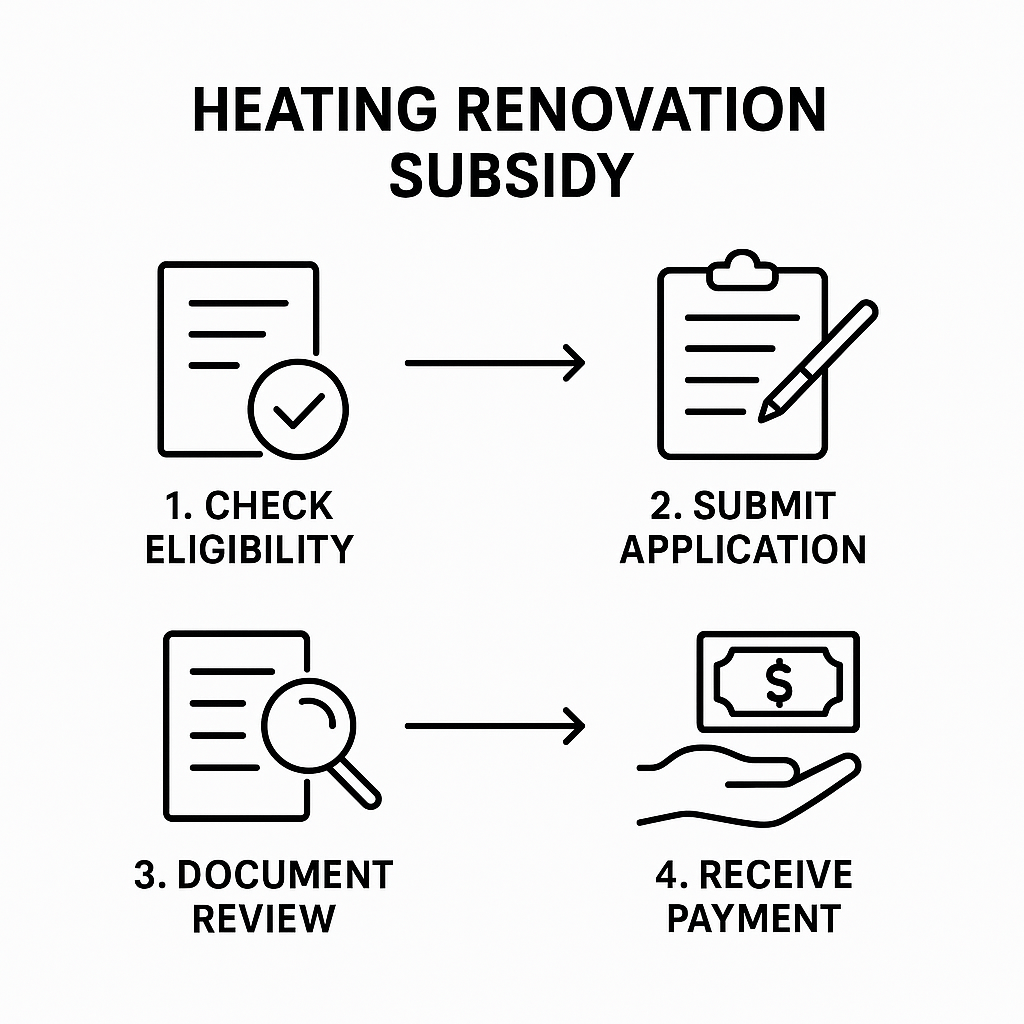
In practice, the best file is not the thickest one, it is the one that is coherent from start to finish. The steps follow each other like dominoes: if the first falls at the wrong time, the others follow. Joking aside, the administrative schedule sometimes matters more than the price of the equipment.
The Order of Steps to Respect
Start by checking whether the work involves a simple replacement or a complete system change. Then, submit preliminary requests where required, especially for the CEE. Finally, never sign a quote too early if it has not been validated and if the aid requires an upstream application: this is the kind of mistake that costs a lot for zero gain.
Documents to Prepare
The file often requires a detailed quote, proof of residence, sometimes proof of income, and sworn statements. The more precise the work, the smoother the processing. The exact equipment references, installation date, and compliance mentions must appear without ambiguity; otherwise, a file return is almost guaranteed.
What Amounts to Expect According to Your Profile?
The final amount depends on income, type of housing, the system replaced, and the choice of equipment. A modest household, a condominium, or a landlord does not activate the same levers, and an older home can sometimes open up more combinations. To give an order of magnitude, the eco-PTZ can go up to €50,000 on some projects, but it is a loan, not a grant.
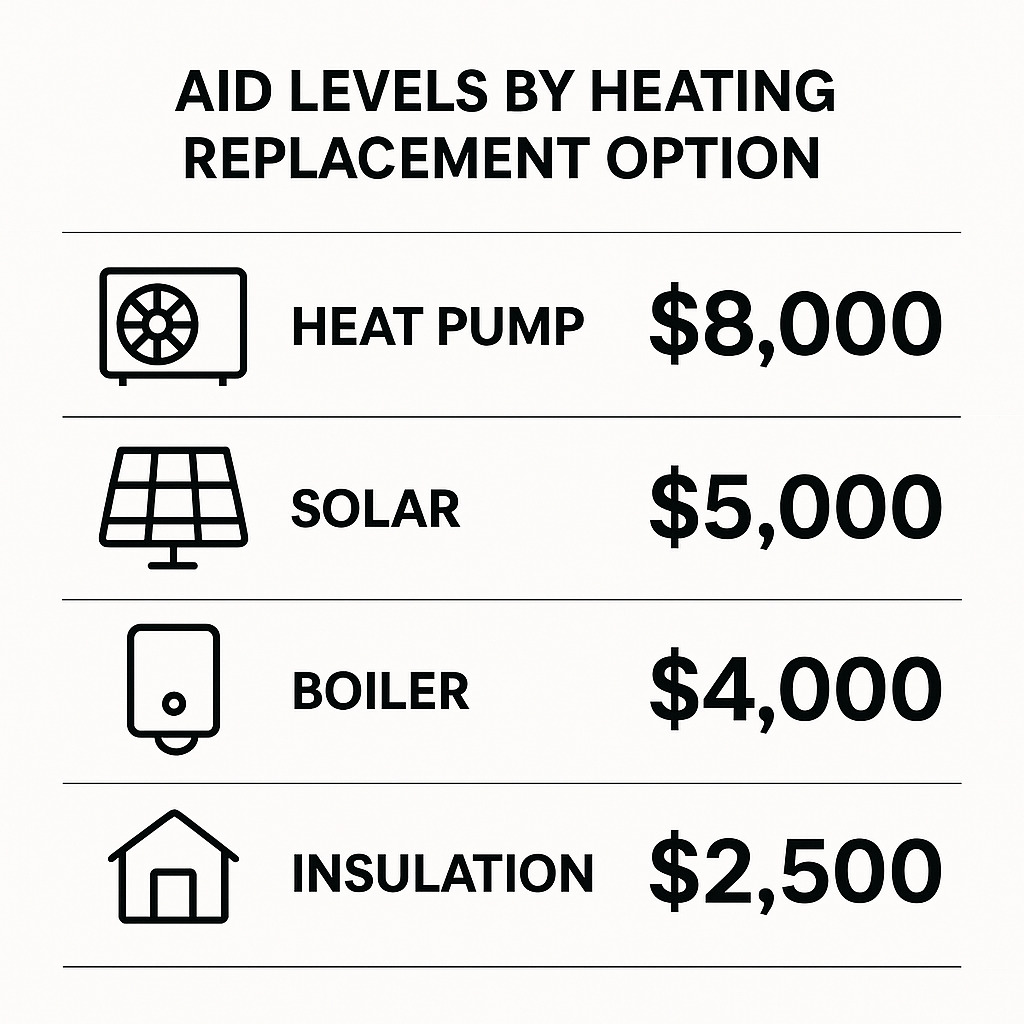
The out-of-pocket cost can therefore vary greatly: a few hundred euros of relief in one case, several thousand in another. It all depends on the mix of aids activated before the work and the technical coherence of the project. At the scale of a dwelling, the right choice is not only based on the price of the boiler, but on the overall installed cost.
Case of an owner-occupier
The owner-occupier often has the simplest process, provided that the dwelling is indeed their main residence and that the supporting documents are complete. They can sometimes combine CEE, reduced VAT, eco-PTZ, and local aid. However, if they stick to a condensing boiler alone, the range of aids will often be narrower than for a heat pump.
Case of a landlord or a co-ownership
The landlord must comply with specific rules, especially if the dwelling is rented or part of a larger project. In co-ownership, the collective decision and the quality of the technical file become decisive. It is also here that upstream identification, at the level of the property manager or the assembly, can avoid weeks of delay and missing documents.
FAQ: condensing boiler aids
Can you get aid if the quote is already signed?
Not always. For CEEs in particular, the application often must be made before the start of the work, otherwise eligibility may be lost. If the quote is already signed, you must immediately check the rules of the relevant scheme, as some funders are much stricter than others.
Can a co-ownership finance a condensing boiler?
Yes, but the process is different from an individual file. The collective decision, the type of part concerned, and the status of the work change everything. In co-ownership, local aids or certain loans can help, but a more structured setup is often required than in a single-family house.
Should supporting documents be kept after installation?
Absolutely. Keep quotes, invoices, certificates, proof of payment, and exchanges with organizations. In case of inspection or request for additional documents, these papers make the difference. Without them, even a compliant project can get stuck in administrative pipelines.
Does annual maintenance affect the aids?
Indirectly, yes. Maintenance alone does not open an aid, but it can secure operation, compliance, and sometimes the equipment’s lifespan. A poorly adjusted or maintained boiler condenses less well, consumes more, and loses part of its initial benefit.
Is it better to replace with a heat pump?
In terms of aids, often yes. A heat pump more easily benefits from national schemes and additional bonuses because it reduces emissions more. However, the best solution also depends on the dwelling, climate, insulation, and overall budget.