
In brief
🧾 For a rental investment, the bank almost always requires borrower insurance, but it often accepts lighter coverage than for a primary residence.
🔎 The most common base remains death + PTIA. The guarantees ITT, IPT, or job loss can be useful, but they are not systematically essential.
💡 The real lever is the combination of coverage percentage + TAEA + insurance delegation. This is often where savings are made, not in marketing promises.
📌 Since the Lemoine law, a loan insured for less than €200,000 per insured repaid before age 60 can, in some cases, be taken out without a medical questionnaire.
Is borrower insurance mandatory for a rental investment?
Yes, in practice, the bank almost always requires it to finance a rental property. Legally, nothing imposes insurance in all cases, but the lending institution can condition its offer on a specific level of coverage. In plain terms: without insurance, the loan rarely goes through, or then under much less comfortable conditions.
Short answer: borrower insurance is not an absolute legal obligation, but it is almost always a banking requirement for a rental investment. For this type of project, the bank often accepts simpler coverage than for a primary residence, with at least death and PTIA.
The important point is that the lender’s risk is not the same depending on the project. In a rental, rents often cover part of the monthly payment, which makes the file clearer for the bank. This is also why it can sometimes accept fewer guarantees than when buying a primary residence.
According to Service-Public.fr on borrower insurance contracts, the lending institution can require this insurance before issuing its loan offer. In other words, the insurance contract is not negotiated separately from the loan: it is part of the overall arrangement, almost like a piece of the puzzle.
What guarantees should you really choose for a rental property?
For a rental property, the most common base remains death and PTIA (total and irreversible loss of autonomy). The ITT and IPT guarantees can be useful depending on your level of debt, but they are not always essential if the rents already amortize a good part of the loan.
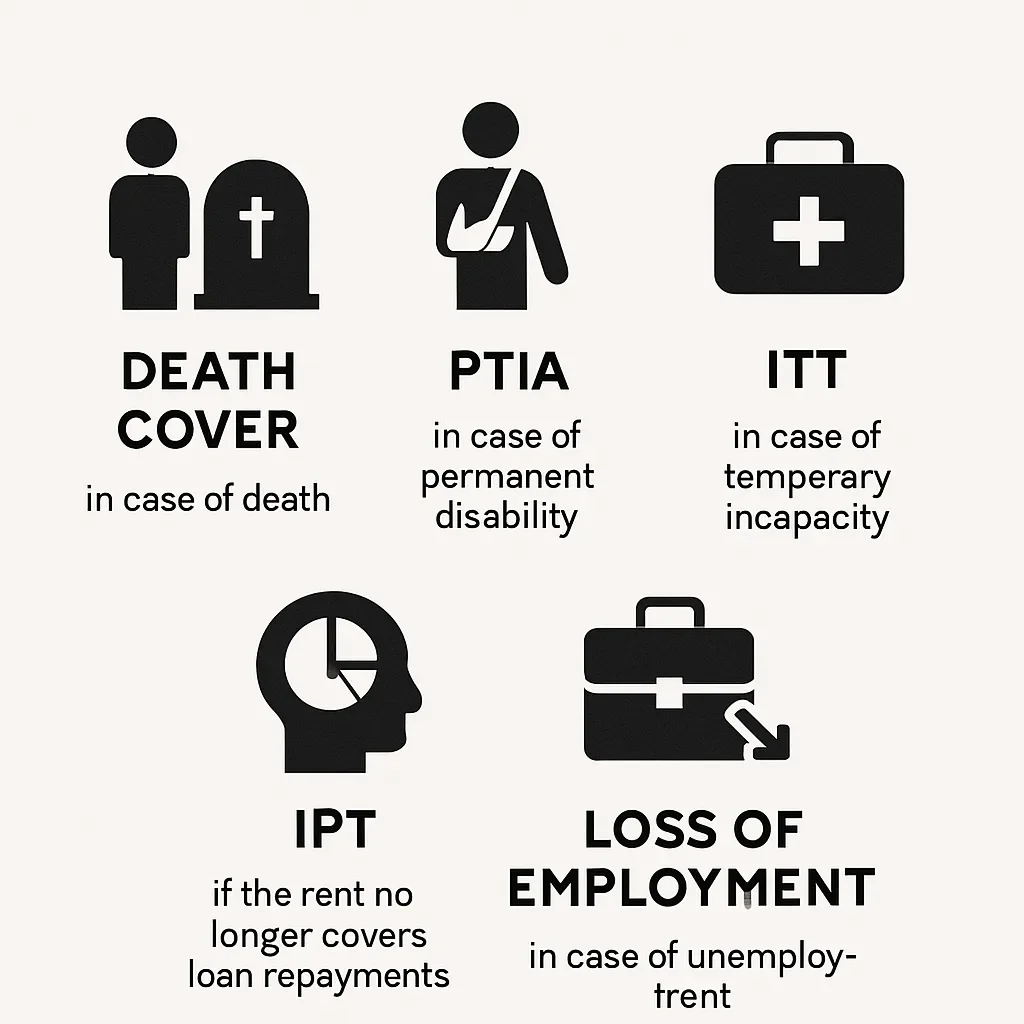
Here’s the simple idea: the more your investment is self-supported by rents, the more the bank can tolerate lighter coverage. Conversely, if the cash flow is tight, it’s better to seriously consider disability and invalidity guarantees. Joking aside, a monthly payment you cannot absorb in case of a hard hit rarely ends well.
| Guarantee | Usefulness in rental | To watch out for |
|---|---|---|
| Death | Protects heirs and loan repayment | Essential in most cases |
| PTIA | Covers severe loss of autonomy | Often required along with death |
| ITT | Takes over in case of work stoppage | Very useful if the property does not self-finance |
| IPT / disability | Compensates for permanent disability | Watch out for contract definitions |
| Job loss | Reassuring on paper | Often expensive, rarely a priority |
The real question is therefore not “which coverage is the broadest?”, but “which coverage protects the project without ruining its yield”. For a rental property, you want to avoid unnecessary overlaps. A job loss guarantee, for example, is rarely essential if your rents already secure part of the repayment.
How to choose the share when investing as a couple?
The share is the portion of the loan covered by each borrower. As a couple, it changes everything: 100/100 offers maximum protection, 50/50 costs less but can leave a real gap in case of death or disability. The right choice depends on income level, remaining living expenses, and the property’s cash flow.
Short answer: as a duo, the share must match the household’s economic reality. If a single income can cover the loan, an asymmetric coverage may suffice; if the project relies on two salaries, it is often better to aim for stronger protection, even if it costs a bit more.
In a typical setup, banks like shares that total at least 100%, but nothing prevents going up to 200% for maximum protection. Cherry on top, this is not necessarily the smartest formula if the property is already very profitable. One must always balance security and total cost.
In practice, some investor couples first take a very high share “to be safe”, then realize a few months later that the premium eats into their net yield. A broker based in Lyon often observes the same scenario: after comparison, clients keep solid coverage, but cheaper and better calibrated.
For a purchase via SCI, the reasoning remains similar: you must cover the risk that would jeopardize the project’s balance. If one partner holds the majority of income or shares, the share can follow this economic logic. However, if the partners want to avoid any surprises, a more homogeneous coverage remains more comfortable.
| Situation | Share logic | Useful observation |
|---|---|---|
| Single investor | 100% on one head | Coverage is simple, but cost must be monitored |
| Couple with similar incomes | 50/50 or 70/30 | To be calibrated according to the capacity to absorb the loan alone |
| Couple with a dominant income | 80/20 or 100/100 | Protection must follow the real financial dependence |
| Family SCI | According to contributions and shares | Too theoretical breakdowns should be avoided |
How much does rental loan insurance cost, and why are the differences so huge?
The cost mainly depends on age, loan duration, insured capital, level of coverage, and pricing method. In rental properties, insurance may seem “small” in the monthly budget, but over twenty years, it quickly represents a significant amount. The right approach is to look at the TAEA, not just the monthly payment.
Why such a difference? Because a young non-smoking borrower is not charged like an older profile with a higher medical risk. The same goes for the insured portion: insuring 100% of the loan or 200% obviously does not have the same impact. Added to this are exclusions, deductibles, and sometimes medical surcharges.
The most misleading aspect is the low visibility of the cost in loan simulations. Insurance costing €20 or €30 more per month may seem insignificant, then turn into several thousand euros in the end. That’s why it’s necessary to think in terms of total cost, not just the “small print” in the loan offer.
For a rental investment, the best insurance is not the broadest on paper. It’s the one that truly protects cash flow without weighing down profitability with options you don’t need.
How to pay less without taking a foolish risk?
The right method is to compare offers with equivalent coverage, check the insured portion, monitor exclusions, and activate insurance delegation if it lowers the TAEA. In practice, the price reduction does not come from a miracle but from a contract better tailored to your profile and project.
Since the Lemoine law, it is also possible to change borrower insurance at any time, provided the equivalence of guarantees is respected. This is a real relief valve, especially if you signed too quickly at the bank. According to the logic recalled by the AERAS convention, more fragile health profiles must closely examine exclusions and possible contract adjustments.
To get straight to the point, here is the useful checklist before signing:
- Compare the TAEA and not just the nominal rate displayed.
- Check exclusions related to the back, psychological disorders, sports, or profession.
- Calibrate the insured portion according to the household’s real repayment capacity.
- Look at the deductible in ITT: 30, 60, or 90 days, it’s not the same at all.
- Avoid gimmick options if the rental is already well secured by rents.
In other words, insurance should be thought of as a risk management tool, not just a box to check. A contract that is too cheap can leave a big hole if the monthly payment remains entirely your responsibility after a claim. But an oversized contract can also unnecessarily degrade your net return.
Special cases: SCI, LMNP, SCPI, fragile health… what should be checked?
Some complex setups deserve a real look. In SCI, LMNP, or when buying SCPI shares on credit, the logic remains the same: the bank wants to be repaid no matter what. But the level of requirement can vary depending on the file, legal structure, and the share of income the project is supposed to generate.
For more sensitive health profiles, the issue is not only price but also file acceptance and the quality of exclusions. The right to be forgotten, the AERAS system, and simplified medical questions can change the game. This is where you need to take your time because an “accepted” contract is not necessarily an “adapted” contract.
The good practice is to ask the banker or broker which guarantees are really required, then get several versions of the contract priced. It is often seen that a simpler, better-targeted setup is more than enough. The idea is not to go through the entire catalog to reassure yourself but to protect the investment with the right amount of coverage.
FAQ on borrower insurance and rental investment
Can a rental investment be financed without ITT coverage?
Yes, in many cases, ITT is not essential if the bank accepts death/PTIA coverage and if the project is economically sound. However, if the property is not very profitable or if your budget is tight, this coverage can become useful again. It all depends on the level of cash flow absorption.
Can the bank impose its loan insurance?
It can require insurance, but not necessarily impose its contract if you present an equivalent solution. The principle of delegation fully applies here. The real issue is the equivalence of guarantees: if your external contract covers what is required, the bank must seriously consider it.
Is it necessary to insure 100% of the loan when investing as a couple?
Not necessarily. A 100% share on one borrower may suffice if the other borrower can take over without difficulty. Conversely, if the project heavily depends on both incomes, a more protective share becomes logical, even if it costs a bit more.
What happens if the rental property remains vacant?
Rental vacancy does not trigger borrower insurance, as this contract covers the borrower, not the tenant. If the property remains empty, the monthly payment is still due. That is why loan insurance and rental security should never be confused: they are two different safety nets.
Can insurance be obtained without a medical questionnaire?
Yes, in certain specific cases. Since the Lemoine law, the medical questionnaire can be waived for loans under €200,000 per insured, repaid before age 60. Outside of this framework, the insurer may still request health information.
Does an SCPI financed by credit necessarily have to be insured like an apartment?
Often yes, but requirements may vary depending on the institution and the arrangement. The logic remains to secure the loan repayment, except that the underlying asset is not a physical property rented directly by you. Therefore, the contract must be read carefully, especially regarding guarantees and exclusions.