Understanding the VTC Driver Profession
The VTC driver transports clients by reservation, offering a service focused on comfort, punctuality, and quality. It is often called becoming a private driver, but the framework is not trivial: you manage driving, customer relations, trip organization, invoicing, and often part of your commercial prospecting.
Definition of the profession and daily tasks
Overall, the job combines driving, welcoming, time management, and a sense of service. You can chain trips from home to airport, train station to hotel transfers, professional appointments, or rides booked via platforms and direct channels. In other words, driving is only part of the work: organization and reputation matter as much as driving.
Differences between VTC and taxi
The most important difference lies in the mode of pick-up. The taxi can cruise and be hailed on the street, whereas the VTC works by prior reservation. The taxi also has a specific pricing regime and access to taxi stands, while the VTC relies more on perceived quality, pre-booking, and customer loyalty.
| Criterion | VTC | Taxi |
| Pick-up | Prior reservation | Reservation or cruising |
| Pricing | Free but announced in advance or calculated by the platform | Regulated by taxi regulations |
| Customer access | Platforms, direct clients, companies | Taxi stands, street, reservation |
| Commercial logic | High-end service and customer relationship | Availability and territorial coverage |
Who is this job suitable for?
The job is well suited for autonomous people, comfortable with driving, able to keep smiling even after a busy day, and ready to think like an entrepreneur. If you like freedom but not total improvisation, VTC can be a good playground. However, if you are looking for a stable income without commercial management, the model will be more frustrating.
What are the conditions to become a VTC driver?
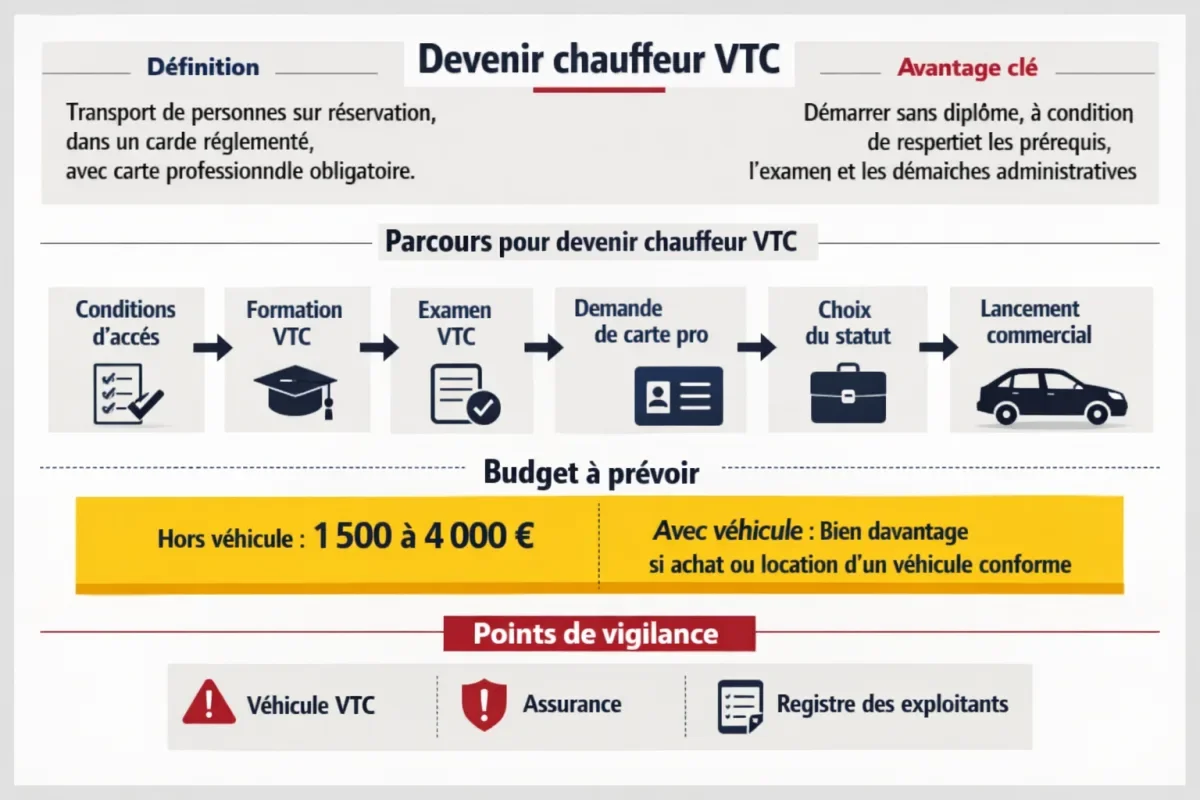
To practice legally, you must meet several basic conditions: license, driving seniority, medical fitness, compatible criminal record, and proper administrative file. These are essential prerequisites. Even though the job does not require a diploma, it does not tolerate approximation regarding the documents or your personal situation.
Age, license, and driving seniority
The starting point is the B license. In practice, you generally need to have held it for at least three years, or two years if you went through accompanied driving. The idea is simple: the administration wants to ensure you have sufficient driving experience before transporting clients. You must therefore verify your exact situation before any registration.
Criminal record, medical fitness, and administrative prerequisites
You must present a criminal record compatible with the activity, as well as medical fitness validated according to the procedure in force. Depending on your background, some equivalence or exemption routes may exist for professionals already active in transport, but they remain regulated. It is therefore better to check your eligibility very early, before committing to a training budget.
Conditions related to the vehicle and insurance
The VTC vehicle must meet specific criteria: number of seats, doors, comfort, technical compliance, and insurance coverage adapted to the activity. Never confuse standard insurance with operating insurance: in case of a problem, the difference can be very costly. This is also where many beginners fail, for lack of comparing offers.
What are the steps to obtain the VTC professional card?
The VTC professional card is the key that authorizes you to practice. To obtain it, you must follow a logical sequence: choose a good training, review the exam subjects, pass the test, then submit a complete file. The essential thing is not to skip steps, as an administrative error can delay the launch by several weeks.
Choose VTC training adapted to your level
A well-structured VTC training saves you time, not just knowledge. It must cover transport law, road safety, commercial management, the theoretical test, and ideally, mock exams. If you hesitate between several organizations, keep a simple criterion: good training prepares for the exam but also for the field. A BVTC training, for example, is only useful if it truly supports the candidate up to the card application and business start-up.
Prepare and pass the VTC exam
The VTC exam includes theoretical knowledge related to regulations, management, and service, as well as a practical part according to current modalities. It is not an academic competition, but method is required. The candidates who succeed most often are those who do training series, correct their mistakes, and revise regularly rather than panicking the day before.
Obtain the professional card
Once the exam is passed, you submit your professional card application to the competent authority. This is an administrative step, but it requires a clean file: identity documents, license, exam results, medical documents depending on the case. An incomplete file slows down the entire process. That is why this phase must be prepared with the same rigor as a technical inspection, leaving no ambiguity.
Register and regularize your activity
After the card, you must regularize your operation: registration, VTC operators’ register, choice of status, insurance, tax and social obligations. The core issue is not just “having the right to drive clients,” but “having a proper business.” This is what prevents you from working in a gray area and discovering problems at the worst moment.
Quick checklist before submitting the file
- Valid B driving license with sufficient seniority
- Identity document and proof of address
- Certificate of passing the VTC exam
- Medical certificate if required
- Verification of insurance for the future vehicle
- Preparation of legal status and registration
How much does it cost to become a VTC driver?
The initial cost mainly depends on your entry point: whether you already have a compatible vehicle or not, whether you take a full training course or a shorter preparation, and whether you go for rental, purchase, or leasing. In practice, the cost of a VTC driver can vary quickly from one to three times. The best approach is therefore to budget generously, then adjust according to your actual situation.
| Item | Approximate cost | Comment |
| VTC Training | €300 to €1,200 | Varies depending on format, support, and included modules |
| Exam and administrative fees | €100 to €300 | Depends on organizations and procedures |
| Professional card and formalities | €50 to €250 | To be supplemented with possible medical fees |
| Professional insurance | €800 to €2,500/year | Highly variable depending on vehicle, area, and profile |
| Vehicle | Rental: €300 to €900/month | Purchase: €8,000 to €25,000 | Cost strongly depends on category and engine type |
Example of a realistic starting budget
Let’s take a candidate who starts with a vehicle already available. They can plan about €900 for training and exam, €150 for formalities, and an initial insurance budget around €1,200 to €1,800 per year. So, the total is often between €1,500 and €4,000 excluding the car. However, if you need to buy a compliant vehicle, the bill quickly climbs beyond €10,000.
Practical case: Samir, 31 years old, settles in an urban area. He takes training, passes the exam, buys a used hybrid car, then launches his activity on platforms. His first month is average, but he quickly understands that his profitability mainly depends on three things: time slots, commissions, and the rate of rides actually accepted. In suburban areas, the same budget may lead to a slower start, but with longer trips and more clients through direct booking.
Which legal status to choose to operate?
The right VTC driver status depends on your ambition, volume of rides, and level of investment. If you want to test the activity with few expenses, the simplest regime may suffice at first. If you aim for higher turnover, with more deductible expenses, it is better to look at structures more suited to a highly equipped service activity.
| Status | For whom? | Advantages | Limits |
| Micro-enterprise | Start quickly and test the market | Simple, fast, little administration | Non-deductible expenses, thresholds to monitor |
| EI (Sole proprietorship) | Operate alone with more flexibility | More fiscal freedom than micro | Must be well configured from the start |
| EURL (Single-member LLC) | Solo with serious entrepreneurial logic | Structured, credible, adaptable framework | Heavier management |
| SASU (Single-member simplified joint-stock company) | Development project or more “business” image | Statutory flexibility | Often higher social and administrative costs |
VTC auto-entrepreneur: good idea or false good plan?
The VTC auto-entrepreneur can be interesting if you start slowly, with few fixed costs and a market test objective. However, if you have many recurring expenses — fuel, commissions, insurance, maintenance, rental — the regime can become less comfortable, because you do not deduct your actual expenses. For an ambitious project, the decision often deserves the advice of an accountant.
How much does a VTC driver earn?
The income of a VTC driver depends as much on the volume of rides as on the quality of your organization. Two drivers can work the same number of hours and show very different results. One fills their slots with long and regular rides, the other lets part of their margin slip away due to commissions, downtime, and a vehicle that is too costly to operate.
Gross income, expenses, and profitability
The turnover may seem attractive, but it should never be confused with net income. Between platform commissions, fuel, insurance, maintenance, tolls, and sometimes vehicle financing, the margin shrinks quickly. In practice, profitability is decent when the occupancy rate is good and the vehicle remains inexpensive to use.
Factors influencing turnover
- Activity area: big city, suburbs, airport, train station, tourism
- Hours: nights, weekends, shuttle mornings
- Acquisition channel: platforms, direct clients, B2B
- Type of vehicle: consumption, comfort, reliability
- Level of commissions and additional fees
| Context | What it changes | Practical reading |
| Dense urban area | More requests, more competition | High volume, but commissions and waiting times to watch |
| Suburban or rural | Fewer immediate rides | Increased interest in bookings and B2B |
| Corporate clientele | More planned rides | Better visibility on occupancy |
Common mistakes that reduce margin
The most common mistakes are almost always the same: buying a vehicle that is too expensive, ignoring professional insurance, working without a time strategy, depending on a single platform, and neglecting maintenance. Conversely, the drivers who do best manage their activity like a small business, with closely monitored costs and a clear profitability goal.
How to properly start your VTC activity?
Launching is not just about opening an app and waiting for rides. To start properly, you must prepare your client acquisition, your rates, your slots, your documents, and your online reputation. This is often where the difference lies between an activity that stalls and one that takes off, even on a small scale.
Finding your first rides and developing your clientele
At the beginning, platforms can help you fill the order book. But a healthy activity should not rely solely on them. The real lever is diversification: direct clients, events, hospitality, local businesses, train station-airport shuttles. The more varied your sources, the less you depend on algorithm changes or commission spikes.
Taking care of your reputation and retaining clients
VTC is a profession where customer feedback matters a lot. Vehicle cleanliness, punctuality, smooth driving, discretion, and presentation quickly make a difference. Some drivers learn this the hard way: repeated bad ratings can sink the activity. Conversely, a few loyal clients and well-managed recommendations sometimes are worth more than expensive advertising.
Best practices for the first 30 days
- Block time slots consistent with your area
- Test several acquisition channels
- Note every expense to track the real margin
- Optimize empty trips
- Systematically ask for reviews after a successful ride
Why compare training courses before starting?
Not all training courses are equal, and this is precisely where a beginner can save a lot of time. The best VTC training is not the one that promises to “succeed quickly,” but the one that seriously prepares you for the exam, the card procedures, and the realities of the field. Comparing helps avoid programs that are too short, too vague, or too theoretical.
Criteria for Choosing a Reliable Organization
- Program compliant with the expectations of the VTC exam
- Availability of mock exams and detailed corrections
- Support for the professional card application
- Clarity of pricing and financing terms
- Consistent and transparent learner feedback
What a Good Training Should Include
It must cover at least the regulations, business management, safety, customer relations, and practical cases. A truly useful training goes further: it teaches you how to prepare your file, understand insurance obligations, estimate your expenses, and avoid startup pitfalls. It is this comprehensive vision that transforms a simple candidate into a future professional.
FAQ: Becoming a VTC Driver
Is a diploma required to become a VTC driver?
No, no specific diploma is required to become a VTC driver. However, you must meet the access conditions, follow appropriate preparation, pass the exam, and obtain the professional card. In short, the profession is accessible without a diploma, but not without regulatory validation.
How long does it take to get started?
The timeframe mainly depends on your availability, the chosen training, and administrative processing time. In practice, it often takes several weeks to a few months between the start of preparation and the first paid client. If your file is complete and your organization is solid, you save valuable time.
Can you become a VTC driver without buying a car?
Yes, it is possible. You can opt for long-term rental, leasing with option to buy (LOA), or other solutions compatible with your activity. The advantage is to reduce the initial investment. The downside is that the monthly payment becomes a significant fixed cost, which must be absorbed with a sufficient volume of rides.
What is the average income of a VTC driver?
There is no universal average income, as it depends on the area, hours, vehicle, and status. One driver can earn a decent income in a dense area with good organization, while another, poorly positioned or burdened with high expenses, will break even without real profit.
Is the BVTC training suitable for beginners?
It can be if it truly covers the basics of the profession, the VTC exam, and business startup. For a beginner, the most important thing is not the name of the organization, but the educational quality, practical training, administrative support, and clarity of the program. The rest is just gloss.
Conclusion
To become a VTC driver under good conditions, you must think like a professional from the start: check your prerequisites, choose solid training, pass the exam, obtain the professional card, select a coherent legal status, and start with a realistic vehicle and commercial strategy. This framework is what turns a vague project into a viable business.
Regulations may evolve, costs may vary depending on your city and vehicle, and income strongly depends on your discipline. If you maintain this practical approach, with monitored figures and well-executed steps, you already start with a head start.