In brief
🔎 The MRH primarily covers the dwelling, movable property, and civil liability. The heart of the contract is there, not in marketing gimmicks.
🧩 The real issue is the quality of coverage: deductible, limit, depreciation, options, and exclusions change everything at the time of the claim.
🏠 Whether you are a tenant, owner-occupier, co-owner, or non-occupant, the protection to aim for is not the same. The same applies for shared housing, furnished rentals, or a second home.
What does a multi-risk home insurance really cover?
An MRH insurance mainly protects three blocks: the dwelling itself, the belongings inside, and civil liability if you cause damage to third parties. Depending on options, it can add theft, assistance, legal protection, or weather events. However, the contract remains governed by limits and exclusions.
In clear terms, MRH is not a magic safe. It serves to restore a dwelling after an accidental claim and to compensate for the loss or damage of insured belongings, within the limits provided in the contract. This is precisely the point emphasized by the Ministry of Economy, ABE Info Service, and France Assureurs.
In other words, the home multi-risk coverage is based on a simple logic: first protect the real estate and movable assets, then add a layer of civil liability for damages caused to others. This structure is common to most contracts, but the details make all the difference. A guarantee may seem comprehensive in the brochure and remain much narrower in real life.
What guarantees are generally included in the home insurance policy?
The basic guarantees generally cover fire, explosion, water damage and, depending on the contracts, storms, hail, snow or glass breakage. The logic is simple: the contract compensates for an accidental and sudden damage, not for postponed maintenance or a risk left unattended.
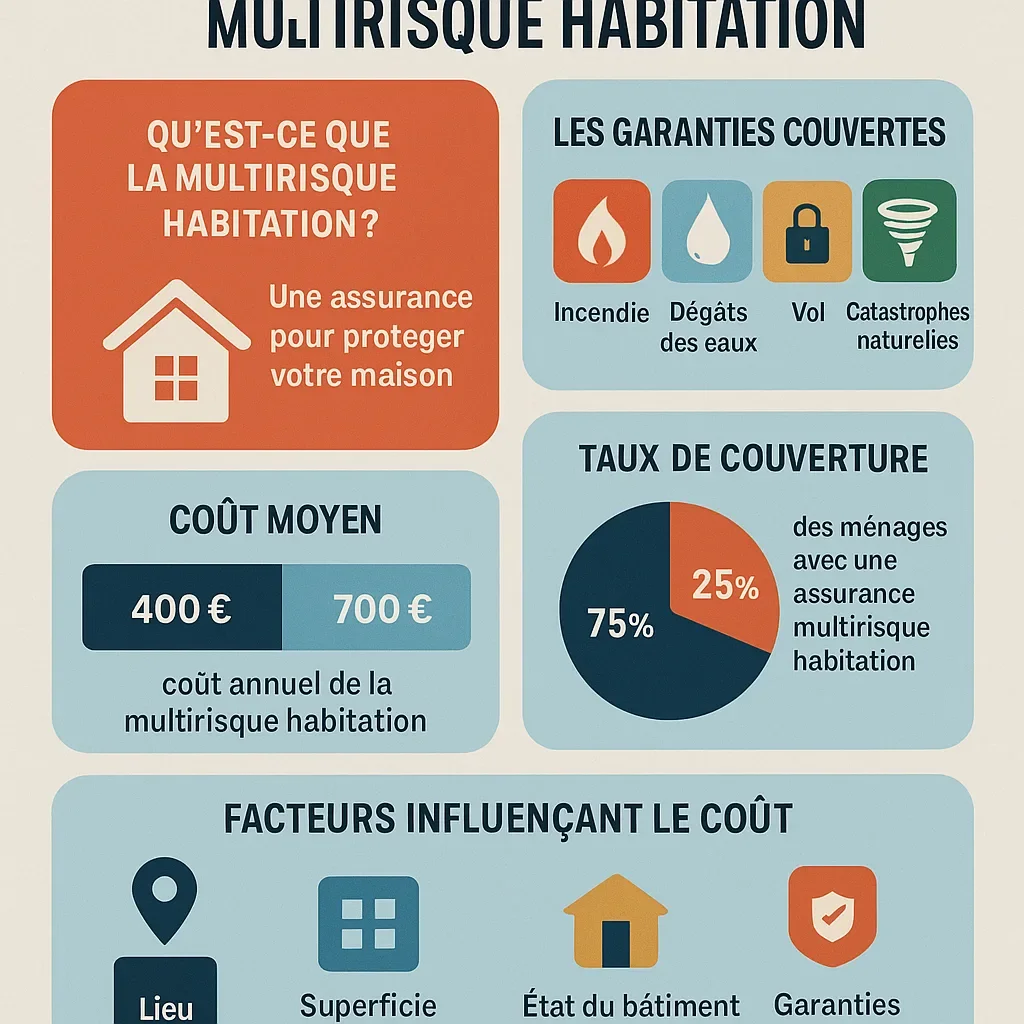
The “material” base primarily targets the elements of the dwelling: walls, roof, floors, fixed installations, sometimes interior fittings. Then come the movable goods: furniture, household appliances, clothing, computer equipment, everyday objects. Finally, the home civil liability covers damage caused to a neighbor, a third party or, in some cases, the common areas of the building.
Here is a simple reading of the coverage levels often found:
| Level | Examples | Often included? | Point to check |
|---|---|---|---|
| Dwelling base | fire, explosion, water damage | yes | ceilings and depreciation |
| Movable goods | furniture, household appliances, clothing | yes | overall insured capital |
| Civil liability | damage at a neighbor’s, common areas | yes | persons excluded from the household |
| Options | theft, assistance, legal protection | often | deductible and activation conditions |
For an old apartment in Lyon, water damage is often the sensitive point; in a detached house near Nantes, one more readily looks at storms, the roof and outbuildings. The contract must follow the real risk, not the other way around.
What exclusions and limits derail compensation?
The most frequent exclusions concern undeclared objects, poorly insured outbuildings, obvious negligence, certain external damages and claims beyond the ceilings. In other words, a guarantee may exist on paper while being limited by the deductible, depreciation or a very precise contract condition.
The most underestimated point is the trio deductible, ceiling and depreciation. The deductible is the part that remains your responsibility. The ceiling corresponds to the maximum reimbursable amount. Depreciation is used to deduct the wear of the item. On the ground, it is often there that the final bill is decided, not in the name of the guarantee.
Exclusions always come back in similar forms:
- valuable items not declared or too weakly capped;
- outbuildings not mentioned: cellar, garage, garden shed, workshop;
- progressive damages linked to lack of maintenance;
- voluntary claims or obvious negligence;
- external goods not covered by the basic formula;
- professional activities carried out at home without adapted extension.
If you have jewelry, a high-end computer or an electric bike worth €2,000 stored in the common area, you need to read the fine print. A contract may cover theft, but with a condition of locking, proof of break-in or a per-object ceiling that changes everything. Cherry on the cake, some contracts also apply a harsher depreciation on electronics than on classic furniture.
How does MRH coverage change according to your profile?
The content of the MRH mainly changes according to your status: the tenant must at least cover rental risks, the owner-occupier also protects the building, and the co-owner must consider the private part and civil liability. In shared housing, furnished rentals, or secondary residences, the boundaries shift quickly, so you need to reread the contract without pretending.
Tenant: the minimum coverage targets damage caused to the rented housing, especially fire, water damage, and explosion. In practice, the insurance certificate is often requested at the signing of the lease and then every year. A studio in Paris does not require the same depth of coverage as a three-room apartment in the suburbs, but the legal foundation remains the same.
Owner-occupier: you must mainly protect the real estate and the furniture. If your house includes a garden, a pool, a veranda, or a separate garage, check that everything is properly declared. The distinction is essential because a forgotten outbuilding may be partially compensated, or not at all.
Co-owner: the coverage must avoid gaps between private parts and common areas. A water leak that passes through a ceiling, damage in a hallway, or damage caused to a neighbor are not handled like a simple domestic accident. In co-ownership, the boundary between your contract and that of the building is very important.
In practice, an old apartment in Bordeaux more often triggers “water damage” claims than “theft,” whereas in a detached house around Rennes, the requests focus more on storms and outbuildings. The right MRH is not the one that checks everything, but the one that fits the real lifestyle.
Non-occupant, shared housing, furnished rental: here, vigilance rises a notch. The non-occupying owner, for example, has an interest in following civil liability and damage to the housing when it is not occupied. In shared housing, it is also necessary to clarify who insures what, especially if the furniture belongs to the landlord and not the tenants.
How to be well compensated after a claim?
After a claim, the best coverage is the one you can activate quickly and prove properly. Report within the deadlines, photograph the damage, keep the invoices, and immediately notify the neighbor or the property manager if the damage involves a third party. Without evidence, even a good contract can become frustrating.
The classic timeline is simple, but you must follow it to the letter:
- secure the housing to prevent worsening of the damage;
- document with photos, videos, invoices, and inventory of goods;
- declare the claim to the insurer within the prescribed time;
- keep the damaged goods until the possible agreement of the expert;
- follow written exchanges to keep a record of requests and responses.
The most common trap is to throw away objects affected by water or fire too quickly. Bad idea. The expert needs to see the actual condition of the goods. In an apartment in Marseille after water damage, for example, the smoothest claims are often those where the claimant kept the evidence and provided a clear inventory from the start.
How to choose the right coverage without paying for nothing?
Choosing the right home insurance (MRH) means aligning the actual value of the home, that of the belongings, and the risks of the neighborhood or building. A cheap plan may suffice for a studio, but become too light for a house with outbuildings, garden, or valuable items. The right contract is the one that fits your usage, not an attractive brochure.
To keep it simple, first look at four sliders: furniture capital, deductible, limits per item, and useful extensions. If your furniture is worth about €20,000, but the limit set for all belongings is much lower, you already know where the problem lies. The same logic applies for a cellar, a garage, a pool, or a bike room.
Here are the golden questions to ask before signing:
- Is theft included, and under what conditions?
- Does liability insurance properly cover damages to neighbors and in the building?
- Are outbuildings and annexes declared?
- Do valuable items have a separate limit?
- Does the plan provide for replacement at new value or compensation with depreciation?
- Are natural disasters and climatic events properly included?
To cross-check the basics, the Ministry of Economy details the general framework of home insurance, ABE Info Service explains how MRH works, and France Assureurs summarizes the basic guarantees. This trio is already enough to avoid many shortcuts.
FAQ — Multi-risk home insurance: coverage and limits
Does MRH cover valuable items?
Yes, but rarely without limits. Jewelry, artworks, musical instruments, or high-end equipment are often subject to a specific ceiling, sometimes much lower than their actual value. You need to check the contractual definition of “valuable item” and the storage conditions.
What if I live in a shared apartment?
The coverage must specify who insures what: each person’s personal belongings, the landlord’s furniture, and the civil liability of all occupants. In shared housing, ambiguity is costly, especially in case of water damage or breakage in common areas of the dwelling.
Is a secondary residence covered like a primary residence?
Not exactly. A secondary residence is still insured by an MRH, but some risks are more sensitive, notably prolonged vacancy, theft, or freezing. Insurers may impose stricter surveillance conditions, especially in winter or in isolated areas.
Does theft coverage apply if the door was not forced open?
Not always. Many contracts require a break-in, signs of intrusion, or minimum security measures, such as a compliant lock. If the door was left open or the dwelling was not properly closed, compensation may be reduced or denied.
Should I take the legal protection option?
It is not essential for everyone, but it is useful as soon as a dispute with a neighbor, a property manager, or a craftsman can become troublesome. The cost often remains reasonable, and it sometimes avoids having to pay out of pocket for protracted procedures.
Does MRH replace specific insurance for the garden or pool?
No, not automatically. Some contracts include them partially, others limit them strongly, and some require a dedicated extension. If your house has a landscaped garden, a pool, or a valuable garden shed, you need to check this before a claim, not after.