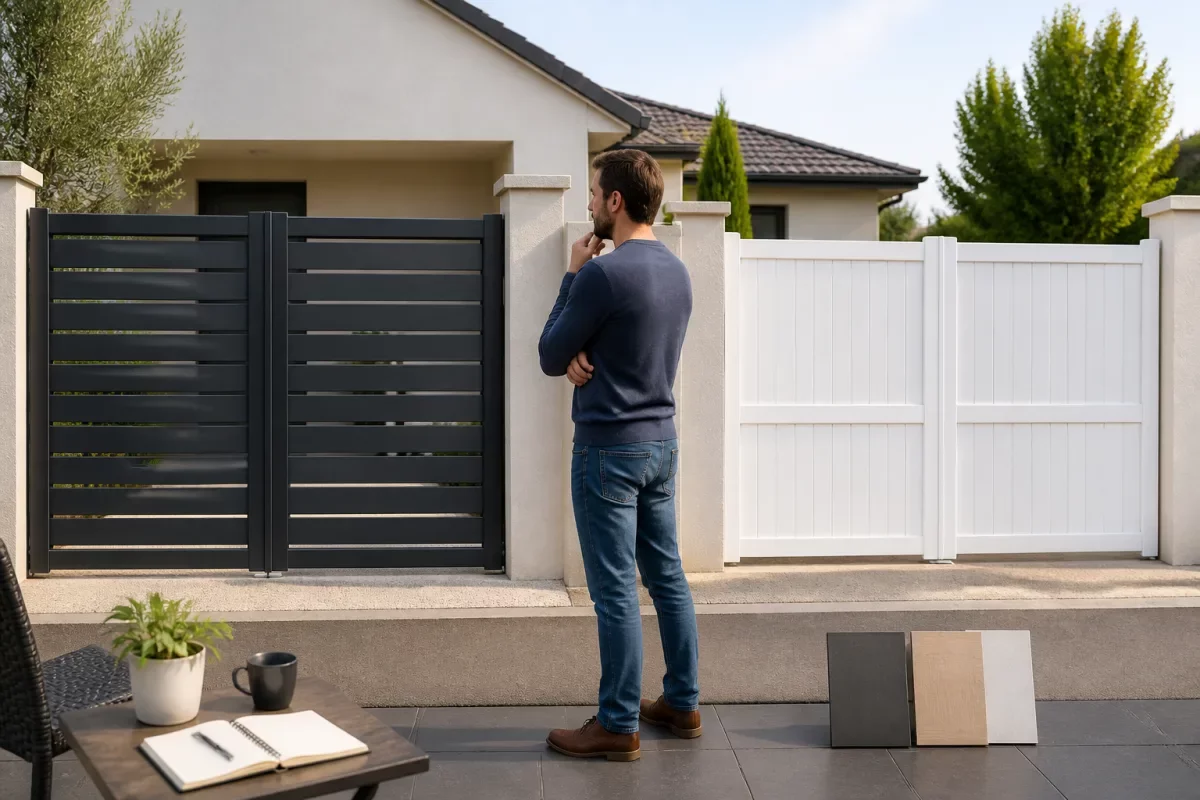
In brief
💰 PVC remains the most economical choice for a simple entrance, with little exposure and reasonable dimensions. It requires little maintenance but is less suitable for intensive use and wide openings.
🔒 Aluminum takes the advantage for a main gate that is secure, durable, and aesthetic. It resists corrosion, does not rust, and offers better mechanical stability over time.
🧽 Regarding maintenance, both materials are easy to handle: clear water or soapy water is generally enough. The real difference lies more in visual stability, UV resistance, impact resistance, and rigidity.
🏡 For a swing, sliding, or motorized gate, the right choice also depends on the configuration: width, wind exposure, frequency of opening, need for privacy, and quality of installation.
How to choose between aluminum or PVC gate without making a mistake?
Between an aluminum gate and a PVC gate, the best choice mainly depends on your priority. PVC appeals with its price and minimal maintenance, while aluminum takes the lead as soon as you seek more robustness, better longevity, and more credible security for a main entrance.
The comparison aluminum or PVC gate: which to choose often starts with price. It makes sense: a gate represents a visible expense, especially when you have to add installation, motorization, pillars, accessories, and sometimes masonry. But limiting yourself to the entry ticket can distort the reasoning. A gate is not a decorative object that you replace every two years; it is an exterior closure exposed to rain, sun, gusts of wind, repeated maneuvers, and sometimes impacts.
In practice, a secondary entrance, rarely used, does not impose the same requirements as a main gate opened morning and evening by the whole family. A gate leading to a small protected courtyard also does not have the same constraints as a wide entrance, exposed to wind, with a motorized sliding gate. That’s why the right question is not just “which material is best?”, but rather: which material is consistent with my actual use?
It is observed in the field that disappointments rarely come from a “bad” material per se. They mostly appear when an economical gate is installed on an entrance that is too wide, too exposed, or too heavily used daily.
Even before requesting a quote, keep three criteria in mind:
- The overall budget: gate, installation, possible motorization, accessories, site preparation.
- Actual maintenance: cleaning, color retention, sensitivity to dirt and UV.
- Security: rigidity, filling, lock, motorization, quality of fixings, and pillar stability.
The best gate is not necessarily the most expensive: it is the one whose material matches the width, exposure, and usage frequency of the entrance.
Aluminum or PVC gate: which one to choose point by point?
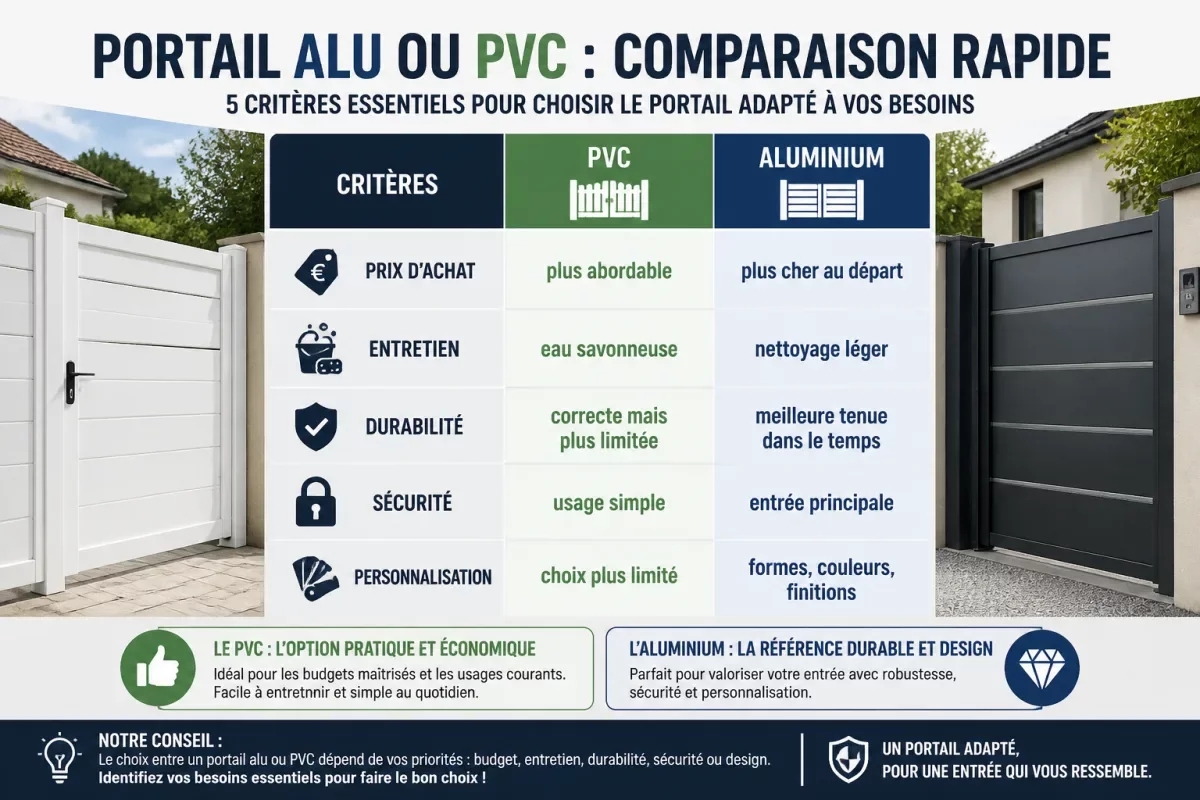
For an honest aluminum vs PVC gate comparison, you need to look at the overall cost, maintenance, durability, customization, and probable lifespan. PVC wins on immediate price. Aluminum wins on robustness, stability, aesthetic choice, and security, especially for a main or motorized entrance.
An aluminum gate and a PVC gate can both suit a single-family home. Both withstand weather, do not require regular painting, and are much easier to live with than a wooden or iron gate to maintain. But their limitations are not the same. Aluminum is known for its corrosion resistance, relative lightness, and ability to maintain a stable structure. PVC, on the other hand, stands out for its affordable price, light weight, and easy cleaning with soapy water.
The table below summarizes the most useful trade-offs before requesting a quote. The levels are deliberately practical: the goal is not to crown a universal winner, but to know where each material becomes relevant.
| Selection criterion | PVC gate | Aluminum gate | To remember |
|---|---|---|---|
| Purchase price | Generally more affordable | More expensive initially | PVC suits tight budgets |
| Maintenance | Soapy water, simple maintenance | Light cleaning, no specific treatment | Close match on routine maintenance |
| Durability | Decent, but more sensitive to UV and deformation | Better long-term performance | Aluminum is more reassuring in the long run |
| Security | Suitable for simple use | More robust and credible for a main entrance | Aluminum takes the lead |
| Customization | More limited choices | Wide range of colors, shapes, and finishes | Aluminum integrates better with demanding projects |
Purchase price and overall cost
The PVC gate is generally cheaper than the aluminum gate. This is its main argument, and it remains perfectly valid for a simple entrance, a narrow gate, or a project where the goal is to close neatly without blowing the budget. However, one must distinguish between purchase price and overall cost. A cheaper gate but less rigid, less durable, or less suitable for motorization can become less interesting if it needs reinforcement, repair, or earlier replacement.
The aluminum gate price is higher initially, especially if you choose a custom model, a refined finish, a solid filling, or motorization. In return, aluminum offers better stability, strong corrosion resistance, and more advanced customization. In other words, it is more considered as an investment for the house entrance than just a simple closure purchase.
Daily maintenance
Regarding maintenance, good news: neither aluminum nor PVC requires heavy treatment. Cleaning with clear water, or soapy water if dirt sticks, is generally enough. No need to sand, stain, or repaint every year. Cherry on the cake, aluminum does not rust and PVC is rot-proof, making both suitable for typical outdoor exposure.
The difference lies in visual aging. PVC can, depending on exposure and material quality, lose its shine or yellow over time due to the sun. Powder-coated aluminum generally retains its appearance better, provided you choose a quality finish and regularly clean off pollution deposits, pollen, or salt in coastal areas.
Security and Strength
For a main entrance, security weighs heavily. Aluminum generally guarantees enhanced security compared to PVC, as it offers better rigidity and structural resistance. This does not mean that a PVC gate offers no protection, of course. But over a large width, with a solid or semi-open gate, frequent openings, and motorization, aluminum inspires more confidence.
It should be noted that the material is not everything. A secure gate also depends on the filling, the lock, the hinges, the rail in the case of a sliding gate, the quality of the pillars, and the installation. A poorly installed aluminum gate will be less reliable than a properly sized and well-installed PVC gate. That is why you need to look at the entire system, not just the material sheet.
The security of a gate depends as much on its rigidity as on the quality of its installation, its fixings, and its accessories.
Aesthetics and Customization
In terms of style, aluminum clearly has more leeway. It can be custom-made with different shapes, colors, heights, and cutouts. It adapts just as well to a contemporary house with a solid anthracite gate as to a more traditional facade with an openwork design. PVC offers decent finishes, sometimes with imitations or varied shades, but its palette generally remains more limited than that of aluminum.
Overall, aluminum enhances the house entrance more. It is not just a matter of taste: a well-proportioned, stable gate that is coherent with the fence immediately gives an impression of seriousness. PVC, on the other hand, has a more functional appearance. This is not a flaw if your goal is simple: to close neatly, pay less, and limit maintenance.
Which Material to Choose According to Your Profile?
The right choice depends on your dominant priority. If you are primarily looking for an economical gate for a simple entrance, PVC remains consistent. If you want a durable gate, more secure, customizable, and suitable for intensive daily use, aluminum often becomes more rational despite its higher price.
If Your Priority Is Budget
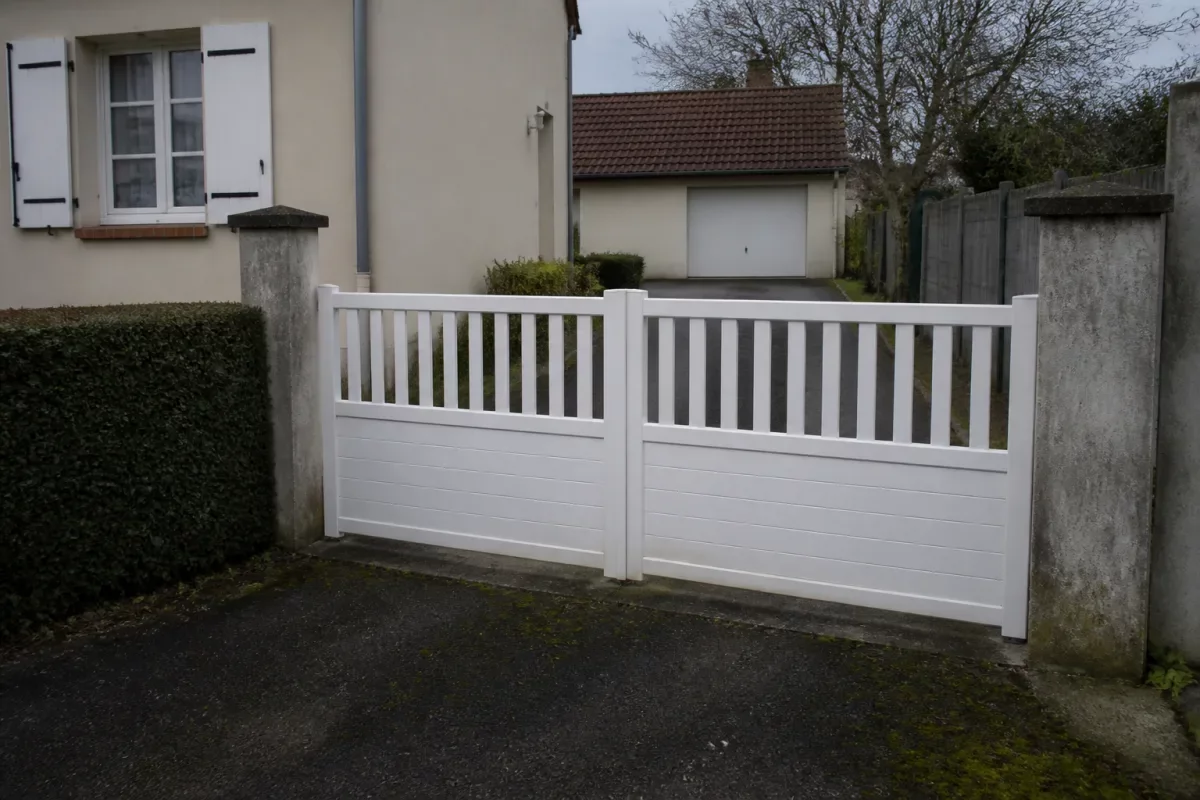
PVC is the logical choice if you need to control immediate expenses. It is lightweight, easy to handle and install, which can also simplify some projects. For a secondary entrance, a small swing gate, or a house located in a less exposed area, it checks many boxes without requiring a large financial effort.
However, compromises must be accepted from the start. PVC is less resistant than aluminum, its aesthetic palette is more limited, and it may be less suitable for large dimensions. If you choose this option, favor a good quality model and, when the width or exposure requires it, an aluminum frame to reinforce the structure.
If You Are Looking for Durability and Peace of Mind
Aluminum becomes interesting as soon as you think over several years. It withstands weather well, does not rust, requires no specific treatment unlike wood or iron, and generally does not deform as an insufficiently reinforced PVC might. Cherry on top: it also allows you to choose a more precise design, which matters when the entrance is very visible from the street.
An exterior closures installer observes that families who open their gate several times a day rarely regret choosing aluminum, especially when the gate is wide, solid, or motorized. The initial extra cost is often better accepted when daily use is intensive.
If You Want to Enhance Entrance Security
For a main entrance, aluminum is often the best choice. Its robustness, mechanical stability, and compatibility with more demanding configurations make it a more reassuring solution. This is particularly true for a solid, tall, motorized gate or one exposed to wind. In other words, if your gate must both close, protect, last, and give a solid image, aluminum starts with a head start.
PVC remains feasible if the security need is moderate: small entrance, quiet area, light gate, low-intensity use. But if the priority is clearly to secure access, it is better not to skimp on the structure, fastenings, lock, and quality of installation.
Which special cases really change the decision?
The opening system, motorization, and climatic exposure can tip the choice. A simple swing gate more easily accepts PVC than a large motorized sliding gate. An entrance exposed to wind, sun, or dirt also requires more rigidity and stability over time.
Swing gate or sliding gate
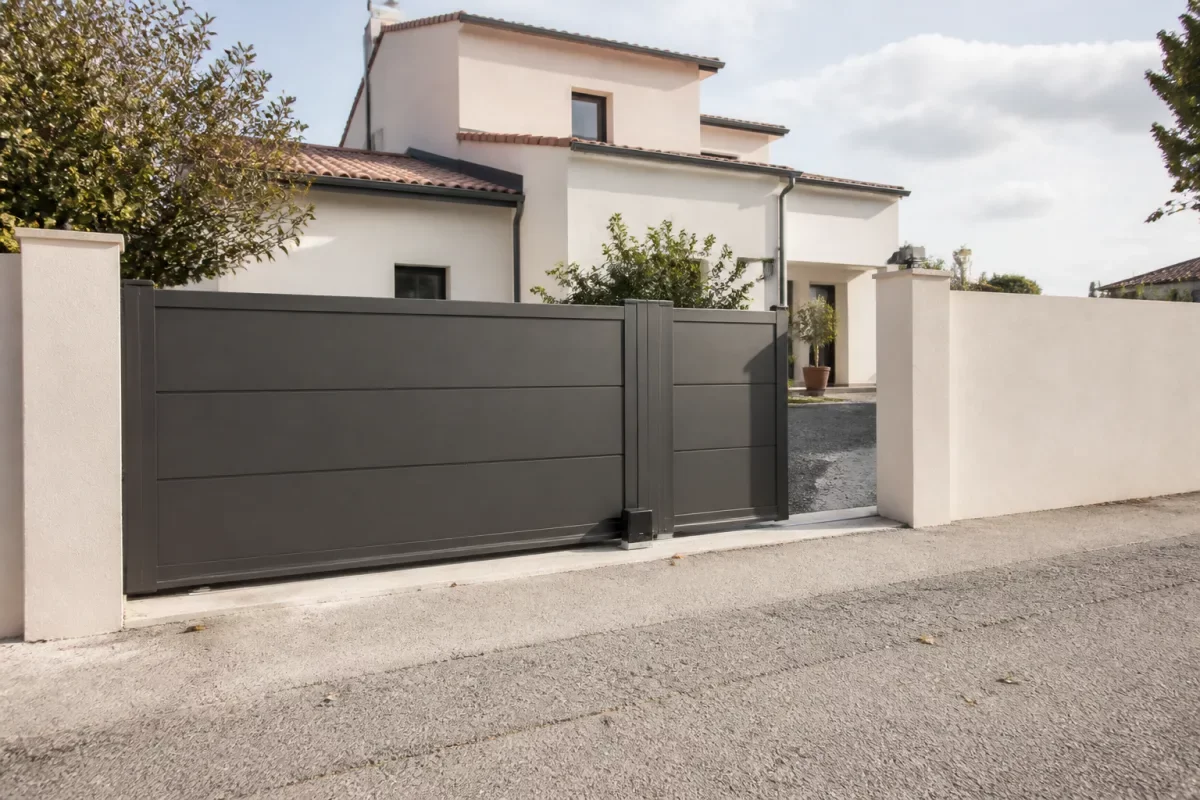
A swing gate is often simpler to design and can suit both materials, provided the leaves remain properly sized. PVC can perform adequately on a moderate width and reasonable exposure. Aluminum becomes more relevant as soon as the leaves are large, solid, or heavily used.
A sliding gate, on the other hand, requires a different logic. The single leaf can be long, sometimes heavy, and it moves on a rail or self-supporting system depending on the configuration. In this context, aluminum’s rigidity is a real advantage. A PVC sliding gate can exist, but it must be seriously reinforced to avoid deformation and poor adjustments over time.
Motorized gate
A motorized gate adds constraints. The motor repeats the same effort at each opening, the fastenings work, and the gate must remain well aligned to avoid friction. Aluminum, light and rigid, is often comfortable in this setup. PVC can also be motorized, but attention must be paid to the type of motorization, structural reinforcement, and compatibility with the chosen model.
Entrance exposed to wind or sun
An exposed entrance changes everything. Wind exerts significant pressure on a solid gate, especially if the leaves are wide. The sun can accelerate visual aging, notably on certain PVCs. In a very sunny area, an aluminum gate with quality finish generally offers better appearance retention. In a windy area, it is especially necessary to check the filling, fastenings, pillars, and wind resistance.
Good to know: before modifying or installing a gate visible from public space, it may be useful to check local urban planning rules. Depending on the municipality, the local urban plan may regulate the height, color, or appearance of fences and gates. The Service-Public.fr gate offers a useful entry on urban planning procedures for individuals.
What mistakes to avoid before requesting a quote?
The most frequent mistakes are to look only at the price, forget the actual dimensions, underestimate installation, and choose a material without considering exposure. A good quote must specify the type of opening, reinforcements, motorization, accessories, and site constraints.
Before signing, take the time to check what is really included. An attractive price can hide essential options: lock, stopper, rail, motorization, remote controls, reinforcements, finish, removal of the old gate, or masonry repair. And yes, handling all these details manually is no fun, but it is often where the difference between a fair quote and a bad surprise lies.
- Don’t just compare the material: also compare the profile section, filling, and accessories.
- Check the exact dimensions: width between pillars, desired height, possible slope, available clearance.
- Plan for motorization: even if it is planned for later, the gate must be compatible from the start.
- Consider the exposure: wind, sun, rain, sea spray, dust, and proximity to a road.
- Ask about the nature of the warranties: material, finish, motorization, installation, and wear parts.
Regarding environmental impact, both materials can be recyclable depending on available channels, but the most responsible approach is also to choose a durable, repairable gate suited to the use. ADEME regularly reminds, in its responsible consumption advice, the importance of extending the lifespan of equipment and favoring choices that avoid premature replacement; you can consult its resources on waste and everyday object management.
Conclusion: aluminum or PVC gate, which to choose according to your priorities?
If your priority is to close a simple entrance with a tight budget, the PVC gate remains a coherent option. It is economical, lightweight, easy to maintain, and sufficiently practical for moderate use. Provided, of course, that you do not expect it to do what it cannot: withstand very large widths without flinching, intensive use, or high security requirements.
If you are looking for the best balance between security, durability, aesthetics, and peace of mind, the aluminum gate is generally the most rational choice. It costs more, yes, but it resists corrosion, does not rust, is highly customizable, and holds up better over time. For a main entrance, a sliding gate, a motorized project, or a house you want to enhance, aluminum clearly takes the advantage.
To summarize, the question aluminum or PVC gate: which to choose does not call for a single answer. It calls for a clear decision: PVC to pay less for simple use; aluminum to invest in a more robust, durable, and secure closure.
Key takeaways
- 💰 PVC is the smart choice for a simple entrance and a tight budget.
- 🔒 Aluminum provides more reassurance for securing a main entrance.
- 🧽 Both materials require little maintenance, especially with regular cleaning.
- 🌦️ Wind, sun, and large dimensions often favor aluminum.
- 📋 A serious quote must include installation, accessories, motorization, and site constraints.
FAQ
What are the disadvantages of a PVC gate?
The PVC gate is less rigid and generally less durable than aluminum. It may also offer fewer colors and become more sensitive to visual aging, especially under strong sun exposure. For a large width, an aluminum frame is often preferable.
What is the best material for a main entrance gate?
For a main entrance, aluminum is often the best choice thanks to its robustness, corrosion resistance, and better longevity. PVC remains suitable if the use is simple, the width moderate, and the budget a priority.
Can a PVC gate be motorized?
Yes, a PVC gate can be motorized, but you need to check the model’s compatibility, the rigidity of the leaves, and the possible presence of reinforcements. For a wide or heavily used gate, aluminum is generally more comfortable and stable.
Does an aluminum gate really require little maintenance?
Yes. An aluminum gate does not rust and does not require specific treatment like wood or iron. Periodic cleaning with clear or soapy water is usually sufficient, especially in polluted, dusty areas or near the coast.
Should you choose a solid or openwork gate?
A solid gate better protects from prying eyes but catches more wind. An openwork gate is visually lighter and limits wind resistance. The right choice therefore depends on your need for privacy, exposure, and the strength of the pillars.