
Complementary Health Solidarity: Conditions, Beneficiaries, and Procedures
The complementary health solidarity helps many households avoid having to choose between getting medical care and maintaining a manageable budget. And frankly, it’s anything but an administrative gimmick: when income is tight, the CSS can make a difference for a consultation, glasses, or hospitalization.
What needs to be clarified is the trio that often blocks applications: who is eligible for CSS, how resources are calculated, and which procedures allow for obtaining a response without scattering efforts. Here is the user guide, without unnecessary jargon and with the right reflexes to avoid delayed files.
Sommaire
In Brief
🩺 The complementary health solidarity replaces a traditional mutual insurance for households with modest incomes. Depending on the situation, it is free or requires a contribution ranging from 8 to 30 € per month.
👨👩👧👦 Eligibility is assessed for the entire household, with resources reviewed over the last 12 months. A stable and regular residence in France remains essential, including for certain foreigners with regular residence status.
🧾 The application is made via ameli or by paper form. The smartest approach is to first prepare proof of income, household composition, and administrative status, then check the result on the official portal.
Who Can Benefit from Complementary Health Solidarity?
Yes, if you live in France in a stable and regular manner, are affiliated with Health Insurance, and your household income remains below the thresholds. CSS can be free or require a small monthly contribution depending on your age and situation.
The basic rule is simple: the complementary health solidarity targets people with modest incomes who are already affiliated with Health Insurance. In practice, this concerns precarious employees as well as retirees, job seekers, single-parent families, or self-employed individuals whose activity no longer generates much income. The core issue is not social status, but the actual income level of the household.
A stable residence in France is also required, generally for at least three months, and a regular residence status for concerned foreigners. The most common cases remain beneficiaries of the RSA, for whom eligibility can be automatic, but also people receiving AAH, ASPA, or households that switch after a drop in income. The official portal complementaire-sante-solidaire.gouv.fr and the ameli page on beneficiaries summarize this logic well.
In reality, many people think they are “not poor enough” to apply. However, CSS is not limited to extreme situations. A drop in activity, a transition to unemployment, a separation, or a low retirement pension can be enough to shift the threshold. At CPAM reception desks, it is often observed that files are submitted late even though eligibility existed for several months.
On the ground, a CPAM reception agent notes that many apparent refusals mainly come from incomplete declarations. A forgotten alimony payment, a small survivor’s pension, or occasional income can change the calculation result. Families often report that after correction, the official simulator no longer shows the same answer at all.
How are resources and thresholds calculated?
The calculation is based on a fairly simple idea, but the details matter: Health Insurance looks at the income of the entire household over a recent reference period, then compares it to a threshold that depends on the number of people in the household and the territory. In other words, a single person, a couple with two children, and a large family do not start from the same point.
It is most useful to think in terms of family composition and period, not just “monthly salary.” Generally taken into account are salaries, unemployment benefits, pensions, self-employed income, certain benefits, and, depending on the case, the resources of the spouse or persons attached to the household. The official simulator is valuable because it avoids rough estimates that give false hopes or unnecessary fears.
| What to look at | Why it is important | Concrete example |
|---|---|---|
| Household composition | The threshold depends on the number of people taken into account | A single person is not assessed like a couple with children |
| Resources from the last 12 months | The calculation smooths out fluctuations and better reflects the real situation | A recent drop in activity can change eligibility |
| Territory of residence | Rules can vary between mainland France, overseas departments, Mayotte, and Alsace-Moselle | Thresholds are not read exactly the same way everywhere |
The key point not to miss is the complete declaration. If you omit a regular aid, a pension, or supplementary income, the calculation becomes incorrect. And if your household situation has recently changed — separation, birth, moving back with parents, a child leaving — it must be reported, because the relevant threshold is no longer the same.
How to apply for complementary health solidarity?
The application is done online on ameli or with a paper form, then with the requested supporting documents. The good reflex is to submit a complete file, because missing documents slow down the review and can delay the certificate unnecessarily long.
The process is not complicated, but it requires some method. From the Service-Public file, the general logic is found: check the right, complete the application, submit the documents, then wait for the decision. The most efficient remains to prepare everything needed before clicking, so as not to play ping-pong with the supporting documents.
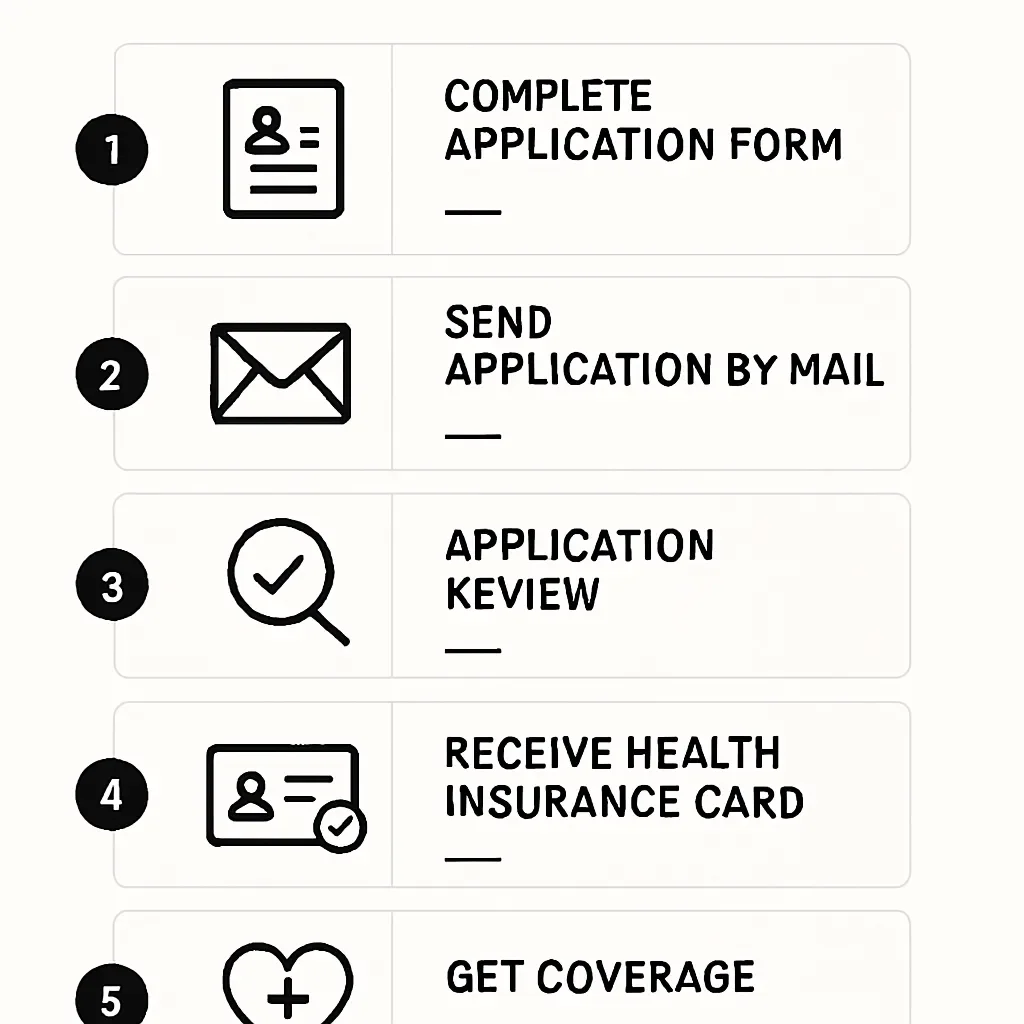
- Do a simulation on the official portal or in your ameli account to check if your household falls within the thresholds.
- Gather the documents: identity, address, social security number, proof of income for the last 12 months, and, depending on the case, documents related to your household.
- Fill out the application online or on the paper form if you prefer a physical submission.
- Submit the file to your CPAM or to the complementary organization indicated in the procedure.
- Wait for the response then keep the certificate, as it serves to show your rights to health professionals.
Little practical advice: if you already have a mutual insurance, do not cancel it blindly before the final decision. A coverage gap, even a short one, can quickly become troublesome when you have to pay expenses urgently. The Ministry of Solidarity’s portal also reminds that the C2S can cover the entire household, which changes the way to manage the existing contract.
What does the complementary health solidarity cover, and what does it not pay for?
The complementary health solidarity covers the complementary part of most routine care, hospitalization, and part of dental, optical, and hearing equipment, often without upfront payment. However, comfort services, certain extra fees, and options outside the reimbursable package remain your responsibility.
| Covered with the CSS | Often reimbursed at 100% of the base rate | Frequent out-of-pocket expenses |
|---|---|---|
| Consultations, treatments, tests | Yes, within base rates | Extra fees, if applied outside the CSS framework |
| Hospitalization | Co-payment and daily fee | Private room, comfort services |
| Dental, optical, hearing | According to regulated packages and prices | Equipment outside the package or more expensive choices |
The important nuance is that not everything is “magically free” in the broad sense. The CSS mainly protects against expenses that hurt the budget: consultation, treatments, hospitalization, glasses or prostheses when they fall within the planned frameworks. This is where the difference between a theoretical right and a real financial shield is seen. For acts outside the framework, the bill may remain partially your responsibility.
CSS is not just another social aid. It is a tool that reduces the abandonment of care, provided you understand where coverage ends and out-of-pocket expenses begin.
Alongside the rise of expensive care, there is another very concrete advantage: the third-party payment. Simply put, you do not have to advance the full cost at professionals who offer it. This is especially appreciated when you go from a pharmacy to a consultation and an exam, because small amounts quickly add up to a big hit on the budget. CSS precisely limits this snowball effect.
Should you keep your mutual insurance if you get the CSS?
In practice, no, not necessarily: if CSS is granted, a traditional mutual insurance often becomes unnecessary for the part already covered. But you need to think carefully, because a contract may cover other household members or have specific cancellation deadlines. The right reflex is therefore to wait for confirmation, then notify the insurer without delay.
In real life, decisions are not always clear-cut. In Marseille as in Lille, families are seen keeping their mutual insurance a few weeks too long “just in case,” even though CSS is already active. This sometimes means paying twice for overlapping protection. Conversely, canceling too quickly can create a coverage gap. In short, you need to keep a cool head and check the dates before acting.
If your household is mixed — for example, one parent eligible for CSS and a partner who is not — the strategy may change. You then need to compare what the family mutual covers, what CSS already takes care of, and what remains truly useful. In this case, the best option is not always the most obvious on paper.
Renewal, refusal and special cases: what to do?
The CSS is not granted for life: rights are granted for 12 months, then reviewed. You must therefore monitor the expiration date and prepare the renewal before the end of the rights, especially if your resources have changed or if the household composition has changed. The worst thing is not losing the right; it is letting the deadline pass without doing anything.
If your file is refused, the first reflex is to check the cause: resources too high, missing document, unjustified stay, incorrectly reported household, or incomplete declaration. A refusal is not necessarily final. A corrected, better documented file can sometimes succeed in the next round. It is also noted that the most common errors relate to forgotten income or a poor consideration of the household.
Special cases deserve close attention: students, Swiss cross-border workers, people at the end of rights, beneficiaries of AAH or ASPA, residents of the DOM and Mayotte. The rules are not all read in the same way, and the right contact is not always the one you initially imagined. For situations spanning multiple schemes, it is better to consult the official C2S page or your fund before preparing the file.
It is observed on the ground that renewal oversights mostly happen when the deadline is noted in a letter filed “for later.” A social worker often says that the simplest files are those where the end date is already identified three months in advance. This little lead time avoids breaks in rights and unpleasant surprises at the pharmacy.
FAQ on the complementary health solidarity
Is the complementary health solidarity free for everyone?
No. It can be free for the most modest households, but a monthly contribution may apply when exceeding the first resource level. The amount depends on age and can range, depending on the case, from about 8 to 30 € per month.
Can you apply for the CSS when you are a student?
Yes, but it all depends on your administrative situation and household affiliation. A student living alone is not assessed like a student still fiscally or financially attached to their parents. You must therefore look at the household in terms of the application, not just the student status.
How long does it take to get a response?
When the file is complete, the response usually arrives within a few weeks, with a processing time often close to 2 months. If a supporting document is missing, the delay quickly lengthens. The safest is to track your file and keep a copy of all documents sent.
Does the CSS also work in the DOM and Mayotte?
Yes, but the rules are not always the same as in mainland France. The ceilings and certain conditions vary according to the territory. If you move, it is better to check your local situation before submitting or renewing the application.
What to do if my income increases after approval?
Most often, the right is reviewed at the annual expiration. If your situation changes significantly in the meantime, you must update your file to avoid an inaccurate declaration. In short, it is better to report a significant change than to discover it at renewal time.
Can the CSS cover the whole family?
Yes, it can cover the entire household if everyone meets the conditions. This is precisely what makes it interesting: a single right can protect several people at once, provided that the resources and administrative situation are consistent for everyone.