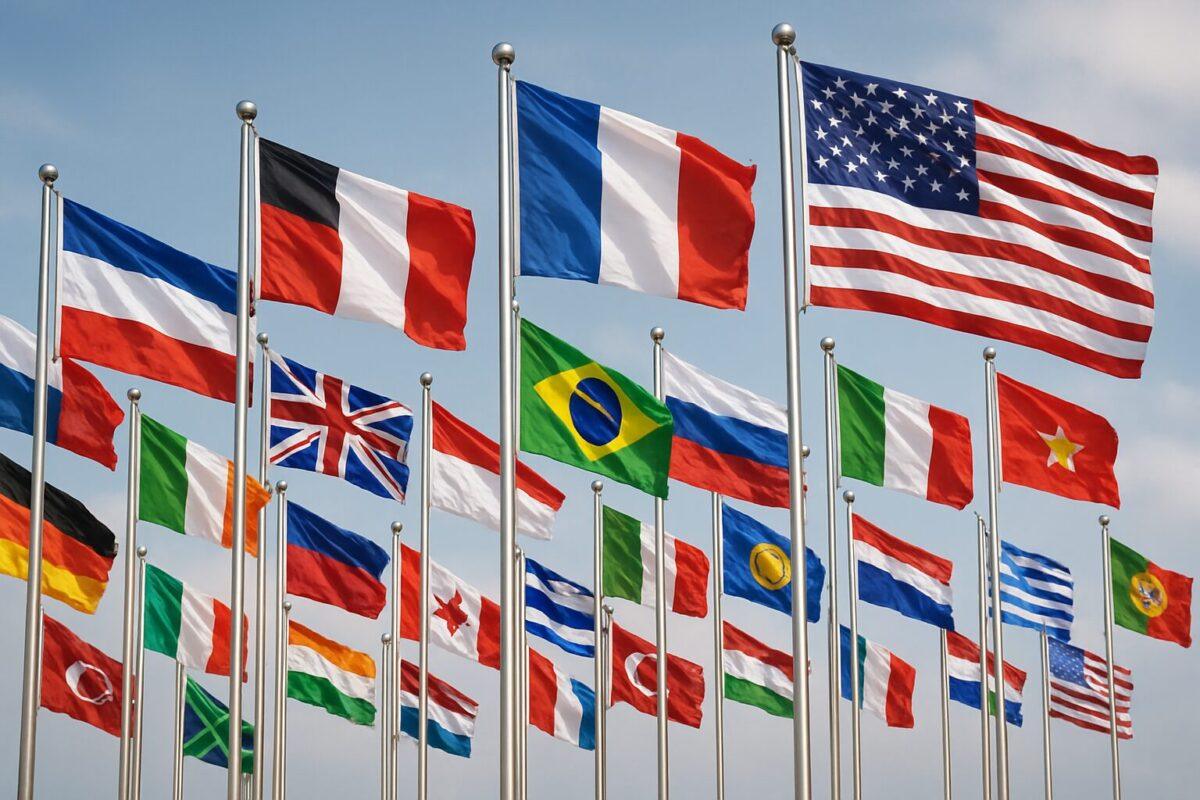
Flags fascinate because they condense an identity, a memory, and a collective project into a few colors. From medieval battlefields to stadium stands, from institutional facades to shop windows, they signal, gather, and inspire. This educational guide traces the history of flags, explains their standards, provides selection guidelines (materials, sizes, finishes), and shares anecdotes to better understand this universal visual language.
Sommaire
1. Brief history of flags (vexillology)
Long before the era of nations, peoples displayed banners, oriflammes, and standards to mark their presence. In Antiquity, military ensigns guided troops and embodied authority. In the Middle Ages, coats of arms identified lords and cities, while maritime pennants codified the origin of ships. The revolutions of the 18th–19th centuries accelerated the emergence of modern national flags, often bearing ideals (freedom, union, sovereignty). Since then, the flag has become a powerful marker of belonging and national narrative.
2. Anatomy of a flag: useful vocabulary
The pole refers to the vertical support and the hoist edge is the attachment border. The canton designates the upper part at the hoist (e.g., the Union Jack in the Australian flag). The ratio (proportions) varies by country: 2:3, 3:5, 1:2, or more rarely non-rectangular shapes. Colors can be solid, striped, with coats of arms or central symbols. Understanding these elements helps recognize the graphic logic of a flag and order the correct finish (grommets, strap, halyard, sleeve).
3. Standards, codifications, and best practices
Although there is no single global standard, shared references exist. The ISO 3166 codes (alpha-2/alpha-3) are often used in catalogs to identify countries. Maritime flags rely on the International Code of Signals to transmit messages. Common recommendations concern protocol preference (display order), half-mast for mourning, cleanliness and integrity of the flag. Manufacturers also specify shades close to industrial references (e.g., Pantone equivalents) to ensure faithful color reproduction.
4. Flags and visual communication
In sports, the flag is a silent shout: it unites supporters and teams. In business, oriflammes and beach flags enhance visibility at trade shows, points of sale, or events. In public spaces, flag displays provide a visual rhythm to national holidays and cultural seasons. Communities and associations increasingly use custom flags to embody their message.
5. Choosing well: materials, sizes, finishes
- Materials: woven polyester (durable/outdoor), lightweight mesh (floating effect), satin (ceremonial indoor).
- Sizes: adapt to viewing distance and pole (often 1/4 to 1/3 of the pole height).
- Finishes: reinforced hems, double stitching, grommets or strap and halyard, UV treatments.
- Printing: front visible on back by transposition, or double thickness for perfect reading on both sides.
Maintenance: limit friction on corners, clean cold if necessary, check attachments. In sites very exposed to wind, alternating two copies significantly extends the lifespan.
6. Anecdotes and vexillological peculiarities
Nepal has the only national flag that is not rectangular, composed of two superimposed pennons. Some countries have changed their flag several times throughout their history; Libya, for example, flew an entirely green flag at the end of the 20th century before returning to a tricolor design. Very similar flags are distinguished by coats of arms (e.g. Ireland/Italy vs. Mexico). Finally, displaying a flag upside down is traditionally perceived as a distress signal in certain contexts, hence the importance of respecting the orientation.
7. Where to buy easily and with full confidence?
Specialized online stores make it easy to search by country, size, material, or use. To save time and get suitable finishes (grommets, sleeve, mast accessories), rely on a recognized online flag store: large catalog, customizable variations, controlled delivery times.
FAQ — your questions about flags
1) Which material should be preferred for intensive outdoor use?
Woven polyester 110–150 g/m² remains the standard. Pair it with reinforced stitching and metal grommets to withstand gusts.
2) How to choose the right size?
Aim for a ratio of 1/4 to 1/3 of the mast height. On a facade, 100×150 cm or 150×225 cm offer a good balance of visibility and space.
3) Do colors fade in the sun?
UV-resistant inks and a good textile base limit fading. Reduce continuous exposure during the hottest hours.
4) Can I order a custom flag?
Yes. Provide a vector file (SVG, AI, PDF) or an HD image. Specialized stores offer templates and color control.
5) What are the lead times for customization?
Generally count on 3 to 10 business days depending on production queue and shipping. Plan ahead for large formats or multiple series.
6) What are good display practices?
Respect cleanliness, integrity, and orientation. In protocol, consider the order of precedence and half-mast during mourning periods.
7) How to extend the lifespan?
Position the mast away from sharp edges, monitor the wind, repair early tears, and alternate two copies if needed.
Conclusion
A graphic, cultural, and memorial object, the flag tells a story while carrying a clear message. By understanding its vocabulary, usage norms, and material constraints, one chooses better and displays longer. For a simple and reliable purchase, the online flag store offers quick access to national, regional, or custom models, with finishes adapted to each context.