Quick verdict: for whom, and at what mental price
The “mobile home” project works very well if you are looking for a regular base (weekends + holidays) and accept a recurring annual budget (plot rent, fees, maintenance). On the other hand, it fits less well those who want total freedom of movement or a classic real estate appreciation. My recommendation: move forward if you have a favorite region, the ability to project yourself over 5 to 10 years, and if the plot contract is clear, stable, and compatible with your stay habits.
Recommended for: families, active retirees, seasonal nomadic teleworkers, nature lovers who want comfort.
Strengths and weaknesses of a mobile home in a campsite
Before talking about models, let’s be honest: this type of residence has obvious advantages… and structural constraints. Listing them early avoids “love at first sight” purchases that turn into headaches.
- Immediate comfort: kitchen, bathroom, bedding, storage, terrace depending on configuration.
- Camping life: services, pool, activities, sometimes kids’ club, seasonal shops.
- More transparent budget: purchase + annual fees, with identifiable items.
- Flexible use: short stays, long holidays, hosting family/friends.
- Plot not acquired: the location depends on a contract (conditions, duration, increase).
- Possible depreciation: a mobile home ages, value depends on model and campsite.
- Site rules: internal regulations, opening periods, vehicles, works.
- Resale regulated: sometimes buyer validation, conditions on model age.
Understanding what you are really buying: mobile home, plot, rights
A key point: a mobile home is generally a mobile leisure residence installed in a campsite or a residential park. You become the owner of the property (the mobile home), and you rent the right to occupy a plot via a separate contract. This distinction changes everything: the quality of the campsite, its management, its positioning and its plot policy influence your comfort… as much as the resale.
Concretely, your project rests on three pillars:
1) The mobile home: condition, layout, insulation, equipment, terrace, brand/model.
2) The campsite: geographical location, level of services, opening, atmosphere, rules.
3) The contract: annual plot rent, fees, duration, renewal conditions, conditions for selling the mobile home on site.
When hesitating between two offers, I advise deciding based on the “campsite + contract” pair rather than the color of the facades. A mobile home can be replaced, renovated, resold. A vague contract, however, sticks to your holidays year after year: unexpected increases, access constraints, difficult resale. Lasting comfort starts on paper.
La Plume Cartographe, method note (2026)
Budget: items to plan for before signing
The purchase price draws attention, but the real question is the total annual cost. Anticipating these items prevents the feeling of a “surprise subscription” starting from the second season.
| Item | Approximate idea | To check in your case |
|---|---|---|
| Plot rent | Variable depending on region | Indexation, included services, schedule |
| Charges & services | Depending on the campsite | Water/electricity, maintenance, equipment access |
| Insurance | Depending on coverage | Theft, water damage, storm, liability |
| Maintenance & repairs | To be averaged over the year | Roof, seals, water heater, terrace |
| Transport / installation | If mobile home needs to be moved | Site access, crane, connections |
Simple tip: ask the campsite (or the seller) for a detailed annual forecast, item by item. A clear 12-month document is better than a rough estimate.
If your project is the purchase of a mobile home in a campground, the showcase My Home Flower Campings can serve as a starting point to spot models and offers associated with campgrounds.
Choosing the right campground: location sometimes matters more than the mobile home
Two mobile homes close on paper can offer opposite experiences depending on the site. To aim correctly, observe the campground as a living space: flow in high season, noise, microclimate, distances, services actually open.
Location: the “acceptable distance” on a daily basis
We often project ourselves onto the big summer… then we mostly go in spring, off-season, or on weekends. Test your threshold: 2h30 drive is manageable; 6h changes the usage. Also look at the proximity of your “essentials”: beaches, trails, market, train station, hospital, supermarket.
Plot: sun, wind, privacy, traffic
On site, take a walk around. A very nice plot at 10 a.m. can become stifling at 4 p.m. Look for balance: partial shade, natural ventilation, oriented terrace, reasonable neighbors, not stuck to the playground if you like quiet.
Services: check what is really included
“Pool,” “activities,” “wifi,” “grocery store”: ask for opening dates and conditions (included or paid access, hours, reservation). A campground can be perfect in July-August and much more minimalist off-season, which is not a flaw… if you know it.
Visit checklist: what I systematically look at
To compare two offers without getting lost, use a simple and repeatable grid. The goal: spot weak signals (humidity, overheating, maintenance, rules) before they become expenses.
| Check point | What you observe | Why it matters |
|---|---|---|
| Floor & odors | Flexibility, humidity, stuffiness | Indicator of waterproofing and ventilation |
| Woodwork | Closure, seals, condensation | Thermal comfort and infiltration risks |
| Water heater / heating | Age, maintenance, operation | Frequent breakdown item, comfort impact |
| Terrace | Structure, guardrail, fastening | Safety, longevity, restoration cost |
| Plot | Shade, privacy, noise, access | Quality of stay + resale value |
Good reflex: do the visit under real conditions. Once at noon (sun, heat), once late afternoon (returns, noise, parking). And keep 10 minutes of “silence”: no talking, no photos, just the atmosphere. In a mobile home, comfort depends as much on the plot as on the living room.
The Cartographer’s Pen, field notebook (2026)
Plot contract: clauses that deserve a slow read
The contract (or agreement) governing your plot is the key document. Consider it as a vacation document: it conditions your use, your fees, your resale rights, and sometimes even your ability to change the model.
Duration, renewal, and rent increase
Clarify: initial duration, renewal terms, notice period, method of rent revision. An increase can be normal (costs, inflation), but it must be predictable and explained.
On-site resale conditions
This is a sensitive point. Some campsites impose rules: maximum age of the mobile home accepted on the site, approval of the buyer, administrative fees, obligation to go through an intermediary. Nothing shocking if it is written, transparent, and coherent. The problem is the implicit.
Works, improvements, and “personalization”
Terrace, garden shed, air conditioning, cladding: who authorizes what? According to which standards? With what aesthetic limits? A family campsite often ensures visual harmony and safety. Anticipate to avoid investing in a terrace… then having to modify it.
For guidance on local taxation (tourist tax, municipal rules) and general information, the official pages of Service-Public.fr remain a useful resource to consult when preparing your file.
Which mobile home to choose: layout, seasons, resale
With equal comfort, a good mobile home is one that fits your habits: number of people, lifestyle, season of use, tolerance to heat, storage needs. When buying, also think about “resale” from the start: exiting is part of the plan.
2 or 3 bedrooms: the real question is usage
Two bedrooms are often enough for a couple + children, or for occasional guests. Three bedrooms provide flexibility (friends, grandchildren), but sometimes reduce the size of the living room. Ask yourself a simple question: how many nights per year at full capacity? If it’s rare, a convertible bench and a comfortable bedroom can be better than a cramped third bedroom.
Insulation and equipment: aim for seasonal coherence
If you mostly come in summer, the priority may be ventilation, shade, mosquito nets, a pleasant terrace. If you like the off-season, pay attention to heating, waterproofing, and the mobile home’s ability to stay comfortable when nights cool down.
Terrace: your “extra room”
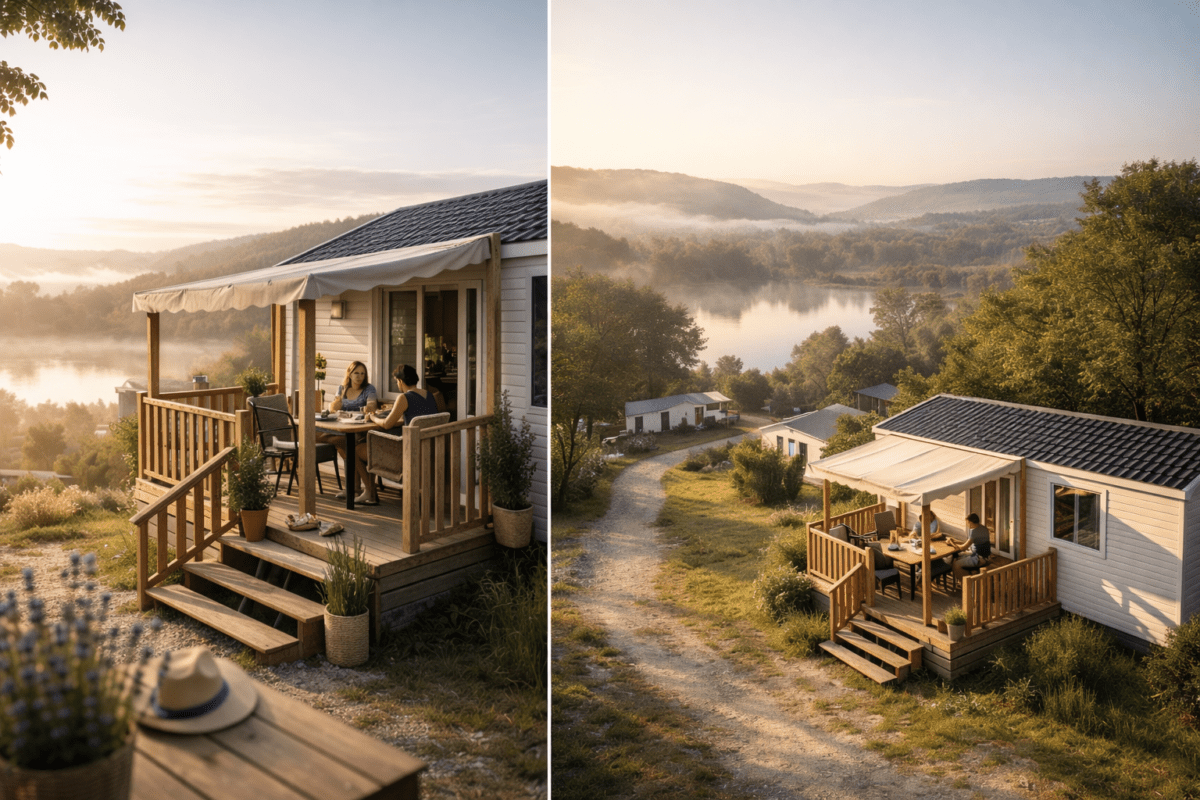
A well-thought-out terrace changes life: outdoor meals, reading, games, aperitif, storage for wet items. Check the quality of the structure, anchoring, and safety (railings, steps). In many projects, the terrace is the most used part… so it deserves the most attention.
Common mistakes: those that cost the most (in time and energy)
Bad surprises do not always come from a visible defect. They often arise from a mismatch: actual use vs imagined promise, underestimated annual budget, or contract read too quickly.
- Overpaying for emotion: a crush without realistic annual costing.
- Ignoring the plot: noise, shade, traffic, overlooking… then lasting regret.
- Discovering the rules afterwards: forbidden works, limited season, regulated resale.
- Delaying insurance: weather damage and liability poorly covered.
The right antidote: a simple file with your non-negotiable criteria (distance, quiet, openness, services), a maximum annual budget, and reading the contract “pen in hand.”
Next step: moving from dream to file (without stress)
If you’ve made it this far, you already have the essentials: a clear vision of the cost items, points to check, and sensitive clauses. The next steps boil down to three actions: (1) shortlist of up to 3 campsites, (2) visit at two different times, (3) request documents (contract, rules, charges) before any decision. Only then compare mobile homes. With this approach, you buy less “a model” than a sustainable vacation style.
FAQ: frequently asked questions about buying a mobile home in a campsite
Can you live year-round in a mobile home in a campsite?
It all depends on the status of the site and its opening conditions. Many campsites have seasonal openings. Even when access is long, occupancy rules and services (water, reception) can vary. The answer is found in the contract and the internal regulations.
Do you also buy the land with the mobile home?
Most often no: you buy the mobile home and rent the plot through a contract. That’s why reading the clauses (duration, increase, resale) is as important as the condition of the mobile home.
What documents should be requested before signing?
At minimum, ask for: the plot contract, the internal regulations, details of charges and services, and a summary of the resale conditions on site.
When is the best time to buy?
The off-season often allows calmer visits and longer discussions with the team. Spring is useful to check the site’s reopening. Ideally: visit outside July-August, then return once during a busier period.
Should you favor a new or used mobile home?
A new one offers peace of mind on condition and equipment; a used one can offer a better entry price. In both cases, the key remains the camping + contract coherence and the ability to resell without blockage.
How to estimate the resale value of a mobile home?
Look at the general condition, age, quality of equipment, and especially the campsite’s policy: does it accept mobile homes beyond a certain age? Does it impose fees? Does it approve the buyer? These are decisive factors.
What questions to ask about the plot?
Ask about orientation, summer shade, wind risks, proximity to noisy areas, car access, and possibilities for development (terrace, shelter, planting) with possible authorizations.
Is specific insurance needed?
Yes, adapted insurance is generally necessary (at least liability insurance, and often coverage against water damage, storms, theft). The campsite may require a certificate.
What “hidden” charges often recur?
The most common: service options, terrace maintenance, water heater replacement, carpentry repairs, and sometimes costs related to connection or winterizing. It’s better to spread these expenses over the year.
How to compare several offers without getting distracted?
Set 5 “non-negotiable” criteria (distance, quiet, opening, annual budget, resale conditions), then rate each offer on these points before looking at aesthetic details. You will save time and gain peace of mind.