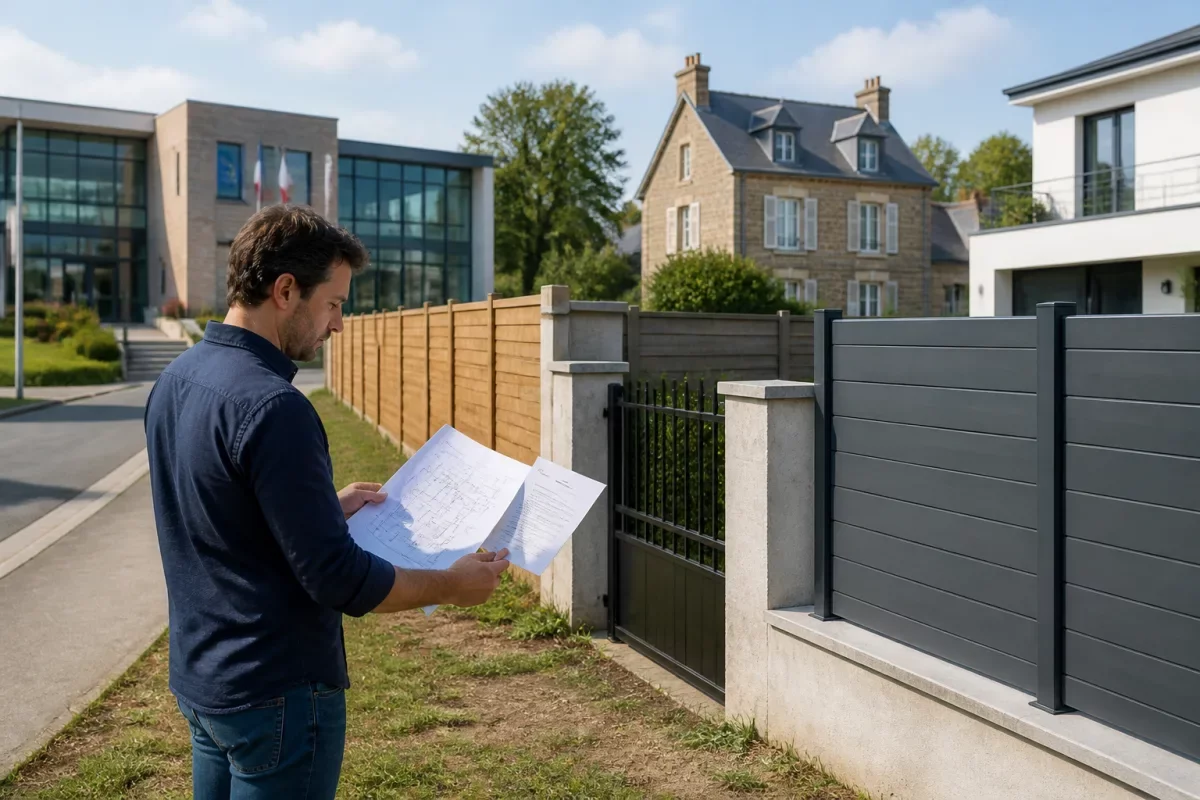
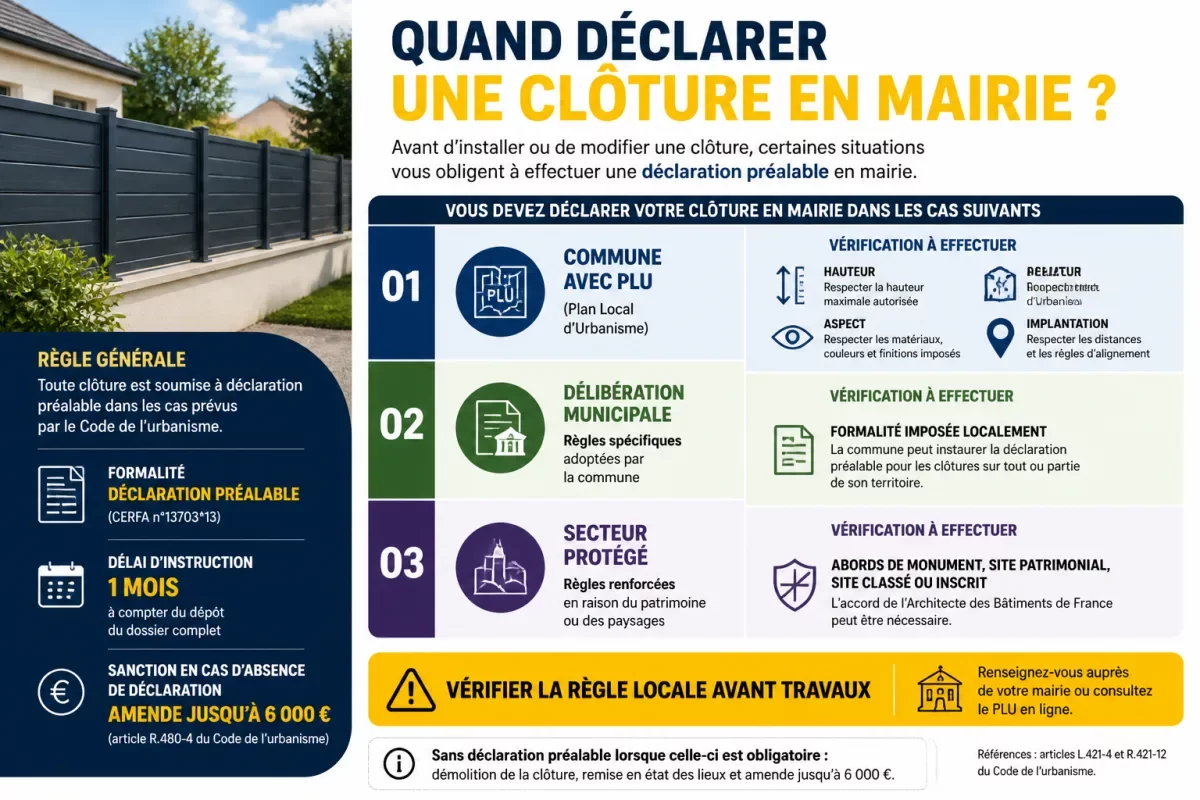
✅ Declaring a fence at the town hall is not automatic everywhere, but the prior declaration becomes common as soon as a Local Urban Plan (PLU), a municipal rule, or a protected sector applies.
🏛️ The sensitive points are almost always the same: height, materials, color, location on the property boundary, and visibility from the public road.
📌 Before work, at least two checks must be combined: the local urban planning regulations and a confirmation from the urban planning department if the project is doubtful.
⚠️ An undeclared fence when it should have been declared can lead to a request for regularization, a modification of the project, or even a redo of the work already done.
Why doesn’t this question have a single answer?
Installing a fence does not always require a prior declaration, but the town hall can impose it depending on the municipality, the PLU, a local resolution, or the presence of a protected sector. Before work, the right question is therefore not “is it always necessary to declare?”, but “is my land subject to a local rule?”.
A fence is not just an object placed between two plots. In urban planning law, it can change the external appearance of a plot, the perception of a street, the safety of a road corner, or the harmony of a heritage sector. In other words, what looks like a simple garden feature can become a fence declaration formality as soon as the local context requires it.
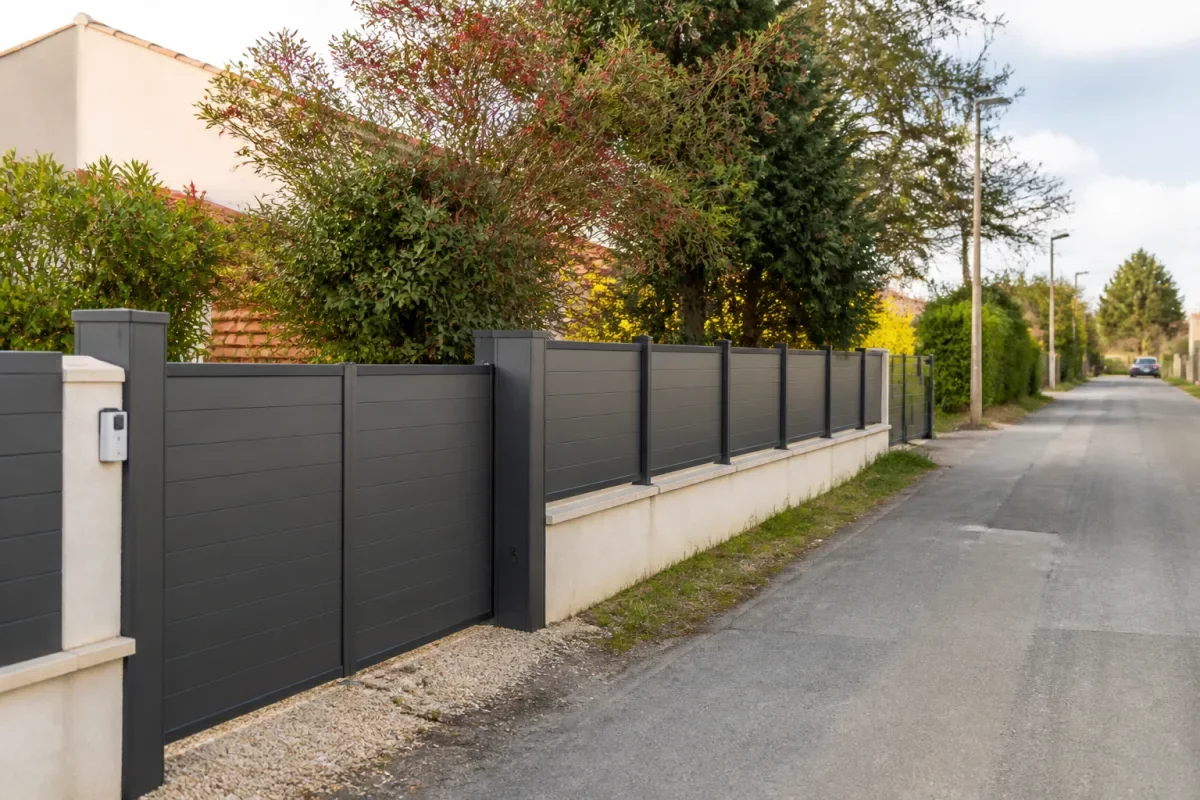
In a residential street, the appearance of a fence visible from public space can be regulated by the PLU or a municipal rule.
The nuance is important: the national law provides a framework, but the municipality can adapt it through its urban planning document. It is this interaction that creates the most frequent errors. An owner reads that a fence does not necessarily require a building permit, then concludes that they can start work freely. However, permits and prior declarations do not serve the same purpose.
The classic trap is to confuse the absence of a building permit with the total absence of any formality.
It is true that a fence is normally not subject to a building permit nor a development permit. But it can be subject to a prior fence declaration. And if the fence accompanies a larger construction, it can also be included in the overall project file. Joking aside, this is often where problems start: no one “forgot the permit,” but everyone skipped the declaration.
What Owners Often Confuse
In practice, the word “fence” covers very different situations. A discreet wire mesh between two gardens, a solid wall facing the street, a motorized gate, a hedge, or a privacy screen made of opaque panels do not produce the same visual effect. Yet, all can be subject to an urban planning interpretation according to local rules.
A fence creation: it changes the state of the land and deserves systematic verification.
An identical replacement: it can be simpler, but still needs to be checked if the appearance actually changes.
A wall, low wall, or pillar: it draws more attention to height, materials, and placement.
A gate: it can be treated with the fence, especially when it changes the appearance from the public road.
A hedge or privacy screen: they can also raise neighborhood, visibility, or local regulation issues.
It is observed on site that errors often arise from a “slight” change: replacing an open wire mesh with solid panels, adding a masonry base, or raising an existing low wall. For the owner, it is an aesthetic improvement; for the town hall, it can become a change of appearance to be verified.
Is a prior declaration required for a fence?
A prior declaration must be filed for a fence when the land is located in a municipality or area where this formality is imposed, notably in the presence of a Local Urban Plan (PLU), a municipal resolution, or a protected zone. The town hall then controls the placement, height, materials, and appearance.
The prior declaration is an urban planning formality lighter than a permit, but it is not merely decorative. It allows the town hall to verify that the project complies with the applicable regulations: placement on the boundary or set back, maximum height, color, materials, possible transparency, treatment of corners, and consistency with the street landscape.
The key point to remember is simple: the town hall does not only validate the idea of “closing off a plot.” It examines how this fence fits into a specific environment. This is especially true in streets where fences form a continuous urban façade, in housing developments, near a busy road, or in areas subject to heritage review.
Land Situation
Declaration Risk
Point to Check Before Work
Municipality with PLU
Frequent
Zone regulations: height, appearance, placement
Municipal resolution imposing the prior declaration
High
Local decision available at the town hall
Heritage site or surroundings of a historic monument
Very high
Heritage constraints and possible opinion
Project on the boundary of a public road
Variable
Visibility, safety, alignment, street appearance
Strictly identical replacement
Lower
Proof of existing state and local rule
For a reliable interpretation, three levels must be distinguished. First, the general law: it frames the cases where a declaration may be necessary. Next, the PLU or local regulation: it details the rules by zone. Finally, the land itself: it may be affected by a protected perimeter, an easement, an uncertain boundary, or a subdivision regulation.
In which cases can the town hall require a fence to be declared at the town hall?
The town hall can require a declaration when the fence is located in a municipality covered by a PLU, in a municipality that has adopted a specific resolution, or in a protected area. Heritage sectors, the surroundings of historical monuments, and certain classified or registered sites increase this vigilance.
The most common case remains that of the municipality which regulates fences in its urban planning document. The PLU can set precise rules: authorized height, prohibited materials, recommended colors, open or solid fence, masonry base, location relative to the street or boundary lines. Cherry on top: these rules can vary from one zone to another within the same municipality.
The three triggers to check as a priority: PLU, municipal resolution, and protected sector.
Protected areas deserve special attention. If the land is located in a remarkable heritage site, near a historical monument, in a classified or registered site, the prior declaration becomes a real tool for controlling the exterior appearance. The urban planning department can also direct the file to the competent contacts when heritage constraints apply. To identify certain perimeters, the Heritage Atlas of the Ministry of Culture can help, without replacing confirmation from the town hall.
It is also necessary to watch out for “ordinary” situations that become sensitive: street corner with visibility issues, very opaque fence on a narrow road, gate installed too close to the public space, low wall encroaching on an alignment, or panels placed on an uncertain boundary. Like a facade renovation visible from the street, a fence can change the reading of a parcel’s facade.
Two identical fences can be treated differently if one borders a protected street and the other a back parcel without public visibility.
Good to know: a prior declaration can sometimes group several small works. If you plan at the same time a fence, a gate, a facade renovation, or a garden shed, it may be more coherent to present a clear file rather than multiply separate procedures. Provided, of course, that the whole complies with local rules.
What should be checked before installing the fence?
Before installing a fence, you need to check the PLU, the situation of the land, the property boundary, any easements, and the subdivision regulations if they exist. In case of doubt, the best protection remains a written confirmation from the urban planning department before purchasing materials.
The first reflex is to read the correct zone of the PLU, not just the general page of the town hall’s website. On the Urban Planning Geoportal, some municipalities make their documents available, but the town hall remains the reference contact to interpret an ambiguous rule. A phrase like “mandatory openwork fences on the road” can completely change the choice between rigid mesh, wooden panels, and solid walls.
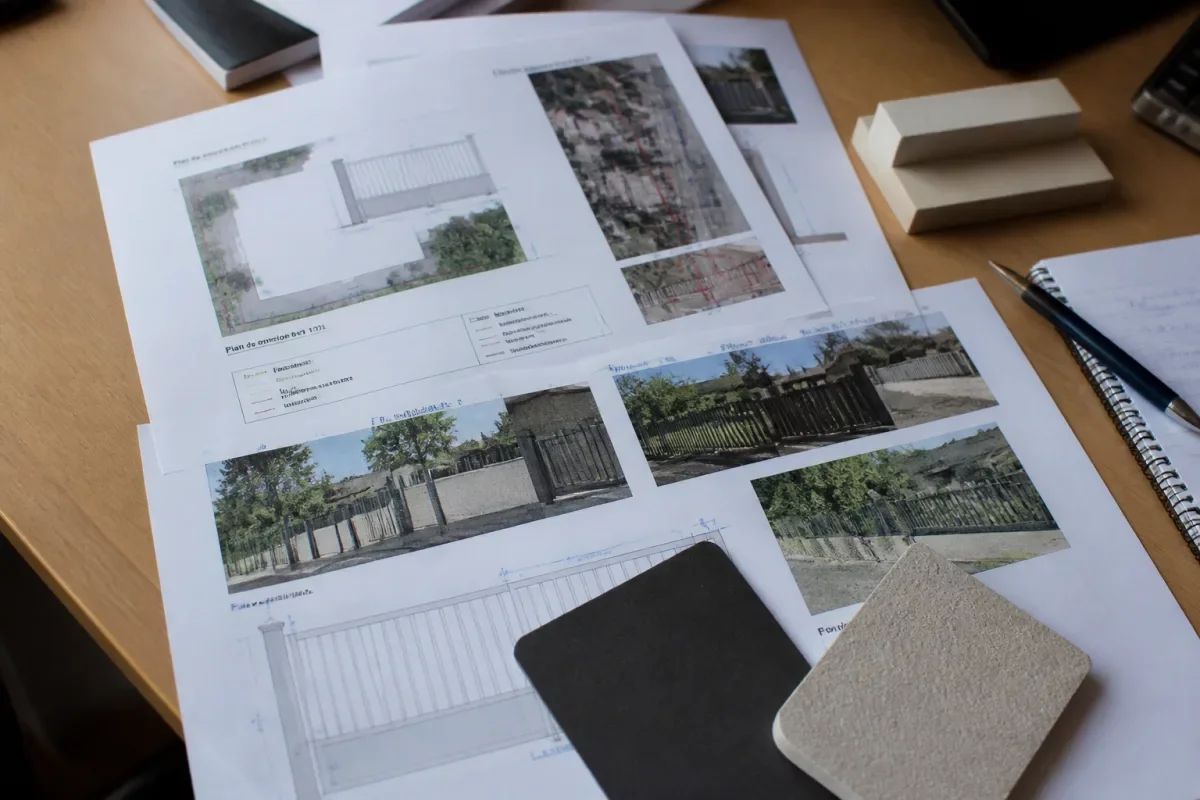
A readable file with plan, photos, and project description reduces the risk of additional requests.
Next, you need to secure the property boundary. A poorly placed fence can trigger a conflict with the neighbor, even if it perfectly complies with the PLU. The boundary marking, when it exists, then becomes a valuable document. Otherwise, it may be wise to consult cadastral documents and, in tense cases, to involve a competent professional. This avoids having to manually regularize the situation because three posts encroach on the neighboring plot.
An urban planning officer in a peri-urban municipality observes that the simplest files are those that clearly show the existing state and the proposed state. Photos taken from the street, indicated height, and described materials: these elements often avoid unnecessary back-and-forth.
The useful checklist before purchasing materials
Before ordering panels or signing the quote, the ideal is to carry out a short but thorough check. It’s not very glamorous, certainly, but it is often what separates a smooth project from one blocked for several weeks.
Identify the PLU zone applicable to the plot and read the rules on fences.
Check protections: surroundings of historic monuments, heritage site, classified or registered site.
Control the property boundary: boundary marking, party wall, alignment on public road.
Compare the project to the rules: height, color, materials, openwork, base.
Prepare photos of the nearby environment, especially if the fence is visible from the street.
Request confirmation from the town hall if a phrase in the regulation leaves room for doubt.
The declaration can be submitted by the owner, their representative, a buyer, or a company authorized by the owner. This is convenient when the contractor prepares the file, but it does not exempt the owner from verifying the content. Overall, the town hall processes a project: if the description is imprecise, the decision may be based on a misunderstood version of the fence.
What are the risks if the closure formality is forgotten?
Forgetting a prior declaration can lead to a request for regularization, a subsequent refusal, a modification of the fence, or a resumption of work. The risk increases when the project does not comply with the Local Urban Plan (PLU), is located in a protected area, or creates a conflict with a neighbor.
The simplest scenario is regularization: the owner submits a declaration after the fact and the town hall accepts it because the fence complies with the rules. But this is not automatic. If the height, color, materials, or placement are not compliant, the administration may request compliance. In other words, what has been paid for and installed may need to be modified.
The situation becomes more delicate when the fence affects the neighborhood. An uncertain placement, a wall that blocks visibility, a gate obstructing access, or a fence deemed too opaque can trigger a report. Again, this is not just a paperwork issue: urban planning rules, property boundaries, and neighbor relations overlap.
It should be noted that the demolition of a fence may itself require a formality in certain contexts, especially when a demolition permit is required. This is why the reasoning “at worst, I remove it and start again” should be avoided. In some areas, even dismantling the structure may call for verification.
A good prior declaration file for a fence clearly describes the land, location, dimensions, materials, final appearance, and visible environment. The more the town hall understands the project without ambiguity, the lower the risk of additional exchanges or refusal due to misinterpretation.
The file generally relies on a few basic documents: a Cerfa form, a location plan to locate the land, a site plan to place the fence on the plot, graphic documents to show the landscape integration, and photographs of the environment. This is not an architecture contest, but readability matters greatly.
Here are some common mistakes to avoid because they confuse the review and give the impression of a hastily cobbled-together file:
indicating an approximate height without specifying whether it includes the base;
forgetting the gate even though it is part of the visible aspect from the street;
not showing the existing fence in case of replacement;
confusing cadastral boundary, marked boundary, and actually occupied boundary;
describing a generic material without color or level of opacity.
In summary, a solid file tells a small visual story: where the land is located, what exists today, what will be installed tomorrow, and how the whole fits into the street. This logic reassures the town hall, but it also protects the owner if a dispute arises later.
The right reflex to install your fence without unpleasant surprises
Declaring a fence at the town hall is not a procedure to do “just to be safe” in all cases, nor a formality to ignore because the project seems modest. The right approach is to reason by context: municipality, PLU, protected area, visibility, neighborhood, and the exact nature of the work.
In practice, residents of municipalities with precise regulations save time when they contact the urban planning department before finalizing their quote. A written response, even brief, is better than a memory of a conversation at the town hall counter. It allows archiving the obtained position, sending it to the contractor, and keeping a useful record in case of sale.
The perfect fence from a catalog is not always the authorized fence on your plot. What matters is not only the chosen product but its location, height, color, opacity, and the landscape in which it fits. This is why an upstream check almost always costs less than regularization after construction.
To remember
✅ Declaring a fence at the town hall mainly depends on the PLU and local context.
🏛️ Protected areas make prior verification almost indispensable before work.
📏 Height, materials, color, and placement are the most controlled points.
🧭 A poorly verified property boundary can create a conflict despite a compliant fence.
📄 A clear file with plans and photos facilitates processing by the town hall.
FAQ
Can a fence be built without authorization?
Yes, it is possible in certain cases, but only if no local rule requires prior declaration and if the project complies with the applicable constraints. The safest approach is to check the PLU, the presence of a protected area, and any municipal decisions before starting.
Does a wire mesh fence need to be declared at the town hall?
Wire mesh does not automatically escape the rules. Even if it seems light, it may need to be declared if the municipality requires a prior declaration, if the land is in a protected area, or if the PLU regulates the appearance of fences.
Is the neighbor’s consent required to install a fence on the property boundary?
If the fence is installed entirely on your land, the neighbor’s consent is not always necessary. However, as soon as there is a shared boundary, an uncertain limit, or a shared structure, a written exchange can avoid conflict. A boundary survey may be useful before work.
What to do if the fence has already been installed without declaration?
It is sometimes possible to submit a prior declaration retroactively to regularize the situation. But if the fence does not comply with local rules, the town hall may request a modification or even removal of the structure in the most problematic cases.
Is the gate included in the fence declaration?
It can be when the gate is part of the same project and changes the appearance visible from the street. It is often preferable to present the entire fence, gate, pillars, and low wall in a coherent file, rather than leaving part of the project out of scope.