Current Overview of the Real Estate Market in Strasbourg
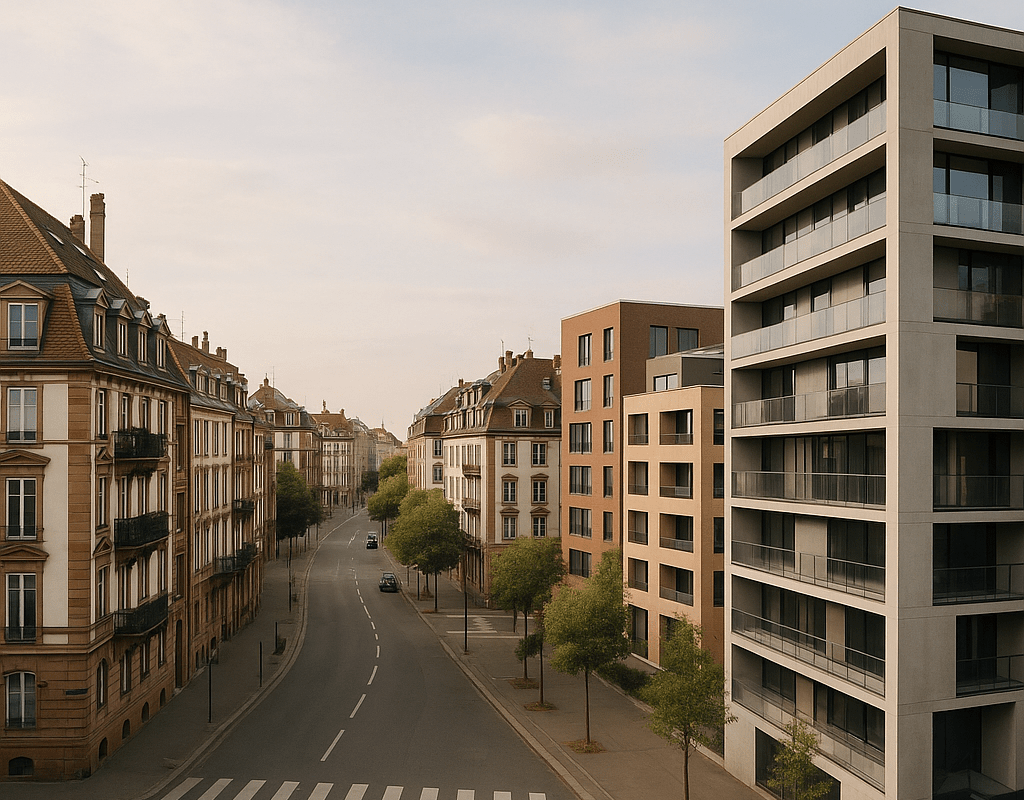
The Strasbourg metropolitan area has more than 500,000 inhabitants, making it the seventh largest urban area in France. First-time buyers often turn to properties offering a good compromise between financial accessibility and quality of life, while others primarily seek asset appreciation. The housing stock is thus divided between old apartments with character – moldings, parquet floors, high ceilings – and new developments offering modern amenities (insulation, home automation, balconies). Since 2018, the average annual price increase has reached 4 to 6%, but the gap between downtown and the suburbs sometimes exceeds €2,000/m².
Price per Square Meter: Where Do We Stand?
According to recent studies, the average price per m² in the city center now flirts with €5,000, while in some peripheral neighborhoods like Cronenbourg, it falls below €3,000. For a 50 m² property, an investor’s budget can thus vary from €150,000 to €250,000 depending on the location and the age of the residence. For comparison, the price is around €4,500/m² in Bordeaux and nearly €6,000/m² in Nantes, highlighting a moderate positioning for Strasbourg despite a certain dynamism.
| Area | Average Price (€/m²) | Annual Variation |
|---|---|---|
| City Center | 4,900 | +5.2 % |
| Krutenau | 4,200 | +4.8 % |
| Cronenbourg | 2,900 | +3.1 % |
| Neudorf | 3,800 | +4.5 % |
Factors Influencing Price Variations
Several levers explain the differences between neighborhoods and market segments:
- Transport Accessibility: proximity to the tramway or TGV station plays a major role.
- Building Quality: renovated old housing versus new building, energy performance weighs in the calculation.
- Facilities and Services: schools, local shops, parks, and cultural life shape attractiveness.
- Land Supply: rare available spaces in the city center versus large areas undergoing urban renewal.
- Regulatory Context: local aid or environmental standards modifying the cost/rent balance.
These factors combine differently from one street to another, to the point that two adjoining apartments can show a price difference greater than 10%.
Focus on the Most Sought-After Neighborhoods
Each sector of the city cultivates its own identity. For a first purchase, young households favor Krutenau or Neudorf, where the offer of cafes and restaurants is constantly expanding. Families tend to turn to the XV district, with its traditional houses and green spaces. As for investors, they scrutinize the potential of the Malraux peninsula, recently rehabilitated, to anticipate a capital gain upon resale.
In the suburbs, Lingolsheim and Ostwald attract thanks to well-labeled new developments, with underground parking and integrated bike lanes. Prices are softer there, but the quality of life remains high.
Perspectives and Upcoming Trends
The extension of the tram network, coupled with the “Territories Master Plan,” should modify flows and redraw the map of valued sectors. Developers’ calculators anticipate an average increase of 3% per year by 2026, driven by land scarcity. At the same time, the rise of the Port du Rhin eco-district or the soft link project to Robertsau could reshuffle the cards and offer unprecedented investment opportunities.
Finally, the digitalization of services (virtual visits, online transactions) and the rise of coliving could open new niches, especially among students and young professionals. The Strasbourg market thus presents itself as a territory where tradition mixes with innovation, inviting to keep an eye both on the numbers and on the schedule of urban operations.
FAQ
1. How is the average price per square meter calculated in Strasbourg?
It results from the average of transactions recorded over 12 months, weighted according to the surface area, the condition of the property, and its location. Notaries make these figures available via the DVF database (Demand for Property Values).
2. Which neighborhoods offer the best quality-price ratio?
Neudorf and Cronenbourg often stand out, thanks to a price per m² below average and an expanding range of services. The presence of new activity hubs and public transport strengthens their attractiveness.
3. Should you favor old or new properties for rental investment?
New properties ensure better energy performance and low condominium fees, while old properties can generate a quicker capital gain upon resale if well renovated. The choice partly depends on tax objectives and the initial budget.
4. How to include additional costs in the overall budget?
Beyond the purchase price, you need to account for 7 to 8% notary fees on old properties and 2 to 3% on new ones, plus any possible work, insurance, and condominium fees. A safety margin of 5% is recommended.
{
“@context”: “https://schema.org”,
“@type”: “WebPage”,
“about”: {
“@type”: “Thing”,
“name”: “Strasbourg real estate market”
},
“keywords”: [“Strasbourg real estate”, “price per m2 Strasbourg”, “market trends”, “neighborhoods”, “prospects”]
}