Profitable Rental Investment Guide: Strategies and Practical Advice to Maximize Your Yield in 2026
Profitable Rental Investment Guide 2026: Choosing the Right Property, Calculating Rental Profitability, Financing, Optimizing Taxation, and Managing Risks with a Concrete Method.
🔎 A profitable property is first identified by the rental demand, not just by the size or the decor.
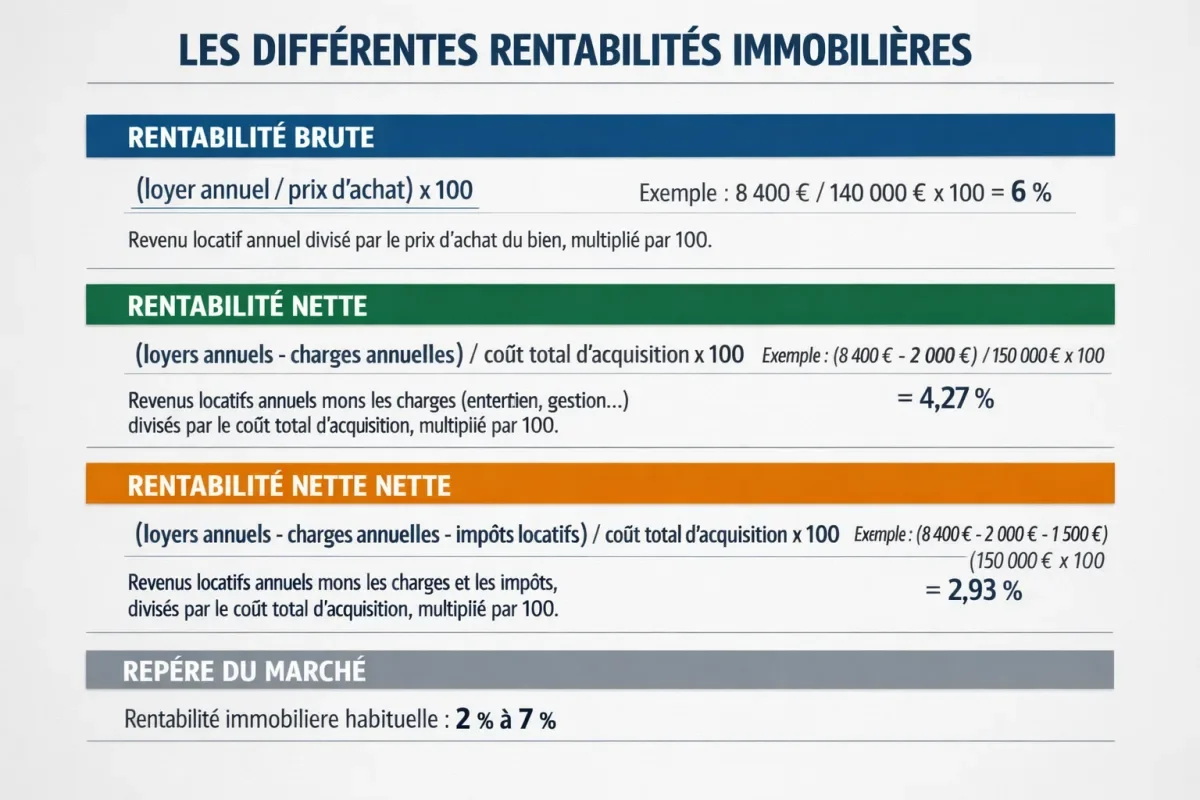
📐 The right calculation involves the gross profitability, then the net and the net-net to avoid surprises.
🏦 Financing matters as much as the property: duration, rate, insurance, and down payment change the final return.
🧾 Taxation does not fix a bad purchase; it optimizes an already coherent project.
Understanding Rental Investment and Its Advantages
Rental investment consists of buying a property to rent it out and generate regular income, while building wealth. In practice, its strength comes from the credit leverage effect, the possibility to index rents on the IRL (rental reference index), and the creation of a tangible asset, useful for preparing retirement or diversifying capital.
Demand remains supported by household growth. INSEE projections forecast more than 4 million additional households by 2050, which maintains pressure on housing in many areas. The value of real estate owned by the French has also doubled in twenty years according to the Bank of France, confirming its patrimonial role.
A profitable rental investment is rarely won at the exit: it is mainly secured at the time of purchase, when the price, possible rent, and local demand are still negotiable.
For a beginner investor, the right question is not “which property to buy?”, but “which project can remain solid if rates change, if the market slows down, or if the tenant stays longer than expected?”. This filter distinguishes a patrimonial purchase from a fragile one.
How to Choose the Ideal Property and Location?
For a profitable rental investment, start with a property you can rent quickly, at a price consistent with the area. Location weighs more than decoration: proximity to transport, employment basin, schools, shops, rental pressure, and ease of resale should guide the decision before any attractive visit.
A clear, well-located, and easy-to-rent property reduces vacancy risk.
The right area is not necessarily the most expensive or the most famous. A medium-sized city with a tight market, a well-served neighborhood, and stable demand can offer a better risk-return ratio than a prestigious city center that is too expensive at entry. The goal is to target an area where rent remains supported without the purchase price crushing profitability.
Rental demand: presence of students, young professionals, families, or mobile employees.
Accessibility: train station, metro, bus, roadways, travel time to employment hubs.
Building condition: well-managed co-ownership, clean inspections, identifiable repairs before purchase.
If you hesitate between two properties, remember this rule: the most profitable is often the one that rents out effortlessly and maintains sufficient market depth in case of resale. Vacancy quickly costs more than a slight difference in size.
How to calculate the real rental yield?
The calculation of rental yield must go beyond the listed rent. The gross version is used for initial screening, but only the net yield, then the net-net yield, allows you to know what the property actually earns once charges, taxes, and operating costs are included.
Gross yield is used for quick screening; net and net-net yields are used to decide.
Educational example: for a purchase at €200,000, with €10,800 annual rents, €2,400 charges, and €1,200 rental tax, the yield goes from 5.4% gross to 4.2% net, then to 3.6% net-net.
The range of 2% to 7% remains a common benchmark for average rental yield, but it only makes sense when placed in the context of risk level, local market, and rental mode.
The right method is to quantify the project with three scenarios: optimistic, central, and cautious. The cautious scenario must include vacancy, unforeseen repairs, and non-recoverable charges. This is the only way to know if the property holds up even when the context becomes less favorable.
How to finance your rental investment effectively?
Good financing is not only about obtaining bank approval; it also protects profitability. For a rental project, you must balance down payment, duration, rate, insurance, affordable monthly payment, and the ability to absorb one month of vacancy without unbalancing your personal budget.
The best arrangement is one that allows maintaining a monthly payment compatible with the expected net rent, while keeping a margin for unforeseen events. A longer loan can improve monthly cash flow but increases total cost. A shorter loan reduces total cost but weighs more on cash flow.
Calculate your borrowing capacity before visiting, to avoid a purchase beyond your budget.
Prepare a clean bank file: income, savings, job stability, any other loans.
Simulate several durations to compare monthly payments, credit cost, and cash flow comfort.
Include borrower insurance and additional fees in the overall cost.
Keep a safety reserve for vacancy, repairs, and rental transition periods.
In rental investment, leverage works when the property finances a large part of its expenses without relying on a hypothetical future gain. If the rent poorly covers the monthly payment, the project can remain patrimonial, but it becomes less robust financially.
What taxation to aim for a profitable rental investment?
Taxation should not be chosen afterwards. It influences net yield from the start. To maximize a profitable rental investment, compare the tax framework before purchase, especially if you hesitate between furnished rental, unfurnished, or corporate structuring. The right regime depends on the level of expenses, the amount of work, and your holding horizon.
The most common approaches are LMNP under actual or micro regimes, unfurnished rental with deduction of certain expenses, or structures like SCI depending on the patrimonial objective. The right choice is not universal: it must be aligned with the holding period, transmission logic, and desired simplicity level.
LMNP: often relevant when the property is furnished and expenses are high.
Unfurnished rental: interesting for simpler management and a more patrimonial strategy.
SCI: useful in some joint projects, especially to organize ownership.
Property deficit: relevant when significant work can be deducted within an appropriate framework.
The decisive point remains the coherence between taxation and the actual use of the property. A regime attractive on paper can become poor if management is too heavy, if work is underestimated, or if administrative obligations are poorly followed. Conversely, a sober but well-executed taxation can secure profitability over several years.
How to manage rental and prevent risks?
Rental management serves to preserve yield, not just to collect rent. You must anticipate vacancy, check files, monitor work, and remain rigorous on deadlines. A profitable property can lose much economic value if management is approximate or too reactive.
The most frequent risk is not spectacular: it is an accumulation of small losses. A few weeks of vacancy, a longer-than-expected relocation, a forgotten expense, delayed maintenance, then net-net profitability degrades without visible alert.
Common mistakes to avoid
Calculating profitability with only gross rent and ignoring expenses, vacancy, and taxation.
Buying a property “easy to visit” but difficult to rent sustainably.
Choosing a tax regime without checking its administrative constraints.
Not reserving cash for urgent repair or temporary unpaid rent.
Optimizations and best practices
Check the real rent level by comparing several ads and similar properties.
Favor a property simple to maintain, with few technical weak points.
Formalize your controls: inventory, receipts, maintenance schedule, expense tracking.
If the area allows, consider shared rental or furnished to improve yield.
Keep photos, invoices, and tax documents from day one.
Vacancy cannot be corrected afterwards: it is reduced at purchase, with a clear property, realistic rent, and an area where demand remains strong.
Which strategy to choose according to your investor profile?
Your strategy must depend on your available time, risk tolerance, and need for immediate yield. A hurried investor will not execute the same method as a patrimonial buyer. The right approach is the one you can maintain for several years, without overloading your schedule or cash flow.
If your priority is yield, target a tight market area, a simple property to rent, and a format suited to local demand. If your priority is stability, favor a deep market, low vacancy, and more sober management. If your priority is transmission, the legal structure and holding period weigh more than the displayed gross yield.
Profile
Coherent strategy
Point of caution
Cautious beginner
Studio or one-bedroom apartment in a stable rental area
Do not overpay for the property
Yield investor
Furnished, shared housing or high-demand rental sector
Control vacancy and management
Long-term patrimonial
Quality property, deep market, simplified management
The most profitable strategies are not necessarily the most complex. In many cases, a well-bought, well-financed, and well-managed property outperforms a poorly executed sophisticated setup. Operational discipline counts more than marketing promises.
Tools and resources to succeed in your investment
To make a reliable decision, rely on verifiable data: price per m², rent level, vacancy, demographic evolution, condominium fees, and public indices. A good rental investment is decided with numbers, not with isolated intuition.
DVF to compare actual prices of past sales in the targeted area.
INSEE to read population, household, and employment trends.
Rent reference index to track regulated rent evolution.
Bank of France to place the project in its financial and patrimonial context.
Bank simulation to verify financing robustness before signing a preliminary contract.
Quick checklist before signing: validate rental demand, test the actual rent, calculate gross, net, and net-net profitability, simulate the monthly payment, choose the tax framework, and keep a safety reserve. If any of these points remain unclear, the project deserves further verification.
Conclusion
A profitable rental investment in 2026 relies on a simple mechanism: buy right, finance smartly, rent quickly, manage cleanly, and choose a coherent tax system. When these five levers are aligned, yield becomes more predictable and risk more readable.
The right reflex is not to look for the best isolated rate, nor the best tax scheme, nor the most attractive property. The real goal is to build a complete project, capable of withstanding uncertainties without losing its economic logic.
Key takeaways
🧭 Location and rental demand take precedence over size or property staging.
📊 Net-net profitability is the true test of a serious rental project.
🏦 Financing must protect your cash flow, not just validate the purchase.
🧾 Taxation optimizes a solid project; it does not fix a bad entry price.
🛠️ Rental management and safety reserves limit invisible losses.
FAQ
What yield should you aim for in a rental investment?
There is no universal threshold, but the range of 2% to 7% is often used as a benchmark to compare projects. The important thing is to interpret this figure with risk, rental pressure, and taxation. A lower yield can remain relevant if it is very safe and very liquid.
Should you favor unfurnished or furnished rental?
Furnished rental is often more dynamic in terms of yield, especially in student or urban areas. Unfurnished rental can be simpler to manage and more patrimonial. The right choice mainly depends on local demand, the level of charges, and the time you want to dedicate to the property.
How to know if a property is really profitable?
Do not be satisfied with the annual rent alone. Include charges, repairs, vacancy, insurance, and tax related to rental income. If the net-net profitability remains correct in a cautious scenario, the property is more likely to be robust over time.
What down payment should be planned for a rental investment?
The down payment depends on your banking profile, the property, and the level of risk of the file. The key is not to put in the maximum, but to preserve your ability to absorb acquisition costs, unforeseen expenses, and the first months of ownership. A down payment that is too high can also reduce the leverage effect.
How to reduce the risk of rental vacancy?
Choose an area where demand is strong, a property that is easy to understand, and a realistic rent. Avoid atypical properties without a clear advantage. Good management of rental vacancy starts at the time of purchase: quality of location, clarity of the property, and a well-prepared rental application.