
Is France Really Experiencing Demographic Decline?
Not exactly. At the national level, France continues to grow slightly in population, but the demographic engine is clearly weakening. The decline in births, the increasing weight of seniors, and strong territorial disparities thus feed an impression of decline, without the country yet entering a sustained general decrease.
The term France demographic decline is often used as if it referred to a simple and indisputable fact. However, in demography, several indicators must be distinguished: total population, natural balance between births and deaths, migratory balance, age structure, and distribution between territories. A country can age without immediately losing inhabitants; it can also still grow nationally while seeing some of its departments fall behind.
According to recent reports from the INSEE on population and demographic balance, France remains one of the most populous major European countries, with about 68.4 million inhabitants as of January 1, 2024, including Mayotte. This figure alone therefore does not confirm the idea of a collapse. However, the growth rate has slowed, and this is precisely where the diagnosis becomes interesting.
Why is there so much talk about demographic decline in France?
Because several negative signals are accumulating: fewer births, declining fertility, rapid aging, and closures of services in certain areas. Even without an immediate national population decrease, these changes are already producing visible effects on schools, housing, and healthcare provision.
The word “decline” is especially used because demographics are now reflected in everyday life. When a town loses a class, when a nearby maternity ward is weakened due to lack of activity, or when the number of elderly people increases faster than the supply of doctors, statistics become concrete. In practice, residents often associate this type of change with a form of collective setback, even if the overall French population is not yet decreasing.

The second factor is European. Compared to Germany, Italy, or Spain, France has long maintained the image of a relatively dynamic country in terms of family life. This reputation remains partially true, but the gap is narrowing. According to the INED and harmonized Eurostat data, France no longer escapes the fertility decline affecting the entire continent. It simply slows down a little less abruptly than some neighbors.
Finally, demographic aging changes the perception of the country. An older population is not synonymous with disaster, but it changes collective demand: more chronic care, more accessible housing, fewer students in certain areas, new daily transport needs. It is not just a question of volume; it is a question of structure.
10 figures to decide between myth and reality
To avoid slogans, it is necessary to look at several indicators at once. Taken individually, each can support a partisan interpretation. Taken together, they show a France that is not collapsing demographically, but is clearly entering a phase of slowdown and aging.
| Figure | What it shows | Useful reading |
|---|---|---|
| 68.4 million | French population as of January 1, 2024 (INSEE, entire France) | The total population is still increasing slightly. |
| 678,000 | Births in 2023 approximately (INSEE) | The decline in births is clear and lasting. |
| 1.68 | Children per woman in 2023 (INSEE) | Fertility is well below the replacement level, around 2.1. |
| 631,000 | Deaths in 2023 approximately (INSEE) | The level remains high due to aging and large generations at advanced ages. |
| +47,000 | Estimated natural balance in 2023 (births minus deaths) | The natural surplus still exists, but it has become very small. |
| Around 42 years | Median age in metropolitan France, according to recent INSEE series | The age structure is gradually shifting upwards. |
| More than 21% | Share of those aged 65 and over in the French population | Aging is no longer marginal; it is becoming structural. |
| Around 80 years for men, 85 years for women | Life expectancy in 2023, INSEE order of magnitude | People live longer, which mechanically increases the number of seniors. |
| 234 cities | Cities involved in the Action Cœur de Ville program led by the ANCT | The public response to the weakening of some medium-sized cities is now massive. |
| Sometimes more than 30 minutes | Access time to certain health services in sparsely populated rural areas | Demographic decline is often felt more through the remoteness of services than by a national figure. |
The two most important data points are probably the following. On the one hand, France remains above many European countries in total population and has not yet engaged in a continuous decline at the national level. On the other hand, its natural balance has tightened so much that the demographic safety margin is now low. If the decline in births continues and deaths remain high with the arrival of large generations at advanced ages, France could approach stagnation or even decline in the medium term.
Does the real shift come from births or aging?
Both, but not at the same level. The decline in births is the most immediate signal, while aging is the most structuring transformation in the long term. One reduces future numbers; the other already changes needs in health, housing, mobility, and public services.
The decline in births hits because it is quickly visible. A drop over a few years quickly shows in nurseries, kindergartens, then elementary schools. In some school districts, class closures are now linked to smaller cohorts, not just to school zoning. This development does not imply that all of France is emptying; it means that the incoming generations are smaller than those preceding them.
Aging, on the other hand, produces more diffuse but often heavier effects. When the share of those over 65 exceeds one in five inhabitants, public policies change in nature. More home help is needed, more single-story housing or with elevators, local medical services, and adapted transportation. In a medium-sized town like Guéret or in several living areas of Nièvre, the issue is not only population decline; it is mainly the increase in the weight of older ages.

There is another way to interpret the phenomenon: the decline in fertility acts as a brake, while aging acts as a multiplier of needs. In other words, the first weighs on tomorrow’s numbers; the second is already transforming the local economy. This is why elected officials often prefer to talk about medical deserts, home care, or senior mobility rather than simple demographics.
It is observed in the field that the demographic issue changes face depending on the municipalities. A local official from a medium-sized city notes that the decline in school enrollments is becoming noticeable, while a rapid increase in aging-related demands is simultaneously mobilizing social services. The feeling of “decline” often comes from this double pressure.
Where is demographic decline already visible in France?
The decline is especially visible in certain rural departments, former industrial basins, and small or medium-sized towns far from large metropolitan areas. Conversely, coastal areas, metropolitan zones, and overseas territories like Mayotte maintain very different dynamics.
French demographics are deeply territorial. Departments such as Creuse, Nièvre, or certain parts of Haute-Marne have long experienced a delicate combination: departure of young adults, marked aging, and a narrow labor market. Conversely, metropolises like Toulouse or Nantes continue to attract workers, students, and families, even though they are not immune to the general decline in fertility.
The case of Paris illustrates the nuance well. The capital does not represent a “classic” demographic decline of a retreating rural territory; rather, it experiences complex residential movements related to housing costs, the size of family housing, and household trade-offs settling in the inner or outer suburbs. Regarding the perception of decline, it sometimes arises less from a raw decrease than from a change in the profile of residents.
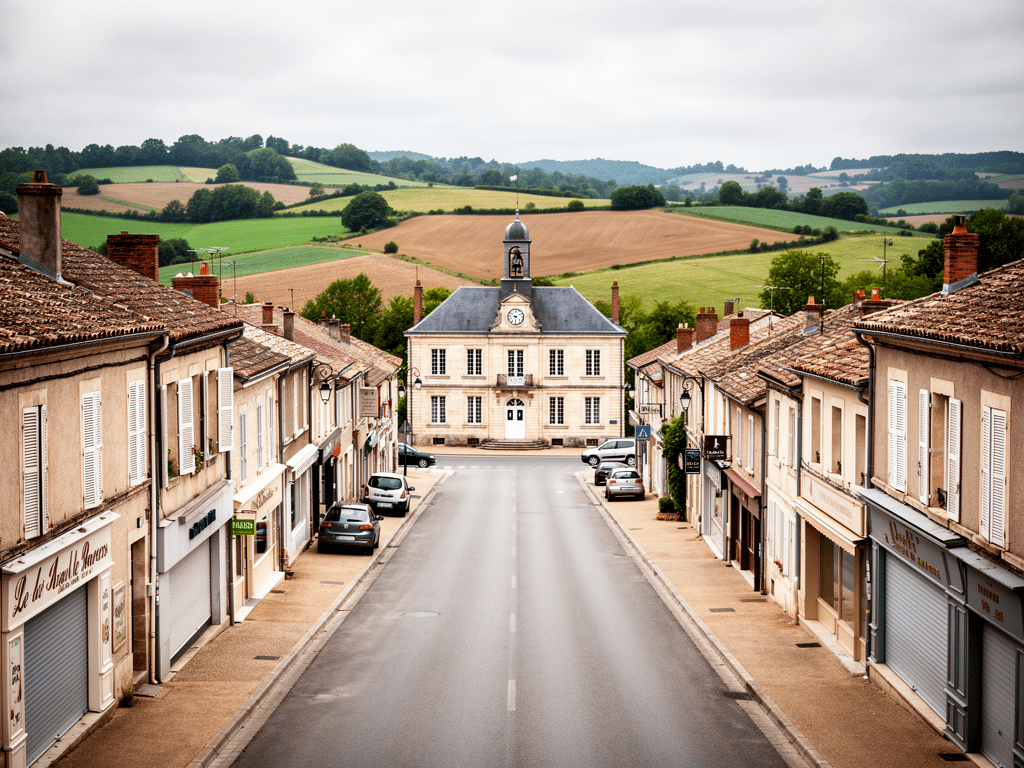
Public policies have indeed incorporated this diversity. The Action Cœur de Ville program, led by the ANCT, targets 234 towns to support housing, commerce, mobility, and services. This institutional response says something about the challenge: the problem is not only the national population but the ability of territories to remain livable when demographic balances change.
On the ground, the geography of services is often more telling than the number of inhabitants alone. The public open data available on Data.gouv.fr and INSEE’s work show that access to certain everyday facilities becomes longer in low-density areas. For a family or an elderly person, an extra 20 to 30 minutes travel to a doctor, maternity ward, or train station can be enough to create a feeling of territorial downgrade.
What are the concrete consequences for the economy and public services?
Demographic slowdown is not an abstract debate reserved for statisticians. It directly affects the local economy, public finances, and planning. Fewer children means, in the long run, fewer students and sometimes fewer classes. More seniors means increased health expenses, support for autonomy, and needs for adapting the housing stock. Between the two, local authorities must make decisions in an already tight budgetary context.
For the labor market, the issue is ambivalent. An aging population can increase recruitment tensions, particularly in health care, home help, renovation construction, and transportation. But it can also support a so-called “moneyed” economy, focused on services for seniors, prevention, adapted equipment, or telemedicine. The issue is therefore not only the quantity of the population, but its composition and location.
In terms of housing, the effects can go in two directions. In some tight areas, the decrease in household size sustains demand despite a slowdown in births. In others, especially where young adults’ departures are lasting, the housing stock becomes vacant and loses value. This explains why the same demographic trend can produce a pressured real estate market in Bordeaux and residential decline in a small town far from major employment centers.
The real issue is not whether France is “disappearing,” but whether it adapts quickly enough to a less fertile, older, and much more unevenly distributed population.
Should we speak of myth or reality?
The most accurate formulation would be: the demographic decline in France is a myth if one claims that the country is already massively losing inhabitants everywhere and uniformly; it is a reality in the making if one talks about the slowdown in births, the erosion of the natural balance, and aging that is already reshaping territories. The danger is not the vocabulary error itself, but the confusion between the national level and local effects.
In other words, France is not yet in the situation of countries where overall population decline has been established for a long time. However, it is no longer in the configuration of years when its demographic dynamism seemed assured. According to available demographic studies, the country is entering a period of greater uncertainty, where migration, family policies, female employment, housing costs, and access to services will weigh more than before on its trajectory.
For those who want a useful reading, the right compass boils down to three points:
- do not confuse slowdown with collapse;
- look at territories before national averages;
- think in terms of collective needs: school, health, housing, mobility, employment.
It is at this concrete scale that demography ceases to be an anxiety-inducing theme and becomes a decision-making tool.
FAQ
Will France lose inhabitants in the coming years?
It is possible in the medium term, but it is not yet the case at the national level. Everything will depend on whether a positive migratory balance is maintained, the evolution of births, and the level of deaths related to aging. In the short term, the most plausible scenario remains very low growth or near stagnation.
Why is the decline in fertility so worrying?
Because an indicator around 1.68 children per woman in 2023 is clearly below the replacement level, which is around 2.1. If this level persists, future generations will be fewer, with effects on school, the labor market, and social protection financing.
Does demographic decline mainly affect rural areas?
Not only. Sparsely populated rural areas are often the most exposed, but some medium-sized cities or former industrial territories are also concerned. Conversely, attractive rural areas close to a metropolis or the coast can gain inhabitants despite the general aging.
And for pensions, what is the link with demography?
The link is direct: if the proportion of active workers grows more slowly than that of retirees, financing becomes more strained. Aging does not alone determine pensions, but it affects the ratio between contributors and beneficiaries, especially when large generations reach retirement age.
Is France better positioned than its European neighbors?
Yes, but the advantage is shrinking. France maintains a generally less degraded demography than Italy or Spain on several indicators, but it no longer stands out as clearly as before. The decline in births is now significant enough to change the assessment.
Can the trend be reversed?
There is no single solution. Birth rates depend on housing, employment, income, childcare options, and the general social context. However, the effects of aging can be better anticipated through health policies, mobility, housing adaptation, and revitalization of territories.