
/* Css In Brief */
.in-brief .inbrief-header {
font-size: 1.15em;
font-weight: 700;
color: #d97706;
margin-bottom: 0.6em;
display: flex;
align-items: center;
gap: 0.5em;
}
.in-brief p {
font-size: 1em;
line-height: 1.65;
margin: 10px;
}
.in-brief strong {
color: #1c1917;
}
Getting a tasty drip coffee is no accident: it’s an art based on a series of precise steps, from grinding to brewing conditions. In this guide, you will find the 7 essential steps to master every detail and reveal the aromatic richness of your coffee, guaranteed.
Sommaire
In Brief
☕ Bean selection: Choose fresh, quality beans, according to the origin and roast level you prefer.
🔪 Proper grind: Adjust the texture between fine and medium, depending on your method and grinder.
💧 Pure, hot water: Use filtered water at 92-96 °C to extract aromas without bitterness.
⏳ Controlled brewing: Pour slowly and steadily, respecting pause times for a balanced cup.
Step 1: Choose quality beans
The starting point is the bean: it determines 90% of the final taste. Opt for freshly roasted whole beans (less than 2 weeks), ideally vacuum-packed or in airtight bags. Prefer a so-called “medium” or “medium-dark” roast for a balance between acidity and body. Colombian, Ethiopian, or Brazilian origins offer a beautiful aromatic range, from fruity notes to chocolate nuances. Don’t hesitate to try several origins to identify your preferred profile.
Origin and roasting
- East Africa: bright acidity, floral or fruity notes.
- Latin America: sugar/acid balance, nutty and cocoa aromas.
- Asia: heavier body, earthy or spicy nuances.

Step 2: Adjust the grind to the millimeter
The grind plays a central role in extraction: too fine, it blocks water flow and increases bitterness; too coarse, it produces a bland, under-extracted coffee. For drip coffee, aim for a medium grind, comparable to sea salt. A conical burr grinder ensures consistent fineness, essential for uniform brewing. Reserve blade grinders for emergencies, as they often deliver an uneven grind.
Grind level guide
| Method | Texture | Result |
|---|---|---|
| Drip coffee maker | Medium (similar to coarse salt) | Balanced extraction |
| French press | Coarse (large sugar grains) | Pronounced body |
| Espresso | Fine (powdered sugar) | Maximum intensity |
Step 3: Favor quality water
No need to invest in mineral water as your tap water can suffice, provided it is filtered to remove chlorine and limescale. The ideal water hardness is around 150 mg/L total minerals. If your water is too hard or too soft, you risk altering the solubility of aromatic compounds. Heat it between 92 °C and 96 °C: below that, you won’t extract all the aromas; above, you burn the coffee.
Step 4: Heat and pre-infuse
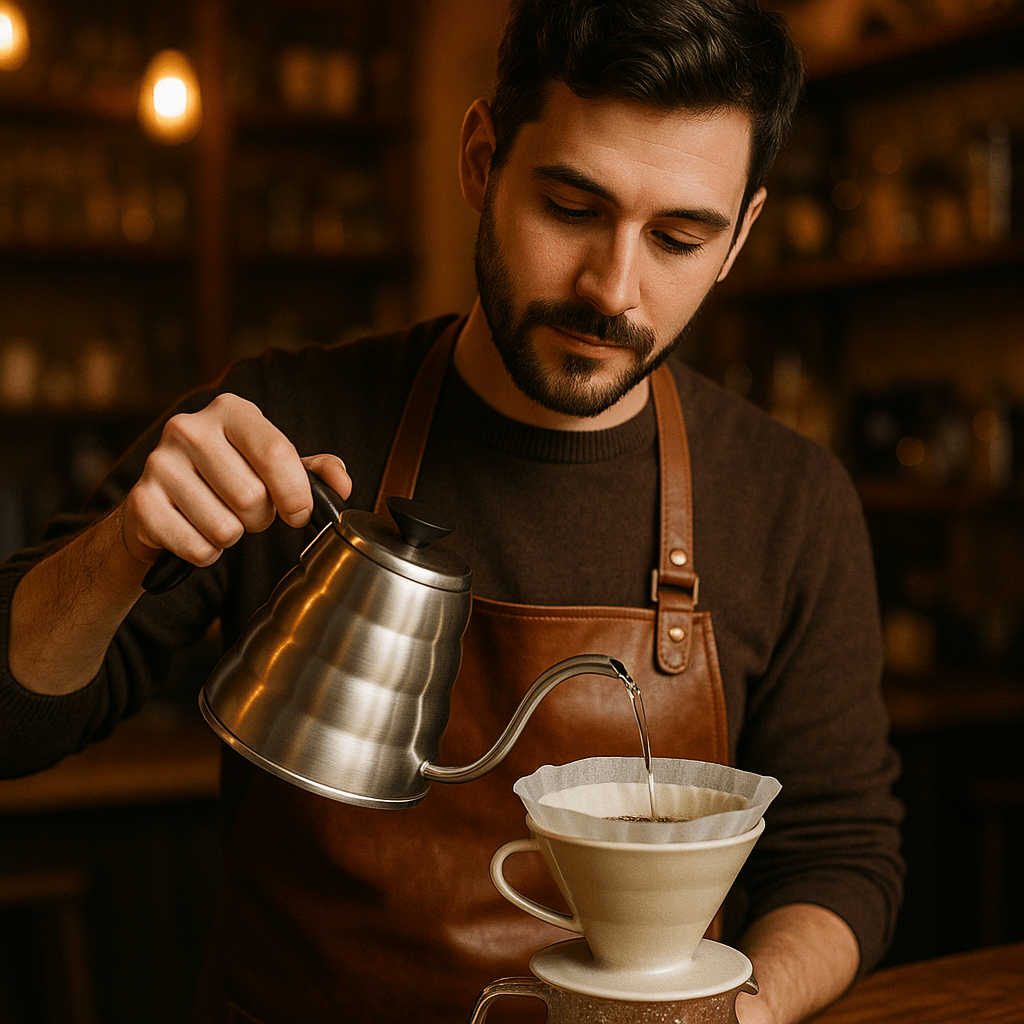
Before starting the actual brewing, perform a pre-infusion (bloom): pour just enough water to moisten the surface of the grounds, then wait 30 seconds. This step releases residual gases and prepares the particles for a more even extraction. Use a gooseneck kettle to precisely control the flow and pouring speed.
Step 5: Pour the water in a spiral
The key is the consistency of the pour: start from the center outward, then return to the center forming a slow and steady spiral. Maintain a pace that completes the infusion in about 3 to 4 minutes, depending on the amount prepared. A flow that is too fast does not extract enough, a flow that is too slow accentuates bitterness. Always keep an eye on the level, so that the grounds remain well submerged without overflowing.
Step 6: Control the coffee/water ratio
The universal equation for drip coffee is around 1 g of coffee for 15 g of water (1:15 ratio). For a 250 ml cup, count about 16 g of coffee. To adjust according to your taste: decrease the water for a stronger result, increase it for a lighter coffee. Use a precision kitchen scale to reproduce this ratio exactly, cup after cup.
Step 7: Taste and adjust
The first sip will inform you about the overall balance: note sensations of acidity, bitterness, or sweetness. If the coffee seems too acidic, extend the grind or lower the water temperature; if bitterness dominates, reduce the brewing time or slightly coarsen the grind. Adjust each parameter until you achieve the perfect combination that suits you.
FAQ
Why pre-infuse drip coffee?
Pre-infusion allows the release of gases trapped in the grounds, ensuring a more even extraction and avoiding preferential channels.
What type of filter should be used?
Bleached paper filters offer a clear cup, while metal filters let through more oils, for a rounder coffee.
How to clean your coffee grinder?
Disassemble the burrs and brush them dry to remove residues, then carefully reassemble to preserve grind uniformity.
Should mineral water be used?
Filtered tap water, without excess limestone or chlorine, is generally sufficient. Highly mineralized water can harm extraction.
Can a large quantity be prepared at once?
Beyond 500 ml, infusion becomes more difficult to control. Prefer several small batches for optimal consistency.