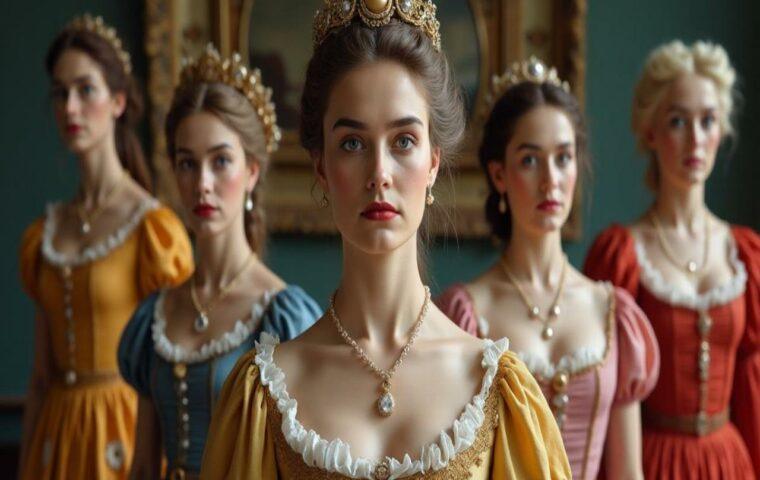
Legal status and inheritance rights
The medieval legal framework placed women within a network of guardianships: under the authority of their father until marriage, then under that of their husband. Yet, one might think this dependence excludes any autonomy, but the reality is more nuanced. Local customs and seigneurial charters vary, sometimes offering widows a dower right — a percentage of the family lands — ensuring them a form of subsistence and power over certain assets. In some regions of France or Northern Europe, particular provisions allow only daughters to inherit in the absence of male brothers, significantly changing the situation.
Inheritance and guardianship
The practice of customary law often reserves the main inheritance for the eldest son (male primogeniture), but the absence of a male heir opens rights for daughters. However, these daughters remain under the guardianship of a male relative until their marriage. This system creates contrasting scenarios: a childless widow can become guardian of her property, while the heiress daughter must deal with a guardian responsible for preserving her inheritance.
Marriage and Contracts
Marital alliances are negotiated with a logic of family interests and sealed by a contract specifying dowry, rights, and obligations. The dowry, made up of movable or real estate property, generally remains under the husband’s custody but serves as financial security for the wife. In certain charters, surprising clauses can be found: the wife may, in the event of widowhood, regain control over lands, or even hope for a remarriage regulated by strict conditions.
Daily Life: From Peasant Woman to Lady of the Court
Women’s daily lives vary radically according to their birth. The peasant woman works the land, raises livestock, and makes textiles for the household. In the city, the craftswoman or merchant runs a shop, welcomes customers, and can even educate her children. At court, the lady manages the living environment, organizes festivities, and can, under certain conditions, influence political alliances.
Peasant and Craftswomen
In the village, the day begins at dawn. Between milking cows, preparing bread, and cultivating vegetables, the peasant woman is everywhere at once. At nightfall, she spins wool or weaves the cloth that will clothe the family. In towns, craftswomen such as tanners, seamstresses, or brewers contribute to the local economy, sometimes within guilds where they exchange know-how and trade secrets.
Ladies of the Court and Lordly Management
The high-ranking lady finds her role far from manual labor: she administers the manorial records, oversees the collection of dues, and receives travelers. Her domain may extend over several villages, and her authority is manifested through the appointment of tenants and the holding of manorial justice. Thus, despite social constraints, she exercises a form of economic and political power.
Economic Roles and Invisible Entrepreneurs
While women are often imagined confined to the home, many are true business leaders before the term existed. They manage shops and workshops, import or export products, keep accounts, and supervise staff. This dynamic is particularly strong in the trading cities of Flanders or Italy.
- Retail trade: sales of spices, textiles, dairy products.
- Craftsmanship: weaving, dyeing, luxury embroidery.
- Finance and loans: some moneylenders grant loans to merchants.
| Social Class | Main Activities | Degree of Autonomy |
|---|---|---|
| Peasant | Plowing, textiles, livestock | Medium |
| Urban craftswoman | Workshop, shop, trade | High |
| Noble | Manorial management, diplomacy | Variable |
Spirituality, Knowledge, and Manuscripts
The monastic world often constitutes a refuge for educated women. In convents, nuns have access to books and writing, which allows them to study theology, botany, or even medicine. In the 12th century, some abbesses enjoyed such prestige that they exchanged correspondence with the papacy.
Abbesses and Religious Power
At the head of vast abbeys, these women manage agricultural domains, decide on the distribution of resources, and supervise religious personnel and the like. Their authority, recognized by the Church and the local lord, is manifested in holding chapters and managing conventual estates.
Scribes, Illuminators, and Restorers
The reproduction of books takes place in the scriptorium workshops where nuns copy and illuminate the pages. With the aim of preserving these treasures, medieval parchment restoration is now an essential skill for researchers wishing to decipher these fragile and precious manuscripts.
Emblematic Figures and Representations
“Women are the souls of the kingdom,” wrote an anonymous chronicler in the 13th century, emphasizing the idea that they carried culture and faith within the family circle.
Eleanor of Aquitaine
Wife of two kings, Eleanor embodies the very example of female diplomacy: patron of troubadours, she organized political alliances while maintaining solid territorial power.
Hildegard of Bingen
Mystic and scholar, Hildegard left a considerable body of work in medicine, music, and theology. Like many nuns, she testifies to the crucial role played by women in the dissemination of knowledge.
Heritage and Modern Perception
Over the centuries, the image of the medieval woman oscillates between that of a submissive creature and that of a prominent actor in economic and spiritual life. Recent research highlights unknown archives, minutes, and wills that reveal the diversity of statuses and the richness of their commitments.
FAQ
1. Could women inherit without brothers?
Yes, in certain customs, the absence of brothers allows the only daughter to claim the main inheritance, subject to a guardian responsible for protecting her interests until her marriage.
2. Did noble women exercise real power?
Absolutely, many of them managed lordships, concluded treaties, and supervised local justice, even if their authority remained framed by patriarchal norms.
3. How did nuns access education?
Thanks to convents, they benefited from an internal educational structure: reading of the Scriptures, copying manuscripts, teaching of grammar and theology.
{
“@context”: “https://schema.org”,
“@type”: “FAQPage”,
“mainEntity”: [
{
“@type”: “Question”,
“name”: “Could women inherit without brothers?”,
“acceptedAnswer”: {
“@type”: “Answer”,
“text”: “Yes, in certain customs, the absence of brothers allows the only daughter to claim the main inheritance, subject to a guardian responsible for protecting her interests until her marriage.”
}
},
{
“@type”: “Question”,
“name”: “Did noble women exercise real power?”,
“acceptedAnswer”: {
“@type”: “Answer”,
“text”: “Absolutely, many of them managed lordships, concluded treaties, and supervised local justice, even if their authority remained framed by patriarchal norms.”
}
},
{
“@type”: “Question”,
“name”: “How did nuns access education?”,
“acceptedAnswer”: {
“@type”: “Answer”,
“text”: “Thanks to convents, they benefited from an internal educational structure: reading of the Scriptures, copying manuscripts, teaching of grammar and theology.”
}
}
]
}
{
“@context”: “https://schema.org”,
“@type”: “WebPage”,
“about”: {
“@type”: “Thing”,
“name”: “place of women in medieval society”
},
“keywords”: [“medieval women”, “legal status”, “daily life”, “medieval economy”, “medieval society”]
}