History of Martinique: Analysis of origins, transformations, and current issues
Historical analysis of Martinique and its contemporary issues: Amerindian peoples, French colonization, slavery, abolition, collective memory, and current challenges.
🏛️ The present Martinique is read through a unique political status, persistent inequalities, and strong environmental vulnerability.
How has geography shaped the history of Martinique?
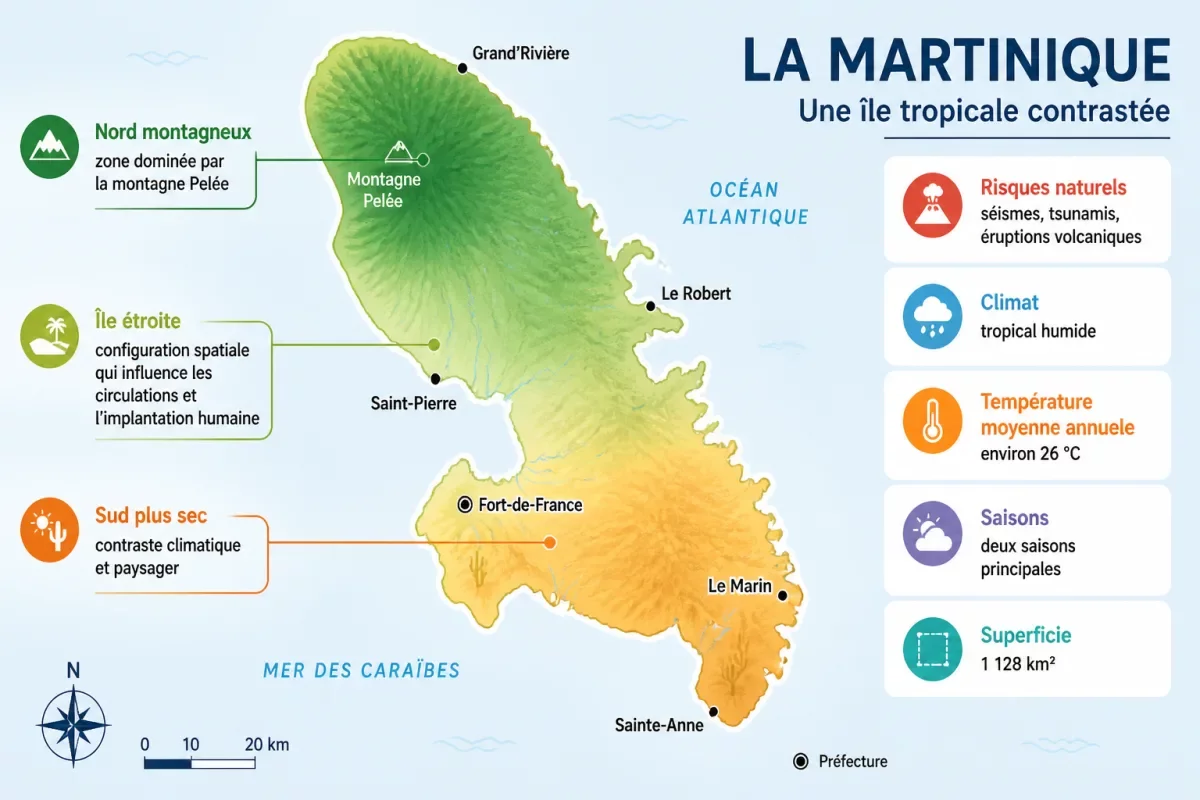
The answer lies in a few decisive features: a narrow island, a mountainous north dominated by Mount Pelée, a drier south, and an environment exposed to earthquakes, tsunamis, and volcanic eruptions. This configuration conditioned human settlements, circulation, agriculture, and even forms of power. Geography is not a backdrop; it is a full-fledged historical actor.
The first Amerindian presences are ancient, interrupted and then resumed over the centuries. Available sources recall that an eruption of Mount Pelée in 295 AD decimated or displaced populations, before a return of the Arawaks around 400 and then the arrival of so-called “Carib” populations around 600 (source: https://fr.wikipedia.org/wiki/Histoire_de_la_Martinique). This chronology shows an island already marked by adaptation and movements long before the European arrival.
On an island of 1,128 km², history accumulates in the reliefs, place names, and land uses as much as in the archives.
The ruins of Saint-Pierre recall the impact of Mount Pelée on Martinique’s history.
Amerindian settlements Millennia before
1635 French colonization
1670s Massive deportation of African slaves
After abolition Social restructuring and lasting memory
2015 Single territorial collectivityFrom Amerindian occupation to the single territorial collectivity created in 2015, Martinique can be read as a series of breaks and reorganizations.
Why did French colonization profoundly transform the island?
Because it did not just establish a new sovereignty: it imposed an economy, a relationship to the land, and a racial hierarchy. French colonization began in 1635 and led to the near extermination of indigenous populations; from the 1670s onwards, the massive deportation of black African slaves changed the demographic composition and founded a plantation society that was durably unequal (source: https://fr.wikipedia.org/wiki/Histoire_de_la_Martinique).
Within this framework, agricultural exploitation was not a simple economic activity. It structured the landscapes, ports, fortifications, and trade routes. Sugarcane, plantations, maritime defense needs, and conflicts of influence between European powers shaped a space dominated by colonial logic. Understanding this sequence is essential to read Martinique’s heritage without sugarcoating it.
The territory became a productive space organized for export.
Society was hierarchized according to origin, legal status, and skin color.
Port cities concentrated trade, defense, and administrative power.
The memory of colonization remains visible in places, ruins, and stories.
Colonization does not just change a map: it creates a society, inequalities, and a memory that survive the end of the colonial regime.
What remains of slavery in contemporary Martinique?
The legacy of slavery is not limited to a painful memory; it still permeates social structure, representations, and public debates. Martinican society is marked by a mestizaje resulting from the colonial system based on the exploitation of slaves, which requires thinking together about historical violence, cultural recomposition, and identity construction. The challenge is not to freeze the past but to measure its lasting effects.
This history has produced paradoxes. On one hand, a powerful Creole culture, multiple forms of expression, and an affirmed Caribbean identity. On the other hand, inherited hierarchies, memory fractures, and inequalities that continue to fuel debates about the island’s place in the French Republic. The abolition of slavery opened a change of status, but not an automatic disappearance of relations of domination.
Period
Major transformation
Lasting effect on today’s Martinique
Amerindian settlements
Ancient presence, movements and recompositions
Memory still fragile, but central in understanding the territory
French colonization
Taking control of the land, ports, and trade routes
Landscapes marked by plantation economy and fortifications
African slavery
Mass deportation and a racially dominated society
Enduring weight of inequalities and the memory of servitude
After abolition
Recomposition of labor and social affiliations
Construction of a more visible Creole culture, but socially marked by tensions
Contemporary Martinique
Unique French territory, single collectivity since 2015
Debates on autonomy, real equality, heritage, and identity
How to read Martinique’s history without reducing it to colonization alone?
The proper reading is to connect colonization, slavery, abolition, departmentalization, and the current situation, without overshadowing one of these moments by the others. Martinique became a unique territorial collectivity in 2015, covers 1,128 km² and had 360,749 inhabitants in 2021; it is also an outermost region of the European Union. These data describe a territory small in size but complex in status and trajectory.
Topography further accentuates this complexity. The mountainous north and the drier south not only create landscape contrasts: they influence mobility, urbanization, agriculture, and risk management. With an average annual temperature of about 26 °C and two main seasons, Martinique belongs to a humid tropical zone where climate is part of societal challenges (source: https://formens.mnhn.fr/mod/page/view.php?id=2789).
Think of the past as a chain of transformations, not as heritage nostalgia.
Connect the memory of slavery to current political and social life.
Integrate natural risks into any reflection on the island’s development.
Read Martinique’s European status as an institutional advantage and a source of debate.
The most often underestimated point concerns environmental vulnerability. The island is subject to strong natural risks, notably earthquakes, tsunamis, and volcanic eruptions. The eruption of Mount Pelée in 1902 destroyed Saint-Pierre and caused the death of 28,000 inhabitants within minutes. This tragedy is not only part of local history: it reminds us that Martinique’s future also depends on adapting to risks.
Why does Martinique’s history reveal its contemporary challenges?
Because the island today concentrates the direct consequences of its long history: memory of colonization, legacy of slavery, attachment to Creole identity, dependence on French and European political frameworks, and strong exposure to natural hazards. Martinique’s history does not remain in textbooks; it organizes public debates, heritage uses, and ways of inhabiting the territory.
The real question is therefore not whether this past still matters. It already structures ways of speaking about autonomy, social justice, cultural transmission, and coastal protection. Martinique is simultaneously a French territory, a Caribbean space, and a postcolonial memory site: this triple belonging explains the density of its present challenges.
Conclusion
Taking Martinique’s history seriously means accepting that a territory tiny in size can be immense in the questions it raises. Amerindian settlements, French colonization, slavery, abolition, the unique collectivity, and climate vulnerability form a single thread. It is this thread that gives meaning to contemporary Martinique and its search for balance between heritage, recognition, and future.
Key Takeaways
🧭 Martinican history is explained by successive breaks, not by a simple chronology.
🌍 Colonization and slavery have durably structured social and cultural relations.
🌋 Mount Pelée reminds us that natural risks are also historical factors.
🏛️ The current political status neither erases the colonial memory nor the identity debates.
🪶 Creole culture was born from a violent history, but today it constitutes a force of affirmation.
FAQ
When does the history of Martinique really begin?
It begins long before the arrival of Europeans, with ancient and intermittent Amerindian occupations. Sources even mention population recompositions linked to very ancient natural events. The colonial period thus only adds a layer to an already long history.
Why is colonization so often discussed in the history of Martinique?
Because it redefined the territory, economy, and society. From 1635, the island entered a plantation system linked to Atlantic trade and slavery. This legacy continues to influence debates on heritage, memory, and social equality.
Did the abolition of slavery resolve inequalities?
No, not by itself. Abolition ended a legal regime of domination, but it did not suddenly erase inherited hierarchies, nor disparities in access to land, power, and recognition. That is why its legacy remains a social and political issue.
Why is Mount Pelée central in Martinican memory?
Because its 1902 eruption destroyed Saint-Pierre and killed 28,000 inhabitants in a few minutes. The event reminds us both of the violence of natural risks and the fragility of coastal cities. It remains a major landmark in local history.
What are the most important contemporary issues for Martinique?
They relate both to historical memory, institutional status, environmental vulnerability, and social balances. Martinique must navigate its French and European belonging while asserting a very strong Caribbean and Creole identity.