
In brief
⚡ The PER is mainly used to prepare for retirement with a tax advantage on entry, useful if you are taxed at 30% or 41%.
🔓 Life insurance remains the most flexible: you can withdraw money whenever you want, making it a true safety reserve.
🎯 In most cases, the two are not opposed: PER to optimize, life insurance to keep breathing room. It is often the smartest duo.
Life insurance or PER: which to choose according to your profile?
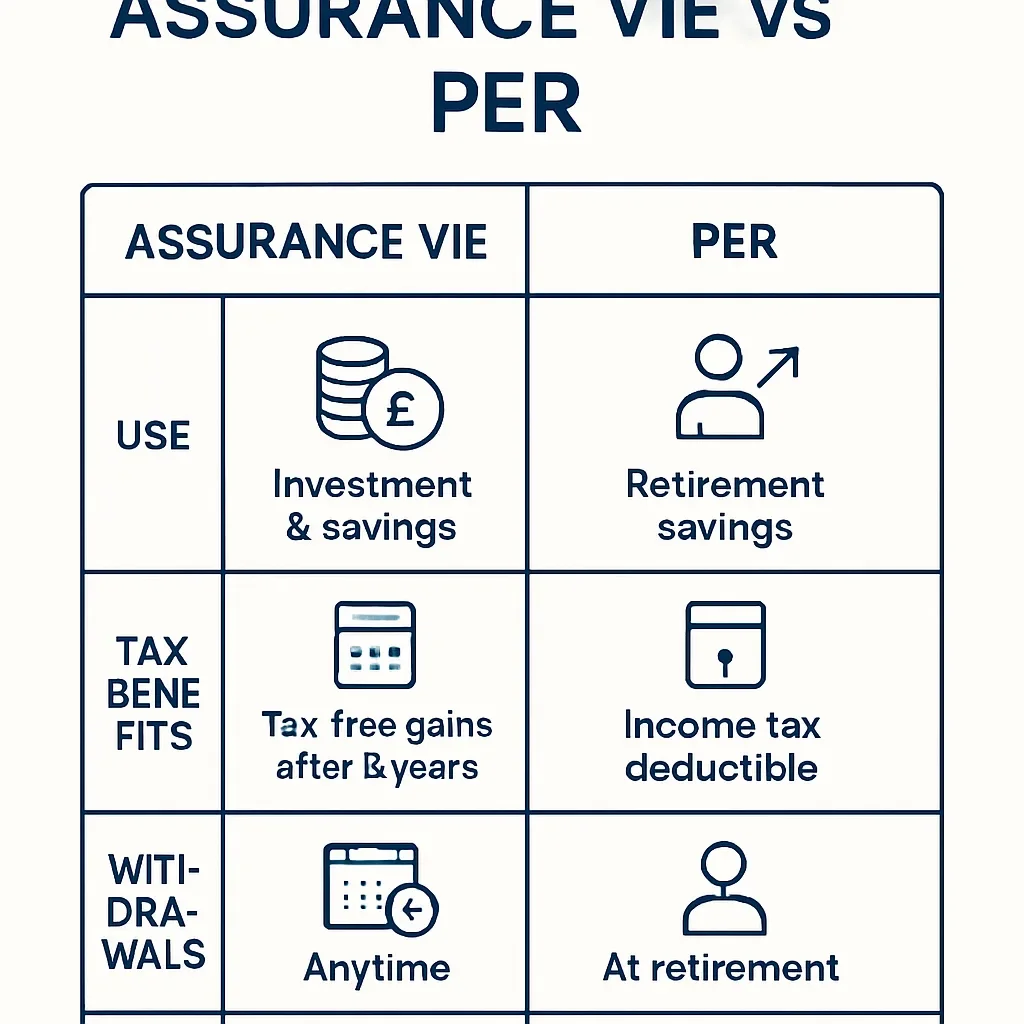
The best choice mainly depends on two things: your need for availability and your marginal tax rate. If you want to keep savings accessible at any time, life insurance remains more flexible. If your tax is high and retirement is the goal, the PER can do better.
In other words, you should not look only at the displayed yield. With identical supports, a life insurance and a PER can very well invest in the same euro funds or unit-linked funds; the real difference lies in taxation, the locking of sums, and the way to withdraw the money.
In practice, many savers first open the wrapper that meets a concrete need: buying, transferring, keeping an emergency fund, or reducing tax. This is a sound logic. What works for a highly taxed executive in Lyon will not necessarily be relevant for a young worker in Nantes who is just starting to save.
| Criterion | Life insurance | PER | What to remember |
|---|---|---|---|
| Availability | Withdrawals possible at any time | Savings generally locked until retirement | Liquidity is the clear advantage of life insurance |
| Taxation | Very attractive after 8 years | Possible deduction on entry | The good tax timing is not the same |
| Withdrawal | Free capital | Capital or life annuity | PER frames the withdrawal more strictly |
| Transfer | Specific inheritance framework | Less flexible than life insurance depending on cases | Life insurance remains the queen of transfer |
| Supports | Euro funds + unit-linked funds | Euro funds + unit-linked funds | Performance mainly depends on allocation |
| Typical profile | Cautious saver, need for flexibility | Taxpayer preparing for retirement | The profile makes the difference, not marketing |
What are the operational differences between life insurance and PER?
The first major difference is the availability of the money. Life insurance acts as a mobile pocket: you contribute, you manage, then you redeem part or all of the contract if needed. The PER, on the other hand, has a tunnel logic: you feed it today to recover later, except for exceptions strictly defined by law.
In terms of investment options, both plans can offer euro funds and unit-linked funds. In other words, they are not inherently more or less risky; it all depends on what you put into them. A very conservative contract can remain defensive, while an allocation heavily weighted in unit-linked funds exposes the capital more to the markets.
The individual PER was launched on October 1, 2019, recalls the Ministry of Economy. The framework was therefore designed to simplify retirement savings, with options for withdrawal in capital, annuity, or a mix of both. Life insurance, on the other hand, remains the Swiss army knife of wealth management, with uses broader than just retirement.
What the withdrawal really changes
When it comes time to withdraw the money, the PER requires a choice more oriented towards retirement. You can often choose between annuity and capital, but the exit taxation is not neutral, especially if contributions were deducted. Life insurance is much more flexible: withdrawals are made as needed, without waiting for a specific legal age.
The key point to remember is simple: if you need intermediate savings, life insurance retains the advantage. If you already know that the money will be used for retirement and not before, the PER can become an excellent optimization tool.
Why does the PER become interesting when taxes rise?
The PER gains value when you pay a lot of tax, because contributions are deductible from taxable income within the limits set by the retirement savings ceiling. Simply put: you invest today, and you reduce the base on which tax is calculated. This is where the leverage effect is most visible.
This simplified calculation is not enough to decide everything, but it provides the right framework for understanding. A non-taxable household does not have the same interest as a household taxed at 30% or 41%. For the former, the deduction loses much of its power; for the latter, it can make a real difference from the year of contribution.
The PER is not magical, however. If you deduct a lot at entry, you must accept taxation at withdrawal, especially if you choose capital. The idea is therefore not to avoid tax, but to defer it. This deferral can be very powerful, provided you plan ahead.
Cases where the PER is most relevant
- You are heavily taxed and want to reduce your taxable income.
- Your horizon is long and you do not need the savings before retirement.
- You are looking for a future income supplement, in capital or annuity form.
- You already have a safety reserve elsewhere, for example in life insurance or a savings account.
Can life insurance and PER really be combined?
Yes, and this is often where the setup becomes smart. The PER is used to capture the tax advantage when you are taxed, while life insurance keeps the safety reserve, the transmission, and flexibility. In short, one finances retirement, the other protects daily life.
The right approach looks less like a duel and more like a sharing of roles. You can very well contribute regularly to a PER if your tax situation justifies it, then keep life insurance for medium-term projects, hard times, or inheritance. It is often more robust than an exclusive choice.
This complementarity works especially if you already have a liquid precautionary cushion. Otherwise, you risk locking too much money in a PER and having to dip elsewhere at the wrong time. A family who arrived in Nantes in 2022, for example, said they underestimated a renovation expense after having “optimized” their retirement too much. The setup was good on paper, less so in real life.
Who has every interest in favoring life insurance?
Life insurance remains the best option for those who want to keep control of their money. If you are planning a purchase, renovations, help for children, or simply an emergency savings, it fits reality better. Its great merit is simple: it does not lock you in.
It is also very strong for inheritance. The inheritance rules of life insurance give it a special status, especially when payments are made before age 70. Result: to organize a patrimony with multiple uses, it remains hard to beat.
The product becomes particularly interesting from 8 years on, when the tax treatment of withdrawals improves. This does not mean you should passively wait eight years before making a move, but that life insurance rewards patience without requiring you to give up liquidity.
- You want savings available at any time.
- You are preparing an inheritance with more flexibility.
- You are not heavily taxed, or not yet.
- You are looking for a versatile investment, not just retirement.
The right reflex is not to choose a side, but to distribute the roles: liquidity on one side, tax optimization on the other.
What pitfalls should be avoided before signing?
The number one pitfall is to look only at the tax advantage of the PER without thinking about the exit. A very attractive PER at entry can become average if you are forced to exit at the wrong time, if your tax situation changes, or if fees eat into performance. Tax savings do not excuse everything.
The second pitfall is to believe that life insurance is necessarily “safe.” This is only true if you choose a cautious allocation. Life insurance mostly invested in unit-linked funds remains exposed to market risk. This is not a flaw, but you need to know it before signing.
On the ground, a wealth management agent observes that the most disappointing contracts are not always the least known, but often those whose fees are poorly understood at the start. Between subscription fees, management fees, and switches, the gap can quickly erode the real return. This is the kind of detail that changes everything over 10 years.
The third pitfall is more subtle: wanting to do a PER when you have not yet secured your short-term savings. In practice, a good strategy often starts with life insurance for the reserve, then with the PER for tax optimization. The order can obviously vary, but you must always start from your real needs, not a commercial argument.
To check the official rules, rely on institutional sources and not only on financial institutions’ simulators:
- the official individual PER fact sheet on economie.gouv.fr
- the Service-Public portal for procedures and unlocking cases
- INSEE statistics on households and savings
FAQ — Life insurance or PER
Can you withdraw money from a PER before retirement?
Yes, but only in specific cases: purchase of the main residence, life accidents, disability, death of a spouse, end of unemployment benefits, over-indebtedness, and a few other regulated situations. The PER is therefore not completely locked, but it remains much more rigid than a life insurance policy.
What if I pay almost no tax?
The PER then loses part of its appeal, since the tax deduction at entry becomes low or non-existent. In this case, life insurance is often more coherent, as it offers flexibility without forcing you to rely on a tax advantage that you do not really benefit from.
Which envelope is more useful for passing on to children?
Life insurance generally keeps the advantage, as its inheritance framework is more flexible and better known. The PER can also be passed on depending on the situation, but it does not offer the same freedom of use. If inheritance really matters, life insurance often deserves first place.
Is the PER necessarily better than life insurance for retirement?
No, not necessarily. The PER is more direct for preparing future income, but life insurance can also serve as a backup, especially if you want to remain free to withdraw funds before retirement. The best choice depends on your age, your tax rate, and your cash flow needs.
Should you open both contracts at the same time?
Not necessarily, but it is often a good idea if your finances allow it. This way, you keep a flexible compartment with life insurance and a retirement-oriented compartment with the PER. This combination limits regrets, especially when your plans evolve faster than expected.