
In brief
📌 The right reflex is to keep a secure base in euro funds, then add unit-linked funds graduated according to the duration of the project and your tolerance for fluctuations.
💡 Diversification is not only about aiming for higher returns: it mainly helps to smooth out the bumps of a fluctuating market while avoiding dependence on a single performance driver.
📉 Fees, rebalancing, and discipline matter as much as the choice of investments. A good contract poorly managed rarely works miracles.
🧭 Beyond 8 years, the taxation of life insurance becomes more favorable, which strengthens the interest of a regular and simple strategy to maintain over time.
How does a multi-support life insurance work?
A multi-support life insurance combines a euro fund, which is rather secure, and unit-linked funds invested in the markets. Good diversification means allocating these pockets according to your horizon, your need for security, and your ability to withstand temporary fluctuations.
In its simplest form, multi-support life insurance is based on a well-known pair: the euro fund on one side, the unit-linked funds on the other. The first acts as a stabilizer; the latter seek higher performance but can fluctuate both up and down. It is this imbalance that creates the product’s appeal… and also its main trap if you push the slider too far in one direction.
The multi-support contract also allows for playing with management. In self-management, you choose your investments yourself. In managed portfolios, the insurer allocates capital according to a cautious, balanced, or dynamic profile. In target-date management, risk exposure decreases as the target date approaches. In other words, the mechanism is not only financial: it is also behavioral.
In practice, many savers start with a simple idea: “I want to avoid bad surprises.” That’s logical. But if the contract remains confined to the euro fund for too long, it may struggle to beat inflation over time. According to the INSEE, inflation hovered around 2% in 2024 in France; in this context, a modest gross return quickly loses its appeal once fees and deductions are factored in.
How to allocate your savings in a multi-support life insurance?
Allocation starts with a secure base, then adds more dynamic assets without concentrating all the risk on a single asset. In practice, a simple logic works well: the longer the horizon, the higher the share of unit-linked investments can be, provided it remains consistent with your profile.
The most effective diversification begins with a very basic diagnosis: what is the money for, and when will you need it? A three-year project is not built like a retirement savings plan over fifteen years. This is where multi-support life insurance becomes interesting, because it allows very different mixes depending on the objective.
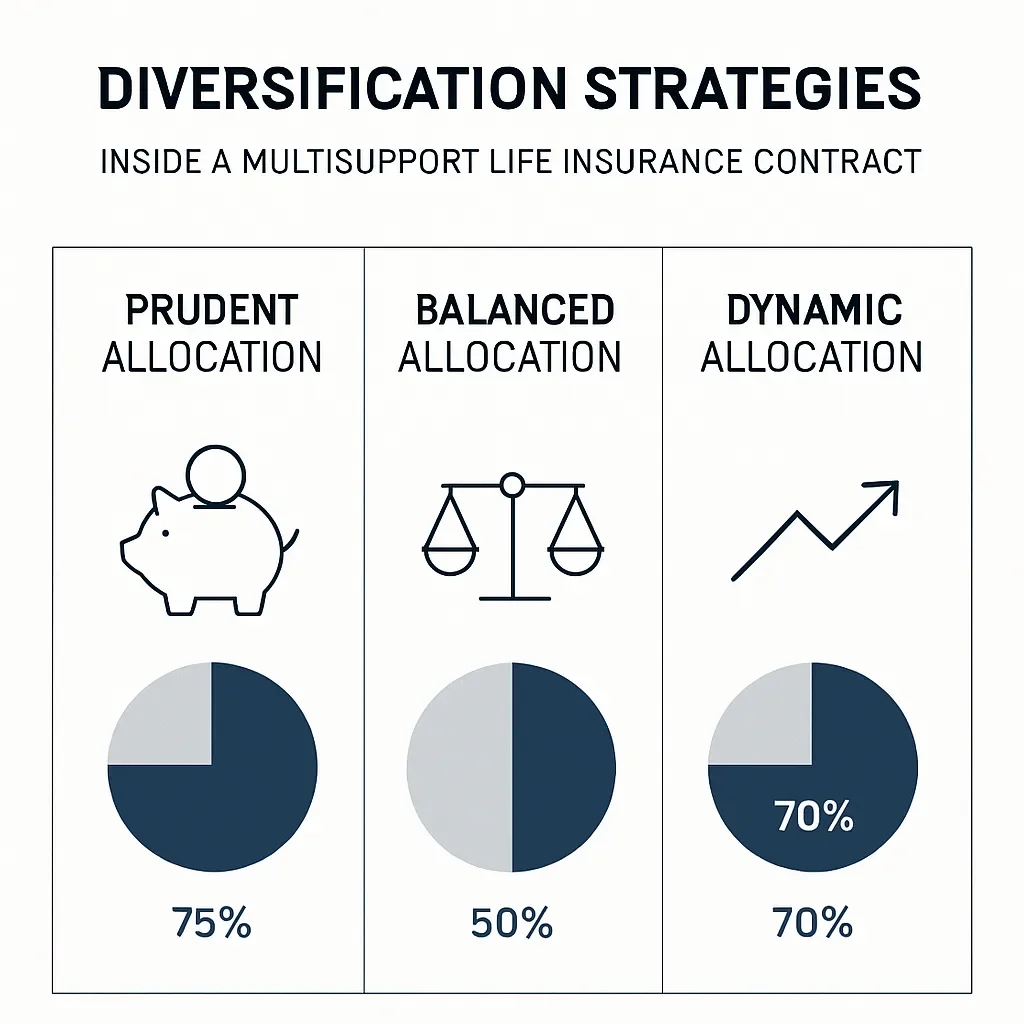
A practical rule helps keep things grounded: the shorter the horizon, the more the secure portion should remain dominant. Conversely, over a period of 8 to 15 years, it becomes more logical to gradually open the door to more volatile assets, such as global equity funds, bonds, or a small real estate portion. The goal is not to “play the stock market,” but to give time to time.
| Profile | Euro funds | Unit-linked investments | Logic |
|---|---|---|---|
| Conservative | 70 to 80% | 20 to 30% | Preserve capital and keep some potential |
| Balanced | 40 to 60% | 40 to 60% | Seek a risk/return compromise |
| Dynamic | 20 to 40% | 60 to 80% | Aim for growth over a long period |
These ranges are not magic formulas, but useful starting points. A person close to retirement generally does not have the same need for volatility as a 35-year-old saver preparing a down payment on a property in ten years. That is why it is better to think in terms of project rather than a fixed “ideal percentage” once and for all.
In practice, a wealth advisor in an agency observes that subscribers who best maintain their course do not look for the miracle asset. They often start with a safety portion, then add unit-linked investments through scheduled contributions. Entering little by little reduces stress… and decisions made on a whim.
Euro funds, unit-linked funds, and real estate investments: finding the right mix
Not all unit-linked funds are equal. Some aim for growth, others better cushion shocks, and others still provide exposure to real estate or bond markets. The important thing is not to multiply holdings just for show, but to combine different drivers. Otherwise, you think you are diversifying when in fact you are concentrating risk under another name.
The AMF usefully reminds that a unit-linked fund does not offer capital guarantee: its value can rise, but also fall. This is why an MSCI World ETF, a short-term government bond allocation, and a yielding SCPI do not exactly play the same role in a portfolio.
The main categories of investments, clearly explained
| Investment | Role in diversification | Main advantage | Point of caution |
|---|---|---|---|
| Euro funds | Security foundation | Stability and visibility | Often more modest returns |
| Equity ETFs | Performance driver | Wide geographical diversification | Sometimes marked volatility |
| Bonds | Cushion | Often more understandable risk | Sensitive to interest rates |
| Paper real estate | Yield supplement | Seeking regular income | Liquidity and fees to watch |
The right mix also depends on how you handle shocks. If seeing your contract lose 5% over a few weeks keeps you awake at night, you need to simplify the recipe. Conversely, if you have time and a real psychological margin, it would be a shame to remain locked in a too cautious allocation for fifteen years. In other words, the best investment is not the most “prestigious”; it is the one you can keep without panicking.
The criteria that really make a difference between two contracts
When comparing two multi-support life insurance contracts, the biggest differences are not always where you think. The yield shown on a marketing document naturally catches the eye. But in real life, it is often the fees, the quality of the range of investments, and the management flexibility that weigh most in the long term. Cherry on the cake: a good contract prevents you from being locked into a single investment universe.
The best multi-support life insurance is not the one that promises the most, but the one that fits your horizon, your fees, and your tolerance for shocks.
The point to check first is the fee structure: entry fees, management fees, arbitration fees, and sometimes hidden fees within certain investments. Half a percentage point more or less in fees, over 10 or 15 years, ends up counting. You also need to verify the real diversity of investments: a contract that only offers a few in-house funds does not provide the same freedom as a platform rich in ETFs, bonds, thematic funds, or real estate investments.
Another often underestimated criterion: the quality of management tools. A good contract should allow simple arbitrations, scheduled payments, possibly credible managed management, and alert or security options. The smoother the interface, the more you keep control without turning your savings into a chore. And frankly, that changes everything over time.
- Fees: compare entry, management, and arbitration fees.
- Investment universe: look at the real variety of unit-linked funds.
- Quality of the euro fund: yield, reserves, consistency.
- Management tools: managed management, automatic arbitrations, scheduled payments.
- Withdrawal flexibility: partial redemption, delays, administrative simplicity.
Errors That Sabotage Diversification
Diversification rarely fails because of the initial idea. It rather fails due to bad habits: overloading volatile assets without a sufficient horizon, staying 100% in euro funds out of fear, or reallocating at the wrong time because a market has dropped for two weeks. The problem is not only financial; it is also emotional.
Another classic mistake is believing that simply adding several assets is enough to be diversified. In reality, three very similar equity funds can react almost the same way. Effective diversification means mixing different asset classes, different geographical areas, and, if necessary, different management rhythms. Otherwise, you just stack positions… without really reducing risk.
You also need to monitor deposits and withdrawals. A large partial redemption can unbalance the allocation, especially if the equity portion has already risen significantly or, conversely, fallen. After a withdrawal, it is better to check if the allocation remains consistent with your profile. It’s a small step, but it avoids unpleasant surprises disguised as a “temporary adjustment.”
FAQ — Multi-Asset Life Insurance and Diversification
Can you start a multi-asset life insurance with a small budget?
Yes, in many contracts, scheduled payments or free payments can start at modest amounts, sometimes just a few dozen euros. The real issue is not the entry ticket, but regularity: it is better to invest little by little than to try to place everything at once without a method.
ETF or SCPI: which helps more to diversify?
Both play different roles. ETFs provide broad and very liquid diversification, while SCPIs add real estate exposure with a profile that is easier to understand on paper, but with fees and liquidity to watch. The best choice mainly depends on your horizon and risk tolerance.
Should you frequently rebalance a multi-asset life insurance?
Not necessarily. Too frequent rebalancing can incur fees and lead to emotional decisions. In practice, an annual or semi-annual check is often enough, unless your personal situation changes significantly or an asset deviates too much from the target allocation.
What proportion of unit-linked funds should be targeted after 8 years?
There is no universal percentage. After 8 years, the tax horizon becomes more favorable, but the share of unit-linked funds must remain compatible with your profile. A cautious saver can remain mostly in euro funds, while a dynamic profile can accept a higher share of volatile assets.
Can partial redemptions be made without breaking the strategy?
Yes, provided you check the contract’s allocation afterward. A partial redemption can unbalance the share of each asset, especially if the markets have moved a lot. After the withdrawal, it is often useful to recalibrate the allocation to avoid drifting unknowingly.
Do scheduled payments really help diversify?
Yes, because they spread entry points over time. This method does not eliminate risk, but it reduces bad timing and helps invest without being guided by the emotion of the moment. It is often the simplest solution to maintain a long-term strategy.