
In brief
🧭 Good idea if the goal is to save long-term for coming-of-age projects, without wanting to access the money every month.
💡 Key point: the contract can be opened very early, but the real question remains the management of payments and the level of risk accepted.
⚠️ To watch: fees, chosen investment options, parents’ consent, and possible adjunct pact if the funds come from grandparents or if one wants to regulate the use.
Is life insurance for a minor child a good idea?
Yes, in many cases, provided you aim for the long term. Life insurance for a minor child mainly serves to accumulate capital for coming-of-age projects, with lighter taxation after 8 years. However, it is not the right tool if you want savings available at any time.
The great advantage of this investment is its flexibility of use. Unlike a locked product, it can serve as an evolving family savings pocket, with a euro fund to secure or unit-linked funds to seek higher returns. It’s not magic, but it’s incredibly practical when you have time ahead.
In practice, life insurance makes perfect sense to prepare for known expenses in advance: higher education, driving license, international mobility, down payment for a first purchase. The contract then becomes a small financial cushion, built calmly. And it is often here that it wins against more rigid or more quickly taxed solutions.
It is also important to recall a simple point: as long as the child is a minor, they do not freely manage the contract. The parents, or legal representatives, keep control. In other words, the tool is interesting if the family framework is clear and if everyone accepts the idea of savings planned for tomorrow, not for today’s emergencies.
How to open a contract in the name of a minor?
Opening a life insurance for a minor child is quite simple on paper, but the legal mechanics matter. The contract is taken out in the child’s name, while the legal representatives sign and manage the payments. The good practice is to prepare the project, clarify the source of funds, and immediately define the contract’s objective.
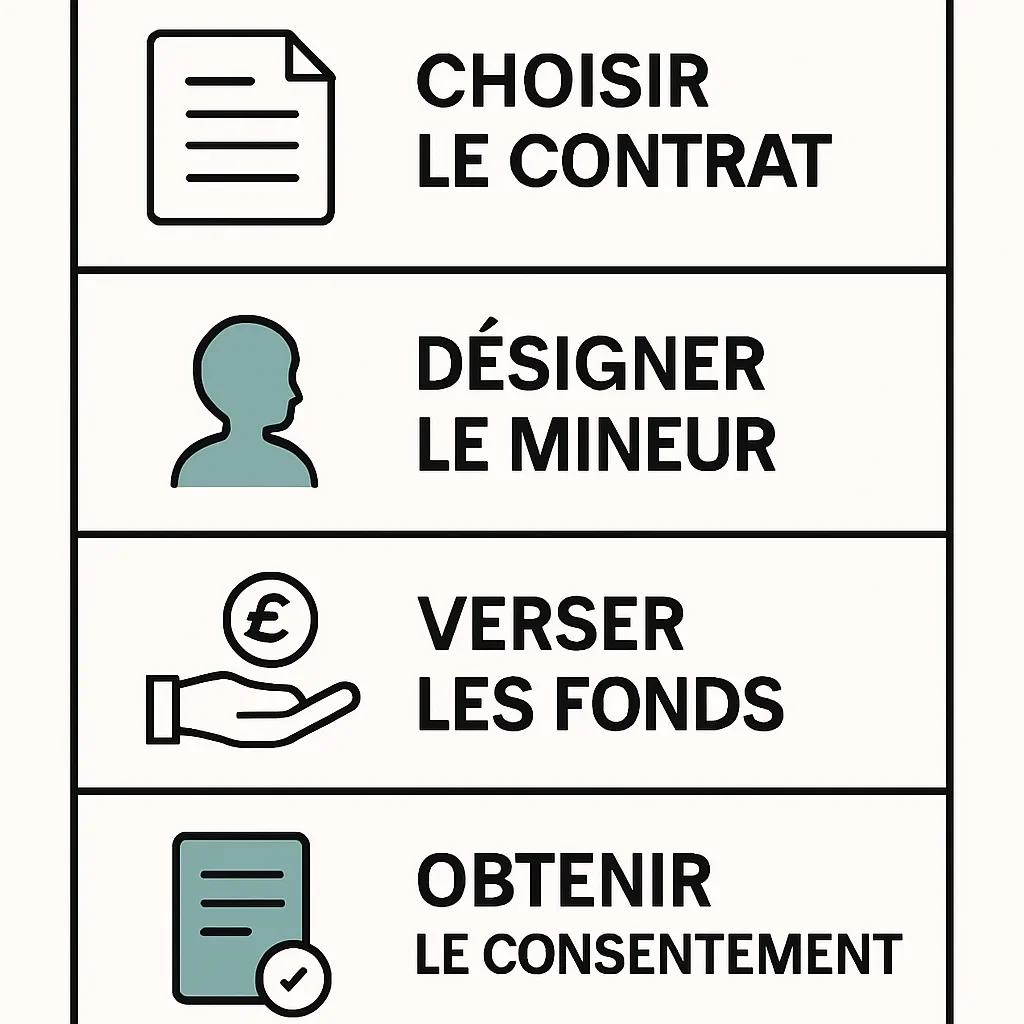
Practically, the insurer generally asks for the identity documents of the minor and the parents, sometimes the family record book, proof of residence, and a bank account details (RIB) to fund the contract. The point of vigilance is the parents’ consent when the act is considered important. In case of disagreement, the process can quickly stall.
If the money comes from a grandparent, godfather, or godmother, the arrangement benefits from being written down clearly. This is where an adjunct pact can become useful: it sets the rules for the use of the funds and prevents a generous gift from being spent in all directions. Joking aside, it’s the kind of detail that avoids family disputes later on.
What strategy according to the child’s age?
The best choice mainly depends on the investment horizon. The younger the child, the more you can afford a gradual and cautious management; the closer to adulthood, the more security takes over. For a short-term project, it is better to avoid overly volatile investments.
When the child is young, the logic is simple: time is on your side. It is often reasonable to prioritize a secure base, then add a small portion of unit-linked funds if the contract allows it and if the goal is really long-term. Over a long period, volatility has time to smooth out, which changes the game significantly.
Conversely, when the child is already 15 or 16 years old, you must think like a future beneficiary close to adulthood. If the money will be needed soon, caution becomes the rule, because a bad entry point in volatile markets can hurt at the moment you actually need the sum.
It is observed in practice that a contract opened at birth is not necessarily funded every month. Many families prefer irregular payments, at Christmas or birthdays, to keep a precautionary savings aside. This rhythm is often more sustainable, and therefore more durable.
In other words, the right allocation is not the same at 3 years old, at 10 years old, or approaching 18 years old. You need to think in terms of distance to the goal, not just returns. This helps avoid the classic mistake: taking too much risk when the need for money is actually closer than expected.
Life insurance, Livret A, PEL: the real comparison
For a minor, the right investment vehicle depends less on marketing and more on practical use. If you are looking for immediate liquidity, the Livret A remains hard to beat. If you aim for a long and flexible project, life insurance regains the advantage. The PEL mainly makes sense in a logic of a pre-planned real estate purchase.
| Product | Main advantage | Limitation | For what use? |
|---|---|---|---|
| Life insurance | Long horizon, varied investments, lighter taxation after 8 years | Less suitable if the money must remain available at all times | Coming-of-age project, down payment, studies, capital growth |
| Livret A | Immediate availability, total simplicity | Limited return | Pocket money savings, emergencies, safety reserve |
| PEL | Structured logic for a future real estate project | Less flexibility and a more rigid framework | Preparation for a home purchase |
| Securities account | Great investment freedom | Higher risk, not suitable for impatient profiles | Long horizon and family already comfortable with risk |
The good test is simple: if you can let the money work for ten years without touching it, a minor child’s life insurance really deserves consideration. Otherwise, a more liquid vehicle will often be more honest.
Taxation, gifts, and attached pact: how does it work?
The taxation of life insurance for a minor child is especially interesting when the contract lasts: before 8 years, gains are subject to less favorable treatment than after this threshold; payments can come from parents or grandparents, but it is important to distinguish between customary gifts, manual gifts, and attached pacts to avoid confusion.
For the legal framework, the portal Service-Public.fr and the section Particuliers on economie.gouv.fr are good entry points. Regarding the risk of investments, the AMF savers’ space reminds that a unit-linked investment can lose value.
Fundamentally, three things must be clearly separated. The customary gift corresponds to a gift proportionate to the occasion and the donor’s means. The manual gift is more formal and can raise traceability issues. The attached pact serves to regulate the gift: possible use at 18 years, at 25 years, or for a specific purpose depending on what is planned.
This is precisely where life insurance is interesting: it allows capital accumulation within a flexible framework while keeping a clear record of the origin of funds if the setup is well thought out. On the other hand, if everything is muddled from the start, it mainly creates complexity. And complexity, in wealth management, always ends up costing more than it yields.
What mistakes should be avoided before signing?
The biggest misstep is confusing useful savings with psychological blockage. A life insurance policy for a minor child should serve a project, not reassure adults because they have “done something” for the child. Otherwise, payments pile up without a real strategy, and both returns and flexibility suffer.
- Opening without a clear objective: studies, housing, future donation, or simple starting capital? Without a compass, the contract becomes vague.
- Putting 100% in unit-linked investments too early: the child does not need a stock market yo-yo if the money is to be used in a few years.
- Forgetting fees: entry fees, management fees, or switching fees can erode returns over time.
- Ignoring the agreement of both parents when required: in case of separation, the file can quickly become complicated.
- Not reviewing the contract during adolescence: as majority approaches, the allocation often deserves to be secured.
Another common trap is letting the contract lie dormant for years without checking the allocation, even though the family situation has changed. A child going to study far away, a real estate project becoming clearer, or an exceptional cash inflow may justify adjusting the course. The contract is not supposed to remain frozen like an old class photo.
FAQ — Life insurance for a minor child
Can a minor withdraw money before 18 years old?
In practice, withdrawals are supervised by legal representatives and must remain in the child’s interest. It is therefore not a self-service piggy bank. When the sum is significant or there is family disagreement, a more formal framework may be necessary.
Can grandparents fund the contract?
Yes, and this is even a very common case. Depending on the amount and occasion, the payment may qualify as a customary gift or a manual gift. If the sum is significant, an attached pact allows better regulation of future use.
Should one choose the euro fund or unit-linked investments?
If the horizon is long and the family accepts some irregularity, a small portion of unit-linked investments can make sense. If the money must be used stress-free at majority, the euro fund often remains the wisest base.
What happens to the contract when the child reaches the age of majority?
At 18 years old, the child legally becomes the master of their contract. They can keep it, change the investments, or proceed with a buyback. That is why it is better to anticipate the transmission of information, rather than letting the topic come up suddenly on their 18th birthday.
Can an emancipated minor subscribe alone?
Yes, from the age of 16 in the case of emancipation, they can act alone within the limits of the legal framework. But insurers often require specific proof, and the practical procedures may vary from one contract to another.