
In Brief
📌 In 2026, the euro fund should remain the foundation of returns, with a credible range around 2.5% to 3.5% gross depending on contracts and bonuses.
⚖️ The best contracts don’t rise on their own: they often require a share of unit-linked investments, regular payments, or stricter access conditions. Cherry on the cake, these offers are sometimes more transparent online than in traditional banks.
🧾 The real figure to watch is not the displayed return, but the net return after fees, social contributions, and inflation. In other words, a 3% gross can behave like much less once the bill is paid.
What Life Insurance Return Can We Expect in 2026?
The most realistic range remains this one, not the mirage of “4% guaranteed” everywhere and for everyone. The market rose when rates went up, but inertia still plays: an insurer’s bond portfolio does not reload overnight.
In practice, three levels must be distinguished. First, the classic euro fund of older or bank contracts, often more stable but not always the most generous. Next, more recent offers, sometimes better remunerated. Finally, entry-level boosted contracts that condition part of the return on holding unit-linked investments or a minimum payment.
| 2026 Scenario | Classic Euro Fund | Boosted Euro Fund | Key Takeaway |
|---|---|---|---|
| Central | 2.5% to 3.0% | 3.0% to 3.5% | Market still supported, but without overheating |
| Favorable | 3.0% to 3.5% | 3.5% to 4.0% and above | Commercial bonuses and well-used reserves |
| More cautious | 2.0% to 2.5% | 2.5% to 3.0% | Margin reductions and less aggressive offers |
The gaps remain logical: the insurer manages a bond portfolio, a profit-sharing reserve, and its commercial policy. When competition is strong, it can sacrifice part of its margin to attract new payments. When inflows slow down, offers often become more cautious. That is why an “average” rate alone does not say much.
How Is the Return of a Life Insurance Built in 2026?
The return of a life insurance is first made in the insurer’s bond portfolio, then in its ability to redistribute part of the gains in the form of profit-sharing. In 2026, market rates, the PPB reserve, management fees, and the weight of commercial bonuses remain the four real levers.
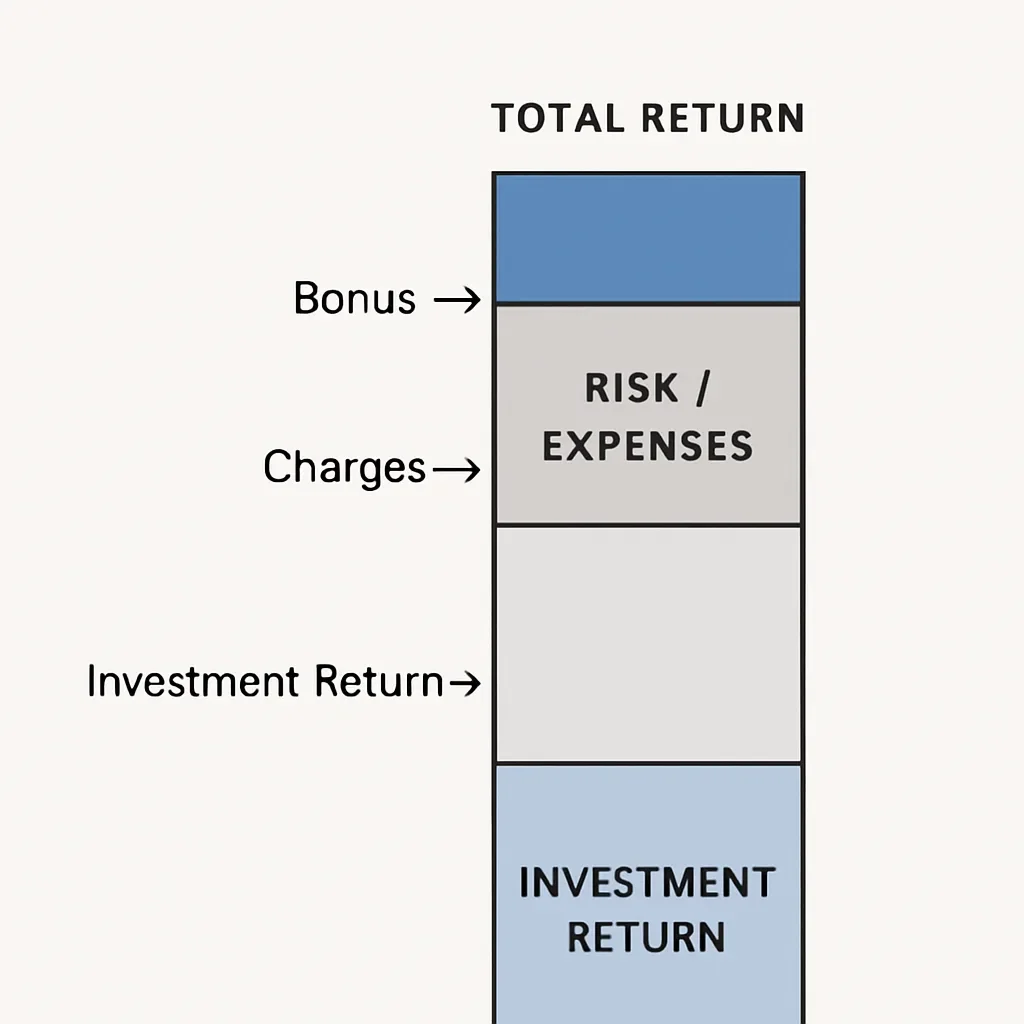
The euro fund is not a black box, even if the envelope remains opaque for many savers. The insurer mainly invests in bonds, sometimes a bit in real estate or stocks, and smooths the results thanks to the provision for profit-sharing (PPB). This mechanism explains why a contract can maintain good rates even after a market downturn.
The ECB key interest rates remain decisive because they influence the yield of new bonds purchased by insurers. The more the interest rate cycle eases, the more the future yield of euro funds can decline, sometimes with a long delay. This is what makes 2026 projections more nuanced than a simple “it goes up” or “it goes down”.
Contracts like CORUM Life or Afer Génération are already part of market discussions because they show that a more dynamic euro fund remains possible. But the counterpart often exists: access conditions, share of UC, or bonus cap. In short, the yield never comes alone; it comes with its little baggage.
Euro funds or unit-linked funds: what should you aim for?
The euro fund reassures because it offers capital guarantee excluding management fees, whereas unit-linked funds expose the contract to financial markets. In exchange, these UCs can aim for higher performance over time, provided one accepts sometimes volatile fluctuations. In other words: more potential, but no safety net underfoot.
| Support | Main advantage | Limit | For which profile? |
|---|---|---|---|
| Euro funds | Capital guaranteed excluding fees | More moderate yield | Cautious, short to medium term |
| Unit-linked funds | Higher performance potential | Risk of capital loss | Long horizon, balanced or dynamic profile |
| Mix of both | Yield/security compromise | Requires monitoring allocation | Most savers |
The trap is to believe that a “more profitable” contract is necessarily better. In reality, a contract can show a good rate on the euro fund while remaining mediocre if UC fees are high or if the unit-linked fund selection lacks clarity. There, the saver sometimes ends up manually managing an overly complicated structure for little gain.
In 2026, the profiles that fare best are often those who do not oppose security and performance but combine them intelligently. A euro base to cushion shocks, a moderate UC portion to seek yield, and regular rebalancing rather than a big gamble.
What is the net real yield after taxes and inflation?
The net real yield is the gross yield minus fees, social contributions, and inflation erosion. On a contract at 3% gross, the perceived yield can quickly drop a notch if prices continue to rise around 2% over the year. This is why the 2026 life insurance yield should be viewed with some perspective.
From a tax perspective, life insurance retains an advantage with the annual allowance after 8 years, according to the Service-Public fact sheet on life insurance. This does not change the yield paid, but it greatly changes the yield received. And for a partial withdrawal, the nuance really matters.
According to INSEE statistics, the general price level remains the main filter of the purchasing power of savings. In other words, a contract at 2.8% can be very decent if inflation remains moderate, whereas a 3.5% can disappoint if fees eat away everything along the way.
The right reflex is therefore to look at three layers at once: gross yield, net tax yield, and real yield. It’s a bit less glamorous than a big number on the cover, but it’s much more honest for managing your savings without fooling yourself.
How to boost yield without blowing up the risk?
For a cautious profile, the goal is not to chase the podium but to secure a euro-denominated base and add, if needed, a diversified unit-linked portion. For a balanced profile, a mixed allocation can make sense, provided contributions are smoothed over time rather than invested all at once.
| Profile | Typical allocation | Target yield in 2026 |
|---|---|---|
| Cautious | 80% to 100% euro funds | About 2.5% to 3.2% gross |
| Balanced | 40% to 70% euro funds + unit-linked | Around 3% to 5% gross depending on markets |
| Dynamic | Higher unit-linked portion | Higher potential, but no guarantee |
A good reflex is to compare the yield actually accessible, not the quoted rate. Contracts like CORUM Life, Afer Génération, or certain online contracts sometimes have clearer mechanisms, but you must check the entry ticket, the required unit-linked portion, and the sustainability of the offer. In short, no magic, just careful reading.
- Check fees: contract management, supports, possible arbitrations.
- Read bonuses: they can raise the yield, but not for free.
- Avoid overconcentration: better several simple unit-linked funds than one very exotic support.
- Consider the horizon: the longer it is, the more unit-linked volatility can be absorbed.
The most attractive yield is not always the one that counts. In life insurance, contract clarity sometimes matters as much as a tenth of a point more.
FAQ: Frequently asked questions about life insurance yield 2026
Is a contract opened before 2026 necessarily worse?
Not at all. Some old contracts have reasonable fees, useful options, and sometimes a more comfortable reserve. However, you need to compare the credited rate, management fees, and available supports, because an “old” contract can also have become average, or even frankly cumbersome to manage.
Are bonuses on euro funds worth it?
Yes, if you accept their conditions. The bonus can improve the yield by a few tenths of a point, sometimes more, but it often requires a unit-linked portion, a minimum contribution, or holding over a given period. Without that, the displayed gain can remain theoretical.
Can you aim for more than 4% without taking too much risk?
You need to be cautious with this promise. In practice, yields above 4% on euro funds often involve bonus mechanisms, commercial conditions, or a unit-linked portion. It’s not impossible, but it’s not the market standard.
Is life insurance still interesting for a retiree?
Yes, especially for the flexibility of withdrawals, transmission, and the possibility to keep a cautious portion. The key point is liquidity: a retiree can favor the euro fund, then add some unit-linked if they don’t need to recover everything in the short term.
Should you change contracts to gain 0.3 points?
Not automatically. If the new contract really offers better accessible yield, lower fees, and more suitable supports, yes. But if the gain depends on complicated conditions or poorly chosen unit-linked funds, the small displayed improvement can quickly be eaten up by fees and risk.
At what time in 2026 should the rates offered be compared?
Most often, insurers publish their euro fund returns at the beginning of the year, with a very active marketing campaign between January and March. It is often then that comparisons are most useful, as the actual rates offered are finally available rather than just announcements.