
In Brief
📌 You do not directly give a life insurance contract like an ordinary asset; most often you go through a redemption, a cash donation, or a well-thought-out beneficiary arrangement.
💡 The rules change a lot depending on age: before 70 years old, the tax framework is much more favorable than after 70 years old, especially if several beneficiaries are involved.
🧾 The good habits remain the same: check the beneficiary clause, assess the place of reserved heirs, and keep written proof of the patrimonial intention.
🚨 The real trap is manifestly exaggerated premiums and hastily improvised arrangements. Joking aside, it is often there that cases get complicated.
Can You Really Make a Donation of Your Life Insurance?
No, not in the classical sense. A life insurance contract is not an asset that you freely give like a car or a bank account. In practice, you rather transfer the money after redemption, or you structure the contract so that it plays its role of transmission upon death, without getting trapped by taxes.
In law, confusion is frequent: many individuals talk about “giving a life insurance,” whereas they mainly want to transfer the contract’s value or benefit a close relative. However, the life insurance contract follows its own rules, with a logic of stipulation in favor of a beneficiary rather than a classic patrimonial transfer.
In other words, three situations must be distinguished. First, the partial or total redemption of the contract, then the donation of the obtained sum. Next, the subscription of a contract in the name of a relative, with safeguards if necessary. Finally, the transmission of capital upon death via the beneficiary clause, which remains the core of the life insurance mechanism.
The important question is therefore not “can you give a contract?”, but rather “what cash flow do you want to transfer, at what time, and with what level of control?”. This is where life insurance donation becomes interesting: it allows choosing between immediate transmission and deferred transmission, without mixing everything up.
Which Life Insurance Donation Strategies Really Work?
The most used arrangements are redemption then donation, subscription in the name of a relative with an attached pact, and the combination of a classic donation with life insurance intended for the part of the estate you want to keep available. The right choice mainly depends on age, family ties, and the control sought.
When you move beyond slogans, three logics come back in serious cases. The first is to redeem the contract, then give all or part of the sum. It’s simple to understand, but you lose part of the life insurance tax envelope. The second aims to benefit a child or grandchild with a well-framed contract, often with an attached pact. The third mixes classic donation and life insurance to spread the transmission over time.
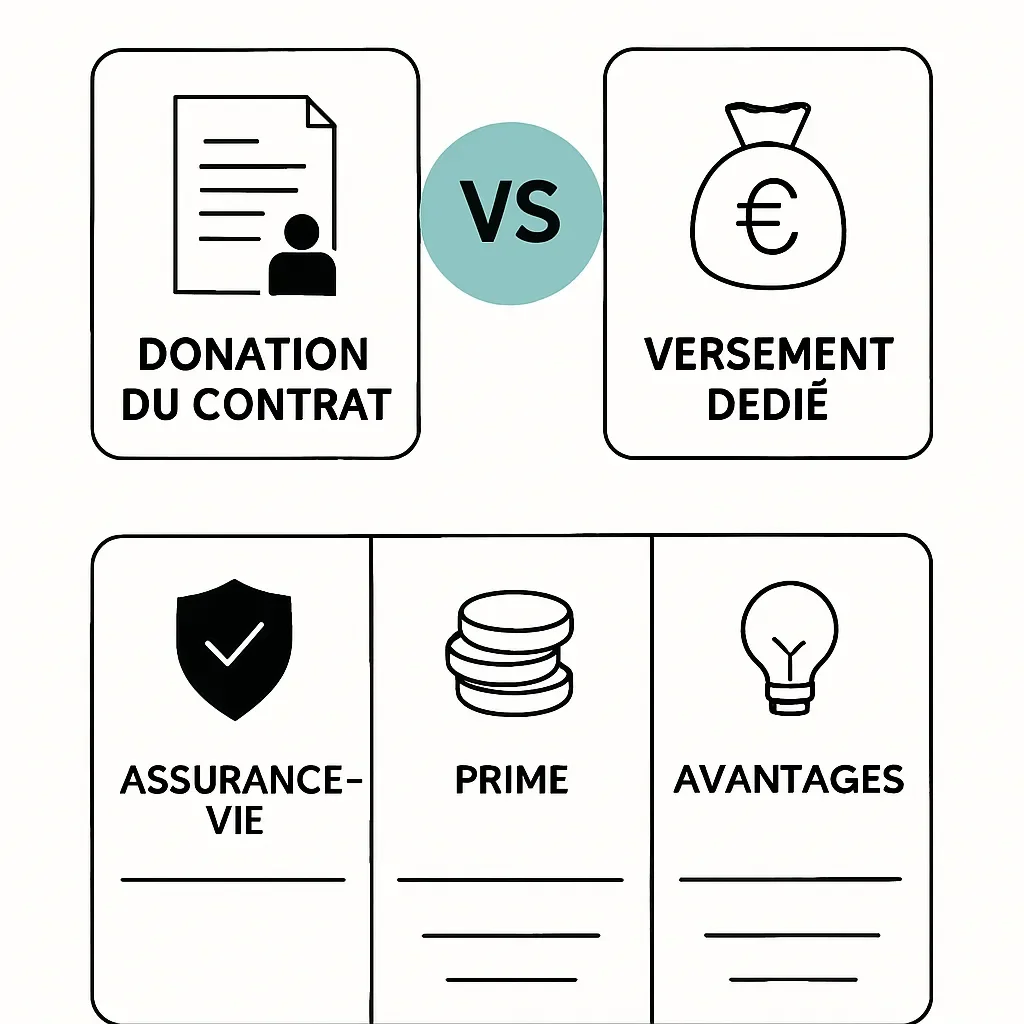
| Strategy | When it is useful | Main advantage | Limitation to keep in mind |
|---|---|---|---|
| Redemption then donation | Need to transfer cash quickly | Clear, direct, easy to explain | Exits the life insurance envelope |
| Payment into a contract in the name of a relative | Adult child, grandchild, relative to support | Flexible transfer, adjustable beneficiary clause | Legal control to secure |
| Attached pact | Minor, young adult, funds with controlled use | Keeps a record of the intention and conditions | The setup must remain coherent |
| Classic donation + life insurance | Already structured estate, desire to smooth the transfer | Good distribution between present and future | Requires proper civil and tax calibration |
The attached pact is often underestimated. It allows you to document what you want to do with the amounts paid, especially when the money must remain useful but not turn into a “disappeared in two weeks” budget. The icing on the cake is that it avoids leaving too much ambiguity if the beneficiary is young.
In practice, families mainly hesitate between transferring immediately and leaving the capital at death. Both approaches can be justified, but not for the same objectives. If you want to help a child buy in Montpellier or finance studies in Lyon, redemption then donation often makes sense. If you mainly want to protect a specific person at death, the beneficiary clause remains the key element.
The right strategy is not the one that promises “zero tax,” but the one that supports a simple reading by the notary, the insurer, and, if necessary, the judge.
How does taxation work before and after age 70?
The taxation of life insurance is not the same depending on the age of the payments. Before 70 years old, the regime of article 990 I of the CGI is generally the most favorable for transfer at death. After 70 years old, the regime shifts to article 757 B, more restrictive, even if not everything is taxed the same way.
This point changes everything. Many families still think that life insurance is “magical” in all cases. In reality, it is especially very powerful if payments are made at the right time and with the right breakdown. Capitalized interest is not treated like the premiums paid, and it is this nuance that explains why the same contract can produce very different results depending on its funding date.
To summarize simply: before 70 years old, life insurance mainly favors transfer outside of inheritance; after 70 years old, it remains useful, but it looks more like an inheritance savings tool than a tax super-rocket. According to the Notaires de France page on life insurance, reading the contract and its payments is therefore essential to avoid shortcuts.
In clear terms, if you have an old contract, you need to reread it before doing anything reckless. The reflex “I still pay a large amount to transfer better” can be excellent in some cases, but counterproductive in others, especially if you are approaching your late sixties or if you have already made several family donations.
How to avoid reclassification as a disguised gift?
The best way to avoid reclassification is to be able to explain why you chose this arrangement and how the money actually flows. Judges and the tax authorities mainly look at the overall coherence: age, assets, contract status, real usefulness, proportion of premiums, and the presence of a genuine transmission objective.
The concept that keeps coming up is that of manifestly exaggerated premiums. In practice, this means that payments must not be disproportionate compared to the overall assets, income, and age of the subscriber. A contract funded very late, for an enormous amount relative to the rest of the assets, quickly attracts attention. This has been seen in practice, notably in cases opened in Bordeaux or Lille, where families had made massive payments without keeping any record of the patrimonial reasoning.
In practice, a notary based in Lille notes that the most problematic cases are those where the saver made large payments very late without explanatory notes or coherence with the rest of the assets. When supporting documents are missing, the debate quickly moves away from technicalities and enters into family conflict.
You also need to watch the forced heirship reserve and the available portion, especially in families with several children or blended families. Life insurance offers flexibility, yes, but it does not magically erase the rights of reserved heirs. If you want to favor a child, grandchild, or third party, it is better to check that the scheme remains defensible in civil court.
- Keep the evidence: payment statements, source of funds, letters to the advisor, patrimonial notes.
- Avoid disproportionate sums if the contract is already heavily loaded or if the insured is elderly.
- Have the beneficiary clause reviewed if the family is complex or blended.
- Request a notarial opinion as soon as there is any doubt about the available portion.
The page on Service-Public.fr about inter vivos gifts remains useful to recall the basics of classical gifting, but it does not replace a detailed patrimonial review when life insurance is involved.
Which scenario to choose according to your family?
The right scenario mainly depends on the profile of the relatives to be helped. For an adult child, the combination “gift today + life insurance for the rest” often works well. For a grandchild, one tends to seek more control over the use of funds. For a spouse, the logic is different again, because inheritance protection does not have the same face as for a descendant.
In a family living in Nantes with two children, the shared gift can limit tensions, while a life insurance contract can be used to smooth out what was not immediately transmitted. In Toulouse, a grandparent who wants to help a grandchild finance their studies may prefer a targeted payment with an attached pact rather than a simple cash gift. And in Marseille, in a blended family, the beneficiary clause often gains importance because it allows for more individualized transmission.
The common point of these situations is the same question: who should receive what, when, and with what degree of freedom? As long as this question has no clear answer, the arrangement remains shaky. A well-thought-out life insurance gift is first and foremost a matter of balance, not tax magic.
- For a child: classic gift + life insurance on the portion you want to keep liquid.
- For a grandchild: controlled payment, often with an attached pact, to avoid mismanagement.
- For a blended family: beneficiary clause reviewed word for word, with arbitration between children, spouse, and possible partner.
- For a comfortable estate: coordination between gift, life insurance, and possible usufruct reserve on other assets.
How to proceed concretely, without making mistakes?
The cleanest method is to start from the actual estate, not a vague idea of “transmitting better.” First, an inventory is made of the contracts, beneficiaries, payment dates, and age at the time of deposits. Only then do you choose between redemption, donation, targeted payment, or simply maintaining the contract. It’s less glamorous than a marketing pitch, but much more effective.
- Reread each contract: beneficiaries, dates, previous payments, current clause.
- Identify the objective: immediate aid, transmission upon death, protection of a loved one, balance between children.
- Measure the tax impact: allowances, age of payments, treatment of premiums and gains.
- Set the right vehicle: classic donation, redemption, attached pact, adapted beneficiary clause.
- Formalize in black and white: letter, estate note, notarized deed if necessary, declaration of the sums given.
When it comes to a donation of sums of money, the declaration often follows a precise formality. In practice, using the appropriate form and ensuring traceability of the transfer avoids many disputes later. For a delicate case, it is better to ask the notary to review everything before executing the transfer, especially if several beneficiaries or multiple generations are involved.
Finally, keep in mind that a good estate strategy is not fixed. A beneficiary clause can be reread, a contract can be redirected, a donation can be calibrated at the right time. This is precisely what makes the strength of life insurance donation: it allows adjusting the settings over the years, provided you don’t wait for the last minute.
FAQ
Can you give a life insurance contract to a grandchild?
Not in the sense of an ordinary contract donation. In practice, it is rather done through a sum of money paid to the grandchild, then possibly through a contract opened in their name. If the grandchild is a minor, additional safeguards are often useful to avoid misuse.
What is the value of a donation after age 70?
It remains possible, but the taxation is less favorable than for payments made before age 70 on a life insurance contract. After 70, the €30,500 allowance applies to premiums paid to all beneficiaries combined, which quickly changes the balance of the arrangement.
Is the spouse better protected than the children?
Often, yes in practical terms, because the beneficiary clause allows a capital to be assigned to them very directly. But it all depends on the contract’s wording, the matrimonial regime, and the overall estate. In blended families, even more caution is needed.
Is it always necessary to go through a notary?
No, not in all cases. But as soon as there are several children, a blended family, a significant estate, or a risk of conflict, the notary becomes a real safety net. They help coordinate donation, life insurance, and the hereditary reserve without risky tinkering.
Can the beneficiary be changed after a donation?
Yes, in principle the beneficiary clause of a life insurance contract can be modified as long as the contract conditions allow it and no irreversible acceptance has been given. However, the exact wording must be checked, as some clauses lock down the room for maneuver more tightly.
Can life insurance be requalified as a donation?
Yes, in some cases. The risk mainly arises when the premiums are deemed manifestly excessive in relation to the estate, age, or usefulness of the contract. Hence the importance of keeping evidence, staying consistent, and having sensitive arrangements validated.