
In Brief
📌 ISR life insurance remains a classic life insurance in its mechanics, but with supports selected according to ESG criteria and a clearer impact logic.
🧪 The real issue is not the “green” label, but the selection method, the labels, and the fees. Without these, the responsible promise can quickly turn into marketing varnish.
💡 On the tax side, life insurance keeps its advantages: after 8 years, the allowance on gains reaches €4,600 for a single person and €9,200 for a couple.
🚀 For a long-term project, it is often one of the few investments where you can still reconcile meaning, flexibility, and return potential.
ISR Life Insurance, a Rare Balance Between Meaning and Return
According to France Assureurs (2024), life insurance remains the leading financial investment of French households, with assets exceeding €1,900 billion. In other words, this is not a niche product. When a portion of this envelope turns to ISR, the challenge becomes very concrete: directing savings towards companies or projects better rated environmentally, socially, and in governance, without losing the tax advantage of life insurance.
In practice, ISR is not a single method. A contract may offer ISR equity funds, responsible ETFs, labeled real estate funds, or, more rarely, a euro fund oriented towards sustainability. This is where many get it wrong: two contracts displaying “ISR” can have very different contents. One may be well stocked with labeled unit-linked funds; the other may only have two or three showcased supports.
The market is also moving because savers compare more. On the ground, the best-selling contracts are not necessarily those promising the greatest impact, but those that clearly explain where the money is invested, what is excluded, and what it costs. It’s simple as that, but it is often what makes the difference between a thoughtful choice and an impulsive purchase.
How does an ISR life insurance policy work in practice?
The engine of the contract remains the same: you deposit money, the insurer invests it in a euro fund and/or unit-linked funds, then you manage it according to your profile. The difference, in an ISR contract, lies mainly in the offered funds. Some managers use a best-in-class approach: they select the best-rated companies in each sector. Others apply stricter exclusions, for example on thermal coal, controversial weapons, or tobacco.
The label matters a lot here. The ISR label applied to life insurance is awarded for 3 years and is based on an independent audit. It is not a guarantee of outperformance, of course, but it is a useful safeguard against funds that would settle for a responsible veneer without a solid method. Alongside, the Greenfin and Finansol labels complement the understanding, each with its own perspective.
It is also important to keep in mind that not all contracts are equal. On some multi-support contracts distributed by banking or mutual networks, the ISR offer is broad but fees can sometimes be higher. Conversely, newer players like Goodvest often prioritize transparency, with a more focused selection. The right reflex is therefore to look at the quality of the unit-linked funds, not just the logo displayed on the homepage.
How to recognize a genuine ISR life insurance policy?
The issue of greenwashing deserves to be taken seriously. Many contracts play on words: “sustainable,” “green,” “responsible,” “solidarity-based.” All this can be interesting, but it is not synonymous with ISR. To avoid being misled, several very concrete points must be checked: the presence of a label, the selection method, the exclusion policy, the frequency of reporting, and the actual share of the concerned funds.
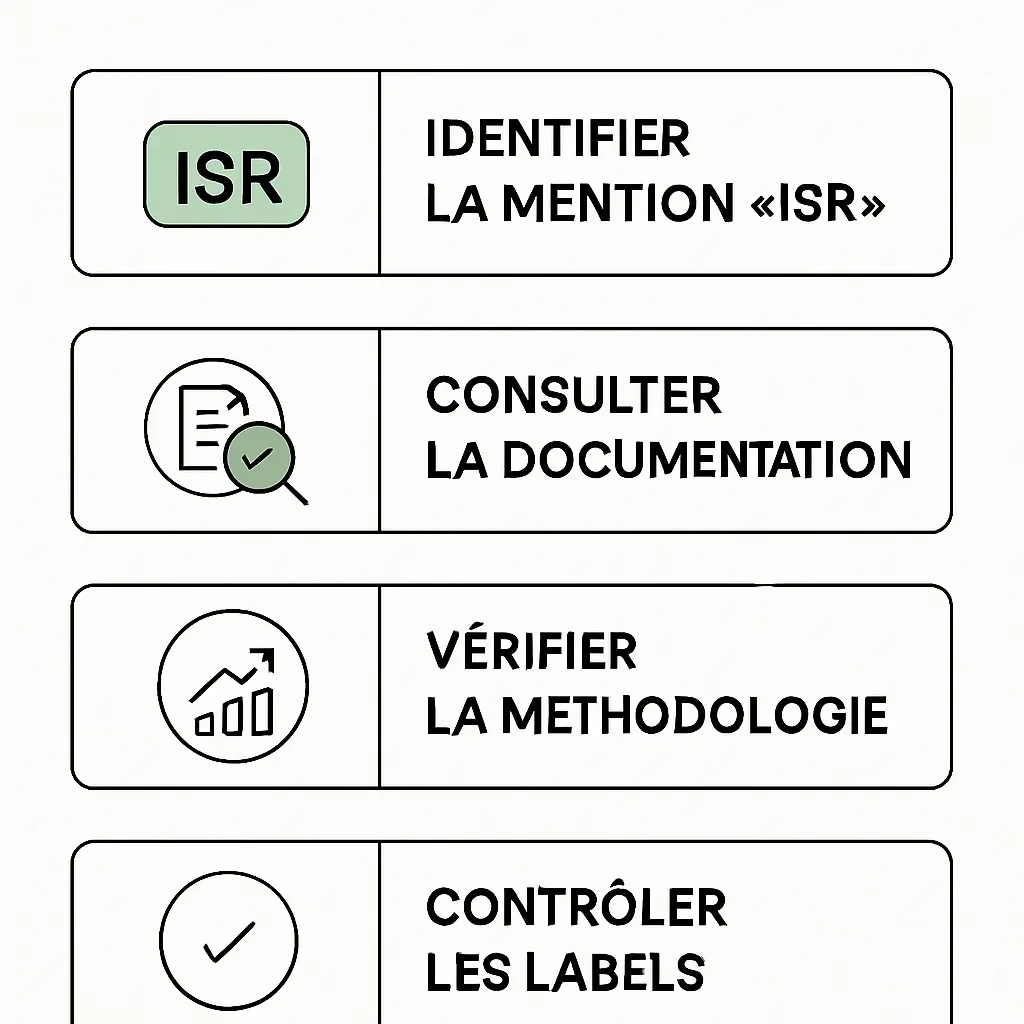
Here is the small checklist that avoids unpleasant surprises:
- Visible label: ISR, Greenfin, or Finansol, with a clear date.
- Described method: best-in-class, sector exclusion, impact, shareholder engagement.
- List of funds: does the contract display the responsible unit-linked funds, or just a marketing page?
- Annual reporting: are the extra-financial results documented?
- Detailed fees: payment, management, switching, fund fees, everything must be clear.
Pre-contractual transparency has become a real quality criterion. In France, the logic driven by the PACTE law and the rise of responsible investments has pushed insurers to better document their ranges. This is also a good indicator: the more a contract explains its functioning simply, the more likely it is to be serious.
Is ISR life insurance really profitable?
The question of profitability deserves a nuanced answer. An ISR fund is not automatically better than a conventional fund. However, it can be as performant as a non-labeled investment, provided that the management is rigorous and the portfolio is well diversified. In practice, what weighs the most are often the fees and the level of risk, well before whether the fund is responsible or not.
Taxation therefore remains a major piece of the puzzle. If you are deciding between two investments with similar returns, life insurance can regain the advantage thanks to its tax framework, especially beyond 8 years. This is particularly true for long-term projects such as retirement planning, inheritance, or gradual investment. Moreover, contributions remain flexible, which avoids locking up your savings as in some more rigid products.
On paper, one might think that the performance of an ISR contract is lower because it excludes certain sectors. In reality, this depends greatly on the type of ISR chosen. A fund that excludes a few controversial industries can remain very close to the market. On the other hand, a very targeted thematic fund, focused on climate or energy transition, may experience greater volatility. In other words, responsible does not mean risk-free.
Which investments to choose according to your saver profile?
The right investment mainly depends on your horizon and tolerance for fluctuations. For a cautious profile, it is best to avoid putting everything into very volatile ISR stocks. For a balanced profile, the idea is often to mix euro funds, diversified ISR UCITS, and a more dynamic portion. For an aggressive profile, ISR ETFs or thematic equity funds can take a larger place, but with real discipline in monitoring.
| Investment | Main advantage | Limitation | Suitable profile |
|---|---|---|---|
| ISR euro funds | More readable capital, low risk | Often moderate return | Cautious |
| ISR equity UCITS | Higher performance potential | Marked volatility | Long term |
| ISR ETFs | Often low fees, broad diversification | Less precise extra-financial selection | Autonomous and disciplined |
| ISR real estate funds | Real estate exposure, diversification | Depends on the real estate market | Heritage mix |
You should also distinguish the “core” portion of the contract from the “satellite” portion. The core portion is the one kept long term with simple, readable, and fairly robust investments. The satellite portion can host more targeted funds: climate, biodiversity, energy transition, or social impact. This is often the best way to avoid the wide gap between caution and ambition.
The right ISR contract is not the one that promises to be 100% green, it is the one that clearly explains what it finances, what it excludes, and how much it costs you.
In this logic, contracts from major networks like La Banque Postale often reassure by their accessibility, while more specialized offers like those from Goodvest seek to push responsible coherence further. No model is perfect. The right choice, ultimately, is the one that fits your profile and your ability to stay the course over several years.
How to compare contracts without getting caught out by fees?
Comparing an ISR life insurance policy should never stop at the percentage yield displayed on a brochure. You need to look at the complete mechanics: fees on payments, management fees, arbitration fees, fees of the funds themselves, and sometimes hidden fees within the unit-linked accounts. On some contracts, the bill remains very light; on others, it eats up a good part of the potential gain. This is where the gap really widens.
In fact, management fees on unit-linked accounts often hover around 0.5% to 1% per year, to which internal fund fees may be added. Online or more recent contracts are sometimes more competitive, while some traditional network contracts retain higher entry or arbitration fees. So you need to compare like with like, otherwise the displayed profitability quickly becomes an illusion.
To go further, you can also consult the AMF fact sheet on life insurance and the Ministry of Economy’s dossier. These resources are useful to reset the basics before signing, especially when a contract mixes financial jargon and promises that are a bit too enticing.
In short, a good method boils down to four points:
- Compare total fees, not just the fees announced upfront.
- Check the ISR universe: number of funds, type of management, quality of reporting.
- Look at flexibility: free payments, arbitrations, management options.
- Choose a clear contract rather than a “bling-bling” contract that talks loudly but explains little.
FAQ — ISR Life Insurance
Can you put 100% of your savings into an ISR life insurance policy?
Yes, but it’s not necessarily the best idea for everyone. A 100% ISR allocation can be coherent for a long-term horizon and good risk tolerance, but it remains exposed to the markets. Many savers prefer to keep a cautious base in euro funds and a portion in responsible unit-linked accounts.
Is ISR life insurance the same as green funds?
Not exactly. A green fund focuses mainly on ecological transition or climate, whereas an ISR fund incorporates a broader reading of ESG criteria. In short, a green fund is often more targeted, while an ISR fund can cover more sectors and extra-financial objectives.
Should you prefer ISR ETFs over actively managed funds?
ISR ETFs often have the advantage of low fees and great transparency. Actively managed funds can, on the other hand, push extra-financial analysis and stock selection further. The right choice therefore depends on your priority: minimizing costs or seeking finer, more engaged management.
What should you look at first: the label or the fees?
Both, but fees have a direct and immediate impact on net performance. A labeled fund remains interesting, but a good label does not compensate for a contract that is too expensive. The healthiest approach is to first check ISR coherence, then compare the total bill over several years.
Is ISR life insurance suitable for passing on capital?
Yes, and it is even one of its major advantages. Life insurance remains a widely used tool for inheritance thanks to its legal and tax framework. If you add a serious ISR selection, you can also align wealth transfer and personal convictions, without losing the contract’s flexibility.