In Brief
🏕️ The best camping in France primarily depends on your profile: family, couple, friends, or nature lovers.
🌊 A seaside camping does not offer the same experience as a quiet countryside campsite, even with equivalent stars.
💬 Camping reviews matter, but you should especially spot recurring criticisms: noise, cleanliness, reception, parking, pool.
🎯 The right choice balances budget, location, comfort, and atmosphere, not just a single commercial promise.
In practice, a satisfied holidaymaker is rarely the one who chose “the most beautiful” campsite on paper. It’s more often the one who found the right balance between location, services, and tranquility. This logic holds even more in high season, when the gap between promise and real experience can become very clear.

How to Choose a Campsite Without Making a Mistake?
The right method is to start with your three non-negotiable priorities, then evaluate each campsite against these criteria. If you want peace, a pool, and the beach within walking distance, you won’t go for the same establishment as a tribe with children wanting activities, slides, and a kids’ club. It’s as simple as that.
The Criteria That Really Change the Experience
On site, four elements often make more difference than the number of stars displayed at the entrance. First, the location: sea, forest, mountain, proximity to a town center or tourist site. Then the level of comfort: tent pitch, standard mobile home, premium accommodation, or simpler option. Then the atmosphere: quiet, family-friendly, festive, or very high-end. Finally, the smoothness of services: reception, circulation, cleanliness, noise, availability of facilities.
- Location: beach access, trails, shops, or points of interest within 10 to 20 minutes.
- Accommodation: tent pitch, caravan, mobile home, or premium cottage depending on your level of demand.
- Facilities: pool, water park, spa, playground, catering, laundry.
- Atmosphere: quiet in the evening, weekend activities, kids’ club, size of the site.
A campsite can be excellent for a family looking for entertainment and disappointing for a couple who came to relax. Quality is not absolute: it depends on the use.
The moment you compare two campsites, you also have to look at what you will actually pay for what you really use. A higher price may be logical if you use the pool, entertainment, and on-site services. On the other hand, if you spend your days outside, the extra cost of a very well-equipped complex can quickly lose its appeal.
What the budget and season reveal
The budget doesn’t say everything, but it greatly influences the level of comfort accessible. In high season, the most popular campsites often display higher prices and a much denser atmosphere. Off-season, the same establishment can become much more pleasant because the facilities remain, but the pressure on common areas decreases significantly.
The right reflex is not to look for the most expensive or the most famous campsite, but the one that remains coherent when it is full.
Are stars, labels, and reviews really enough?
Not really. Stars provide a useful baseline on the level of equipment and hospitality, but they don’t say everything about the atmosphere, noise, or the actual quality of the pitches. Labels and reviews complement the picture, provided you cross-reference them instead of taking them as absolute truth. That’s where smart sorting comes in.
The classification framework for tourist accommodations is managed by Atout France, while the general rules for camping stays are recalled by Service-Public.fr. For a more sober and responsible approach, the guidelines from ADEME for individuals remain useful. In other words, ratings matter, but they never replace a thorough reading of the site.
| Criterion | What it measures | Common limitation |
|---|---|---|
| Stars | Level of equipment and services | Does not say anything about noise or the real atmosphere |
| Campsite reviews | Experience lived by vacationers | Very sensitive to season and client profile |
| Label or eco commitment | Resource management, sorting, sobriety | Does not guarantee a more comfortable stay for everyone |
| Official photos | Visualization of facilities | Often more flattering than the reality of high season |
On the ground, it is often noticed that the most useful critiques are not the extreme reviews, but the repeated feedback. When several travelers mention the same point — night noise, queue at the pool, uneven cleaning, parking too tight — there is generally a signal to take seriously. Conversely, an isolated complaint rarely says much on its own.
Which campsite for which type of vacationer?
The best way to choose a campsite in France is to start from your vacation profile. The needs of a family with young children are not those of a couple who wants peace and quiet, nor those of friends looking for a leisure base, nor those of nature lovers who mainly want to breathe fresh air. A good selection therefore starts with the use, not the reputation.
For families
The best family campsite combines a swimming pool, games, safety, kids’ club, and practical services. Campsites like Les Sablons in Portiragnes, with direct access to the beach, or L’Escale Saint-Gilles in Bénodet, with a 1,000 m² water park, fit this logic of very active holidays. Comfort matters, but the smoothness of the stay matters even more.
For couples
A couple will more willingly look for a quiet campsite, a beautiful view, a good level of comfort, and peaceful circulation. Addresses like Le Ranolien in Perros-Guirec, with its 550 m² spa, or Le Letty in Bénodet, without mobile homes and with direct beach access, illustrate this search for balance between rest and setting. The icing on the cake: less noise, more breathing room.
In this type of stay, the experience often hinges on very concrete details: distance to the restroom, privacy of the pitch, density of the paths, timing of activities, and quality of the sunset facing the sea. It’s no longer about racing for equipment, but about finding a rhythm.
For seaside and high comfort lovers
The seaside campsite appeals to those who want to see the ocean upon waking and limit travel. In this category, Soulac Plage in Soulac-sur-Mer features a water park of more than 1,500 m², while Les Mouettes in Carantec relies on a large water park and an indoor balneotherapy pool. These campsites clearly show that a strong location can be supported by very ambitious facilities.
- Active family: activities, water park, kids’ club, easy beach access.
- Couple: quiet, spa, beautiful pitches, low density, and understated services.
- Group of friends: activities, dining, evenings, accommodations close to each other.
- Nature lover: bare pitches, preserved setting, trails, reduced traffic.
For nature holidaymakers
The nature campsite often remains the best choice for those who want to put the environment at the center of the stay. Le Bois de Valmarie, near Racou beach, or Le Letty, without mobile homes, appeal to travelers who prioritize the place over the spectacle. This type of campsite works very well when looking for real breathing space, not an accumulation of services.
If you want to explore other atmospheres before booking, this selection of refreshing campsites can serve as a starting point. It complements well a search oriented by “holiday style” rather than “fixed ranking.”
Common mistakes that distort the choice
The biggest trap is confusing prestige with suitability. A very well-known, well-equipped, or highly rated campsite can be excellent… for someone else. If you look at only one criterion, you risk booking a technically beautiful stay, but poorly matched to your way of traveling.
- Relying solely on stars when atmosphere and density change everything.
- Choosing based only on the pool photo without checking the actual size of the site or the hours.
- Ignoring the season, while July-August is nothing like June or September.
- Not reading recent reviews, especially those about noise, cleanliness, and reception.
The right campsite is not the one that promises the most, but the one that keeps its promise when you actually occupy it.
The simple method to compare two campsites
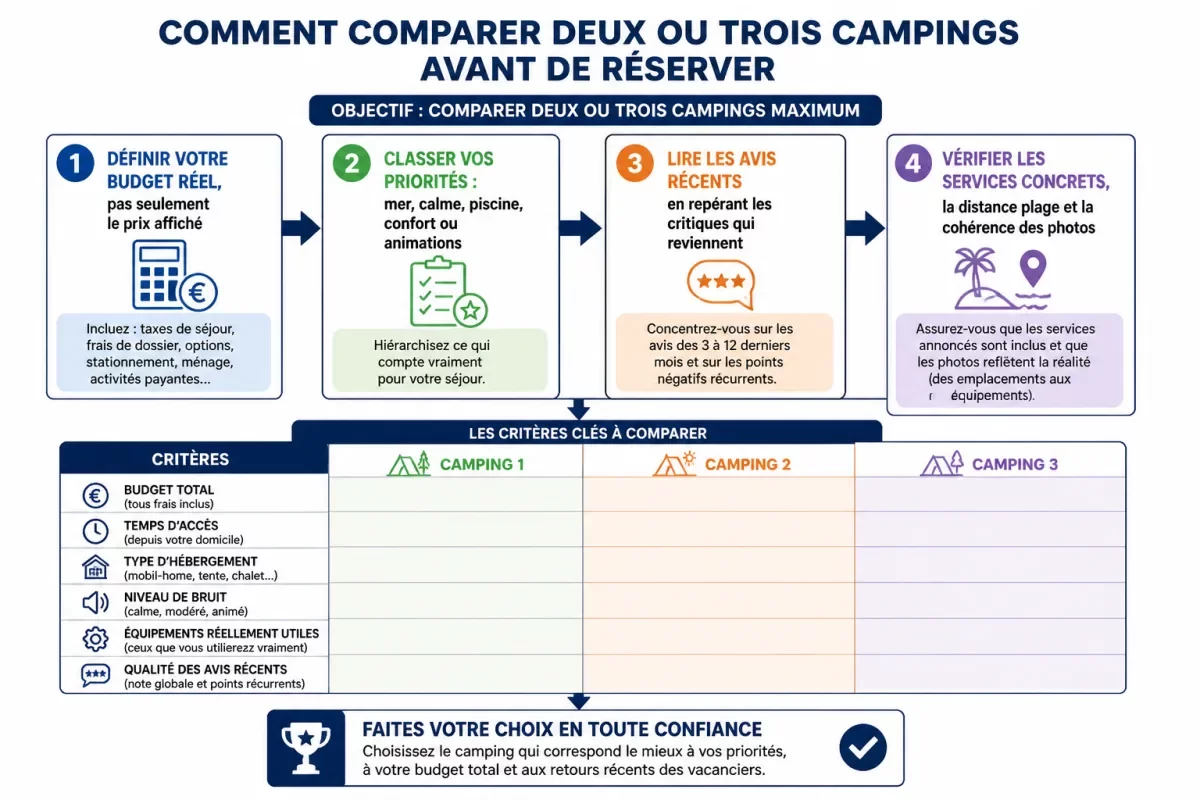
To decide without getting lost, take two or three campsites maximum and filter them by the same criteria. This comparison must be mechanical, almost cold: total budget, access time, type of accommodation, noise level, truly useful facilities, and quality of recent reviews. This is the method that allows choosing without regret.
- Step 1: define your actual budget, not just the listed price.
- Step 2: rank your priorities between sea, calm, pool, comfort, or activities.
- Step 3: read recent reviews by spotting recurring criticisms.
- Step 4: check concrete services, the distance to the beach, and the consistency of photos.
| Type of camping | Suitable profile | Main strength |
|---|---|---|
| Family camping | Parents with children | Activities, safety, practical services |
| Seaside camping | Active holidays and swimming | Quick access to the beach |
| Nature camping | Rest, disconnection, space | Calm and preserved environment |
| 5-star camping | Maximum comfort and full services | Pool, spa, premium accommodations |
The premium campings mentioned above clearly show what to watch for: Le Ranolien for the spa, L’Escale Saint-Gilles for the 1,000 m² water park, Soulac Plage for its more than 1,500 m² of aquatic space, and Les Sablons for direct beach access. These figures don’t tell the whole story, but they already help identify the real positioning.
Key points to remember
🏖️ The best camping depends first on your vacation style, not on a general ranking.
🎯 Always compare location, comfort, atmosphere, and budget in the same frame of reference.
🔍 Recent reviews are worth more than marketing promises or overly perfect photos.
👨👩👧👦 A family camping, a quiet camping, and a seaside camping can all be excellent, but for different needs.
🌿 The right choice is the one that remains consistent once the camping is full in high season.
FAQ
What is the best camping in France?
There is no single answer, because the best camping in France depends on your profile. A family, a couple, or a nature lover will not look for the same thing. The right choice is the one that matches your real priorities, not a general reputation.
Are 5-star campings always the best?
Not necessarily. A 5-star camping often offers more services, but it can also be more expensive, denser, and noisier. For a relaxing stay, a good 4-star well located can sometimes be more pleasant than a very lively 5-star.
How to read camping reviews without making mistakes?
Especially spot themes that come up often: cleanliness, noise, welcome, pool, distance to the beach, and quality of pitches. An isolated review doesn’t say much, whereas the same complaint repeated several times deserves attention. Recent reviews are the most useful.
Which camping to choose for a family holiday?
A family camping must offer real services for children, a suitable pool, a good level of safety, and smooth organization. Campings like Les Sablons or L’Escale Saint-Gilles illustrate this type of stay well, with beach or water park front and center.
Is it better to book early or wait until the last minute?
For the most sought-after campings, booking early often remains the best choice, especially for summer holidays and premium accommodations. Waiting can sometimes allow finding a price drop, but the choice becomes more limited. In high season, flexibility often costs more than anticipation.