
In Brief
- Start by validating your status, budget, and host region before booking anything else.
- Do not confuse immigration procedures, housing, SIN, and RAMQ: the order changes everything.
- The Quebec rental market demands responsiveness, especially in Montreal and around July 1st.
- Keep a safety fund to cover several weeks without stable income upon arrival.
- Rules vary depending on your profile: worker, student, IEC, permanent resident, or family.
Updated April 11, 2026. Settling in Quebec is not just about changing countries: it’s coordinating a series of procedures that depend on your status, budget, and chosen region. The right approach is to treat settling in as a project with multiple steps, clear priorities, and realistic deadlines.
This guide is based on references from the official pages of the Quebec government, Service Canada, and RAMQ, then on practical feedback useful to newcomers. The goal is simple: to help you settle in Quebec without wasting money, losing time, or getting stuck at the wrong moment.
In Quebec, the difference between a smooth arrival and a complicated one often comes down to three things: the right status, transitional housing, and procedures done in the right order.
Field advice in international mobility
How to Prepare Your Project Before Settling in Quebec?
The best preparation is to clarify your entry status, starting budget, and target city before any long-term booking. If you already know where you will live, how long you can manage without stable income, and which procedures depend on your permit, you greatly reduce stress upon arrival.
Before committing, precisely identify the status that authorizes you to enter and, above all, to work or study. A work permit, study permit, IEC, permanent residence, or family reunification do not entail the same rights or procedures. The same word “settle” therefore does not cover the same reality depending on the profile.
Statuses That Change Your Procedures
- Permanent resident or Canadian citizen: easier access to most services, but you still need to organize SIN, address, health, and housing.
- Work permit: priority to work authorization, employer, then everyday life procedures.
- Study permit: be careful about rules on part-time work, insurance, and school documents.
- IEC: flexible arrival, but less long-term visibility; better to plan a stronger savings cushion.
- Skilled worker or immigration candidate: anticipate the CSQ/permanent residence logic, proof of funds, and translated documents.
Steps to Follow Before Departure
- Check your status and the conditions for entry, work, or study.
- Prepare your file: passport, authorizations, diplomas, certificates, civil status documents, proof of funds if necessary.
- Choose a city or region based on employment, cost of living in Quebec, and your mode of transportation.
- Book temporary accommodation for the first few weeks, never committing too early to a long lease.
- Plan an installation budget with a sufficient safety margin to hold out before your first paycheck.
The right order is not “find an apartment then see the rest.” It is first to secure your status, then temporary housing, then everyday life procedures.
Practical rule for settling in Quebec
How Much Should You Budget to Settle in Quebec?
The budget mainly depends on your city, your comfort level, and the time before your first income. To settle in Quebec without financial stress, ideally plan for moving costs, initial purchases, temporary housing, transportation, possible insurance, and several weeks of margin. The amounts below are realistic estimates, not official rates.
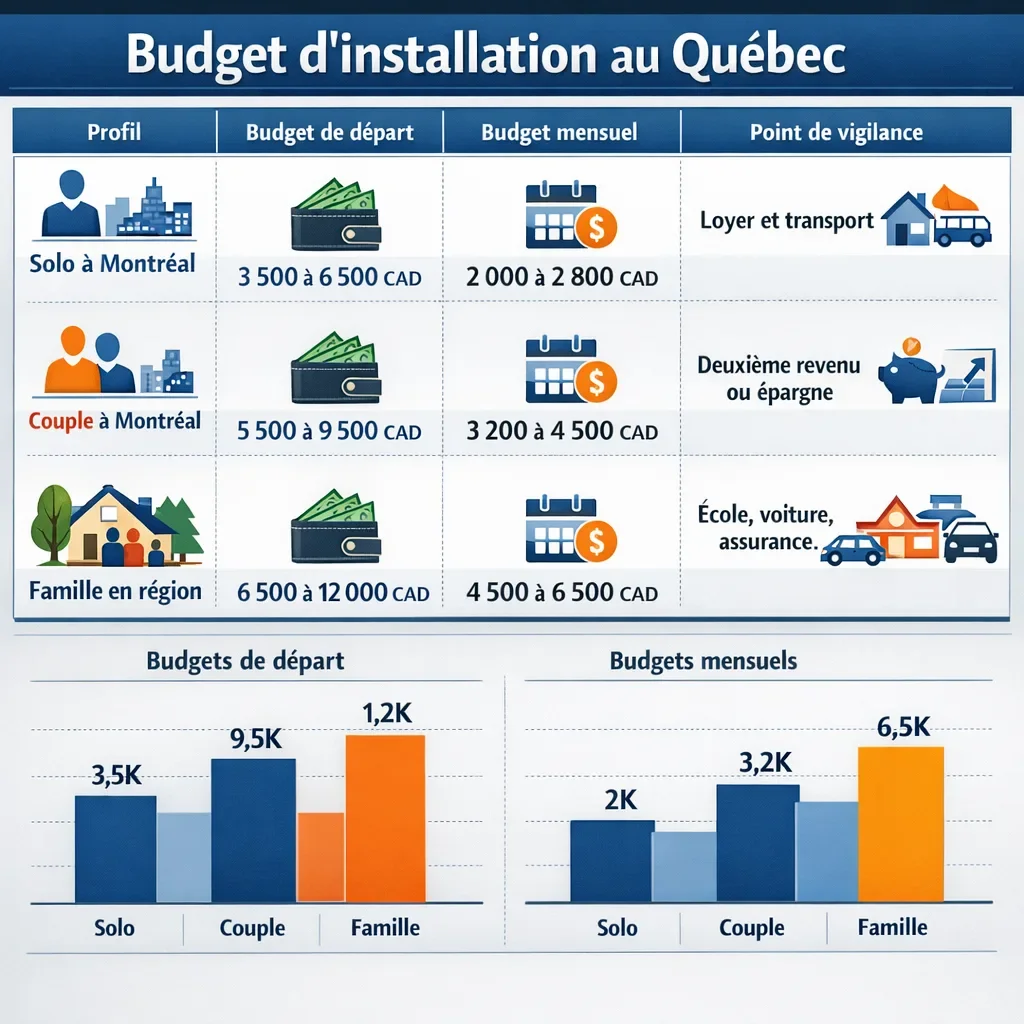
| Profile | Starting Budget | Monthly Budget | Biggest Expenses |
|---|---|---|---|
| Single in Montreal | 3,500 to 6,500 CAD | 2,000 to 2,800 CAD | Rent, transportation, food |
| Couple in Montreal | 5,500 to 9,500 CAD | 3,200 to 4,500 CAD | Second income, larger housing |
| Family in a region | 6,500 to 12,000 CAD | 4,500 to 6,500 CAD | Car, school, insurance, furniture |
These ranges change quickly depending on the rental market and your lifestyle. In Montreal, housing and transportation weigh more heavily. In the regions, rent may be more affordable, but the car, winter equipment, or job search can increase the budget. To settle in Quebec with peace of mind, think in terms of “survival months” and not just ticket costs.
- Do not forget: plane or crossing ticket, baggage transport, first winter purchases, internet connection, phone, household products.
- Anticipate: temporary installation fees, possible deposit on some accommodations, school supplies, furniture if the housing is unfurnished.
- Secure: an emergency reserve for administrative delays, higher-than-expected rents, or a hiring delay.
The biggest financial trap is not the arrival ticket, but the first three weeks without a clear routine and without stable housing.
Newcomer’s feedback
How to Find the Right Housing in Quebec Without Making a Mistake?
The right housing is not just the one that looks good in photos. It is the one that matches your status, your real budget, and your arrival timing. In Quebec, the rental market moves quickly, visits are often grouped, and the best apartment is not always the first one you sign for. You need to check the lease, inclusions, and location methodically.
Two points often surprise newcomers. First, the rental calendar is not the same everywhere, with high demand around July 1st in several neighborhoods. Second, a security deposit is not standard in a typical Quebec lease, which changes how you prepare your war chest. You mainly need to plan for the first rent, not necessarily a classic deposit as in other countries.
| Area | Main advantage | Common limitation | For which profile? |
|---|---|---|---|
| Montreal | Jobs, transportation, services, urban life | Higher rent, strong competition, possible noise | Young professionals, students, mobile profiles |
| Quebec City | More compact city, calmer pace | Sometimes more limited offerings depending on the neighborhood | Families, partial telecommuting, seeking balance |
| Intermediate regions | Often more affordable budget | Greater dependence on car or local job | People already professionally secure |
What to check before signing a lease
- Type of housing: furnished, semi-furnished, or unfurnished.
- Inclusions: heating, hot water, appliances, internet, parking.
- Lease duration and renewal conditions.
- Actual proximity to transport, shops, school, or work.
- Condition of the housing: insulation, windows, noise, humidity, storage, security.
If you arrive without a local history, prepare a simple but serious file: ID, proof of income or savings, employment letter if you have one, reference contacts, and a clear explanation of your project. Landlords appreciate clear, stable candidates who are quick to contact. This is often more decisive than negotiating the price.
I signed my first housing contract too quickly, without checking the heating or the key handover delay. Result: two extra weeks in a hotel and a blown budget.
Field example, arrival in Montreal
What steps to take upon arrival in Quebec?
The first steps must be initiated in a precise order: identity, social insurance number, address, bank, health, and depending on the profile, driver’s license or family registration. Settling in Quebec without stress also means avoiding confusing federal and provincial services, then trying to do everything on the first day.
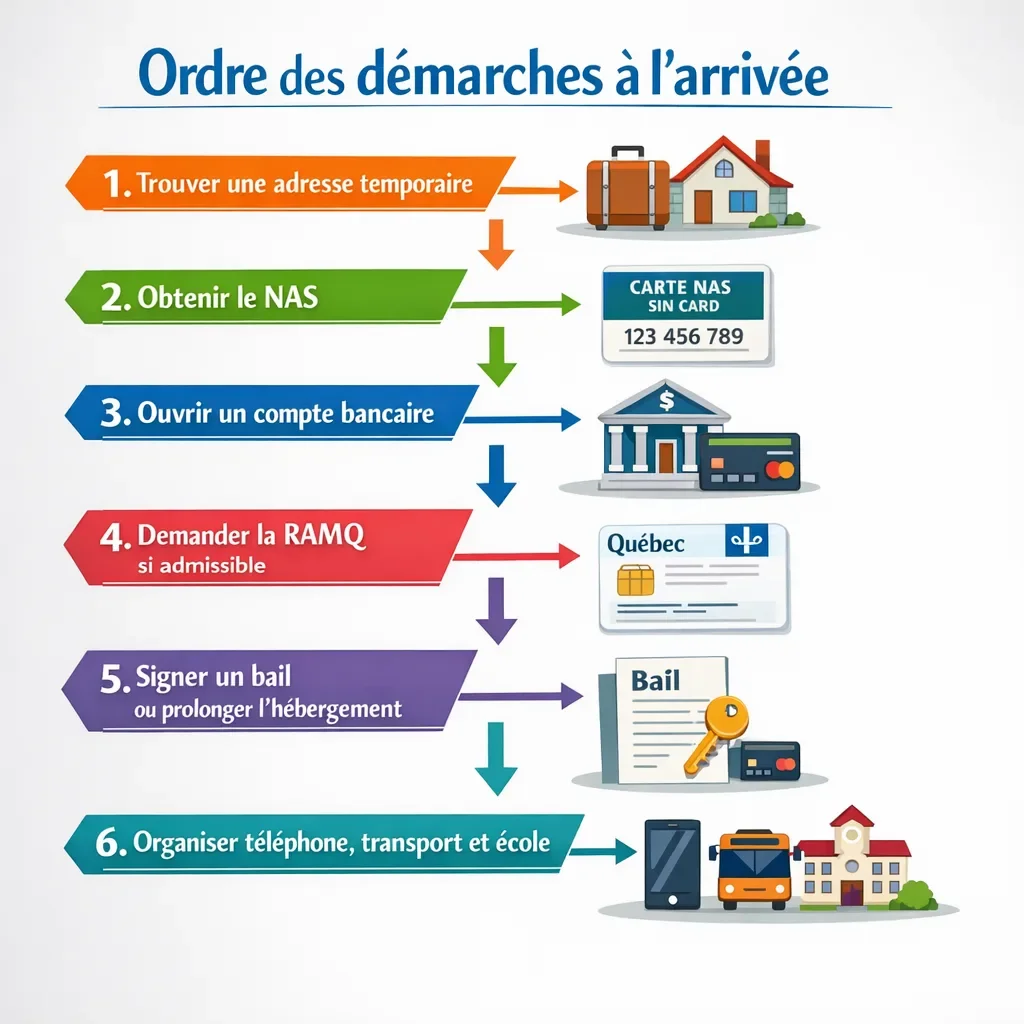
| Step | When to do it | Useful documents | Point of attention |
|---|---|---|---|
| SIN | Upon arrival if you can work | Passport, residence or work permit | Essential for employment and certain formalities |
| Bank account | Very early, sometimes the first or second day | ID, address, status | Useful for rent, salary, and regular payments |
| RAMQ | As soon as you are eligible | Status, proof of address and presence, immigration documents | Access delay varies depending on status |
| Permanent address | When housing is secured | Lease, proof of residence | Used for several administrative files |
| Driver’s license / transport | Within weeks following arrival | Current license, status, ID | To check depending on validity period and applicable agreements |
The SIN, or social insurance number, is not a work permit; it allows you to be paid legally and to carry out certain procedures. The RAMQ, on its side, manages Quebec’s health insurance. The good reflex is therefore to separate the functions: SIN for employment and taxation, RAMQ for health coverage, lease for residential stability.
If you arrive with children, immediately add school, daycare services, daily transport, and basic medical procedures. If you are alone, focus on the bank, phone, housing, and employment network. In all cases, a reliable temporary address is often better than a permanent housing signed too quickly.
How to work in Quebec and secure your future?
Working in Quebec requires as much administrative anticipation as employment strategy. Before actively searching, you need to know what your status allows, whether your authorization is tied to an employer, if you can change jobs, and if your settlement project depends on quick income. This reading avoids costly misunderstandings.
Job searching in Quebec generally values clarity, conciseness, and the ability to demonstrate what you can do. A localized resume, available references, and a good level of French often make the difference. For certain profiles, learning French is not just an integration tool: it is a catalyst for access to the job market and a way to reduce the adaptation period.
In Quebec, a good file is not always enough. You also have to show that you understand local customs, communication codes, and job expectations.
Recruitment field feedback
Levers that save time
- Adapt your resume to the Quebec format: readable, direct, focused on results.
- Prepare proof of diplomas, experiences, and concrete achievements.
- Multiply channels: applications, network, aid organizations, fairs, local contacts.
- Check your permit before signing a contract or leaving a job linked to a specific authorization.
- Anticipate taxes and social protection, especially in case of a first job in Quebec.
If you come for a permanent residence project, the logic is not the same as for a Working Holiday Visa (PVT) or a temporary contract. In the first case, you are building a lasting settlement; in the second, you sometimes have to create a pathway to a future status. This nuance changes how you choose a neighborhood, a vehicle, a school, and even the size of the housing.
How to integrate quickly into Quebec life?
Successful integration does not depend only on housing or work. It also involves simple habits: understanding the seasons, finding your bearings in public services, learning local customs, and building a network, even a modest one, from the first weeks. The more you turn unknowns into routines, the lighter the settlement becomes.
The climate is not just a backdrop; it is a logistical variable. A good pair of boots, a truly warm coat, suitable gloves, and a plan for storm days count as much as a good address. In several regions, the car and snow removal also affect the monthly budget and the organization of trips.
To integrate faster, look for concrete landmarks rather than an abstract “general culture.” Participate in a neighborhood activity, locate nearby shops, test public transport, ask how recycling works, understand holidays, insurance, and health services. These details reduce the feeling of drifting.
- Joining a local group, association, or sports activity helps create connections without waiting for a large circle of friends.
- Taking French language courses can strengthen professional and social ease.
- Learning politeness codes and common phrases avoids many false starts.
- Early identification of useful services — health, transport, banking, employment — gives a sense of control.
Concrete example: a new female arrival with an open work permit, settled in Quebec City, often benefits from first securing simple housing, a transport subscription, a bank, and enrollment in French courses, rather than dispersing her energy on non-priority purchases. This method makes settling in Quebec smoother and more economical.
What mistakes to avoid when settling in Quebec?
The most frequent mistakes are not spectacular. They come from poor prioritization: booking too early, underestimating the budget, ignoring administrative delays, or choosing a region without looking at real employment. Correcting them early saves you time, money, and a lot of mental energy.
- Signing a lease without checking the inclusions: heating, appliances, condition of the housing, move-in date.
- Arriving with too tight a budget: the cost of living in Quebec varies quickly depending on the city and the season.
- Confusing the procedures: SIN, RAMQ, permit, insurance, employment, and lease do not have the same role.
- Neglecting the region: a very expensive neighborhood may be justified if you rely on public transport; a cheaper area may require a car.
- Forgetting the safety margin: a delayed salary, a medical visit, or a winter purchase can unbalance your finances.
- Underestimating the adjustment: winter, distances, and administrative practices require a learning period.
The most costly decisions are often made when you want to “go fast.” In Quebec, going fast without a method often ends up costing more than waiting an extra week.
Principle of caution for new arrivals
Final checklist for a successful settlement
Before leaving or within the very first days, make sure the basics are in place. This checklist prevents common oversights and provides a simple framework to move forward without distraction. Settling in Quebec becomes much easier when everything vital is checked off before the rest.
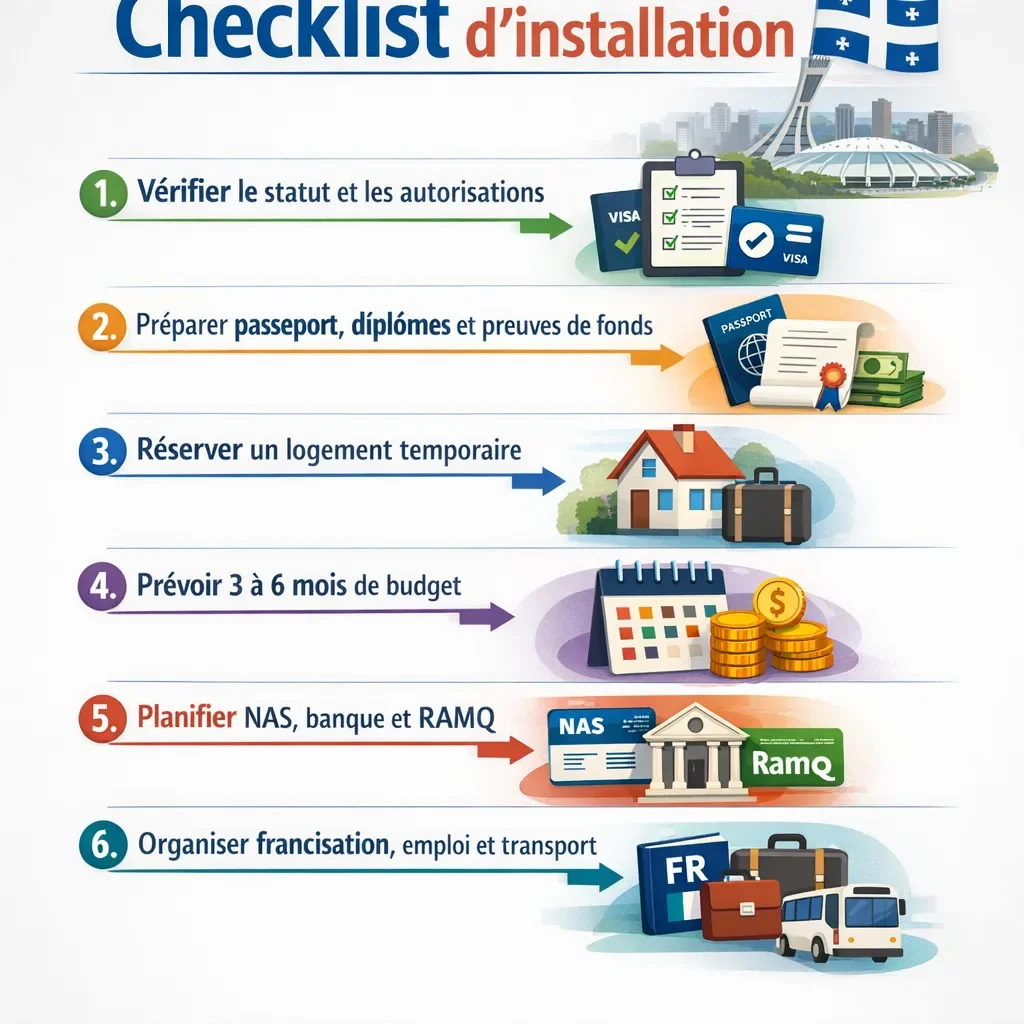
- Immigration status verified and understood.
- Starting budget and emergency fund calculated.
- Temporary housing reserved before the flight.
- Essential documents organized and accessible.
- SIN, bank, and RAMQ planned within the first days.
- Permanent housing chosen after actual neighborhood verification.
- Employment, French language training, and mobility plan launched without delay.
Key points to remember
- The success of your settlement depends mainly on the order of procedures, not just their number.
- Plan a wider financial margin than your initial estimate.
- Quebec housing follows specific rules, especially regarding leases and deposits.
- The SIN, RAMQ, and permit do not serve the same function.
- The choice of city or region influences the cost of living, transportation, and daily rhythm.
- French language training and local networks often speed up professional integration.
FAQ about settling in Quebec
Is it necessary to have permanent housing before arriving?
No, and it is often a bad idea to commit too early. It is better to reserve temporary housing for a few weeks, allowing time to visit, compare neighborhoods, and check lease conditions. This limits the risk of signing in haste.
What minimum budget should be planned to settle in Quebec?
It all depends on the profile, the city, and the delay before the first income. In practice, you should think in terms of starting budget plus safety reserve. A single person will need less than a couple or a family, but no one should arrive without a financial cushion.
Is RAMQ accessible immediately upon arrival?
Not necessarily. Access depends on status, type of stay, and sometimes an eligibility waiting period. Therefore, you must check the official rules before departure, then submit the application as soon as your situation allows. Meanwhile, temporary coverage may be necessary.
Is the SIN used to work in Quebec?
Yes, the SIN is essential to be legally paid and for certain administrative procedures. However, it does not replace a work permit or immigration status. You must distinguish the authorization to work from the number used for social and tax management.
What is the best time to settle in Quebec?
There is no ideal time for everyone. Summer makes housing visits and travel easier but can be more competitive in the rental market. Winter requires more equipment and organization but can sometimes be quieter for certain procedures.