
What is Schengen visa insurance?
Direct answer: it is travel insurance required for a short-stay Schengen visa application, covering at least emergency medical expenses and repatriation, with a nominative certificate valid throughout the entire area concerned. Without this document, the application is often considered incomplete, even if the other documents are in order.

derivative work: Blue-Haired Lawyer (talk) / Wikimedia Commons
Overall, Schengen visa insurance differs from “standard” travel insurance by its level of administrative precision. The contract must explicitly target the Schengen stay, which means the visa center or consulate can immediately identify the covered duration, geographic area, and coverage limit. If any of these elements is missing, the document can be rejected without endless debate.
It should be noted that some travelers think that multi-risk insurance or a “Europe” extension automatically suffices. In reality, this is only true if the general conditions and certificate clearly mention Schengen coverage, repatriation, and the required minimum amount. In other words, you must read the contract, not just the logo on the purchase page.
What are the mandatory guarantees for a Schengen visa?
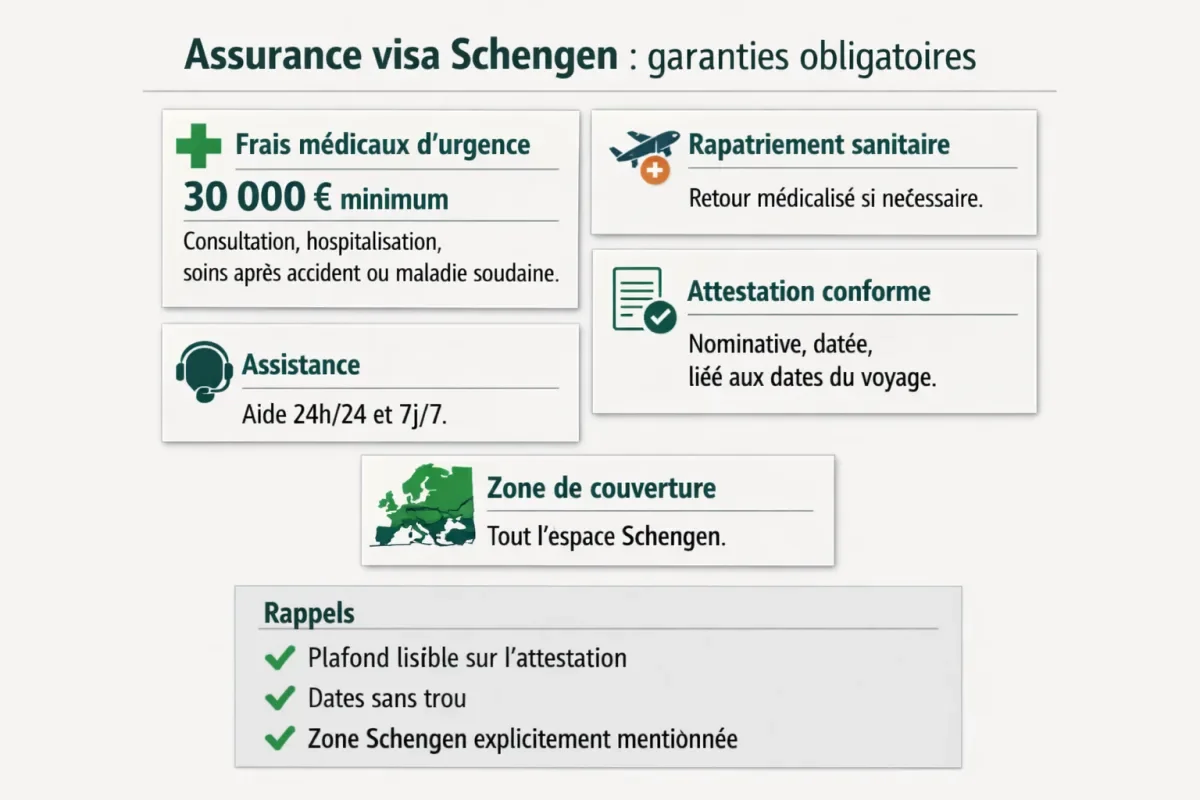
Direct answer: the authorities mainly expect coverage of medical expenses of at least €30,000, assistance, medical repatriation, and validity for the entire duration of the stay in the Schengen area. Useful options exist, but they never replace these basic guarantees.
Coverage of medical expenses: the minimum foundation
The core issue is Schengen medical expense coverage. It must be able to cover an emergency consultation, examinations, hospitalization, and, if necessary, treatment after an accident or sudden illness. The minimum threshold generally expected is €30,000, sometimes more depending on the chosen offer. This amount is not decorative: it must be clearly readable on the certificate.
- Emergency medical consultations: visit to a doctor, prescription, immediate care.
- Hospitalization: admission, emergency surgery, stay costs.
- Care after accident or sudden illness: coverage of unforeseen expenses during the trip.
- Coverage limit: at least €30,000, with a higher ceiling if you want some margin.
Assistance and repatriation: the guarantee that reassures the consulate
Visa repatriation insurance is the other pillar. If your health condition requires a medicalized return, the insurer must be able to organize transport to the country of residence or to a suitable medical center. This guarantee often includes 24/7 telephone assistance, which avoids having to manage crisis logistics manually in the middle of a stay abroad.
- Medical repatriation if a doctor deems it necessary.
- Early return in case of a serious event affecting a close relative.
- 24/7 assistance to guide the traveler in case of trouble.
- Coverage of transport according to the conditions provided in the contract.
Geographical and temporal validity: watch the details
The coverage must be valid throughout the Schengen area, not just in the country of entry. And above all, the dates must match the actual stay: arrival, departure, possible transit or extension if the file provides for it. An end date that is too short can be enough to raise concerns at the visa center. Good to know: authorities also check consistency with tickets, accommodation, and the application form.
| Element | What to look for | Common mistake |
|---|---|---|
| Amount | At least €30,000 | Ceiling too low or not mentioned |
| Area | All Schengen countries | Coverage limited to “Europe” without specification |
| Duration | From the first to the last day of the stay | Some days missing at the beginning or end |
| Assistance | Repatriation and 24/7 help | Guarantee absent or not readable |
What is the price for Schengen visa insurance?
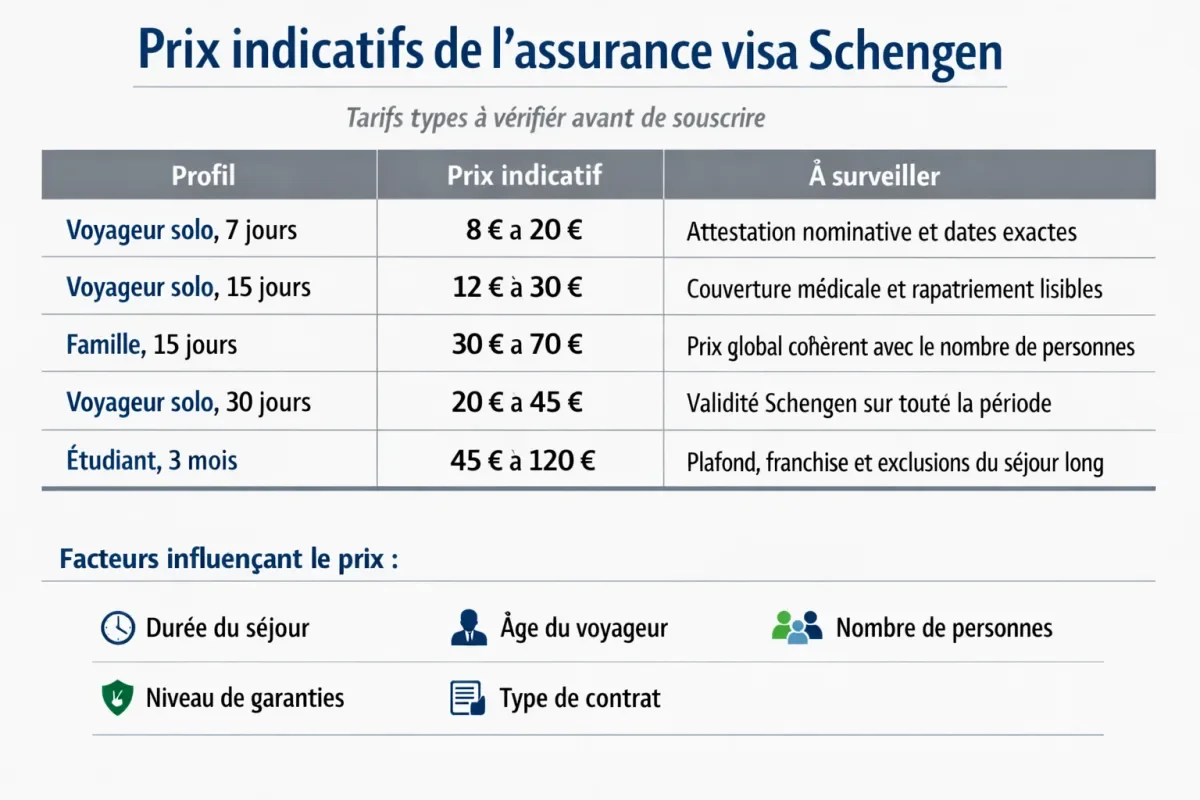
Direct answer: the price of Schengen visa insurance generally remains affordable for a short stay, but it varies according to age, duration, level of guarantees, and number of travelers. For a simple trip, there are often clear differences between a basic plan and a more comfortable coverage with immediate certificate.
The right approach is to think in terms of total file cost, not just the displayed price. A very low offer may seem attractive, but it quickly becomes less interesting if it does not provide a clear certificate, if the ceiling is just barely sufficient, or if exclusions are too numerous. That is why the price must always be read together with the guarantees.
Factors that affect the price
- Duration of stay: the longer it is, the higher the price climbs mechanically.
- Traveler’s age: rates are often higher for senior profiles.
- Number of people: family or group = overall rate often more interesting per person.
- Level of guarantees: higher ceiling, additional options, teleconsultation, etc.
- Type of contract: simple short stay, multi-trip, student, family visit.
Indicative Price Ranges
| Profile / duration | Observed price | To watch out for |
|---|---|---|
| Solo traveler, 7 days | €8 to €20 | Named certificate and exact dates |
| Solo traveler, 15 days | €12 to €30 | Readable medical coverage and repatriation |
| Family, 15 days | €30 to €70 | Overall price consistent with the number of people |
| Solo traveler, 30 days | €20 to €45 | Schengen validity for the entire period |
| Student, 3 months | €45 to €120 | Ceiling, deductible and exclusions for long stay |
For a Schengen insurance comparison, always compare the price with equal coverage. A plan at €18 with a rejected file is worth less than a plan at €28 that issues a clean certificate in a few minutes. The real good deal is the European travel insurance that ticks the boxes without forcing you to decode a legal novel.
How to obtain a compliant Schengen insurance certificate?
Direct answer: you must subscribe to a plan that issues a travel insurance certificate or a Schengen insurance certificate with your name, in PDF or printable format, showing the dates, the covered territory, the guaranteed amount, and the insurer’s contact details. The certificate must be consistent with the passport and the rest of the file.
A good Schengen insurance certificate does not just indicate that you are insured. It must prove compliance, period. If it is vague, incomplete, or written in a simple generic format, the visa center may request another document. This is especially true when the file is submitted at the last minute.
Mandatory information to include
- Full name exactly as on the passport.
- Complete coverage dates, without gaps.
- Geographical area: Schengen area or clearly listed countries.
- Amount of coverage: at least €30,000 for medical expenses.
- Repatriation and assistance clearly mentioned.
- Policy number or contract reference.
- Insurer’s contact details for possible verification.
Here is what a compliant certificate looks like in spirit: “Ms. Léa Martin, covered from May 12 to 26, Schengen area, medical expenses minimum €30,000, assistance and repatriation, contract no. XXX, insurer reachable 24/7.” The document does not need to be spectacular. It must be clear, precise, and readable at a glance.
Check compliance before submitting the file
- Compare the dates of the ticket, hotel, and insurance.
- Verify that the certificate is named.
- Check the minimum amount of €30,000.
- Ensure that the Schengen area is explicitly covered.
- Read the main exclusions: risky sports, pre-existing illness, deductible.
How to choose the right Schengen insurance according to your profile?
Direct answer: the best plan depends on your age, the length of stay, and the risk level of your trip. For a short tourist stay, simple coverage may suffice. For a student, a family, or a senior traveler, it is better to aim broader, especially on assistance and repatriation.
In practice, three profiles often come up: the solo traveler for a few days, the family for two weeks, and the student for several months. The needs are not the same, and this is precisely where the choice of insurance makes the difference. A too basic plan may be suitable on paper but become fragile at the first problem.
| Profile | What to prioritize | Indicative budget | Point of caution |
|---|---|---|---|
| Solo traveler, 7 days | Quick certificate, minimum €30,000 coverage, repatriation | €8 to €20 | Exact dates and name identical to passport |
| Family, 15 days | Multi-person contract, family assistance, clear coverage | €30 to €70 | Check if each member appears on the certificate |
| Student, 3 months | Broader coverage, limited exclusions, certificate issuance | €45 to €120 | Be careful about the actual duration of stay and possible waiting periods |
Bank card insurance, bank or dedicated insurer?
A premium bank card can sometimes cover part of the trip, but it does not always tick all the boxes. The problem is not just the level of coverage: it is also the absence of a clear nominative certificate and the difficulty in proving compliance quickly. Dedicated Schengen visa insurance often remains the simplest solution to avoid back-and-forth with the file.
- Bank card: useful as a supplement, but often insufficient to prove compliance.
- Bank / travel package: convenient if the contract is well written and the certificate is available.
- Dedicated insurer: generally more straightforward to obtain a compliant and readable certificate.
What mistakes cause a Schengen visa application to be refused?
Direct answer: refusals or requests for additional documents often come from an administrative detail, not a “big” problem. Incomplete dates, too vague geographical area, non-nominative certificate or coverage limit too low: these are the classics. A final two-minute check often avoids a week of unnecessary stress.
Here are the most common mistakes seen when submitting the application, sometimes even with experienced travelers: insurance starts after arrival, the name does not exactly match the passport, the certificate only mentions “Europe,” or repatriation coverage is nowhere to be found. The consulate has no reason to guess what the contract meant.
- Non-nominative certificate or with approximate spelling.
- Incomplete coverage dates, especially at arrival or return.
- Insufficient territory: “Europe” instead of clearly mentioning Schengen.
- Absent or unexplained repatriation coverage.
- Coverage limit too low or not visible on the certificate.
- Poorly understood exclusions: sports, pregnancy, pre-existing conditions, high deductible.
Conclusion: secure your visa with compliant insurance
To avoid the classic misstep, keep in mind the essentials: minimum €30,000, coverage throughout the Schengen area, repatriation, assistance, and a readable nominative certificate. Before purchase, compare the price, but above all the quality of the document provided. Good mandatory travel insurance for Schengen is the one that passes the file check without unnecessary discussion.
Always keep the PDF of the certificate, the general conditions, and proof of payment. In case of doubt, the best reflex remains to reread the requirements of the consulate or the relevant visa center, as final acceptance depends on them. This small check avoids unpleasant surprises and forced submissions.
FAQ on travel insurance for Schengen visa
What insurance is accepted for a Schengen visa?
Insurance is generally accepted if it covers at least medical expenses, hospitalization, and repatriation throughout the Schengen area, with a nominative certificate. Ideally, choose a contract that clearly displays the €30,000 limit and the exact dates of the stay.
What is the mandatory minimum amount?
The minimum amount generally required for a short-stay Schengen visa is €30,000 for medical expenses and assistance. This threshold must appear on the certificate. A higher ceiling may be useful, but it does not replace the accuracy of the document.
Does the certificate need to be printed?
In practice, yes, it is better to print it, even though a PDF can also be requested or viewed online. The most important thing is to have a readable, personalized, and compliant document. Keeping both a paper version and a digital version is often the safest.
Can the dates be changed after subscription?
Yes, depending on the insurer, but this may require an update of the contract or a new certificate. It is especially important to avoid dates that no longer match the ticket or visa form. If your departure changes, immediately adjust the insurance to keep a consistent file.
Is bank card insurance sufficient?
Not always. Some cards cover part of the expenses, but they do not necessarily provide a certificate compliant with the Schengen visa, nor a clearly indicated ceiling. For a solid file, dedicated insurance is often simpler, especially if you need to prove coverage quickly.
What to do if the visa is refused after subscription?
Check the contract’s refund conditions. Some insurers refund all or part if the visa is refused before departure, provided official proof of refusal is provided. This is an important point to check before purchasing, because this kind of clause can make a difference.