
In Brief
🔎 Canceling borrower’s insurance is possible at any time since the Lemoine law, provided you subscribe to a new contract with equivalent guarantees.
📉 The savings often come from a gap between bank group contract and individual insurance: over a long loan, the difference can amount to several thousand euros.
⏱️ The bank generally has 10 business days to respond to a complete request. If a document is missing, everything can slow down, no joke.
🧾 The winning trio remains simple: new contract, standardized information sheet, clear written request. Without these, the file quickly stalls.
How to Cancel Borrower’s Insurance Without Mistakes?
The right method is to choose a new contract first, then send a substitution request to the bank with supporting documents. Since the Lemoine law, cancellation is possible at any time, without fees or penalties, if the guarantees of the new contract are at least equivalent.
In practice, canceling borrower’s insurance almost never happens “in a vacuum.” You have to think in pairs: you close the old contract because a new contract takes over. If you interrupt coverage without a replacement solution, the bank may block, and above all, you expose yourself to an uninsured period, which is not really a good idea when dealing with a mortgage loan.
The Ministry of Economy also reminds, in its sheet dedicated to changing borrower’s insurance, that the request can be made by any durable medium. For an official reminder of the principles, you can consult the Ministry of Economy’s sheet on changing borrower’s insurance and, more broadly, the Individuals section of the Ministry.
| Term | What It Means | What It’s For |
|---|---|---|
| Cancellation | Ends the old contract | Change insurance without keeping two contracts |
| Substitution | Replacement of insurance by another | The bank verifies the equivalence of guarantees |
| Insurance delegation | Contract subscribed outside the bank | Often more flexible and cheaper than the group contract |
You should also keep in mind the history of the texts. The Hamon law opened the door to change during the first 12 months, then the Bourquin amendment added an annual window. The Lemoine law, effective in 2022, simplified everything: today, you can cancel at any time. In short, the schedule is no longer a headache.
Why canceling your borrower’s insurance can reduce the cost of the loan?
Because borrower’s insurance is often sold with a “packaged” logic by the bank, whereas an individual contract can better fit your profile. A young non-smoking borrower, for example, does not always benefit from paying the same rate as a riskier profile. And this is where the bill can shrink, sometimes without changing much in the actual coverage.
A difference of a few tenths of a point may seem tiny on paper, but it weighs heavily on a loan of €200,000 to €300,000 over 15 to 25 years. On a file of €250,000 over 20 years, a rate difference can represent several thousand euros in total savings. In Lyon as in Toulouse, households regularly discover that the monthly payment decreases little, but the overall cost breathes much better.
Canceling borrower’s insurance only makes sense if you replace an expensive contract with truly comparable protection. The right reflex is not to “cut,” but to optimize.
The real advantage is not just the price. It is also the possibility to adjust the guarantees to your situation: disability, work incapacity, death, sometimes job loss depending on the contracts. A clearer, more flexible, and better-priced contract is often the winning combo. Cherry on top, you keep control if your situation changes, for example after a professional change or the birth of a child.
In practice, cancellations succeed fastest when the file is prepared like a small notary file: numbered documents, guarantees compared line by line, and signatures of all co-borrowers. A broker based in Lille observes that delays rarely come from the substance of the file, but almost always from a formal oversight.
What steps to follow to cancel and replace the contract?
The cleanest sequence is always the same: compare, choose, sign, then notify the bank. The process may seem trivial, but it is what prevents coverage gaps. Once the new offer is validated, the bank examines the equivalence of guarantees and, if all is good, the substitution is implemented. Simple in principle, but you must be rigorous with every document.
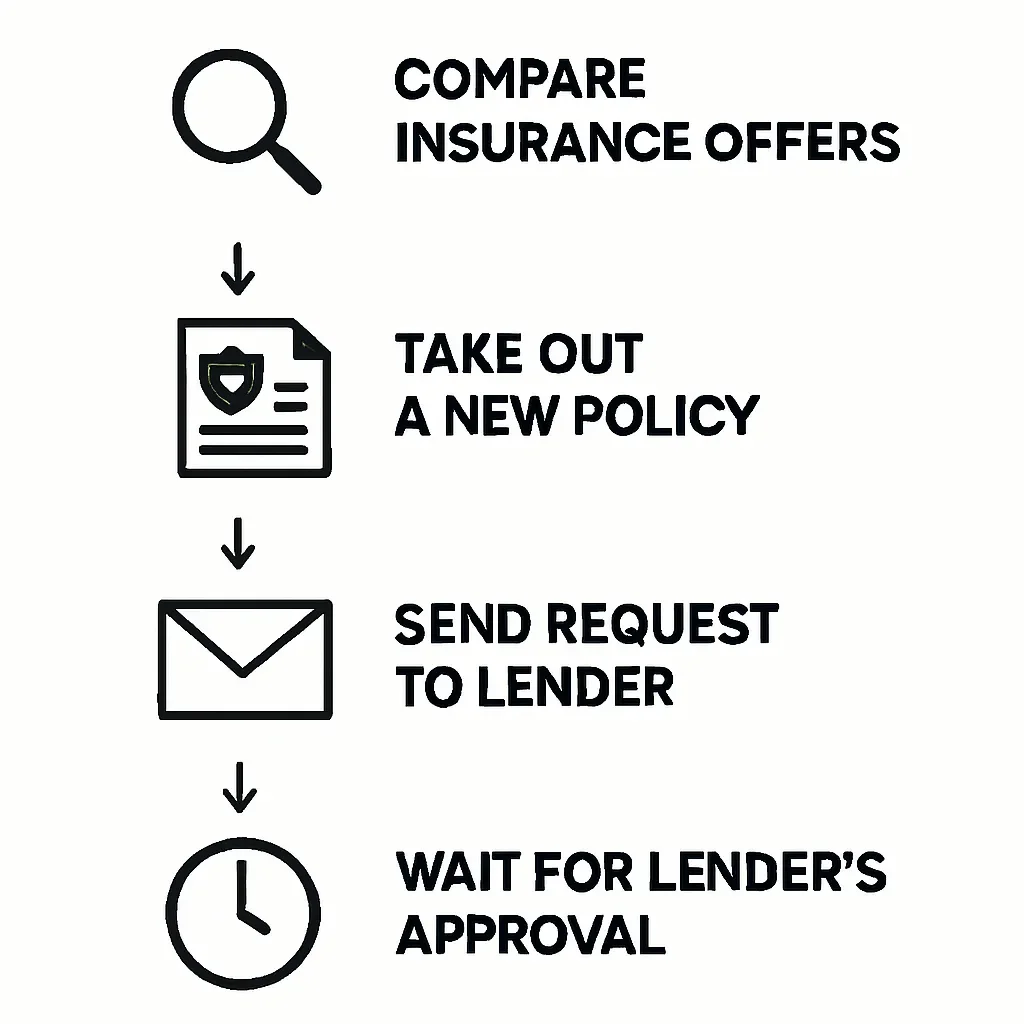
- Compare contracts: check the level of coverage, not just the displayed price. Two contracts with similar rates can protect very differently.
- Request the standardized information sheet: it allows you to compare guarantees clearly, item by item.
- Subscribe to the new contract: do not cancel before having an accepted offer, otherwise you lose time and security.
- Send the request to the bank: do it in writing, with a durable record, to avoid unclear discussions.
- Wait for validation: the bank verifies equivalence, then confirms or justifies a refusal.
For the most official procedures, Service-Public.fr remains a good verification reflex. The idea is not to become a lawyer overnight, but to secure your mail and supporting documents. A well-prepared file goes much better than a hastily sent approximate email.
What documents should you prepare to avoid a back-and-forth?
A solid cancellation file is not a random pile of papers. You especially need to provide the elements that allow the bank to compare the same guarantees, on the same basis. The clearer the file, the less you leave room for a purely formal refusal. And frankly, that’s where you save time.
- The new insurance contract or the draft contract, signed or ready to be signed.
- The standardized information sheet of the new contract.
- The loan offer or the references of the mortgage loan concerned.
- The payment schedule or amortization table, to clearly identify the loan.
- The written request for cancellation/substitution, dated and signed.
- The signatures of all co-borrowers if the loan is shared.
In files with multiple parties, this is often where it gets stuck. For a couple in Rennes or a family in Bordeaux, a single missing signature is enough to slow down the whole process. The best practice is to send a single, paginated file, with names identical to those on the loan offer. You might slap your forehead when you discover the omission, but at least you can correct it quickly.
What to do if the bank refuses the request?
Ask for a written refusal and the precise list of guarantees deemed non-equivalent. If the reason is vague, or if the bank seems to block for commercial reasons, you can correct the file, resend the request, and contact the banking mediator. The refusal should never remain a simple oral statement.
A refusal is legitimate if the new contract does not exactly cover the loan’s requirements. However, the bank cannot be satisfied with a vague “no.” It must explain what is missing: death, disability, incapacity, quota, or technical clause. This is where a line-by-line comparison becomes useful because it cuts short approximate answers.
If you think the bank is abusing, keep all exchanges, ask for a written justification, and resend a clean file. In case of persistent blockage, the banking mediator can be contacted. And if the bank’s response seems contrary to substitution rules, reporting to the competent supervisory authority can also move things forward. In short, don’t give up at the first “no.”
What special cases should be kept in mind?
Cancellation is simple on paper, but some profiles deserve a bit more attention. A loan with two borrowers, a credit buyback, a quick sale of the property, or early repayment are not handled exactly the same way. Again, the right reflex is to check who must sign, which part of the loan remains covered, and the exact date the old insurance really ends.
- Co-borrowers: both signatures are often necessary, especially if the insurance share changes.
- Sale of the property: the contract can be canceled when the loan is paid off, with supporting proof.
- Early repayment: the insurance is no longer useful on the repaid portion, but the cancellation must be formalized.
- Credit buyback: the new loan often opens the door to new insurance, to be compared from the start.
- SCI or professional loan: the setup can change the signatories and the documents to be provided.
In these situations, it pays to read the contract before sending anything. For example, a credit buyback file in Marseille does not have the same mechanics as a personal loan secured by a primary residence in Strasbourg. The deadlines remain close, but the documents sometimes change completely.
FAQ: canceling borrower insurance
Can I cancel borrower insurance if my loan is old?
Yes, since the Lemoine law, the age of the loan is no longer a barrier. You can request substitution at any time, even on a loan signed several years ago. The key point remains the equivalence of guarantees and the presence of a new contract ready to take over.
Do I have to fill out a medical questionnaire to change insurance?
Not always. The Lemoine law has eliminated the medical questionnaire in certain cases, notably for mortgage loans meeting conditions of amount and term. However, depending on the contract and situation, the insurer may still request health information on other files.
Can borrower insurance be canceled if you are a smoker or in a high-risk profession?
Yes, but the comparison must be even more careful. The smoker profile, certain jobs, or sports sometimes expose to surcharges or exclusions. Canceling can then remain interesting, provided the new contract really covers the same level of risk.
Can the bank change my loan rate if I change insurance?
In principle, no: borrower insurance and the loan rate are two different things. Changing insurance should not be used as a pretext to renegotiate the loan upwards. If this happens, you must request a written explanation and check the terms of the initial offer.
What happens in case of early repayment of the loan?
When the loan is repaid before its term, the insurance linked to this loan is no longer necessary on the settled portion. However, you must notify the insurer and keep proof of repayment. On a partial repayment, the cancellation only applies to the concerned part.
Is canceling borrower insurance useful for a small remaining capital?
Sometimes yes, but the gain logically becomes smaller at the end of the loan. If the remaining capital is already low, the monthly savings may be modest. However, if the guarantees are too broad for your current situation, an adjustment can remain relevant despite a limited gain.