
In brief
💡 The right contract is not chosen solely based on price: you need to look at the guarantees, the professional exclusions, the deductible, and the coverage percentage.
🛡️ For a professional loan, the essential base generally remains death, PTIA, temporary incapacity, and disability. Without these building blocks, the coverage can quickly become an empty shell.
📌 Insurance delegation is often the best option to tailor the contract to your activity, especially if you are self-employed, a co-borrower, or exposed to a particular professional risk.
What guarantees should you really demand on a professional loan?
The essential base almost always remains the same: death, PTIA, temporary work incapacity, and disability. The right professional contract is not just about ticking boxes; it must above all cover your ability to repay without bringing the business to its knees if a hard blow occurs.
For a professional loan, the real question is not “is there insurance?”, but “does the insurance reimburse when your activity really stalls?”. A well-crafted contract protects the bank, yes, but it mainly prevents the manager or self-employed person from having to dip into cash flow to continue paying an installment that has become too heavy.
The core: death, PTIA, and disability
The death guarantee extinguishes the outstanding capital in case of the borrower’s death, which immediately secures the loan. The PTIA — total and irreversible loss of autonomy — applies in the most serious cases, when the person can no longer perform essential acts of daily life. These are the two foundations of the contract.
Next comes disability, often broken down into total or partial permanent disability, and temporary work incapacity. This is where the detail matters, because a contract can seem complete on paper while remaining very restrictive in its definition of work stoppage, partial resumption, or professional disability.
Exclusions and deductibles to read before signing
The devil is often in the exclusions. Some contracts more broadly exclude risky sports, psychological disorders, back problems, or pathologies related to repetitive motions, even though these are common among craftsmen, caregivers, or manual professions. Joking aside, this is often where everything is decided.
- Deductible: waiting period before compensation, to align with your cash flow.
- Professional exclusion: a critical point for physical or exposed activities.
- Definition of ITT: prefer a definition linked to your profession when possible.
- Compensation method: lump sum or indemnity-based, with very different effects depending on your income.
How to compare professional loan borrower insurance without making mistakes?
The right comparison is not made solely on the rate. You need to look at the coverage level, professional exclusions, deductible, coverage percentage, and compensation method. With equivalent guarantees, a more flexible contract can be well worth its extra cost if your activity is risky or irregular.
Comparing a professional loan borrower insurance is not about finding the cheapest contract, it’s about finding the one that fits your reality. A low premium with an endless deductible or overly broad exclusions can cost much more on the day you actually need to activate the coverage. The icing on the cake is that the “simplest” contract is sometimes the one that offers the least protection.
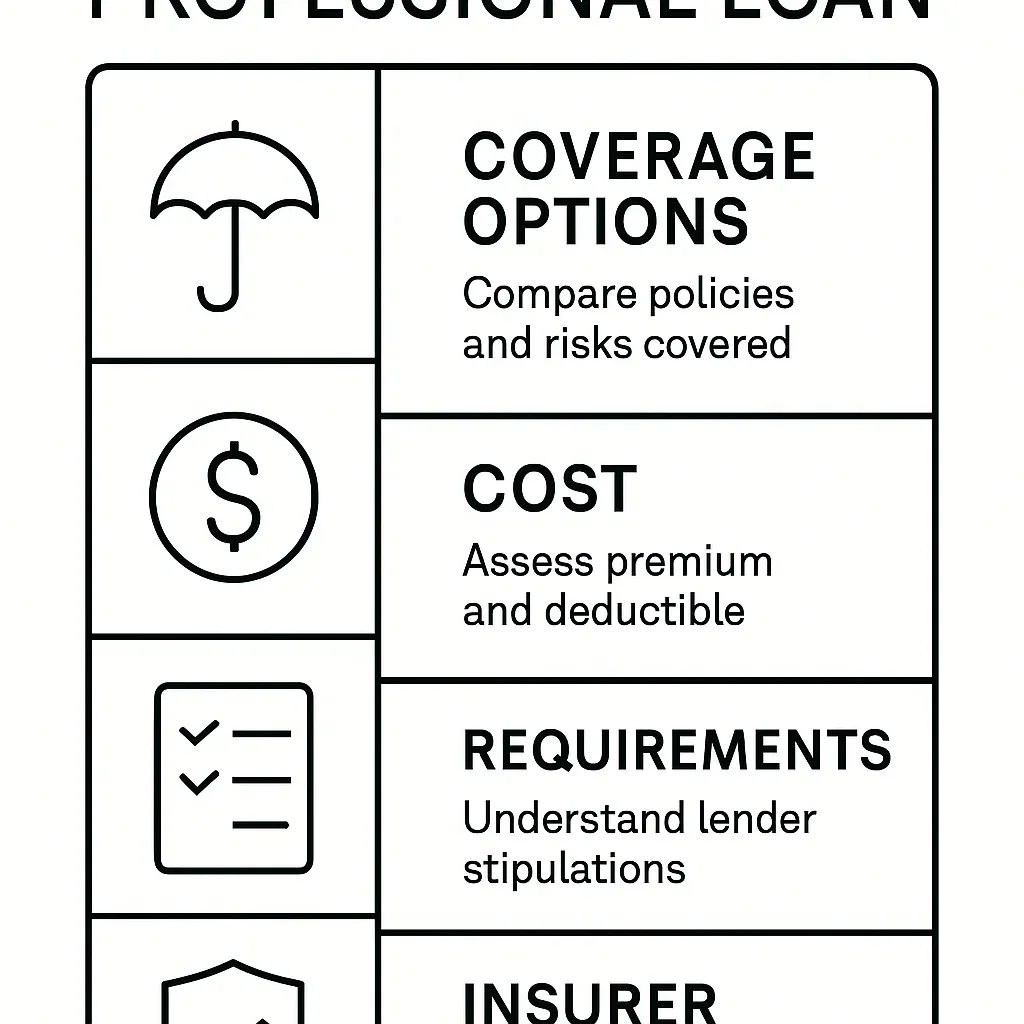
To find your way, start with five simple criteria, then check each line in black and white. It’s longer than just slapping your hand on a promotional quote, but much more useful in the end.
| Criterion | Why it’s important | What to check |
|---|---|---|
| Guarantees | The real foundation of protection | Death, PTIA, ITT, disability |
| Exclusions | Situations not covered | Profession, sport, back, psychological, travel |
| Deductible | Delay before compensation | 30, 60, 90 days or more |
| Quota share | Portion of insured capital | 50/50, 70/30, 100/100 depending on the setup |
| Compensation method | Concrete effect on reimbursement | Fixed or indemnity-based |
Bank or insurance delegation: which option to choose?
The bank remains practical, but insurance delegation is often more flexible and better tailored for a professional file. For a manager, a self-employed person, or a co-borrower with an exposed activity, the right reflex is to compare both options with equivalent guarantees. The simplest solution is not always the smartest.
In practice, the bank’s group contract standardizes a lot, which reassures the lender. Delegation, on the other hand, often allows adjusting guarantees to the profession, age, income level, and type of project. In other words, you sometimes avoid paying for unnecessary protections while strengthening sensitive points.
| Comparison point | Bank contract | Delegation |
|---|---|---|
| Flexibility | Rather standardized | More customizable |
| Price | Often smoothed | Sometimes more competitive with equal guarantees |
| Professional exclusions | Hardly negotiable | Sometimes better adapted |
| Medical formalities | Variable depending on the file | Also variable, but more choices |
However, you need to keep an eye on a key point: the bank may require a level of guarantee equivalent to what it demands to approve the loan. So, before signing a delegation, compare the definition of ITT, the presence of professional disability, waiting periods, and exclusions. For a file with two partners, the question of quota share becomes absolutely central.
How much does borrower insurance for a professional loan cost?
The cost mainly depends on age, health status, profession, loan duration, and insured capital. For a professional loan, the premium can also be calculated on the initial capital or on the outstanding capital, which significantly changes the final bill. For a file of €200,000, the gap between two “comparable” offers can already be noticeable.
According to the INSEE, the French economic fabric remains largely composed of small structures, which explains why an increase of a few dozen euros per month can weigh heavily on a very small business (TPE). For a machine costing €80,000 in Rennes or a takeover at €450,000 in Toulouse, the logic is clearly not the same.
On the ground, an agent observes that leaders of very small businesses in Lyon and artisans in Marseille first compare the deductible, then the contribution. Those who sign too quickly often discover that the low price hides a poorly calibrated ITT or overly broad professional exclusions.
With similar guarantees, price differences between a group contract and a well-targeted delegation can exceed 20% depending on the profile and risk level, especially when the subscriber is young, a non-smoker, and has no medical history. Conversely, some exposed professions may see the premium rise if coverage is extended to professional disability.
Regarding taxation, the Ministry of Economy reminds that a charge is only deductible if it is related to the business and properly recorded. In other words, the insurance premium does not have the same treatment depending on whether the loan is carried by the company, by the sole proprietor, or by a wealth management structure. It is better to validate the arrangement with the accountant.
Can you change insurance during a professional loan?
Yes, but not automatically. For a professional loan, substitution rules do not always copy those from personal mortgage loans. You need to reread the contract, check the termination clauses, the lender’s agreement, and especially the equivalence of guarantees. The general guidelines published by Service-Public.fr are useful, but each professional file has its own constraints.
The point that most often blocks is not the borrower’s goodwill, but the initial setup. If the bank has taken a guarantee on the outstanding capital, or if the contract was negotiated with a particular share, the change must preserve the same level of security. Otherwise, the lender may refuse or request an adjustment.
- Reread the clause on maintaining guarantees.
- Request a written equivalence between the old and new contract.
- Check the effective date to avoid a coverage gap.
- Anticipate any file or modification fees.
How to negotiate a contract truly adapted to your activity?
The best negotiation starts from your profession, not the insurer’s catalog. A doctor in Toulouse, a construction artisan in Nantes, or a shopkeeper in Lille do not have the same risks, therefore not the same priorities. You need to ask for a contract that fits the reality on the ground, with a clear definition of disability, readable exclusions, and a bearable deductible.
If you borrow with others, the share deserves as much attention as the price. A pair of co-managers can, for example, split coverage 50/50, 70/30, or insure 100% of the capital on each head depending on the chosen strategy. For a company that depends on a single project leader, broader coverage may be more coherent than a cheaper “standard” contract.
- Demand the standardized information sheet before comparing.
- Ask for details of professional, sports, back, and psychological exclusions.
- Choose a deductible aligned with your actual cash flow.
- Adapt the share to your project structure and partners.
- Check whether coverage applies to the initial or outstanding capital.
A good professional borrower insurance contract does not try to cover everything. It protects the right risks, at the right time, with a bearable deductible. The rest is often commercial varnish.
FAQ — Professional loan borrower insurance
Is borrower insurance mandatory for a professional loan?
Not by law, but in practice the bank very often requires it to secure the credit. It can refuse the financing or impose certain guarantees if the file seems fragile to it. It is therefore a frequent contractual obligation, even if it is not legal.
Should 100% of the capital be insured for each borrower?
No, and it is sometimes even excessive. The right quota depends on the number of borrowers, their role in the company, and each person’s income level. For a couple of managers, an asymmetric coverage can be more logical than a systematic 100/100.
Can a high-risk profession be insured without a huge surcharge?
Yes, but the contract must be chosen carefully. Jobs exposed to carrying loads, frequent travel, or repetitive gestures often face exclusions or surcharges. The more you anticipate these points, the less you risk a bad surprise at the time of the claim.
Is the insurance premium tax-deductible?
The tax treatment depends on the legal and accounting setup. When the loan is carried by a company, the premium can often be treated as an operating expense, subject to proper accounting. The safest is still to validate the matter with your accountant.
Can a cash loan be insured or only premises?
Yes, insurance can cover several types of financing: premises, equipment, takeover, stock, or cash. What changes is the level of risk and sometimes the duration of the loan. The more the loan finances a strategic asset, the more important the quality of the coverage becomes.