
In brief
⏱️ Since September 1, 2022, cancellation is possible at any time, without waiting for an annual deadline.
🧾 The key point remains the equivalence of guarantees: the bank compares the level of coverage, not just the price.
💰 The older your bank contract and the higher the remaining principal, the more interesting the change can be over time.
How to change borrower insurance with the Lemoine law?
The Lemoine law allows changing borrower insurance at any time, without waiting for the anniversary date, provided the new contract offers equivalent guarantees. The bank must review your request with a complete file, not based on the contract price.
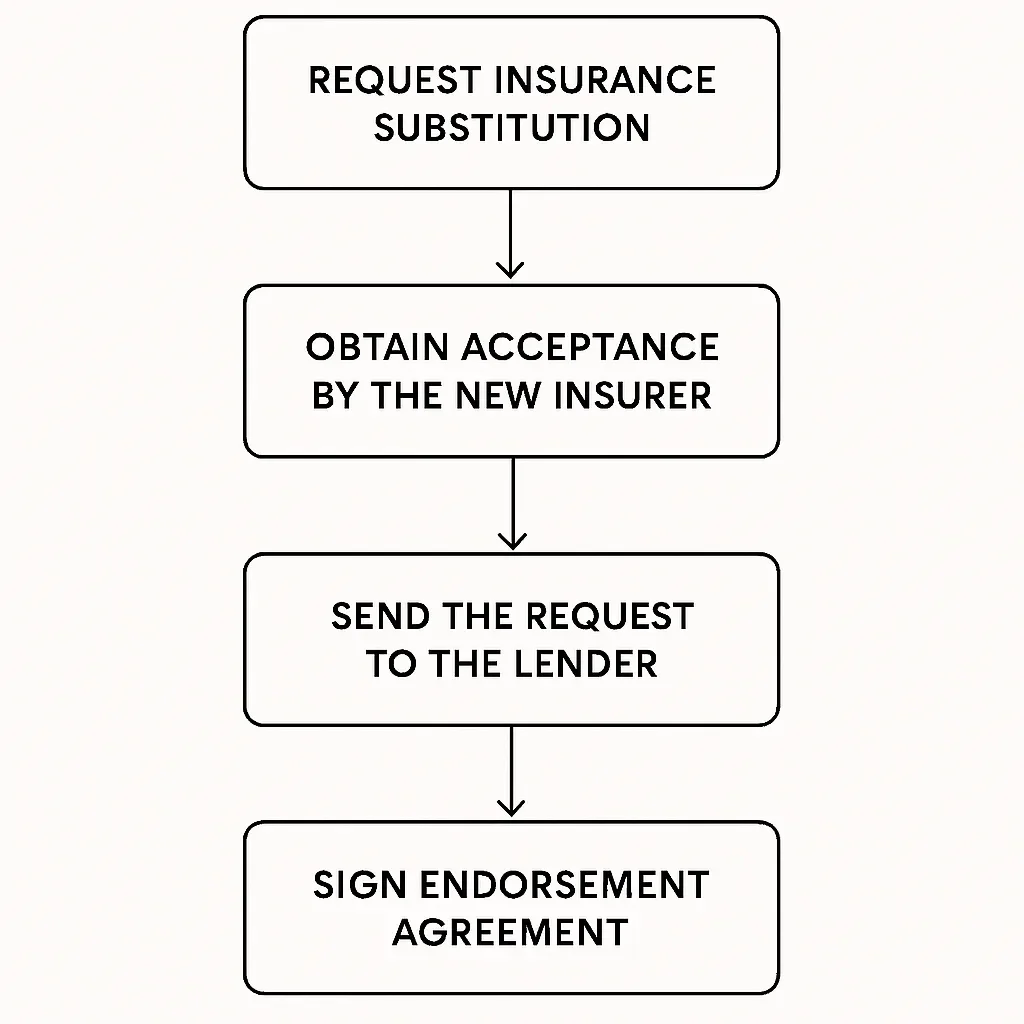
The change happens in four steps, and it’s not complicated if the file is clean from the start. First, you compare offers. Then, you verify that the guarantees requested by the bank are properly included. Next, you submit your substitution request before receiving an endorsement if everything is compliant.
Practically, it’s best to prepare a well-organized file. Here are the documents most often requested: a new contract or a membership certificate, the bank’s standardized information sheet, and sometimes a summary table of guarantees. If a document is missing, processing quickly gets delayed. Joking aside, this is often where everything hinges.
- Step 1: request a competing offer with at least equivalent guarantees.
- Step 2: compare the standardized information sheet with the new contract.
- Step 3: send the substitution request to the bank, with supporting documents.
- Step 4: wait for approval and the implementation of the endorsement before considering the change complete.
It is always advisable to keep a written record of everything: emails, acknowledgments of receipt, PDFs of the new contract, amortization table if requested. In other words, the more traceable the file, the less the bank can nitpick on a formality.
What are the conditions for cancellation without fees?
The change is open to all borrowers with an ongoing contract, including for an old loan. The Lemoine law does not reserve this right for new credits: it also applies to already signed contracts, as long as the new insurance respects the equivalence of guarantees and the coverage required by the lender.
The official framework is recalled by the Ministry of Economy’s page, while the Action Logement guide summarizes the logic of the system well. In practice, the loan signing date matters less than the compliance of the new contract.
| Situation | What the law allows | Point of caution |
|---|---|---|
| Ongoing contract | Change possible at any time | The bank must validate equivalent guarantees |
| Loan signed before 2022 | Yes, the right also applies | No need to wait for an anniversary date |
| Insured capital ≤ €200,000 per person and repayment before 60 years old | Medical questionnaire removed in many cases | The ceiling is assessed per insured, not per household |
| Medical history | Right to be forgotten reduced to 5 years for certain cancers and hepatitis C | The period is calculated after the end of the therapeutic protocol |
Good to know: the medical questionnaire does not disappear for everyone, nor in all cases. However, when you tick the right boxes, it avoids the headache of health declarations and can reopen access to more competitive rates. This is where the mechanism becomes really interesting.
How to verify the equivalence of guarantees without making a mistake?
The right reflex is to compare the guarantees required by the bank and those of the new contract, line by line. The bank does not only look at the price: it mainly checks that the level of protection remains at least equivalent on the covered risks, deductibles, waiting periods, and certain exclusions.
In practice, it is often a very silly detail that causes blockages: a guarantee poorly named, an insufficient share, or a longer deductible than the one imposed in the standardized information sheet. This is where technical terms take on their full meaning: DC for death, PTIA for total and irreversible loss of autonomy, ITT for temporary work incapacity, IPT for permanent total disability.
- DC: basic protection in case of the insured’s death.
- PTIA: coverage if the insured can no longer perform essential acts of daily life.
- ITT: coverage in case of temporary work stoppage.
- IPT: coverage if the disability becomes permanent and severe.
- Share: portion of the capital covered for each borrower, not to be overlooked on a joint loan.
Joking aside, the real battle is not about the commercial name of the contract. It is about the guarantee lines, exclusions, and the share. A cheaper contract but poorly calibrated can quickly become a false good idea.
What if the loan is joint, in an SCI, or already renegotiated?
Change remains possible in these cases, but you must check the loan structure before sending anything. On a joint loan, the share is often the sensitive point. In SCI, the contract can also be changed, but the insurance must remain consistent with the credit structure and the use of the property.
| Special case | What to look at | Common mistake |
|---|---|---|
| Co-borrowers | The total share and each one’s coverage | Replacing the contract without verifying that 100% of the capital remains insured |
| SCI | The loan allocation and the contract wording | Thinking that an SCI automatically excludes the right to change |
| Credit buyback | The new loan has its own insurance | Confusing insurance substitution with refinancing |
| Rental investment | The level of coverage requested by the bank | Choosing the cheapest contract without checking exclusions |
A broker based in Lille notes that the smoothest files arrive when the standardized information sheet has already been compared, especially on ITT and IPT guarantees. Conversely, vague requests drag on quickly, even when the offer is cheaper.
In a family that is still repaying a large principal with two people, changing can be particularly profitable, but one must not fall into the trap of “cheaper at all costs.” A poorly adjusted coverage percentage can cause the sought-after protection to be lost, and frankly, the savings are then worth very little.
How much can be saved with the Lemoine law?
Savings mainly depend on age, remaining principal, remaining duration, and level of coverage. On a well-amortized loan, a better-priced external contract can save several thousand euros over time, especially if the bank insurance is old.
The logic is simple: the more expensive the bank contract is initially, the more visible the gap becomes. On some mortgage loans, the cost of insurance can represent a significant part of the total budget, and changing then allows regaining control. Competition is fierce, especially when the group contract was subscribed several years ago.
However, it is important to keep a cool head. If the loan is almost finished, or if the initial contract is already competitive, the gain will be more modest. Conversely, on a long credit with a high remaining principal, the snowball effect can be truly interesting. In other words, the right time is often when there is still some way to go.
- Favorable case: old bank contract, standard coverage, still high principal.
- Average case: loan already well amortized, but insurance still expensive.
- Weak case: loan end near or contract already optimized.
To summarize, the Lemoine law does not guarantee automatic savings. It mainly provides a negotiation lever. And that, for a borrower, is far from a detail.
What to do if the bank refuses or delays the request?
If the bank blocks, ask for the reason in writing, check the standardized information sheet, and correct the contract or the file. When everything is compliant, the refusal generally does not hold. In practice, many blockages come from a simple form discrepancy or a missing document.
The first reflex is to ask for a precise reason. If the bank mentions insufficient coverage, compare it point by point with the standardized sheet. If it talks about an incomplete file, immediately send the missing documents. The goal is to remove ambiguity because it is in ambiguity that files get stuck.
When the file is compliant, substitution should not be blocked for a price issue. The bank can contest equivalence, not the fact that you choose a cheaper contract. If the response is delayed, follow up in writing and keep all exchanges. It’s basic but extremely useful.
- Check the Standardized Information Sheet before any signature.
- Compare the required coverages one by one.
- Keep proof of sending and receipt.
- Escalate to the complaints department if the file remains blocked without solid reason.
In practice, the most frequent blockages are due to a wrong coverage percentage, too broad an exclusion, or a non-compliant waiting period. In other words, refusal is not always a refusal in principle: sometimes, adjusting two lines is enough to unblock everything.
FAQ
Can you change borrower insurance at any time?
Yes, since the Lemoine law, cancellation is possible at any time for ongoing contracts. It is no longer necessary to wait for an anniversary date or a specific window. However, substitution only becomes effective once the guarantees are validated by the bank.
Can the bank refuse if the new contract is cheaper?
No, price alone is not enough to justify a refusal. The bank can only contest an insufficient equivalence of guarantees, for example if the coverage percentage or ITT/IPT coverage is too low. If everything is compliant, a cheaper contract remains perfectly acceptable.
Does the medical questionnaire disappear for everyone?
No, the removal does not apply to all files. It concerns loans insured up to €200,000 maximum per insured and repaid before age 60. Beyond that, the bank can still request health information.
What if I have already had cancer or hepatitis C?
The right to be forgotten has been reduced to 5 years for certain cancers and for hepatitis C, under conditions. This period starts after the end of the therapeutic protocol. In practice, this can reopen access to much more affordable insurance.
Can an SCI change borrower insurance?
Yes, the SCI does not exclude changing as a principle. It is especially necessary to check the purpose of the loan, the wording of the contract, and the distribution of guarantees. The file must remain consistent with the legal structure of the financing, otherwise the bank may request adjustments.
Should you inform your bank before signing the new contract?
The safest approach is not to cancel the old contract too early. It is better to have the new contract validated first, then initiate the substitution. Otherwise, you risk ending up with a poorly timed coverage period, and that is never a good surprise.