
In Brief
🧭 Since September 1, 2022, you can change borrower insurance at any time on eligible loans, without fees or penalties. This is the major change brought by the Lemoine law.
💸 The gain mainly depends on the remaining principal, the remaining duration, and the difference in TAEA between the old and new contract. The younger the loan, the greater the saving margin.
📎 The most common sticking point? The equivalence of guarantees. In other words, the bank must accept the new offer if it covers at least the same level of protection as its original contract.
How Much Can You Save by Renegotiating Your Borrower Insurance?
On a loan of €200,000 over 20 years, a difference of 0.20 points between a group insurance at 0.35% and an individual contract at 0.15% can represent around €8,000 to €10,000 in total savings. The higher the remaining principal, the greater the room for maneuver.
The mechanism is quite simple: borrower insurance is paid over the duration of the loan, so the gain accumulates month after month. A difference that seems tiny on paper quickly becomes serious when applied over ten, fifteen, or twenty years. That’s why the most visible savings often concern recent loans, still heavily loaded with principal.
The Ministry of Economy also reminds that the possibility to change insurance applies at any time since September 1, 2022 for eligible contracts, which puts competition back at the center of the game. For young profiles, non-smokers, without serious medical history, the difference between a bank contract and an individual contract can really drop sharply… in a good way.
- Age at subscription: the younger you are, the more marked the difference can be.
- Remaining principal: this concentrates most of the potential savings.
- Insured portion: as a couple, a poor distribution can reduce the benefit of changing.
- Risk profile: smoker, risky profession, or enhanced guarantees can affect the price.
How to calculate the real savings before signing?
To measure the real savings, compare the remaining cost of the old insurance with that of the new one, taking into account the coverage percentage, the remaining duration, and the TAEA. The correct calculation is done over the loan term, not just on the displayed monthly payment.
The classic trap is to look only at the new monthly rate. Bad idea. What you need to compare is the total cost over the remaining duration, because an insurance can be very attractive on the first line of a quote while becoming average once the coverage percentage, guarantees, and duration are added. In other words, you compare apples with apples, not with a whole basket.
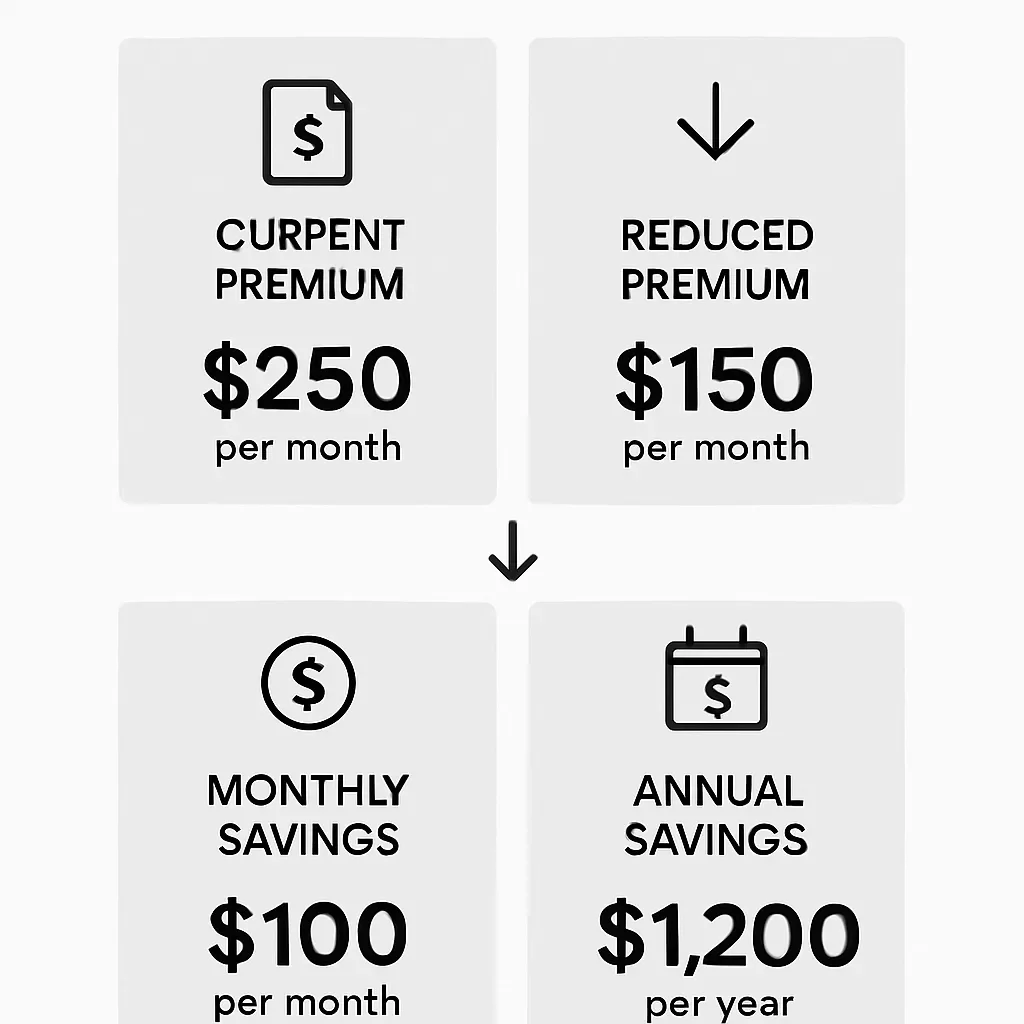
The simple formula that avoids unpleasant surprises
To make a clean calculation, remember this logic: total savings = remaining cost of the old contract – remaining cost of the new contract. If the premium is calculated on the initial capital, the gain remains clearer; if it depends on the remaining capital, the trajectory decreases over time, which changes the situation somewhat.
| Scenario | Old insurance | New insurance | Estimated savings |
|---|---|---|---|
| €200,000 over 20 years | 0.35% | 0.15% | ≈ €8,000 to €10,000 |
| €250,000 over 25 years | 0.30% | 0.10% | ≈ €12,000 to €15,000 |
The right reflex is also to check for hidden fees in the file: some brokers are paid by commission, others by fees. This does not make the operation bad, but these costs must be included in the calculation so as not to tell yourself a nice story that ends on a sour note.
Renegotiate with your bank or change insurer: what to choose?
If the bank is already competitive, renegotiating with them may be enough. If the price difference remains small or if the guarantees are better calibrated elsewhere, delegation to an external insurer is often more profitable. The best choice therefore depends on the file, not the reflex.
In practice, two strategies must be distinguished: negotiating the bank’s group contract or replacing this contract with an external offer. The first is sometimes faster. The second is often more effective on price, especially for good profiles.
| Option | Main advantage | Point of caution |
|---|---|---|
| Renegotiation with the bank | Simple procedures, single contact | Sometimes limited gain if the group contract remains expensive |
| External insurer | Often lower rates and more personalized coverage | Guarantee equivalence must be respected |
| Broker | Accelerated search and comparison | Fees or commission must be included in the calculation |
In practice, it is observed that a file with a complete FSI and perfectly aligned guarantees passes much better. An agent notes that refusals mainly occur when the difference concerns an exclusion, a waiting period, or a too vague definition of ITT. Price matters, yes, but contractual vocabulary also matters.
The Ministry of Economy explains the general framework of the right to terminate borrower insurance at any time. Meanwhile, ANIL reminds of the importance of guarantee equivalence. These two references are useful because they prevent relying on overly polished commercial promises.
From when is the operation no longer worthwhile?
The operation becomes less interesting when the remaining capital is low, the end of the loan is approaching, or the annual gain no longer compensates for the time spent preparing the file. In practice, beyond the last 5 to 7 years, the benefit can seriously diminish, unless your initial contract is clearly out of the game.
In other words, just because the law allows changing does not mean you have to do it at all costs. On a loan that is already well amortized, savings of a few hundred euros may not justify the paperwork, back-and-forth with the bank, and guarantee checks. This is where you need to show cool-headedness, not greed.
- Low remaining capital: the gain becomes mechanically smaller.
- Loan almost finished: the difference dilutes over time.
- Already very good individual contract: sometimes there is little to gain.
- More restrictive new offer: a low price does not always compensate for weaker protection.
Joking aside, the right renegotiation is not the one that shows the lowest price in one line. It is the one that reduces the total cost without sabotaging the guarantees that truly protect the household.
What steps to follow to change without mistakes?
The right method is simple: request the FSI, compare the guarantees line by line, sign the new offer, then send the substitution request to the bank with the necessary documents. The legal response time is 10 working days, which provides a fairly strict framework.
The process seems administrative, but it remains very manageable if you proceed in order. The real issue is not filling out forms for fun, but avoiding refusal over a silly detail: poorly defined ITT guarantee, inconsistent coverage percentage, or poorly timed effective date. In other words, the devil is in the details… but you can slam the door in his face.
- Retrieve the current contract and the information notice.
- Request the FSI to compare the required guarantees.
- Verify equivalence on death, PTIA, ITT and possibly IPP.
- Sign the new offer before sending the substitution.
- Send the complete file to the bank and follow up on the response.
Good to know: for certain mortgage or mixed loans, the health questionnaire is waived if the insured amount per person does not exceed €200,000 and if the repayment ends before the insured’s 60th birthday. This is a very concrete point of the Lemoine law, and it can clearly simplify the process.
There remains one last check not to be botched: the coverage percentage. If you borrow as a couple, the new insurance must cover at least as much as the old one, or offer a coherent distribution if you adjust each person’s protection. A small coverage gap can derail the whole operation at the last moment.
FAQ: renegotiating your borrower’s insurance in practice
Can you renegotiate your borrower’s insurance without a broker?
Yes, absolutely. A broker can save time, but is not mandatory. If you have your contract, the FSI and a bit of method, you can compare yourself and request the substitution directly from the bank.
Do you still have to fill out a health questionnaire?
Not always. Since the Lemoine law, it disappears for certain mortgage or mixed loans if the insured amount per person does not exceed €200,000 and if repayment ends before 60 years old. Outside this framework, it may still be required.
Can the bank refuse a change of insurance?
Yes, but it must rely on a serious reason related to the equivalence of guarantees, not on a simple “we prefer our in-house contract.” In case of refusal, the reasoning must be clear and communicated within the provided timeframe, generally 10 working days.
Is it worthwhile if the loan is already well advanced?
Often less so, because the outstanding principal decreases and the savings diminish. That said, a very expensive old contract can still be profitable to replace, even towards the end. The right indicator remains the total gain, not the salesperson’s enthusiasm.
Should the coverage amount remain the same?
It must at least ensure protection equivalent to that of the replaced contract. As a couple, the distribution can sometimes be reviewed, but it is important to remain consistent with the bank’s requirements and the reality of the risk covered.
What is the best time to compare offers?
As early as possible, especially if the loan is only a few years old. It is at this time that the remaining principal is still high, so the price difference has the greatest impact. Waiting too long often means letting the savings slip away.