In brief
🚗 In 2026, France goes from 25 active ZFEs on January 1, 2025 to 42 affected cities or urban areas. The system is expanding, but it does not apply everywhere with the same intensity.
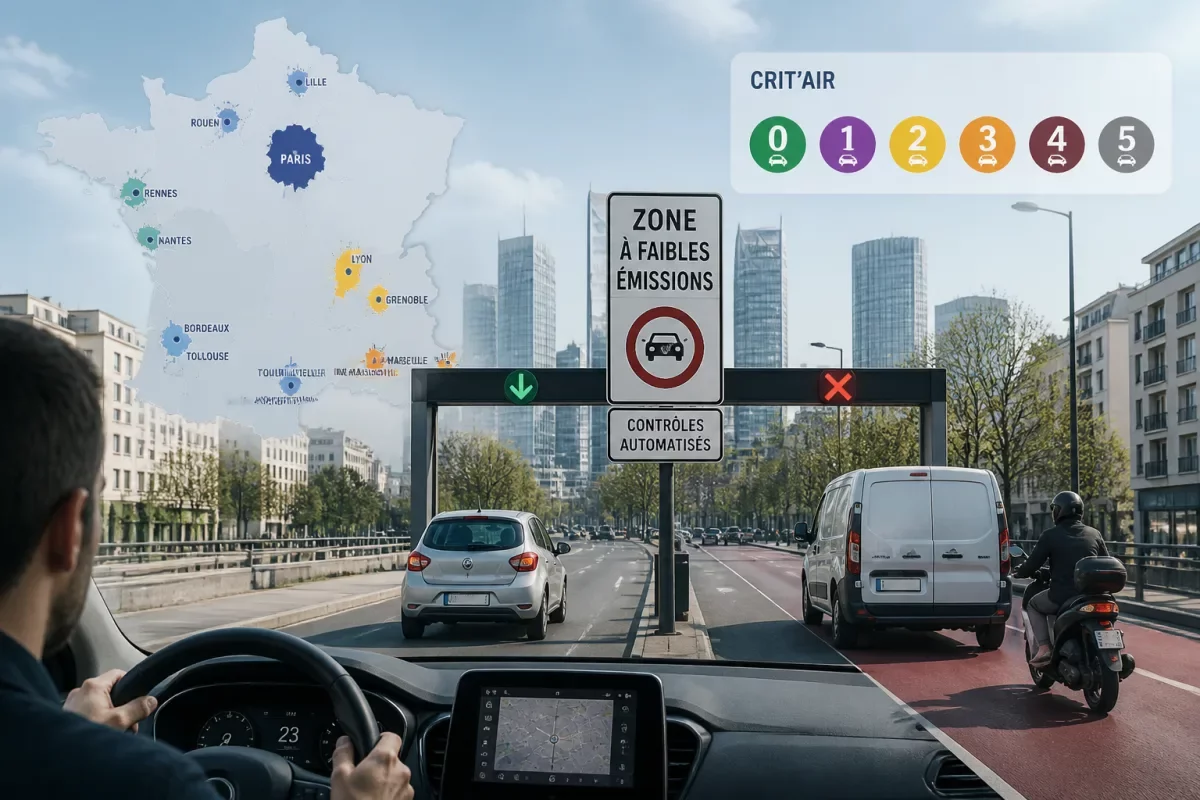
🏷️ The Crit’Air sticker becomes the common language of restrictions: Crit’Air 0, 1, 2, 3, 4, 5 or unclassified. But it is indeed the local decrees that set the concrete prohibitions.
🕒 A ZFE can operate 24/7 in some metropolitan areas, or only during specific time slots elsewhere. In Paris, since January 1, 2025, vehicles with Crit’Air 3, 4, 5 and unclassified are already targeted at certain hours.
⚠️ Driving a non-compliant vehicle generally exposes you to a €68 fine. Before a trip, the good reflex is to check the city, the perimeter, the Crit’Air class, and the exemptions.
Understanding what a ZFE covers in 2026
A ZFE, or low emission zone, is a perimeter within which the circulation of the most polluting vehicles is limited in order to reduce emissions related to road traffic. The principle seems clear on paper: the more pollutants a vehicle emits, the less favorable its Crit’Air sticker, and the more likely it is to be restricted. In practice, this is where it gets a bit complicated.
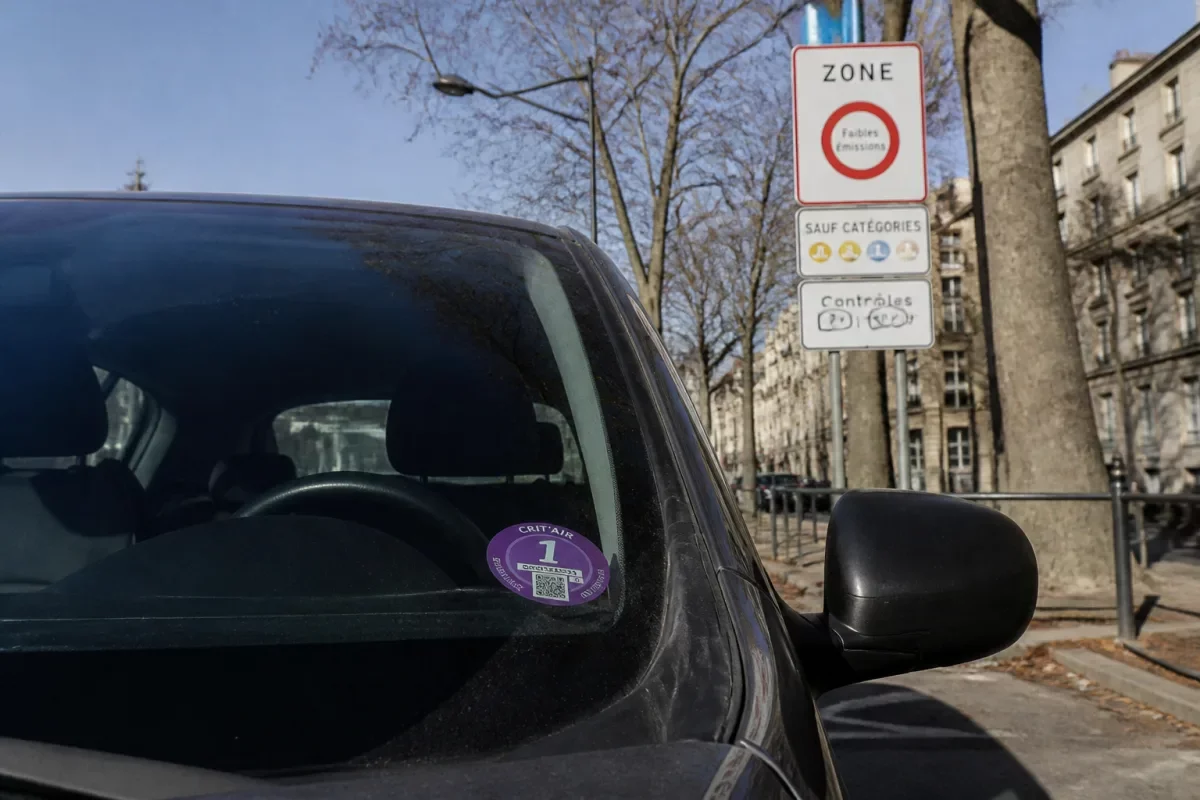
The 2019 Mobility Orientation Law set the framework for creating low emission zones in metropolitan areas where air quality standards are not met. According to the government portal Better breathing in the city dedicated to French ZFEs, restrictions progress according to territories, with schedules that can go as far as the successive banning of unclassified vehicles, Crit’Air 5, Crit’Air 4, then Crit’Air 3.
It is also necessary to distinguish three often mixed concepts:
- The permanent ZFE: it defines a perimeter and regular traffic rules according to Crit’Air categories.
- Differentiated circulation: it can be activated during a pollution episode, even outside the permanent ZFE logic.
- Local restrictions: they specify the schedules, targeted vehicles, included or excluded routes, and exemptions.
In short, the Crit’Air sticker is the key to understanding, but it is not the whole lock. A Crit’Air 3 car will not be treated the same way in Paris, in a metropolis starting its ZFE, or in an urban area where restrictions primarily target utility vehicles and heavy trucks. That is why a national map gives the alert, while the local decree gives the answer.
LEZ, LEZ-m and differentiated traffic: don’t confuse everything
The acronym LEZ-m, for low emission zone mobility, emphasizes the circulation perimeter and the vehicles concerned. Differentiated traffic, on the other hand, is more of a temporary measure during a pollution peak. Joking aside, confusing the two can be costly: a driver may be allowed on a normal day, then prohibited during a pollution episode if an exceptional measure comes into effect.
Why the Crit’Air sticker remains the key to understanding
The Crit’Air classification ranks vehicles according to their pollutant emissions, with categories ranging from electric or hydrogen vehicles to unclassified vehicles. This logic allows metropolitan areas to set readable restrictions, at least in theory. But the level of severity depends on each local authority: some zones mainly target the oldest vehicles, others have already extended bans to Crit’Air 3.
Which cities are concerned by the LEZs in 2026?
In 2026, 42 cities or urban areas are concerned by LEZs in France, compared to 25 active zones as of January 1, 2025. The list notably includes Paris, Lyon, Marseille, Toulouse, Nice, Nantes, Strasbourg, Montpellier, Bordeaux, Lille, Rennes, Reims, Toulon, Grenoble, Dijon, Brest, Rouen and La Rochelle.
The real issue of LEZ 2026 concerned cities is not just “who is on the list?”. It is rather: which city already applies strong restrictions, which one is gradually entering the system, and which one mainly imposes the obligation to have a visible Crit’Air sticker? This nuance changes everything for a motorist.

The list released for 2026 includes metropolitan areas already well identified on the subject, such as Paris, Lyon, Marseille, Toulouse, Nice, Nantes, Strasbourg, Montpellier, Bordeaux, Lille, Rennes, Reims, Saint-Étienne, Toulon, Angers, Grenoble and Dijon. It also includes Nîmes, Aix-Marseille-Provence, Clermont-Ferrand, Brest, Limoges, Le Havre, Saint-Denis, Villeurbanne, Amiens, Metz, Besançon, Perpignan, Orléans, Rouen, Mulhouse, Caen, Versailles, Créteil, Pau, Antibes, Saint-Paul, Boulogne-Billancourt, La Rochelle, Tourcoing and Poitiers.
This increase from 25 to 42 territories does not mean that all these cities will suddenly ban the same vehicles on the same day. This is the major limitation of the too quick lists that circulate: they provide a national overview, but not the rule applicable to a street, a boulevard, a port area or a ring road. To summarize: being on the list indicates a need for vigilance, not a uniform ban.
| Useful reading in 2026 | Examples of concerned cities | What to check |
|---|---|---|
| Already very restrictive metropolises | Paris, Lyon, Grenoble, Greater Paris Metropolis | Prohibited Crit’Air classes, hours, included routes |
| Large urban areas with major urban challenges | Marseille, Toulouse, Nice, Nantes, Strasbourg, Montpellier, Bordeaux, Lille | Exact perimeter and local schedule |
| Concerned regional cities | Rennes, Reims, Saint-Étienne, Toulon, Angers, Dijon, Brest, Limoges | Actual level of application and targeted vehicles |
| Territories with more local reading | Le Havre, Amiens, Metz, Besançon, Perpignan, Orléans, Rouen, Mulhouse, Caen | Decree, signs, excluded or included lanes |
| Paris region and suburban municipalities | Versailles, Créteil, Boulogne-Billancourt, Villeurbanne, Saint-Denis | Coordination with the metropolis and main routes |
| Other cities integrated into the system | Pau, Antibes, Saint-Paul, La Rochelle, Tourcoing, Poitiers | Crit’Air obligation and tightening schedule |
Metropolises where restrictions weigh most on motorists
Paris and the Greater Paris Metropolis remain the clearest example. According to the Greater Paris Metropolis on its metropolitan LEZ, the perimeter covers Paris and 77 other municipalities located inside the A86 motorway. Since January 1, 2025, restrictions have been extended there to Crit’Air 3 vehicles, in addition to Crit’Air 4, 5, and unclassified vehicles already heavily affected.
Within Paris city limits and on the ring road, Crit’Air 3, 4, 5, and unclassified vehicles have been prohibited at certain times since January 1, 2025. This is a very concrete example of the gap between “being in an LEZ” and “actually being prohibited at a given time.” A tradesman with an old utility vehicle, a suburban resident commuting to a job in Paris, or a relative accompanying someone to a medical appointment will not interpret the rule in the same way.
In practice, drivers often remember their vehicle’s Crit’Air class but much less the exact perimeter. In Greater Paris, referencing the A86 helps to orient oneself, provided one checks if the route actually passes through a regulated zone.
Special cases, local exceptions, and recent developments
Some LEZs advance in stages or initially target specific categories. Clermont Auvergne Metropolis, for example, has implemented an LEZ since July 1, 2023, with restrictions targeting light commercial vehicles and heavy goods vehicles not classified within a defined perimeter. Meanwhile, territories like Greater Annecy or Annemasse illustrate the progressive logic: prohibitions may be staggered between 2025 and 2030 depending on Crit’Air categories.
Which Crit’Air restrictions apply according to cities?
The Crit’Air sticker indicates the vehicle’s emission level, but it is not sufficient alone to decide. In 2026, you must cross-check Crit’Air class, city, perimeter, hours, and exemptions. Unclassified vehicles, Crit’Air 5, 4, and sometimes Crit’Air 3 are the most exposed to prohibitions.
The hierarchy is generally simple: the higher the Crit’Air number, the older or more polluting the vehicle, and thus the more likely it is to be restricted. Crit’Air 0, 1, and 2 vehicles are generally the least exposed, while unclassified, Crit’Air 5, and Crit’Air 4 vehicles are on the front line. The tipping zone today mainly concerns Crit’Air 3.
But beware of the trap: a Crit’Air 3 may be allowed in some LEZs and already restricted elsewhere. In Paris and the Greater Paris Metropolis, it has been at the heart of tightening since 2025. In other urban areas, the restriction may be more gradual, target certain professional vehicles, or be conditioned by hours. In other words, the sticker places you in a category; the city decides the consequence.
A LEZ is never interpreted solely by the color of the sticker: it is read as a local rule, dated, geographical, and sometimes professional.
What the least polluting vehicles can or cannot do
Electric, hydrogen, or vehicles classified in the best Crit’Air categories generally have the most comfortable circulation margin. However, they are not exempt from common sense: some zones may require the sticker, some parking lots or lanes may be subject to other rules, and a check may focus on the conformity of the display. The sticker must therefore be placed visibly, even if the vehicle seems “obviously” low-polluting.
The classes most exposed to driving bans
Unclassified vehicles, Crit’Air 5 and Crit’Air 4 are the most vulnerable in most tightening scenarios. Crit’Air 3 becomes the tension category, as it still concerns many vehicles used daily. This is where the social impact appears: not everyone can replace their car when a local rule changes.
- Unclassified: generally very old vehicle, often excluded as a priority.
- Crit’Air 5: category heavily exposed in already advanced LEZs.
- Crit’Air 4: frequently targeted in restriction schedules.
- Crit’Air 3: category to watch closely, especially in large metropolitan areas.
- Crit’Air 1 and 2: less exposed in the short term, without being completely irrelevant.
Exemptions, professions, residents, and temporary situations
According to national rules mentioned by institutional information, some permanent exemptions exist for priority vehicles, such as police or firefighters, low-emission public transport vehicles, collector vehicles, and holders of certain disability cards. Temporary exemptions may also concern professionals, notably merchants, delivery drivers, or healthcare professionals, upon justification.
Good to know: an exemption is not an automatic “privilege.” It must be requested or justified according to locally provided procedures. For a delivery driver operating in Strasbourg, a craftsman in Bordeaux, or a healthcare worker in Greater Paris, the question is therefore not only “Is my vehicle banned?” but “Can I benefit from a documented exception, valid in this specific zone?”
What does a 2026 LEZ change for drivers daily?
The LEZ becomes concrete when it modifies a routine trip. An employee living on the outskirts of Rouen and crossing the center, a family going to a medical appointment in Lyon, or a professional delivering to a restaurant in Toulouse do not experience the regulation as an environmental concept. They experience it as a risk of detour, delay, fine, or forced vehicle replacement.
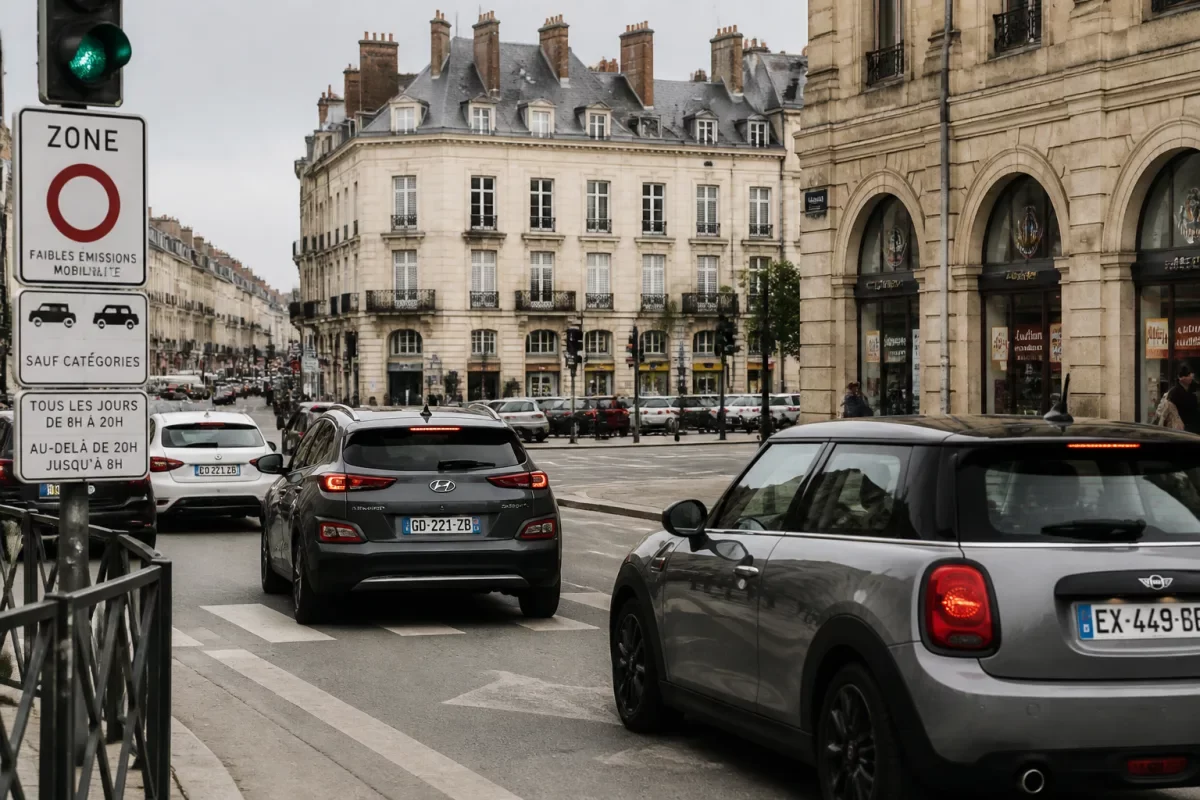
In practice, inhabitants of large metropolitan areas quickly learn to think in “zones” rather than “city.” Entering Paris intra-muros is not the same as bypassing via a peripheral axis, and going to a municipality located within the A86 perimeter does not always have the same effect depending on the route. This is somewhat the annoying part of the system: it forces you to think like a map, not just like a driver.
The reference fine for driving a non-compliant vehicle in a LEZ is €68. This amount does not summarize the real cost: this can be added to a longer trip, a refused delivery, a missed appointment, or the need to rent a compatible vehicle temporarily. For professionals, the issue quickly turns into an economic trade-off.
A family who arrived in 2022 in a nearby suburb recounts that their first reflex was to check the Crit’Air sticker, not the LEZ limits. Yet the blocking point mainly came from the route taken to reach Paris, with regular passage through the regulated perimeter.
Home-to-work trips, delivery, and daily life
The home-to-work trip is probably the most sensitive case, as it repeats. A restriction tolerable once a month quickly becomes burdensome five days a week. For delivery drivers, merchants, or craftsmen, the issue is even more tense: changing routes or schedules can disrupt an entire round. To top it off, the rules are not always identical between two neighboring metropolitan areas, which complicates multi-site travel.
To navigate without having to go through all the administrative pages manually, the best approach is to perform a three-step check:
- Identify the Crit’Air class of your vehicle on the certificate or via the official sticker request.
- Locate the exact perimeter of the ZFE, including boundary roads and any exceptions.
- Read the schedules and exemptions in the local decree before traveling.
Buying a vehicle, used market, and short-term trade-offs
The ZFE already influences the used car market, especially in areas where Crit’Air 3 becomes sensitive. A vehicle still mechanically perfectly usable can lose its appeal if it becomes complicated to enter several urban centers. Conversely, a better-classified car may become more sought after, even if its purchase price is higher. That’s why buying “cheap” without checking the sticker can turn out to be a false good deal.
Why do ZFE rules remain difficult to understand?
ZFE rules remain difficult to understand because they combine a national framework, local decisions, geographic perimeters, schedules, vehicle categories, and exemptions. The Crit’Air sticker simplifies vehicle classification, but it does not replace the official map or the applicable decree in each metropolis.
This complexity fuels part of the public debate. On one hand, the health objective is solid: reducing pollutants related to road traffic in dense areas. In the Greater Paris Metropolis, air pollution is associated with about 5,040 premature deaths per year according to 2019 figures communicated locally, and road traffic accounts for 43% of nitrogen oxides as well as 20% of PM10 particles. On the other hand, social acceptability strongly depends on the available alternatives.
In other words, the ZFE works better when accompanied by credible public transport, park-and-ride facilities, adapted delivery solutions, and clear assistance. Without that, it can be perceived as a downtown rule designed against those who live or work on the outskirts. This debate more broadly relates to how cities balance mobility, attractiveness, and quality of life, as also seen in territorial analyses around the history and heritage of Béziers.
The difficulty is not understanding that a polluting vehicle must be limited; the difficulty is knowing precisely where, when, and for whom the rule applies.
Environmental effectiveness and social acceptability
The effectiveness of a ZFE depends on a fairly clear mechanism: gradually removing the highest-emitting vehicles from the most exposed areas. But the real effect varies according to the share of traffic concerned, the quality of controls, households’ ability to change vehicles, and the available alternatives. A ban without practical solutions risks shifting the problem rather than solving it properly.
Why rules remain difficult to understand without an up-to-date map
An up-to-date map is essential because administrative boundaries do not always correspond to the driver’s intuition. A ring road can form a boundary, a municipality can be included even if it seems peripheral, and some roads may be treated differently. In Greater Paris, the reference to inside the A86 provides spatial logic; elsewhere, the perimeter may follow boulevards, dense areas, or specific municipalities.
How to quickly check if you can drive?
To know if you can drive in a LEZ in 2026, first check your Crit’Air class, then the official city map, the application hours, and the possible exemptions. If any of these four elements is missing, consider the information incomplete before entering the area.
The most reliable method is to start from institutional sources, not from an old screenshot seen on social media. The site Service-Public.fr on the Crit’Air certificate reminds the role of the sticker, while metropolitan websites detail the maps, calendars, and exemptions. The local source always takes precedence, as it translates the national rule into applicable decrees.
Before a one-time trip, keep a simple mini-checklist:
- City concerned: Paris, Lyon, Marseille, Toulouse, Bordeaux, Rouen, La Rochelle or other LEZ territory.
- Perimeter: city center, inside ring road, included municipalities, excluded routes.
- Crit’Air class: 0, 1, 2, 3, 4, 5 or unclassified.
- Time of trip: working day, weekend, specific hours, pollution episode.
- Special situation: disability, classic vehicle, emergency, professional activity, delivery.
It should be noted that zone entry signage does not always suffice to understand all the subtleties. It alerts but does not necessarily detail exemptions or schedules. For a planned trip, it is better to check the day before than to discover the rule at the sign, engine running, with a delivery or appointment waiting.
Key takeaways
- 🚦 The LEZ 2026 concerned cities increase to 42 territories, but the rules remain local.
- 🏷️ The Crit’Air sticker classifies the vehicle; the local decree truly decides the ban.
- 🗺️ The perimeter matters as much as the city: center, ring road, municipalities and routes can vary.
- ⚠️ Unclassified vehicles, Crit’Air 5, 4 and sometimes 3 are the most exposed.
- ✅ Before driving, check city, sticker, hours, official map and possible exemptions.
FAQ
Is the Crit’Air sticker mandatory in 2026?
Yes, the Crit’Air sticker is mandatory to drive in the concerned LEZs in 2026. It must be visible on the vehicle, but it is not enough to guarantee authorization to drive: local restrictions must also be checked.
Which vehicles will no longer be allowed to drive in certain LEZs in 2026?
Unclassified vehicles, Crit’Air 5 and Crit’Air 4 are the most exposed to bans. In some metropolitan areas, Crit’Air 3 are also concerned, such as in Greater Paris since the tightening started on January 1, 2025.
What is the fine for non-compliance with a LEZ?
The indicated fine for a non-compliant vehicle driving in a LEZ is generally €68. The actual cost can be higher indirectly if the trip causes delay, detour, immobilization or inability to make a delivery.
Do classic vehicles have a LEZ exemption?
Yes, classic vehicles are among the categories that can benefit from permanent national exemptions. However, it remains prudent to check local conditions, as justification and usage conditions may depend on the local authority.
Can you cross a concerned city without entering the LEZ?
Yes, it is sometimes possible if your route stays outside the regulated perimeter or uses an excluded route. But you must check the official map: a concerned municipality does not always mean every street is banned, and vice versa.