In brief
- Villeurbanne is very suitable for those who want to live near Lyon without giving up local services.
- Rent differences are marked between ultra-connected sectors and more residential neighborhoods.
- Metro lines A and B and trams T1 and T4 make a difference daily.
- The best neighborhood depends on your routes, budget, and need for quiet.
- Before moving, you need to secure housing, contracts, parking, and local procedures.
Villeurbanne in brief: why settle there?
Villeurbanne is especially attractive due to its strategic position: you remain in a complete urban environment while accessing Lyon, Part-Dieu, campuses, and health or employment hubs quickly. For many households, it is the right compromise between mobility, shops, public services, and neighborhood variety.

The city is not homogeneous, and that is precisely what makes it interesting for a newcomer. Around Gratte-Ciel, the atmosphere is more central and commercial; towards La Doua, student life dominates; further east, there are quieter and often more affordable areas. In other words, Villeurbanne is read neighborhood by neighborhood, not as a single block.
“The right housing is not just the one that fits your budget; it is the one that reduces your daily constraints.”
A useful principle for choosing a neighborhood, especially in a highly connected city
For a first overview, it is crucial to look at three things: the density of shops, the actual travel time to your workplace or school, and the ease of parking if you keep a car. Neighborhoods that seem “close” on a map are not necessarily equal in practice.
What are the best neighborhoods to settle in Villeurbanne?
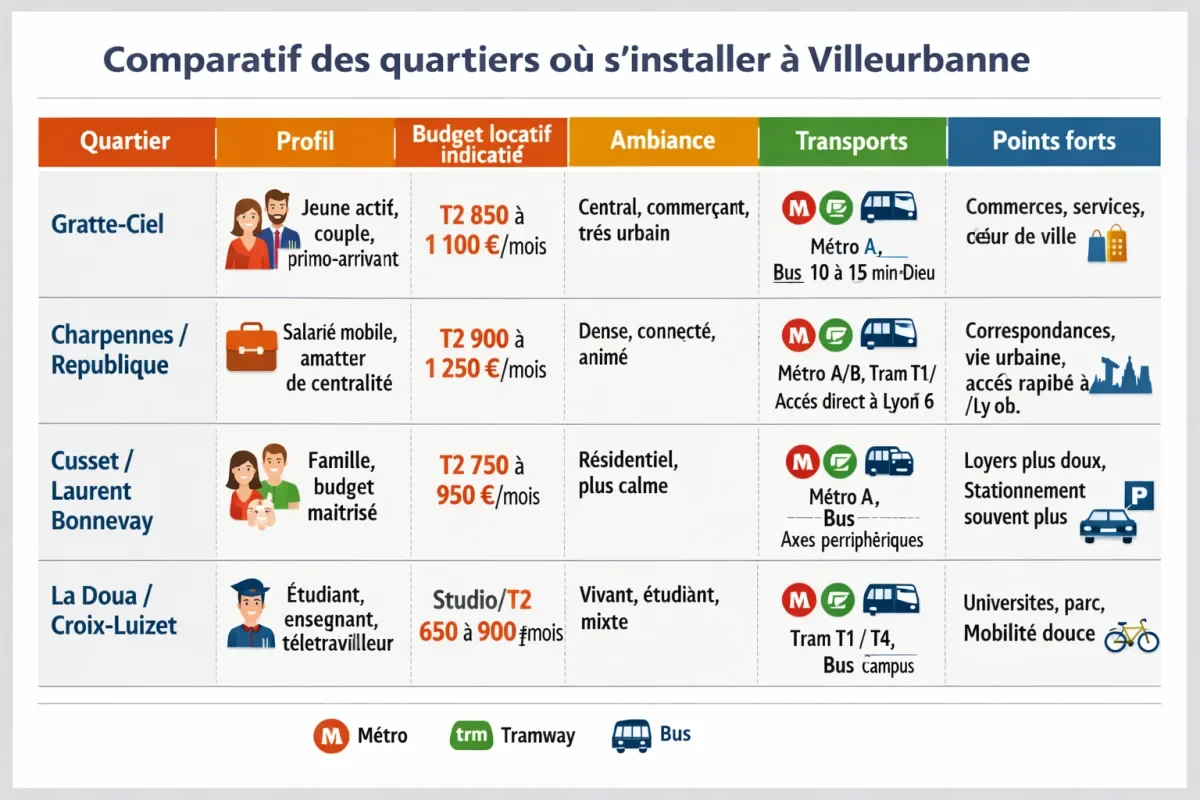
The best neighborhoods in Villeurbanne vary depending on whether you seek quick access to Lyon, a family atmosphere, a more flexible rental budget, or a daily life without a car. If you want a simple answer: Gratte-Ciel and Charpennes for convenience, La Doua for students, Cusset for a price-quiet balance, and the République area for an intermediate position.
| Neighborhood | Profile | Indicative rental budget | Atmosphere | Transport | Strengths |
|---|---|---|---|---|---|
| Gratte-Ciel | Young professional, couple, first-time resident | T2 850 to 1,100 €/month | Central, commercial, very urban | Metro A, bus, 10 to 15 min from Part-Dieu | Shops, services, city center |
| Charpennes / République | Mobile employee, centrality lover | T2 900 to 1,250 €/month | Dense, connected, lively | Metro A/B, tram T1/T4, direct access to Lyon 6 | Connections, urban life, quick access to Lyon |
| Cusset / Laurent Bonnevay | Family, controlled budget | T2 750 to 950 €/month | Residential, quieter | Metro A, bus, peripheral routes | Lower rents, parking often somewhat easier |
| La Doua / Croix-Luizet | Student, teacher, teleworker | Studio/T2 650 to 900 €/month | Vibrant, student, mixed | Tram T1/T4, bus, campus | Universities, park, soft mobility |
For a student, La Doua and Croix-Luizet offer the best practical yield: short trips, campus access, simple daily life. For a young professional working towards Part-Dieu or Lyon 6, Charpennes remains very competitive despite higher rents. For a family, Cusset often allows gaining a bit more space and calm without leaving the city.
- You want to do everything on foot: aim for Gratte-Ciel.
- You are looking for the best transport connections: Charpennes is the safest bet.
- You have a tighter budget: look at Cusset and well-connected peripheral areas.
- You live the campus or telework: La Doua / Croix-Luizet is often the most logical choice.
Which neighborhood to choose according to your profile?
Your best neighborhood depends less on “prestige” than on your actual use. If your hours are fixed, connections and travel time take priority. If you work from home, calm, housing quality, and fiber optic internet matter more. If you have children, schools, parks, and daily logistics become decisive.
The differences between neighborhoods are better understood through four common profiles: student, young professional, family, and teleworker. This is often where Villeurbanne shows its strength, as the city can meet several lifestyles without changing municipality.
“A dense city is not a problem in itself; it becomes an asset when trips, shops, and services are well distributed.”
Urban reading to apply neighborhood by neighborhood
If you are a student or recent graduate
The La Doua / Croix-Luizet area is the most obvious. You are closest to universities, the tram, and useful daily services. Studios are in high demand there, which maintains some rental pressure, but you save time on commuting. For a tighter budget, shared housing remains a relevant option.
If you are a young professional or in professional mobility
Charpennes and Gratte-Ciel are the most rational choices if you commute to Lyon, Part-Dieu, or business districts. Centrality often comes with higher rent, but you recover this cost in time and simplicity. This type of neighborhood quickly becomes cost-effective if you use the car little.
If you are moving with a family
Cusset, some streets around République, and more residential areas in the east of Villeurbanne often offer a better compromise between space, budget, and tranquility. It is especially important to check for schools, local shops, green spaces, and smooth school or work commutes. The parking issue also deserves to be addressed during the visit.
If you telework
The right area combines sufficiently spacious housing, a quieter environment, and easy access to transport for your outings. The teleworker does not always need to be right by the metro, but it is advisable to stay in a well-equipped zone, with shops, parks, and a reliable digital connection.
What budget to plan for living in Villeurbanne?
The budget mainly depends on the proximity to the metro, the condition of the housing, and the type of property. In Villeurbanne, a T2 in a highly sought-after area is significantly more expensive than a T2 in a more residential street. As a first reference, keep in mind a range of €650 to €1,250 for a two-room apartment depending on the location and amenities.
In the most central neighborhoods, rental pressure drives prices up, especially for small renovated units. Conversely, areas a little less visible to the general public can offer a better surface/price ratio, without necessarily sacrificing quality of life. The right approach is to calculate the rent including charges, transport, and parking, not just the rent alone.
| Profile | Estimated total monthly budget | Targeted housing | Practical reading |
|---|---|---|---|
| Student | €900 to €1,200 | Studio or shared apartment | Ideal if you limit car use and target La Doua or a well-connected area |
| Young professional / couple | €1,500 to €2,300 | T1 bis or T2 | The metro quickly becomes a decisive comfort gain, especially towards Charpennes or Gratte-Ciel |
| Family | €2,600 to €3,800 | T3 or T4 | Space, schools, and parking matter as much as the address |
| Teleworker | €1,400 to €2,100 | T2 or small T3 | Prioritize light, quiet, and fiber optic rather than just a “central” address |
For purchase, the observed price ranges generally vary around €3,800 to €5,800/m² depending on micro-areas, the condition of the property, and distance to transport. Renovated old buildings near the most convenient routes are negotiated at higher prices, while streets farther from the metro remain somewhat more affordable. The differences are real and justify a proper visit on site.
“The price per square meter doesn’t tell the whole story: the real cost of housing is also the travel time it saves or imposes on you.”
Useful reading for comparing real estate in Villeurbanne
How to get around easily in Villeurbanne?
Villeurbanne is one of the easiest municipalities to get around without a car in the Lyon metropolitan area. Metro line A serves the densest sectors, metro line B and trams T1/T4 strengthen connections, and major hubs like Charpennes or Gratte-Ciel limit transfer breaks. For many users, this is the number one advantage.
Here are useful routes to keep in mind:
- Charpennes → Part-Dieu: about 6 to 8 minutes depending on connection and time.
- Gratte-Ciel → Lyon city center: around 10 to 15 minutes by metro, depending on the exact destination.
- La Doua → Charpennes: a very short tram ride, convenient for students and campus staff.
- Cusset → Part-Dieu: often 15 to 20 minutes depending on route and congestion.
If you are a cyclist, the area’s appeal is real, especially for short trips and local loops. If you use a car, parking becomes more sensitive in central areas, while more residential neighborhoods sometimes offer a bit more flexibility. Again, the right choice depends on your daily life, not an abstract idea of the city.
Moving to Villeurbanne: essential steps
A successful move is prepared even before the keys are handed over. In Villeurbanne, as elsewhere, you need to organize housing, energy, insurance, internet connection, and administrative procedures in the right order. The more you anticipate, the less you suffer during the first weeks, often filled with unforeseen events and extra costs.
The Villeurbanne town hall highlights, in its services for newcomers, practical life issues: school registration, municipal facilities, neighborhood information, and local services. This is a useful approach to treat the installation not just as a change of address, but as a real local orientation.
“The first steps that really relieve are those that avoid service interruptions and unnecessary trips.”
Logic of an efficient move
- Sign the lease and reread the clauses on charges, the security deposit, and the inventory of fixtures.
- Take out home insurance before moving in.
- Open or transfer electricity, gas, and water if necessary.
- Activate internet early enough, especially if you work from home.
- Update your address with the bank, employer, tax authorities, and social organizations.
- Check parking if you have a car: resident subscription, paid zone, or garage.
- Plan ahead for school or daycare if you are arriving with family.
- Locate the nearest TCL transport and alternative routes in case of disruption.
For a newcomer to Villeurbanne, the best approach is to cross-reference public services, the neighborhood map, and actual routes to your places of life. It is often this preliminary work that turns a stressful move into a smooth transition.
Is Villeurbanne a pleasant city to live in daily?
Yes, if your priority is to have a dense, lively, and well-equipped city. Villeurbanne offers local shops, strong transport lines, parks, sports facilities, and a network of services that simplify daily life. However, the appeal varies greatly depending on the street, the orientation of the dwelling, and proximity to major roads.
To assess quality of life, observe four concrete criteria: noise during rush hours, presence of open shops, evening lighting, and ease of reaching a park or a transport station. This is more reliable than a general reputation, often too vague to guide a move.
Villeurbanne works well for households who enjoy city life, but not necessarily for those seeking a semi-rural environment. If you want a lively daily life, you will be served. If you are looking for absolute silence and plenty of free parking, you should aim for smaller, more residential micro-areas or broaden your search to neighboring municipalities.
Should you choose Villeurbanne or live nearby?
Villeurbanne is often the best compromise for those who work in Lyon, study on campus, or want to stay in a dense urban fabric without paying the highest levels of some Lyon sectors. Neighboring municipalities become interesting if you prioritize more space, more greenery, or a more residential environment.
| Area | When to favor it | What you gain | What you lose |
|---|---|---|---|
| Villeurbanne | If you want transport, shops, and proximity to Lyon | Mobility, services, centrality | Density, high rents in the most sought-after areas |
| Lyon 3 / Lyon 6 | If you are looking for the most central address | Hyper-accessibility, strong urban image | Often tighter housing budget |
| Bron | If you want more space with a more moderate budget | Space, breathing room, some newer housing | More frequent car use depending on the area |
| Caluire-et-Cuire | If you are looking for a more residential setting | Calmer atmosphere, good quality of life | Often high prices on the best-located properties |
In other words, you should not only compare municipalities with each other, but how they serve your daily life. A cheaper apartment far from your office can ultimately cost more than a slightly more expensive but better-located home.
Conclusion: how to choose the right area to settle in Villeurbanne?
To settle in Villeurbanne, the most effective approach is to start from your lifestyle: if you are looking for convenience, consider Gratte-Ciel or Charpennes; if you want a budget-calm balance, target Cusset; if your daily life revolves around the campus, La Doua is often the most logical solution. The right choice is the one that simplifies your days from the very first week.
In practice, Villeurbanne offers several cities within the city. This makes it an ideal area for moving intelligently, provided you visit at the right time, compare rents street by street, and check actual travel routes before signing.
FAQ
What is the best neighborhood to live in Villeurbanne without a car?
Gratte-Ciel and Charpennes are the easiest if you do not want to depend on a car. You will find shops, services, and the main TCL connections there. La Doua is also very convenient if your travel revolves around the campus and tram lines.
Which neighborhood to choose in Villeurbanne for a family?
Cusset, certain areas of République, and the more residential streets in the east of Villeurbanne are often interesting for a family. You especially need to check the size, schools, parks, noise, and parking possibilities. Proximity to a metro station is not the only criterion to consider.
What minimum budget should be planned to live in Villeurbanne?
For a single person, a budget around €900 to €1,200 per month can suffice if you carefully consider housing and travel. For a couple or a family, the budget quickly increases as soon as you aim for a spacious one-bedroom, a two-bedroom, or a well-located three-bedroom.
Is Villeurbanne well served by public transport?
Yes. The city benefits from metro line A, metro line B at Charpennes, key tram lines like T1 and T4, and numerous bus lines. Areas close to stations are particularly advantageous for trips to Part-Dieu, central Lyon, and the campus.
Should you rent in Villeurbanne or in Lyon?
If your priority is quick access to transport and services, Villeurbanne is often the best compromise. If you are looking for hyper-centrality or a very specific neighborhood in Lyon, the comparison may shift. The right choice mainly depends on budget, travel time, and the size you are looking for.