
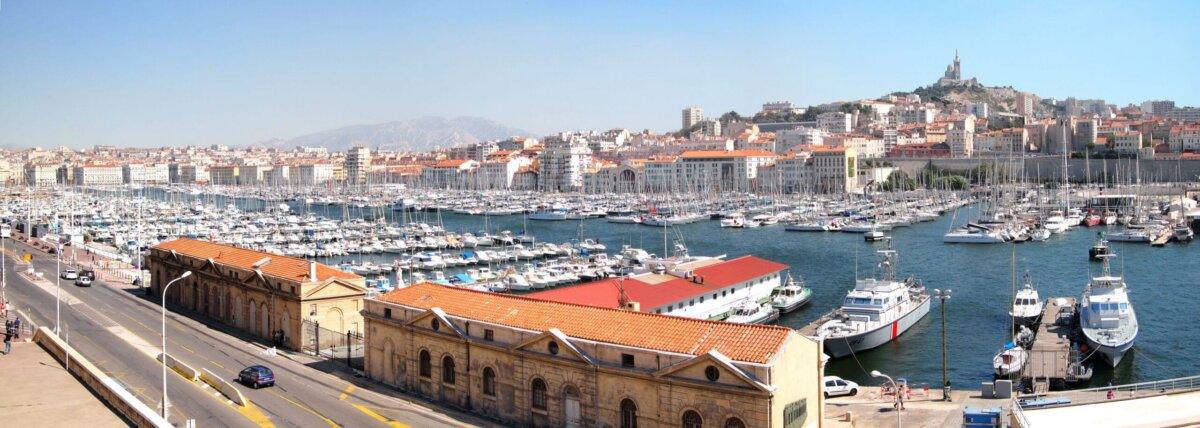
Marseille, the 2nd largest city in France, combines the Old Port, working-class neighborhoods, and spectacular natural landscapes.
Mediterranean capital, it blends heritage, ports, CMA CGM, Mucem, and the Calanques.
Find here geography, demographics (INSEE), transport, employment, culture, and price per m².
Sommaire
Geography & Location 🗺️
Marseille stretches along the Mediterranean coast, in the heart of the Bouches-du-Rhône, between limestone massifs and calanques. Its municipal territory is vast (≈240.6 km²), extending from the coastline (Estaque, Corniche, Prado) to the hills of l’Étoile and Saint-Cyr. The city is divided into 16 districts, from the 1st (Old Port, Canebière) to the 16th (l’Estaque), forming a mosaic of neighborhoods with distinct identities.
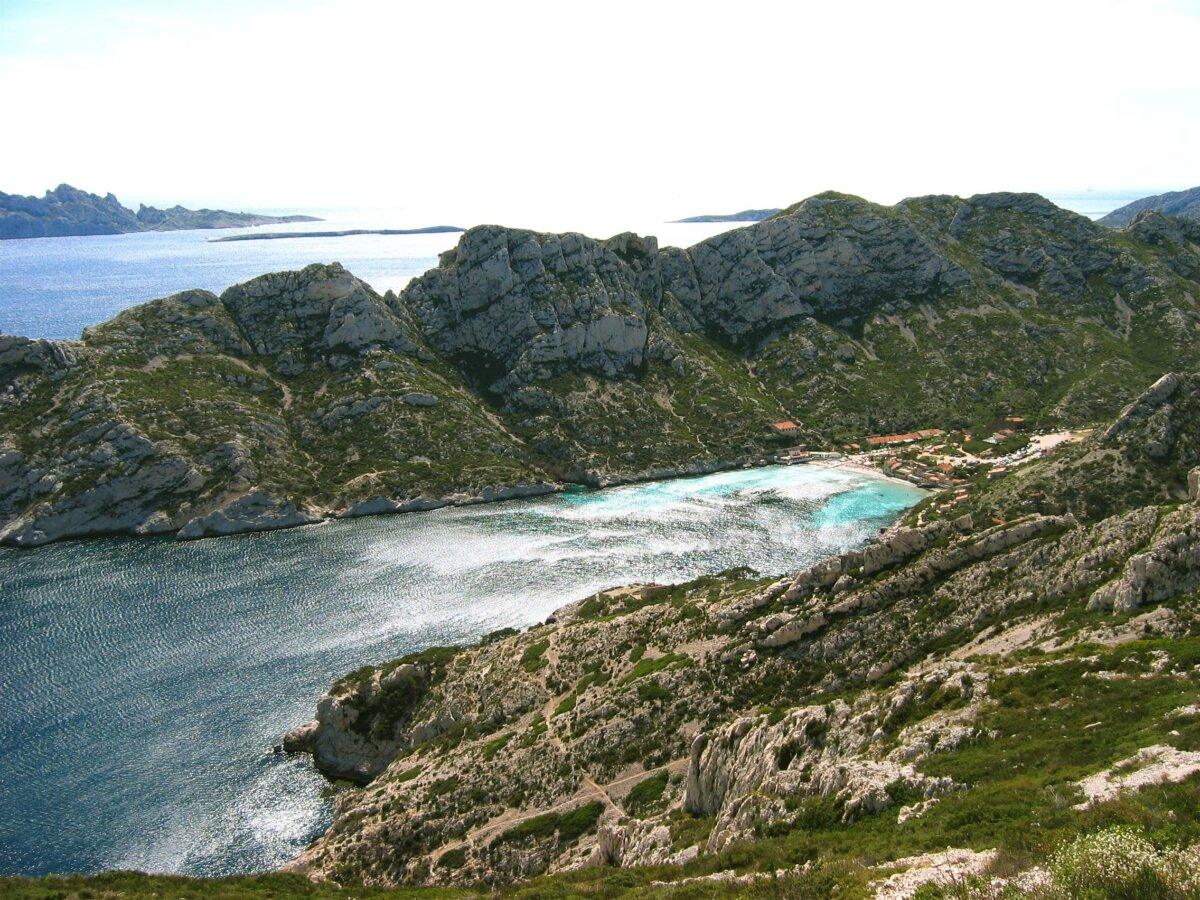
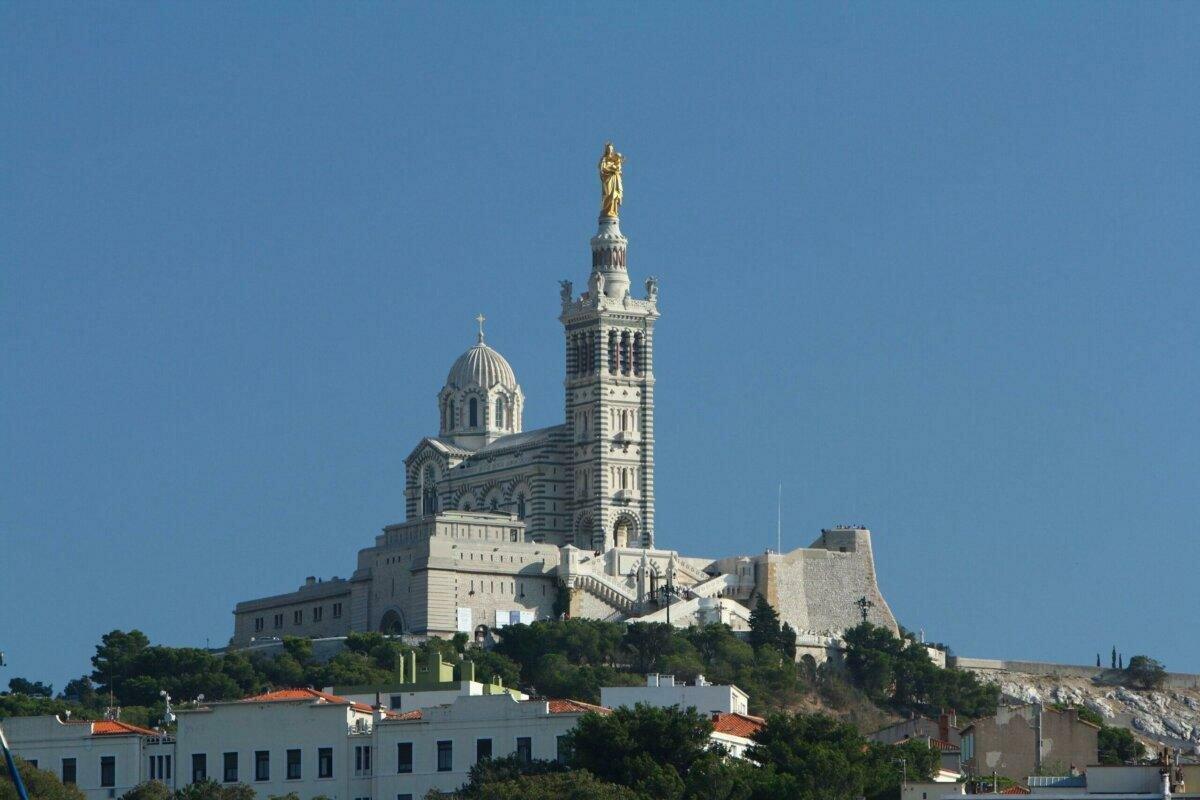
To the southeast, the Calanques National Park protects a unique landscape in Europe: limestone cliffs, coves, and pine trees plunging into turquoise waters. The Mont Puget, the highest point of the Calanques massif (≈563 m), dialogues with other Marseille peaks (Marseilleveyre, Carpiagne) while further north, the Étoile massif peaks at about 652 m. In the city, the “Bonne Mère” (Notre-Dame de la Garde) watches over, perched on a promontory offering a 360° panorama.Key geo figures — Area: ≈240.6 km² • Altitude: from 0 m (coastline) to ~650 m (Étoile massif) • Coastline: about 57 km • Districts: 16 • Demonym: Marseillais·es • Postal codes: 13001 → 13016.
History & Heritage 🏛️
Founded in the 6th century BC under the name Massalia by Phocaean Greeks, Marseille is one of the oldest cities in France. Its history is that of a port: Mediterranean trade, migrations, industry, ships, cable layers, ocean liners, and today ferries & cruises. In the modern era, the city expanded, industrialized (soap factories, oil mills, docks), then was reshaped in the 20th century around its major urban renewal project Euroméditerranée (since 1995), which redesigns neighborhoods near the port.
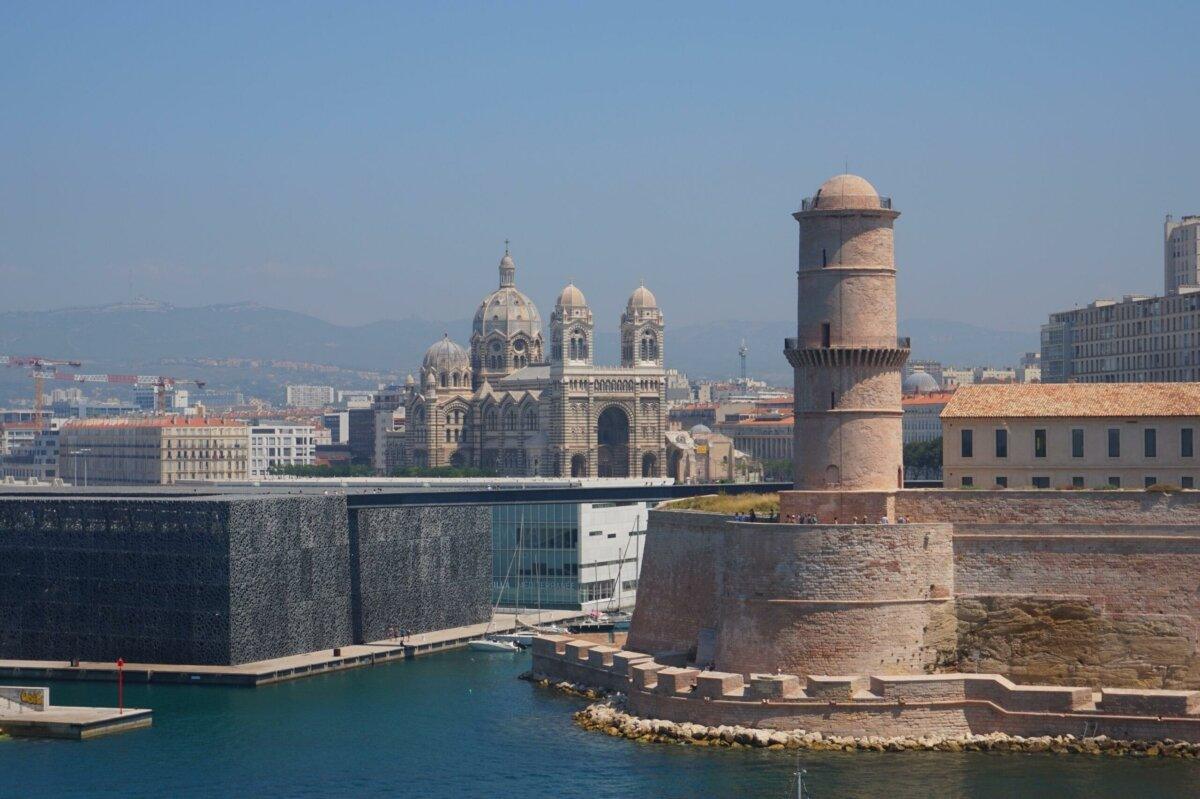
Symbol of this transformation: the CMA CGM Tower (2011, Zaha Hadid), a glass and steel landmark facing the harbor, and the Mucem (2013), a flagship museum extending Fort Saint-Jean with an aerial footbridge. The religious and military heritage is abundant: Notre-Dame de la Garde, Major Cathedral, Saint-Victor Abbey, Forts Saint-Jean and Saint-Nicolas. Offshore, the Château d’If, famous prison of the Count of Monte Cristo, punctuates the harbor.
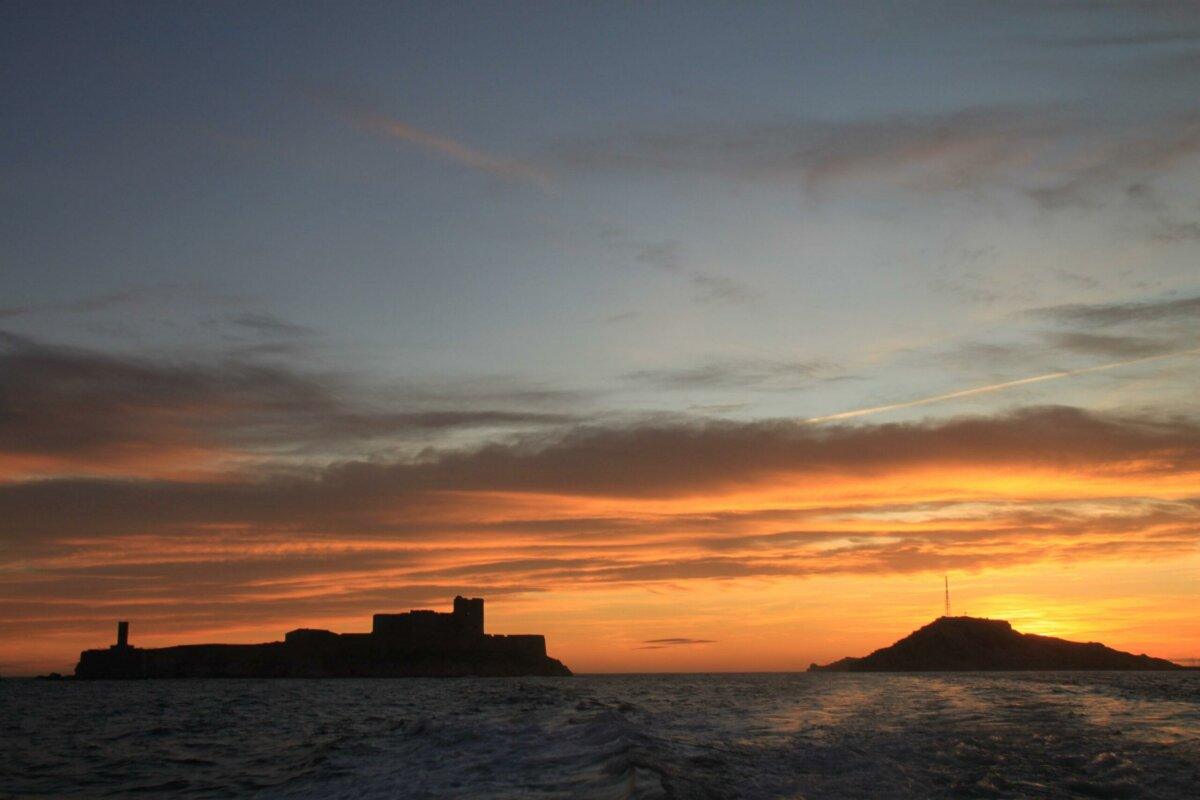
“Marseille is not visited, it is lived. You go up, you go down, you turn, and at every street corner another Mediterranean appears.”
Population & Demographics 👥
Marseille is the second most populous municipality in France. Consolidated data from INSEE (geography as of 01/01/2025) allow us to draw the following demographic profile:
| Indicator (INSEE) | Value – Marseille (13055) | Comment |
|---|---|---|
| Municipal population (2022) | 877,215 inhabitants | 2nd largest city in France |
| Municipal area | 240.6 km² | Very large municipality |
| Density (2022) | ≈3,645.6 inhabitants/km² | High urban density |
| Households (2022) | ≈414,302 | Rather small average household |
| Activity rate (ages 15–64, 2022) | ≈67.6 % | INSEE, census |
| Unemployment rate (ages 15–64, 2022) | ≈14.0 % | Still high, but trending downward cyclically |
Demonym: MarseillaisMarseillaise
Postal codes: 13001 → 13016
Region: Provence-Alpes-Côte d’Azur
Department: Bouches-du-Rhône (13)Official source: INSEE, “Territory Comparator” (2025 geography) — Marseille (13055). Population data 2022, area, density, activity and unemployment.
Economy & Employment 💼⚓
Marseille is a world-class port and logistics metropolis. The Grand Port Maritime de Marseille-Fos (GPMM) concentrates powerful activities (energy, bulk goods, containers, cruises) and announced a notable increase in its traffic for 2024, especially containers (+9%). The port area is in transition (quay electrification, H₂ corridors, “cold ironing”), with record investments and low-carbon industrial projects.
On the tertiary side, the global headquarters of the CMA CGM group — one of the world leaders in container shipping — stands in the CMA CGM Tower (147 m, architect Zaha Hadid) on the Arenc docks, at the heart of Euroméditerranée. Around it cluster service functions: digital, maritime engineering, marine economy, insurance, but also health (AP-HM), higher education and research (Aix-Marseille University, Kedge BS).
The job market remains mixed: a business fabric mostly made up of small companies (commerce/services), strong dynamics of creation and redevelopment of brownfields, but structural unemployment still above the national average, significantly improving during growth phases and urban projects.
Tourism & Culture 🎭🌅
Marseille combines museums, street art, football, and coastal hikes. Here is the Top 5 places to see during a first visit:
- Old Port — historic heart, fish markets, walks, departures for the islands.
- Notre-Dame de la Garde — panoramic view over the harbor and mountain ranges, a must-see at sunset.
- Mucem & Fort Saint-Jean — grand architecture, permanent exhibition on Mediterranean cultures.
- Calanques (Sormiou, Morgiou, Sugiton, En-Vau) — hikes and coves (access regulated in summer: plan early and check information).
- Château d’If & Frioul Islands — boat crossing from the Old Port, visit of the fortress.
Cultural agenda (examples): Festival de Marseille (dance/theater), Fiesta des Suds (contemporary music), Jazz des Cinq Continents, exhibitions at the FRAC, at the [Museum of Marseille History], not to mention the culinary buzz — bouillabaisse, navettes, Levantine, Italian or North African cuisine, reflecting the diasporas that shape the soul of the city.
Transport & Access 🚆🚌🚇
Marseille is connected to France and the Mediterranean:
- Train: TGV Paris–Lyon–Marseille (Saint-Charles station), connections to Nice, Toulon, Avignon, Barcelona…
- Airport: Marseille-Provence (MRS), in Marignane, shuttles to Saint-Charles, numerous European routes.
- RTM urban network: 2 metro lines (M1: La Rose ↔ La Fourragère; M2: Sainte-Marguerite Dromel ↔ Gèze), 3 tram lines (T1, T2, T3) and a comprehensive bus network. Major interchange hubs: Saint-Charles, Castellane, Joliette.
- Ferries: connections to Corsica, Maghreb and cruises departing from Joliette and the maritime station.
Mobility tip 🚴 — The Corniche and the coastal routes offer beautiful cycling paths. In summer, anticipate access restrictions to the mountain ranges (fire risk) and favor public transport for the Calanques.
Local Life 🏫🤝⚽
Daily life in Marseille is organized at the neighborhood level: markets (Noailles, Prado, Cours Julien), beaches (Catalans, Prado, Pointe Rouge), parks (Borely, Longchamp, Pastré), cultural facilities (Opera, Théâtre de la Criée, Friche Belle de Mai). On the education side: a network of schools, middle and high schools, the Aix-Marseille university (more than 70,000 students), engineering and business schools (Polytech, Centrale Méditerranée, Kedge, EMD).
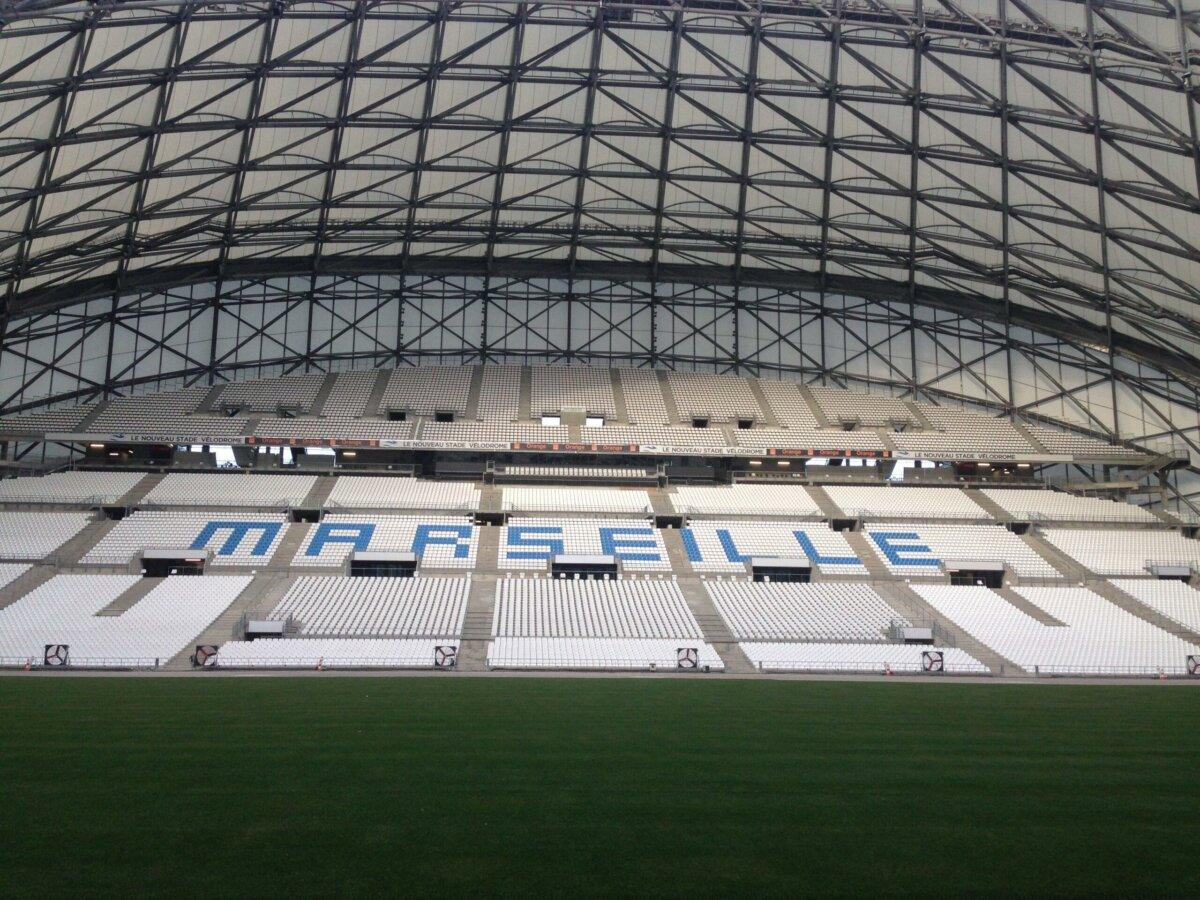
Sport is king: OM at the Vélodrome, rugby at Stade Delort, sailing, diving, climbing, hiking. A dense associative network animates the neighborhoods (community centers, MJC, nautical clubs), and local events mark the year.
Real Estate & Urban Planning 🏗️🏡
Large and heterogeneous market: prices more accessible than on the Côte d’Azur (Nice, Cannes), but very varied depending on the areas (7th, 8th, 6th higher; 15th–16th more affordable; village centers of the 12th or 13th increasing). According to public and private barometers, the average price of apartments in Marseille is around €3,500–3,800/m² in summer 2025, with a wide range depending on condition, street, and neighborhood. Houses remain more expensive per m² in sought-after areas (seaside, Périer, Roucas-Blanc, Endoume).
| Indicator | Marseille (summer 2025) | Indicative source |
|---|---|---|
| Old apartment (average) | ≈€3,500/m² | Market barometers (aggregated) |
| Overall median price | ≈€3,750/m² | Specialized media indicator |
| New (median price) | ≈€4,700/m² | Notaries & portals trends |
| 12–24 month trend | stabilization / adjustments | Notaries-INSEE indices |
On the urban planning side, Euroméditerranée continues the transformation of the waterfront (housing, offices, schools, public spaces), with increasing attention to shade, greenery, and active mobility (climate resilience). Local-scale projects (school renovations, requalification of axes, degraded old housing) strengthen residential attractiveness.
Buying advice 🪙 — In Marseille more than elsewhere, the street matters: market depth, exposure, building quality, common areas, parking. Visit at different times, check the co-ownership and transport access.
Official sources & resources 📚
- INSEE — Territory comparator (Marseille 13055).
- Marseille Tourist Office — marseille-tourisme.com (visit info, Calanques, metro).
- Grand Port Maritime de Marseille-Fos — marseille-port.fr (reports & traffic).
- RTM — Régie des Transports Métropolitains (M1/M2, T1/T2/T3 maps).
- Wikipedia — Marseille (heritage & history summary).
FAQ — Marseille ❓
What to visit in Marseille in 2 days?
Day 1: Old Port, Panier, Mucem/Fort Saint-Jean, climb to Notre-Dame de la Garde at sunset. Day 2: Calanques (Sormiou/Sugiton depending on your level), Corniche and Prado beaches, aperitif at Vallon des Auffes.
What is the population of Marseille?
The municipality has ≈877,215 inhabitants (INSEE, municipal population 2022), over an area of about 240.6 km².
How to get to the Calanques from the center?
Metro M2 to Rond-Point du Prado or RTM bus towards Luminy/La Cayolle depending on the calanque, then marked walk. In summer, access is regulated: check restrictions and favor early morning departure.
Which neighborhoods are pleasant to live in?
Highly sought after: 7th (Endoume, Bompard), 8th (Périer, Saint-Giniez), 6th (Castellane/Vauban). “Village” spirit: 12th (Saint-Barnabé), 13th (Château-Gombert). More affordable and evolving: 3rd/15th/16th, depending on the street and urban project.
What is the price of real estate in Marseille?
In summer 2025, expect around €3,500–3,800/m² for an old apartment (average), with a significant gap depending on areas and condition. New properties are higher (≈€4,700/m² median).
What are the metro and tram lines?
Two metro lines (M1 and M2) and three tram lines (T1, T2, T3), connecting major hubs: Saint-Charles, Castellane, Joliette, Timone, Blancarde…
Conclusion — Marseille today and tomorrow 🌞
Marseille is a world-city whose DNA is tied to the sea, mobility, and cultural mixing. Its dynamism relies on the port, logistics, higher education, and an inventive cultural scene. The challenges match its size: old housing, daily mobility, heat islands, air quality, neighborhood balance. The projects (schools, tram, redevelopments, greening) and the port’s energy transition are shaping a more sustainable and livable city. For visitors and residents alike, Marseille offers this rare blend of Mediterranean grandeur and authenticity, between the Bonne Mère and the calanques.