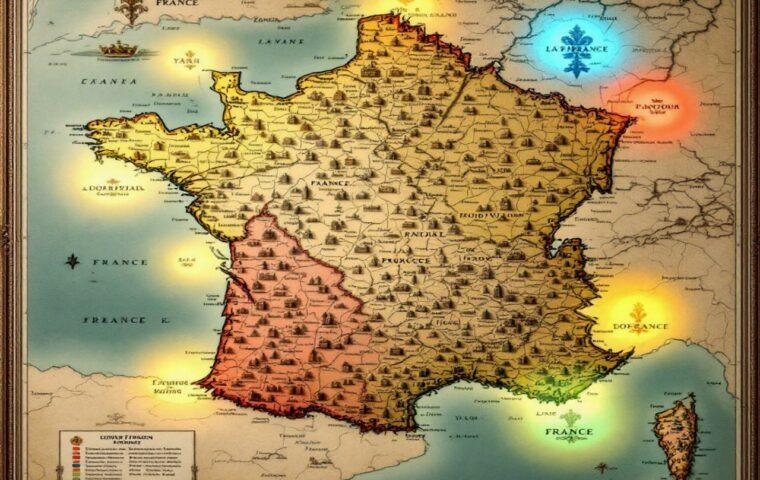
A Loire landscape steeped in history
The Loire, “Europe’s last wild river” according to some geographers, served as a shifting border and communication axis throughout the Middle Ages. Like the countless castles that line its banks, the small minor lordships, often ignored by official accounts, played an equally crucial role in regional power games. In this context, a knight’s tomb appearing out of nowhere takes on a fascinating dimension: it restores a slice of life too often hidden.
Recent excavations remind us how much the valley offers unsuspected archaeological resources. Alongside the exploration of the history of the Loire castles, the Loire soil sometimes yields more modest but equally telling remains: fortified farms, country chapels, and now, this singular burial. Each discovery challenges our understanding of the territory and the feudal dynamics that shaped it.
The circumstances of the discovery
A meticulous excavation campaign
Planned as early as 2022 by Inrap in collaboration with the University of Tours, the campaign’s initial objective was the study of an ancient priory. It was by expanding the perimeter towards wooded hills that the team spotted finely carved limestone fragments. The chief archaeologist, Sophie Brillant, explains:
“We were mainly looking for remains of monastic foundations. The signal of a funerary slab, imperceptible to geological radar, was a nice surprise: under three meters of backfill, the ground had preserved an intact burial.”
Over the months, each parcel was cleared with the utmost care – brush, rubber mallet, photogrammetry, and soil sampling. The tomb structure, measuring 2 meters long by 0.6 meters wide, evokes an individualized vault, indicating a high social status.
Dating methods and scientific analyses
One of the first actions was the sampling of bone fragments for carbon-14 dating. Result: a range of 1180-1220, precisely at the dawn of the Battle of Bouvines (1214). This crucial date marks the peak of Philip II and the strengthening of the Capetians. Simultaneously, isotopic analyses of the bone reveal that the knight had spent his childhood in a more continental region, likely east of the Loire.
The researchers also subjected the residual pigments of the coat of arms to mass spectrometry. The deep red obtained from ferruginous ochre and the blue derived from lapis lazuli imported from Syria indicate usage reserved for elites, further proof of this warrior’s social position.
The treasures of the burial
At the heart of the vault, a millimeter-aligned array of objects drew full attention:
- A long sword, whose partially preserved blade bears the mark of a fleur-de-lis-shaped punch.
- An oval shield laid at the feet of the deceased, displaying a chipped but identifiable coat of arms: three bars and a star.
- A small bronze paten engraved with a Christ on the cross, a vestige of a solemn funeral ceremony.
- Textile remains – bands of wool dyed green and strands of white silk – suggesting a richly decorated shroud.
A summary table helps visualize these findings:
| Object | Material | Condition | Interpretation |
|---|---|---|---|
| Sword | Steel | 45% preserved | Royal punch |
| Shield | Wood and leather | Fragmented | Heraldic arms |
| Paten | Bronze | Intact | Religious ceremony |
| Shroud | Wool & silk | Stubborn fragments | Social link and status |
Clue of an International Warrior
More surprising: traces of olive and myrrh pollen, exotic substances in the Loire region. A sample taken from the textile fibers reveals the presence of religious resin imported from the Mediterranean basin. This detail supports the hypothesis of a pilgrimage to the Holy Land or a diplomatic stay. Perhaps this knight, from a modest house in Touraine, crossed the Mediterranean, forging unexpected alliances.
An Erased but Telling Epitaph
On the slab, an inscription in Old French can be made out beneath the moss: “Here lies noble… lord of… died in the year of grace…”. The central part, which bore the name and lordship, has been conspicuously hammered out. An act of damnatio memoriae? Rival vengeance? This gesture is intriguing: why erase the identity of this knight after his death?
Genealogical Research and Local Leads
About ten noble families of Touraine, mentioned in 12th-century charters, are now being scrutinized. The notarial archives of Lesigny, as well as Meung-sur-Loire, contain mentions of knights bearing arms similar to those recorded on the shield. The historian-scribes compare the shape of the drawn fasces and note striking similarities with the house of Chaumont-sur-Loire.
Meanwhile, the registers of the Pontlevoy abbey mention a knight named Amaury, who died “far from his fief” after swearing allegiance to a powerful baron. If this hypothesis is confirmed, it would offer a rare example of social and geographical mobility on the eve of the war against the Plantagenets.
Impacts and Scientific Perspectives
The discovery fuels several research avenues. First, to better understand pilgrimage networks and diplomatic circuits in the 12th century. Next, to analyze how second-rank knights negotiated their place between emerging kingdoms and local lordships. Finally, this tomb calls for a revision of funerary models in the Loire valley: far from large ecclesiastical necropolises, some warriors chose or were assigned a burial in the open nature, away from prying eyes.
Ultimately, the publication of the excavations and the opening of the site to visitors will allow the general public to grasp this little-known aspect of medieval history. Already, educational workshops are planned to raise awareness of excavation techniques and the reading of the Loire landscape.
FAQ
Who funded the excavation campaign?
The funding mainly comes from the Ministry of Culture, supplemented by local sponsorship from the Centre-Val de Loire region and the Loir-et-Cher departmental council.
How is carbon-14 dating described?
Carbon-14 dating measures the decay of radioactive carbon in bones. Here, the range 1180-1220 was established with a margin of error of ± 30 years.
Can the site be visited?
The site will remain closed to the public until the end of the excavations. Guided tours will be offered in 2025, with prior reservation.
Why was the epitaph hammered out?
This practice, very rare at the time, probably reflects a desire to “make the deceased forgotten,” likely following an inheritance dispute or a posthumous condemnation.
{
“@context”: “https://schema.org”,
“@type”: “WebPage”,
“about”: {
“@type”: “Thing”,
“name”: “Mysterious Tomb Forgotten Knight Loire”
},
“keywords”: [“knight”, “tomb”, “Loire”, “archaeology”, “medieval”]
}
{
“@context”: “https://schema.org”,
“@type”: “Article”,
“headline”: “Discovery: the mysterious tomb of a forgotten knight in the heart of the Loire”,
“description”: “A medieval burial exhumed in the Loire valley reveals an anonymous knight, his sword, his coat of arms, and unprecedented clues about his journey to the Holy Land.”,
“keywords”: [“knight”, “tomb”, “Loire”, “carbon-14 dating”, “heraldry”],
“mainEntity”: {
“@type”: “FAQPage”,
“mainEntity”: [
{
“@type”: “Question”,
“name”: “Who funded the excavation campaign?”,
“acceptedAnswer”: {
“@type”: “Answer”,
“text”: “The funding comes from the Ministry of Culture, supplemented by local sponsorship from the Centre-Val de Loire region and the Loir-et-Cher departmental council.”
}
},
{
“@type”: “Question”,
“name”: “How is carbon-14 dating discussed?”,
“acceptedAnswer”: {
“@type”: “Answer”,
“text”: “Carbon-14 dating measures the decay of radioactive carbon in bones, here a range of 1180-1220 with ± 30 years.”
}
},
{
“@type”: “Question”,
“name”: “Can the site be visited?”,
“acceptedAnswer”: {
“@type”: “Answer”,
“text”: “The site will remain closed to the public until the end of the excavations. Guided tours will be offered in 2025, by reservation.”
}
},
{
“@type”: “Question”,
“name”: “Why was the epitaph chiseled out?”,
“acceptedAnswer”: {
“@type”: “Answer”,
“text”: “This practice probably reflects a desire to erase the deceased, following an inheritance dispute or a posthumous condemnation.”
}
}
]
}
}