Capital of Gard between the Cévennes and the Mediterranean, Nîmes fascinates with its exceptional ancient monuments — Arenas, Maison Carrée (listed by UNESCO in 2023) — and a southern way of life where ferias, terraces, Costières wines, and urban innovations intersect. A complete guide to understand the city, prepare a visit, settle there, or invest.
.jpg?width=1600)
Sommaire
Geography & Location
South of the Massif Central and at the gates of the Camargue, Nîmes occupies a plain of garrigues edged with hills (Puech du Teil, Mont Duplan) and crossed by the cadereaux — these temporary streams that structure the flow of Mediterranean rains. 50 km from the sea, the city enjoys a typical Mediterranean climate (dry and hot summers, mild winters), very pure light, and an open horizon towards Montpellier, Avignon, and Arles.
The urban perimeter stretches along the ancient antique waterway bringing water from Uzès (Nîmes aqueduct) and the historic railway axis Paris–Mediterranean, now doubled by the Nîmes–Montpellier bypass (CNM) which accommodates TGV and long-distance freight.
The municipality, a hub of a significant catchment area, is part of the Nîmes Métropole urban area (39 municipalities). Its road network reads like a palimpsest: the “Écusson“, historic center surrounded by 19th-century boulevards, opens onto residential neighborhoods with stone houses and olive gardens (Castanet, Vacquerolles, Courbessac) while the east and south host business zones (Grézan, Mitra, Georges-Besse) and sports facilities.
History & Heritage: from Nemausus to the Contemporary City
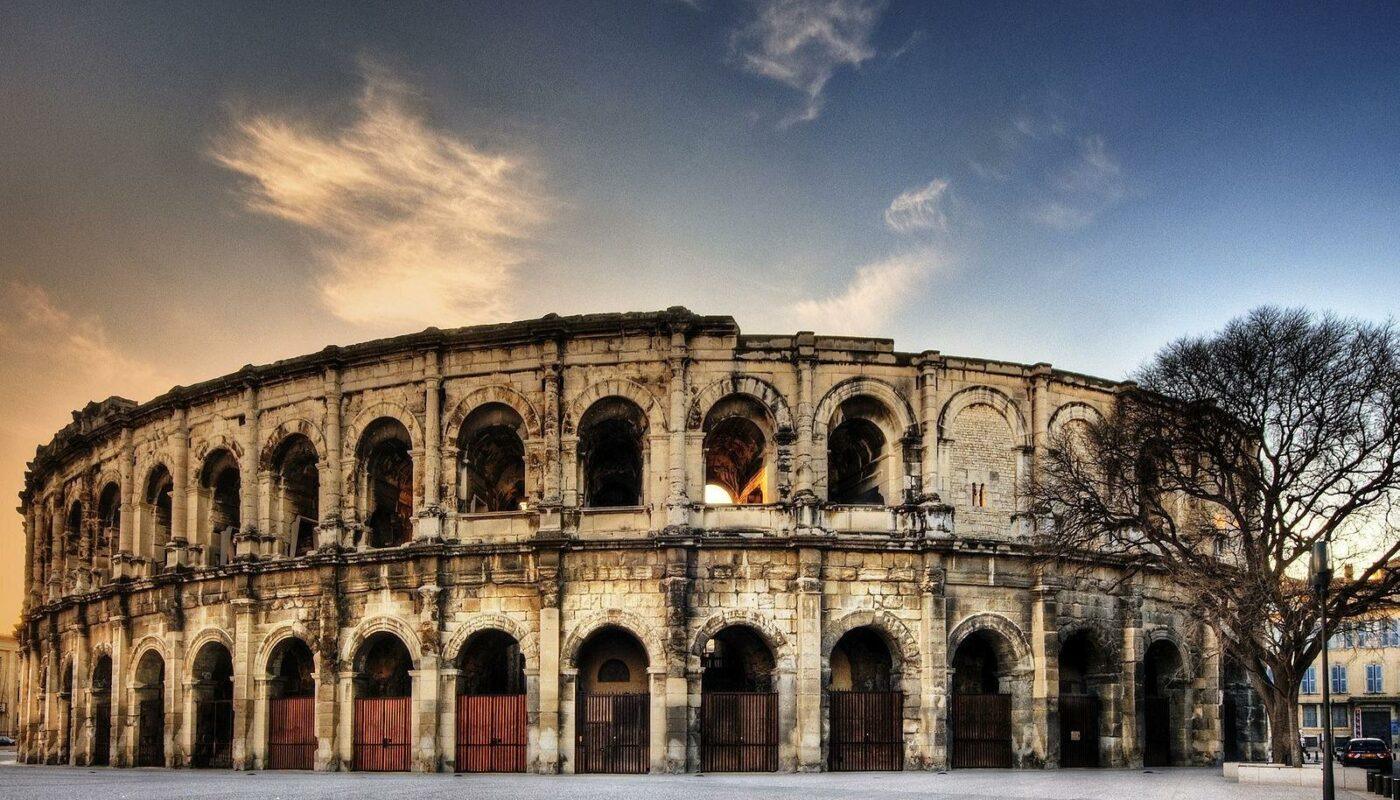
Under the name Nemausus, Nîmes established itself from the Augustan era as one of the most brilliant Gallo-Roman cities in Narbonese Gaul. The Roman monuments, rare for their state of preservation, testify to this: the amphitheater (Arenas) with its two levels of arcades, the Maison Carrée — a Corinthian temple now classified as world heritage —, the Tour Magne overlooking the Jardins de la Fontaine, not forgetting the “Temple of Diana” and the castellum divisorium where water from the aqueduct arrived from the Eure spring (Uzès).
The Pont du Gard, a masterpiece of Roman hydraulic engineering, is the most spectacular part of this ancient aqueduct. After Antiquity, the city experienced medieval upheavals, a compact Middle Ages, and in the modern era, a history marked by the Reformation and the Religious Wars, which left a strong Protestant culture.
In the 19th century, major works reshaped the public space: clearing of the Arenas, monumental alignments, civil and religious buildings. In the 20th century, modernity dialogues with Antiquity: Carré d’Art (Norman Foster, 1993) opposite the Maison Carrée and, in social housing, Nemausus (Jean Nouvel, 1987) symbolize a city that embraces the meeting between heritage and contemporary creation — a dynamic now reinforced by the triennial “La Contemporaine de Nîmes“.
.jpg?width=1600)
Population & Demographics
Nîmes has 150,444 inhabitants (municipal population 2022, figures effective as of January 1, 2025), with a structure mixing families, students (University of Nîmes), and tertiary sector workers, in logistics and commerce. The historic center attracts by its built environment and independent shops, while more spacious residential neighborhoods welcome young households. This social and generational diversity fuels associative, sports, and cultural vitality.
Economy & Employment
Highway junction (A9, A54), railway (Nîmes-Centre station and Nîmes–Pont-du-Gard TGV station) and logistics (Grézan and Mitra platforms), Nîmes has developed a network of companies in distribution, transport, e-commerce, and business services. The ActiParcs — including Georges-Besse — concentrate higher tertiary, engineering, training, and tech projects, five minutes from the station.
Nearby, the residential economy (health, education, commerce), heritage tourism, and agro-viticulture (AOP Costières de Nîmes) weigh heavily. The positioning between Montpellier and Avignon, TGV access, and sunny quality of life feed HR attractiveness.
Tourism & Culture: the 6 must-sees of visiting Nîmes
1) The Arenas of Nîmes
Roman amphitheater among the best preserved, ellipse of 133 m × 101 m, 21 m facade and network of concentric galleries: the speaking architecture of the Arenas impresses as much by its precision as by its scale. Today, the ancient monument hosts visits, concerts, and shows, offering an educational dive into ancient urbanism.
2) The Maison Carrée (UNESCO)
Built in the Augustan era, the Maison Carrée is a hexastyle Corinthian temple with delicate decor, dedicated to Caius and Lucius Caesar. Its world heritage listing (2023) recognizes a unique state of preservation and exemplary proportions. The visit contrasts civic religion, forum, and Roman construction.
3) Jardins de la Fontaine & Tour Magne
The first “French-style” public park built on an ancient sanctuary, the Gardens surround the founding spring of Nîmes. Stairs, basins, and statues dialogue with the remains of the nymphaeum and the Temple of Diana. Overlooking, the Tour Magne watches over the city: breathtaking panorama at sunset.
4) Museum of Romanity
Opposite the Arenas, the Museum of Romanity tells the process of Romanization in Occitania. Its museography combines major pieces (mosaics, statues) and immersive devices. The contemporary architecture creates a glass and wave counterpoint facing the ancient stone, extending the urban signature of the square.
5) Carré d’Art & media library
Designed by Norman Foster, Carré d’Art (1993) houses a contemporary art museum and library, opposite the Maison Carrée, on the former forum. The building, all in transparency, establishes a dialogue between Antiquity and modernity. Exhibitions, mediation, workshops: the address is a pivot of Nîmes creation.
6) The Pont du Gard (27 km away)
Masterpiece of the Nîmes aqueduct, a three-level aqueduct bridge nearly 50 m high, it crosses the Gardon in a spectacular natural site. The visit easily combines with a day in Nîmes; it is the best gateway to understand Roman hydraulic engineering.

.jpg?width=1600)

Local Specialties & Know-How
Impossible to mention Nîmes without the brandade — an emulsion inherited from salt and cod exchanges between the Mediterranean and Atlantic — to be enjoyed cold on toast or hot in gratin. On the drinks side, place for Costières de Nîmes (AOP), red and rosé Mediterranean wines with syrah-grenache blends, and expressive whites. Add picholine olives, Camargue bull, tielles and fougasses from the neighborhood… the Nîmes table has a southern accent.
Transport & Access
- Train: two complementary stations — Nîmes-Centre (TER, Intercités, some TGV) and Nîmes-Pont-du-Gard (TGV/OUIGO and connecting TER) on the CNM, passenger service started in 2019. Paris, Lyon, Marseille, Montpellier, and Barcelona are accessible via fast connections.
- Urban network: buses and BHNS Tram’bus ” Tango! ” (lines T1 to T4) structure North–South and East–West axes, with exchange hubs, real-time information, and park-and-ride facilities.
- Road: A9 (Barcelona–Montpellier–Nîmes–Orange) and A54 (Nîmes–Arles–Salon) form a major highway junction, useful for business travel and freight.
- Air: the Nîmes Alès Camargue Cévennes Airport (FNI) offers seasonal connections and business aviation services.
Local Life: Education, Sport, Associations
University of Nîmes (UNÎMES), IUT and specialized schools support design, law, science, and management fields. On the sports side, handball of USAM Nîmes Gard and football of Nîmes Olympique fill the stands; facilities (Némausa pool, Parnasse, bowling alleys, skateparks) cover most practices. Rich associative fabric — culture, popular education, environment — and contemporary music scenes (Paloma) punctuate the year.
Events & Seasonality
The ferias structure the calendar: Feria de la Pentecôte (spring) and Feria des Vendanges (September) animate Arenas, courtyards, and squares (parades, peñas, bodegas, concerts). On the cultural side, the new triennial “La Contemporaine de Nîmes” asserts the place of current creation. All year round: exhibitions at Carré d’Art, archaeo-workshop at the Museum of Romanity, photo, comic, and world music festivals.
Nîmes vs Avignon vs Arles: which choice?
| Criterion | Nîmes | Avignon | Arles |
|---|---|---|---|
| Roman heritage | Arenas, Maison Carrée, Pont du Gard | Bridge (medieval), ramparts | Theater, amphitheater, mosaics |
| Atmosphere | Urban, modern, dynamic | Historic, enclosed, ceremonial | Bohemian, artistic, village |
| Transport | TGV, modern station, dedicated TGV station | TGV, station in historic center | TER, small historic station |
| Daily budget | €60–80 (entries + meals) | €70–90 (more expensive) | €50–70 (more affordable) |
| Crowds | Moderate (less touristy) | Massive (very well known) | Moderate to heavy |
Verdict: Nîmes is ideal for a heritage weekend with modern transport and urban atmosphere. Avignon for the Papal Palace. Arles for a bohemian break.
Estimated Budget: 1–2 day visit
| Item | Estimated price (1 person) |
|---|---|
| Entries (Arenas + Maison Carrée + Museum) | €18–24 |
| Meals (lunch + dinner) | €35–50 |
| Hotel night (3⭐) | €60–100 |
| Urban transport (BHNS 2 days) | €7 |
| Pont du Gard (half day + entry) | €12 (entry only) |
| TOTAL (weekend 2d/1n) | €132–193 |
Note: prices include external TGV / TER transport. Reduced rates for groups, youth, unemployed.
Real Estate & Urban Planning: where to live in Nîmes?
For the heritage urbanite: the Écusson and its pedestrian streets (Esplanade, Victor-Hugo, Jean-Jaurès) attract with stone, secret courtyards, and neighborhood life. Ideal for young professionals, couples.
For space and greenery: Castanet, Courbessac, Vacquerolles, Uzès road or nearby hills offer individual houses and small condominiums. Perfect for families.
For easy access: areas close to exchange hubs (station, Parnasse) or business parks (Georges-Besse, Grézan) reduce travel times. Recent projects (BHNS, axis requalifications, heritage enhancement) support walking, cycling, and public transport.
Practical Tips for a Full Weekend
- Morning 1: Arenas (opening) then Museum of Romanity and lunch at Place du Marché.
- Afternoon 1: Maison Carrée & Carré d’Art, stroll along Avenue Jean-Jaurès to shaded cafés.
- Morning 2: Jardins de la Fontaine → climb to the Tour Magne (panorama), pass by Avenue Feuchères.
- Afternoon 2: trip to the Pont du Gard (30–40 min depending on traffic) and swimming in season.
Mobility tip: choose central accommodation, use the Tram’bus for main axes, and consider park-and-ride on busy days (ferias, big concerts).
FAQ: Frequently Asked Questions about Nîmes
What is the best time to visit Nîmes?
From March to June and from September to October: mild weather, superb light, and a dense cultural agenda (ferias in spring and autumn). Summer is very lively but hotter.
How much time to plan for the must-sees?
Two full days allow seeing Arenas, Maison Carrée, Museum of Romanity, Gardens, and Tour Magne. Add half a day for the Pont du Gard.
Is the Maison Carrée really UNESCO listed?
Yes. Its 2023 listing recognizes its exceptional universal value and remarkable state of preservation.
Are public transports efficient?
The Tango network (bus + BHNS Tram’bus) serves the urban area with increased frequencies on the main lines (T1–T4) and park-and-ride facilities.
What should you absolutely taste?
The brandade of Nîmes (spread or gratin), the AOP Costières de Nîmes wines, the picholine olives, and Camargue products.
Can you visit Nîmes without a car?
Yes. Compact center, close monuments, BHNS for major axes, and TER/TGV for regional and national connections.
Are there contemporary architecture sites to see?
Yes: Carré d’Art (Norman Foster) and the Nemausus housing complex (Jean Nouvel) illustrate the dialogue between Antiquity and contemporary creation.
Sources & Further Reading
- INSEE — Reference populations 2022, Nîmes (30189): municipal population 150,444 (effective 01/01/2025).
- UNESCO — The Maison Carrée of Nîmes (property sheet, inscription date: 2023).
- City of Nîmes — Roman monuments (Arenas, Tour Magne) & events (Feria de Pentecôte).
- Museum of Romanity — presentation & opening hours.
- Tango Network! — bus network information & BHNS Tram’bus.
- Nîmes–Pont-du-Gard TGV station — service start (2019) & Nîmes–Montpellier bypass.
- Pont du Gard — official site (access, distances) & UNESCO sheet.
- Carré d’Art — museum site & Foster + Partners sheet.
- Nemausus (Jean Nouvel) — tourism sheet & architecture resources.
- Costières de Nîmes (AOP) — appellation site & INAO.
- Gard Tourism — Terroir & gastronomy (brandade).
- Triennial “La Contemporaine de Nîmes” — press article.
💡 Transparency: This article may contain affiliate links to partner accommodations, activities, or restaurants. Commission if purchase, at no extra cost. 100% independent opinion based on official data (INSEE, UNESCO, Nîmes city hall). Updated: Nov 12, 2025.