
Why reading a label in a few seconds changes everything
In practice, most consumers take a quick glance, stop at the ingredient list or the health claim on the packaging. Yet, a few key numbers are enough to assess a product’s impact on your daily diet. An optimized reading allows you to:
- spot hidden sources of sugars or saturated fats at a glance;
- rationally compare two similar brands;
- check the portion size against your actual needs;
- anticipate the integration of this product into a balanced menu.
In short, giving thirty seconds of focused attention to a label is an instant investment to preserve your energy and nutritional balance in the long term.
The 5 steps to decode a label in 30 seconds
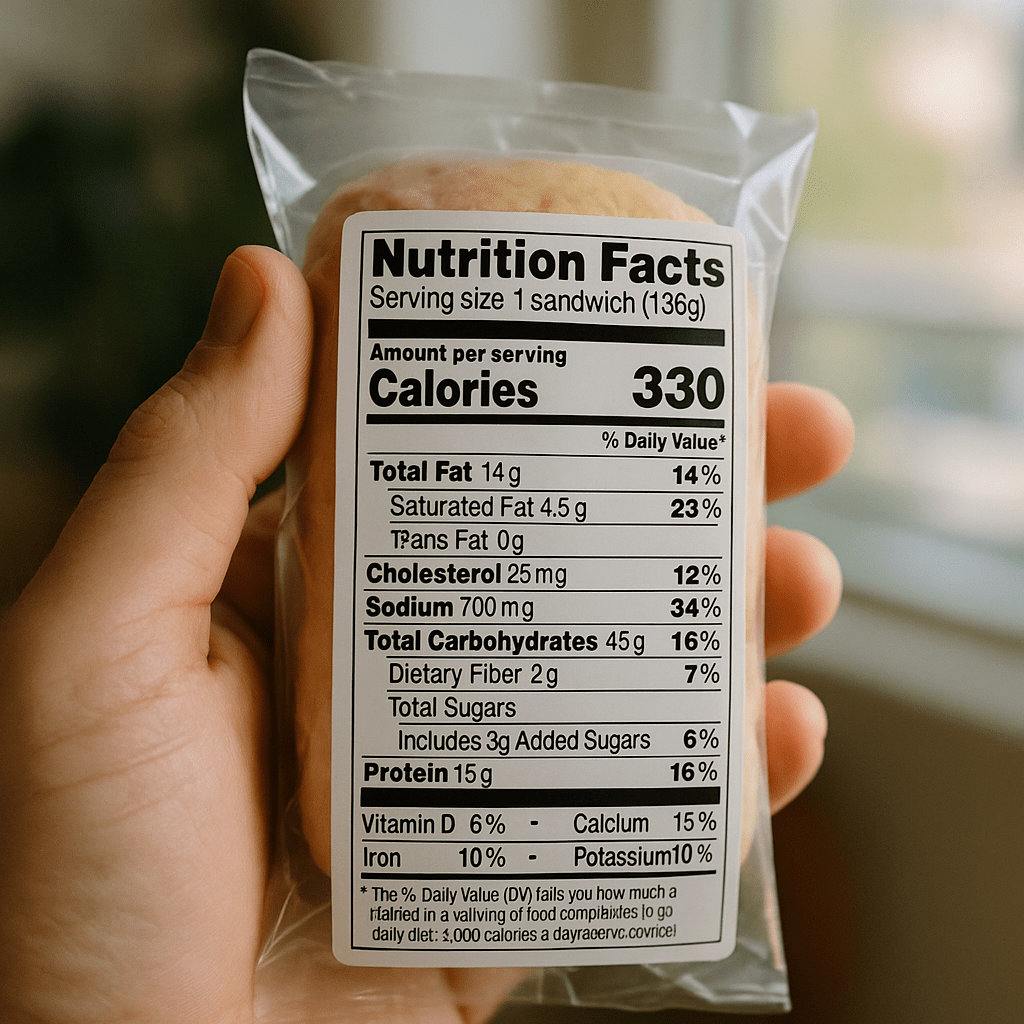
1. Check the portion (5 seconds)
Before analyzing the numbers, identify the reference unit. It can be in grams (g), milliliters (ml), or per defined portion (e.g., « 1 slice »). This step may seem trivial, but it is the basis to avoid calculation errors. Imagine consuming two portions without realizing it: your calories double, as do the sugars and fats initially assessed.
2. Identify the calories (5 seconds)
Calories represent the total energy intake. In a weight management context, it is often the most monitored figure. A quick glance at the “Energy” or “Calories” line tells you if this product is compatible with your goal—whether it is a minimal intake for a snack or a more substantial value for a complete meal.
3. Spot the macronutrients (10 seconds)
Move on to carbohydrates, fats, and proteins. Rather than reading all the sub-lines, focus on:
- Total carbohydrates (including sugars): alert for blood sugar levels;
- Proteins: asset for satiety and muscle rebuilding;
- Saturated fats: to be limited for cardiovascular health.
Other fats (monounsaturated and polyunsaturated) are less critical in a quick read, reserved for a more thorough examination if you have more time.
4. Decode problematic additives and ingredients (5 seconds)
Additives are often listed by an “E” code or by their name (colorants, stabilizers…). In a short read, look for the minimum: if one or two major additives appear among the first ingredients, consider it a deterrent for regular purchase. This simplified sorting does not replace a complete check but effectively alerts to the presence of processed substances.
5. Final check and comparison (5 seconds)
At the end of this quick scan, mentally compare this product to two or three other similar options. Take into account:
- the calories/portion ratio;
- the share of sugars and saturated fats;
- the order of appearance of ingredients (the higher an ingredient is listed, the more present it is).
This quick comparison puts you in the position of a conscious decision-maker, not influenced by enticing packaging but by quantified data.
Bonus tip: a personalized visual reference
To save a few more seconds, create a small personal reference sheet. Note the maximum values of calories, sugars, and saturated fats that suit you. Keep it in your cardholder or on your smartphone. At the grocery store, just consult it alongside the label, gaining precious time without losing reliability.

FAQ
Is it possible to decipher all the information in 30 seconds?
The method targets essential data but does not replace a complete reading if you have specific dietary needs (allergies, strict diets). It aims to provide a reliable overview before a more thorough examination.
Can I adapt this technique to sports monitoring?
Absolutely. Athletes can add the reading of net carbohydrates and forms of proteins (isolate, concentrate) to their mini reference sheet to refine their nutritional assessment.
What to do if the label is poorly legible or ambiguous?
Choose another product or consult the manufacturer’s website. In some cases, a quick online search reveals a more complete and easier-to-interpret digital version.
How to manage family-sized portions?
If the packaging defines “1/4 of the package” as a portion, mentally divide the values by four. Also consider pouring the portion into a graduated bowl to avoid exceeding the limit without realizing it.