
In brief
🧭 After 1 year of contract, you can generally cancel your health insurance at any time, with a 1-month notice period.
📩 The safest way remains to send a request on a durable medium: mail, email, or client area if the insurer clearly accepts it.
🪪 Before one year, a legitimate reason and proof are often required: moving, job change, joining a mandatory insurance plan, etc.
When can you cancel your health insurance plan?
This framework comes from the Service-Public.fr fact sheet on complementary health insurance and the Social Security file on infra-annual cancellation. In short, the logic has changed: you are no longer locked in until the expiration date if your contract has already celebrated its first anniversary.
The point to watch is the start date of the countdown. We look at the first subscription, not the date you received your third-party payment card, nor the date of the last payment. If you renewed an old contract, the one-year period generally continues to run without restarting from zero.
How to cancel your health insurance plan in 3 steps?
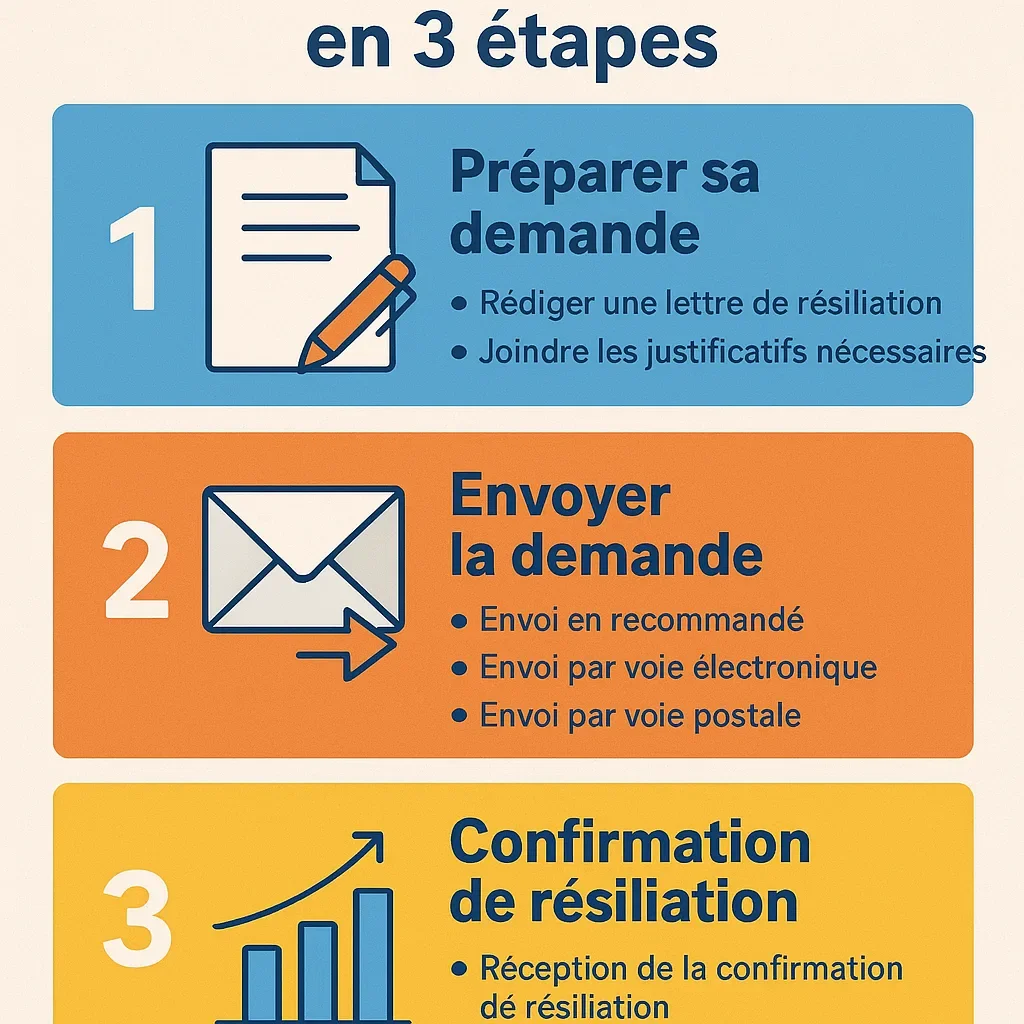
In practice, the smoothest version is often the simplest: a clear message, proof of receipt, and calendar follow-up. Joking aside, this trio avoids endless back-and-forths with customer service.
- mail, ideal if you want solid proof of the request;
- email or client area, if the insurer clearly accepts this channel;
- new insurance, which can sometimes handle the procedures on your behalf to avoid any coverage gap.
Can you cancel before one year without waiting for the deadline?
Yes, but not for just any reason. Before the first year, terminating the contract is still possible, especially in the case of a change in situation well defined by law. The secret is to attach the correct supporting document and act quickly, as the insurer often expects a request made within a reasonable time after the event.
| Situation | Cancellation possible? | Useful document | Point of attention |
|---|---|---|---|
| Moving | Yes, depending on the impact on the contract | Proof of residence | The request must show that the covered risk changes |
| Job change | Yes, if you switch to mandatory coverage | Employer certificate | Check the date of joining the new mutual insurance |
| Marriage or divorce | Sometimes, depending on the effect on the guarantees | Family record book or judgment | The contract must be affected by the modification |
| Retirement | Yes in some cases | Departure certificate | Compare before cancelling, especially if the guarantees change |
When in doubt, reread the general conditions of your contract. Accepted reasons are often similar from one insurer to another, but the proof requirements may vary. A moving certificate or a new employer certificate may suffice, provided the timeline is coherent.
What should be checked for a company mutual insurance or a group contract?
The case of company mutual insurance is a bit more subtle. If it is mandatory, you do not cancel it like a classic individual contract: you generally have to prove that you are leaving the company, that you are switching to mandatory coverage, or that you benefit from an exemption provided by the contract.
This point is often misunderstood. Many think they can “cut” their supplementary insurance like a gym membership, whereas a group contract follows its own rules. In practice, three situations must be distinguished: individual contract, mandatory group, and optional group. It is not the same playing field.
If you are in professional mobility, the smartest thing is to align the dates: new coverage on one side, old cancellation on the other. This is the best way to avoid a coverage gap between two contracts, especially when hospital or optical reimbursements are involved.
What to do if the mutual insurance refuses or continues to withdraw payments?
A refusal is not necessarily final. First, check if the request was properly received, if the correct reason was invoked, and if the supporting document was legible. If the problem comes from a withdrawal that continues after the end date, keep the bank statements and claim a refund immediately.
The right reflex is to tackle the file in order: customer service, written complaint, then mediation if needed. Most blockages come from an administrative detail, not a real legal disagreement. That said, when the insurer has properly received the request, they cannot add fees or penalties.
Cancelling a mutual insurance is not complicated on paper; what really matters is proof of receipt. Without clear trace, even a good file can drag on unnecessarily.
To keep a proper record, always send:
- the date of your request;
- a copy of the message or letter;
- the acknowledgment of receipt, if it exists;
- the bank statement for the month following the announced end.
What cancellation request template should be sent to terminate your health insurance?
The most effective request is short, dated, and straightforward. You need to state your identity, your membership number, the desired contract end date, and, if necessary, the legal reason. The idea is not to write a novel but to leave little room for interpretation.
Here is a simple template to adapt:
Subject: Cancellation of my supplementary health insurance contract
Dear Sir or Madam,
I hereby inform you of my intention to cancel my supplementary health insurance contract No. [contract number], subscribed on [date]. In accordance with applicable provisions, I kindly ask you to take this request into account from [desired date].
Please confirm in writing the acknowledgment of this cancellation.
Sincerely,
[Name, first name, address, e-mail]
If you send it by e-mail, keep the same structure. If you use the client area, take a screenshot of the final page or download the summary. It’s a small detail, but it can save a file when the membership service “cannot find” your request… which happens more often than you might think.
FAQ — canceling health insurance
Is a registered letter required to cancel health insurance?
Not necessarily. The law mainly refers to durable medium, which can include an e-mail or an online form if the insurer accepts it. The registered letter remains useful as proof, but it is no longer the only valid method in many cases.
Who can send the cancellation request?
You can do it yourself, or let the new insurer handle it if you are changing contracts. This is often simpler, as the new health insurance coordinates the effective date and limits the risk of double payment.
Does the cancellation take effect immediately?
No, generally you must allow one month after the insurer receives the request. During this period, coverage continues normally. That is precisely why you need to anticipate if you want to avoid an overlap period.
What should I do if I have already found a more attractive health insurance?
The safest approach is to schedule the new subscription just before or just after the end of the old one, depending on the effective date. The goal is simple: never remain without protection for costly items such as hospitalization or dental care.
Can you cancel your health insurance from abroad?
Yes, if you maintain access to a traceable request channel. An e-mail, a client area, or a letter sent from abroad can be suitable, provided you keep proof. The real issue is not the place of sending but the proof of receipt.
For further information, you can consult the official fact sheet on supplementary health insurance and the file on mid-year cancellation of supplementary health insurance. These pages remain the most useful references when you want to cancel health insurance without missing the deadline.